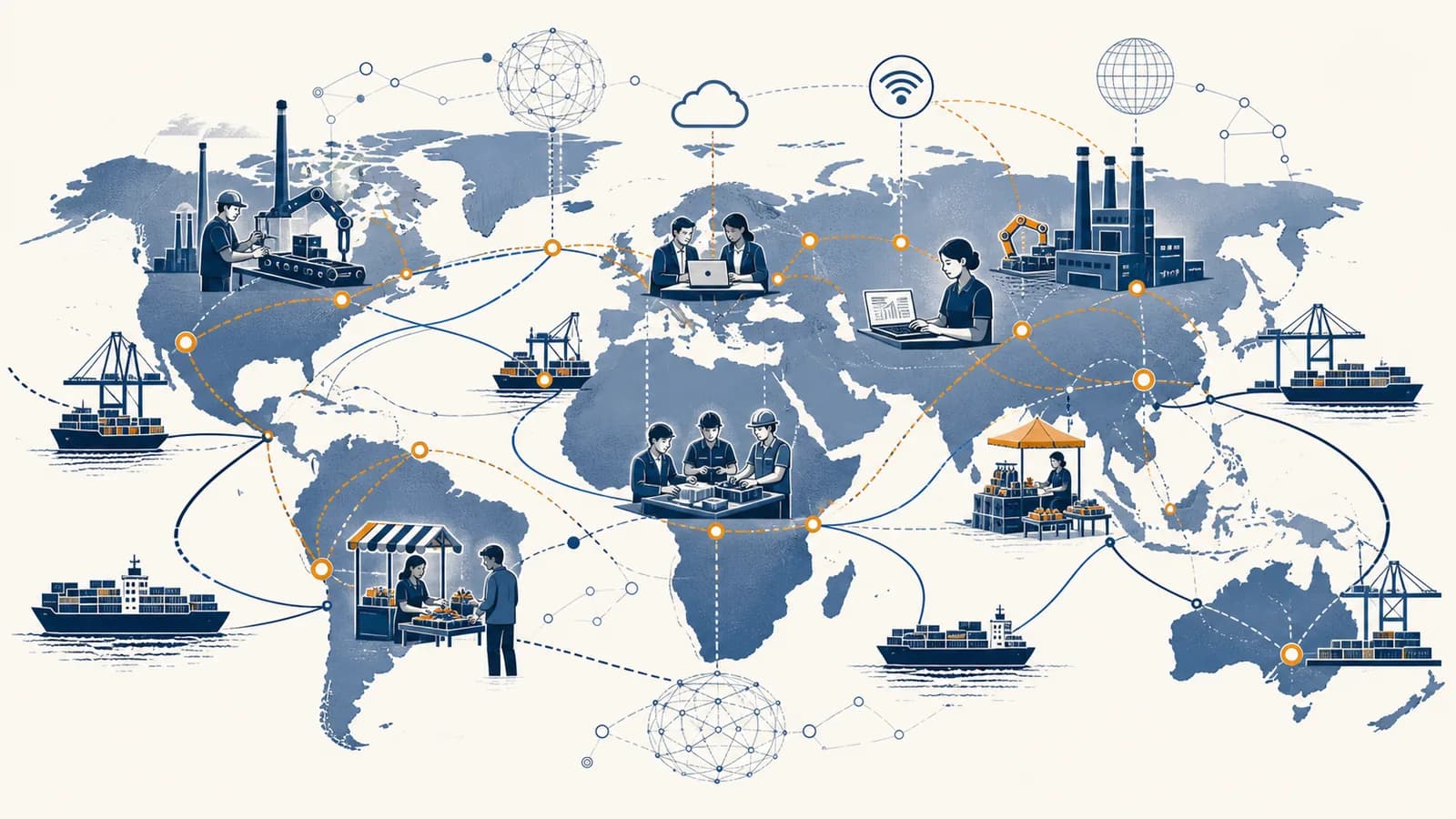
Globalization is a process that connects production, trade, finance, information, and people across national borders, in the context of the world economy. Put simply, the meaning of globalization is growing economic interdependence: choices in one country affect workers, firms, prices, and consumers elsewhere. Its causes include cheaper transport, faster communication, trade agreements, and firms seeking customers or lower costs. Its effects can include lower prices and wider markets, but also job disruption, environmental pressure, and unequal gains. The process exists because exchange lets people specialize and reach resources, skills, and buyers beyond their home country.
What economic globalization actually is
Economic globalization is the increasing movement of goods, services, money, knowledge, and workers between countries. It turns separate national markets into connected systems in which a purchase, investment, rule, or supply failure in one place can change outcomes elsewhere.
The word describes a change in the degree of connection, not a single policy and not a switch that is either on or off. Two countries become more economically globalized when more of their production, spending, lending, or employment depends on cross-border relationships. A country can be highly connected through trade but tightly control migration. Another can welcome foreign investment while protecting farm products with tariffs.
Imagine a cotton shirt sold in a local shop. Cotton may be grown in one country, spun into thread in another, woven and dyed in a third, sewn in a fourth, marketed by a company based in a fifth, and shipped through ports operated by firms from several others. The final price carries wages, energy costs, exchange rates, taxes, insurance, and transport charges from that whole chain.
This chain is global because value is added in multiple economies. It is also interdependent. A drought can reduce the cotton crop, a port closure can delay fabric, and a currency movement can alter the retailer's cost. The shirt is ordinary; the system behind it is not simple.
How globalization works through specialization and exchange
Globalization works when people and firms specialize in tasks they can perform at lower opportunity cost, then exchange their output across borders. Trade can increase total production, although the gains do not automatically reach every worker, region, or household.
Opportunity cost is the value of the best alternative given up. Comparative advantage means having a lower opportunity cost, even if one producer is faster at every task. This distinction explains why exchange can benefit a highly productive country and a less productive one at the same time.
Consider two countries with 100 worker hours each. In Northland, one bicycle takes 10 hours and one crate of oranges takes 5 hours. In Southland, one bicycle takes 20 hours and one crate takes 8 hours. Northland is faster at both. Yet the opportunity costs differ.
| Country | One bicycle costs | One orange crate costs | Comparative advantage |
|---|---|---|---|
| Northland | 2 orange crates | 0.5 bicycle | Bicycles |
| Southland | 2.5 orange crates | 0.4 bicycle | Orange crates |
Northland gives up 2 crates to make a bicycle, while Southland gives up 2.5. Northland therefore has the lower opportunity cost in bicycles. Southland gives up 0.4 bicycle for a crate, compared with 0.5 in Northland, so Southland has the lower opportunity cost in oranges.
Northland sacrifices 20 orange crates to make 10 bicycles, so each bicycle costs 2 crates.
If the trading price is between the two opportunity costs, both sides can gain. Suppose one bicycle trades for 2.2 orange crates. Northland receives more than the 2 crates it gives up, while Southland pays less than the 2.5 crates it would sacrifice by making the bicycle itself. The extra output is the economic case for trade.
Real economies contain thousands of products, changing technologies, transport costs, and bargaining relationships. Specialization also has transition costs. A country may gain overall while a particular factory closes because imports become cheaper. The total gain does not pay the displaced worker's bills unless institutions such as training, insurance, public services, or redistribution connect the gain to that loss.
How goods, services, money, and knowledge cross borders
Cross-border integration moves through four main channels: trade in products, trade in services, investment capital, and knowledge. Each channel uses different contracts and infrastructure, but all connect a decision made in one economy to production or income in another.
Goods trade is visible at customs. Containers carry machinery, food, clothing, chemicals, and parts. Services trade can be less visible. It includes an architect sending plans abroad, a tourist paying for a hotel, a software team maintaining a foreign client's system, or an insurer covering cargo from another country.
Portfolio investment buys financial assets such as shares or government bonds without controlling the organization. Foreign direct investment creates or buys a lasting interest in operations abroad, such as a manufacturer building a plant. The second form usually brings equipment, management, supplier contracts, and training along with money.
Knowledge crosses borders when engineers change employers, universities publish research, firms license designs, suppliers learn a buyer's quality methods, or software is copied almost instantly. Some knowledge is protected by patents, copyright, trade secrets, and contracts. Some spreads through observation and worker experience. Knowledge can raise productivity without being used up in the same way as a barrel of oil, which is one reason its movement can have large effects.
How prices and incentives coordinate a global supply chain
A global supply chain is coordinated by prices, contracts, standards, schedules, and inventories. Each firm compares expected revenue with labor, materials, finance, transport, tax, and delay costs, then chooses suppliers and locations under uncertainty about future conditions.
Start with a company that sells electric kettles. It forecasts how many customers will buy at different prices, a relationship explained more fully by how supply and demand set market prices. The company then asks factories for bids. A low factory price is attractive only if the product meets safety standards, arrives on time, and survives transport.
The seller estimates quantities, selling prices, seasonal peaks, and the risk of unsold stock.
The firm specifies the product and compares suppliers by total expected cost, not the quoted unit price alone.
Contracts assign quality duties, payment dates, currency terms, and responsibility for loss during transport.
Factories schedule labor and inputs, while inspections test whether output matches the agreed standard.
Freight firms, customs agents, warehouses, and retailers bring the product to the customer.
The relevant measure is landed cost, the full cost of getting one usable unit to its destination. Suppose a kettle costs $18 at the factory, freight and insurance add $2, the tariff adds $3, inspection and warehousing add $1, and one unit in every 20 is damaged. The pre-damage cost is $24. Nineteen saleable kettles cost , so the effective landed cost is per saleable kettle.
The cheapest quote may not be the lowest cost. Delays, defects, tariffs, large minimum orders, and exchange-rate movements can outweigh a lower factory price.
Firms respond by holding extra inventory, using several suppliers, placing production near customers, or accepting a higher price from a more dependable source. Each choice trades efficiency against resilience. Inventory ties up money and storage space. Multiple suppliers reduce dependence but can make quality control harder. Local production shortens transport but may use higher-cost inputs.
Globalization versus free trade
Globalization is the broad growth of cross-border economic connections, while free trade is a policy approach that removes barriers to imports and exports. A country can participate in globalization while using tariffs, quotas, product rules, investment screening, and migration controls.
A description of connected markets, production, finance, information, and people. Technology and private decisions can increase it even when governments retain restrictions.
A policy ideal under which goods and services cross borders without tariffs, quotas, or discriminatory treatment. No major economy applies it without exceptions.
A tariff is a tax on imports. If an imported bicycle has a customs value of $400 and faces a 10 percent tariff, the importer owes . The importer may absorb the charge through a smaller profit margin, ask the foreign supplier for a lower price, or pass some of it to the buyer. Market conditions decide who bears the burden; the person who sends the payment is not necessarily the person whose income falls.
A quota limits import quantity. A product standard requires a good to satisfy rules on matters such as electrical safety, ingredients, or labeling. A trade agreement can reduce tariffs and also establish procedures for customs, services, investment, and disputes. Governments may keep barriers to protect national security, health, tax revenue, infant industries, or politically influential producers.
These choices create trade-offs. Protection can preserve domestic capacity and jobs in the protected activity, but it can also raise costs for consumers and for local firms that use the protected product as an input. A steel tariff may help steel producers while making appliances, vehicles, and construction more expensive. Policy analysis has to follow the cost through the chain.
How exchange rates change trade and investment
An exchange rate is the price of one currency in terms of another, and its movement changes the home-currency value of foreign sales, imports, debts, and assets. The effect depends on which currency sets the contract and how buyers respond.
Suppose a British shop imports a machine priced at $10,000. At an exchange rate of $1.25 per pound, the machine costs . If the pound weakens to $1.00 per pound before payment, the same dollar invoice costs . Nothing about the machine changed, but the importer's cost rose by £2,000.
You run a small online shop and order stock from abroad three months before the holiday season. Your customer prices are already printed. If your currency weakens before the supplier is paid, your margin shrinks unless you raise prices, renegotiate, or arranged an exchange-rate hedge in advance.
A weaker currency often makes a country's exports cheaper to foreign buyers and imports dearer to domestic buyers. The word often matters. An exporter may use imported parts whose cost rises. A foreign distributor may keep the retail price unchanged and take a larger margin. Buyers may also take time to switch products, and contracts may fix quantities for months.
Exchange rates respond to demand for currencies. Trade creates some of that demand, but investment can move much larger sums quickly. If investors seek bonds in a country, they generally need its currency, which can increase demand for it. Expected inflation, risk, economic growth, and interest rates can all change investment decisions. This is how a central bank decision made for domestic conditions can affect exchange rates and foreign trade.
How globalization creates gains and distributes losses
Globalization can raise total income by expanding markets, competition, specialization, and access to ideas, yet it distributes gains and losses unevenly. The outcome for a person depends on what they buy, what work they do, what assets they own, and where they live.
Consumers can gain from lower prices, greater variety, and access to products that cannot be produced locally at reasonable cost. Exporting firms can spread design and equipment costs across more sales. Workers can gain when foreign demand expands their industry, while firms can learn better methods from international customers, competitors, or suppliers.
The same process creates pressure. Import competition can reduce revenue for a domestic producer. A plant may automate, cut wages, relocate, or close. The lower consumer price is spread across many shoppers in small amounts, while the job loss is concentrated on a smaller group. A national total can therefore look positive while a town experiences lasting damage.
Lower prices and export income can make the economy larger in total. This figure combines people with very different experiences.
A household may save on imported goods but lose far more if its main earner's job disappears or bargaining power weakens.
Ownership matters too. When a global firm's profits rise, shareholders benefit. Workers benefit only if demand for their skills, pay agreements, taxes, or public services transmit some of that gain. Landowners near a growing export hub may see rents rise. Renters can face higher housing costs even if they never work in the export sector.
This connects globalization to the forces shaping income distribution and inequality. Education, labor law, competition policy, taxation, social insurance, transport, and housing rules all affect who can move into growing work and who carries the adjustment cost. Trade policy is only one part of the result.
The quote is a test for any claim about globalization. Ask whose revenue rises, whose costs fall, whose job becomes less secure, and over what period. Also ask what alternative is being compared. Blocking an import may protect one job while raising an input cost that threatens another.
How global connections show up in jobs, law, and daily decisions
Globalization appears in ordinary choices about employment, shopping, saving, business, and public rules. People meet it through imported inputs, overseas customers, foreign-owned employers, data systems, professional standards, exchange rates, and laws governing cross-border transactions.
Jobs depend on both imports and exports
A job can depend on foreign demand even when the worker never travels. A machinist may make parts for exported medical equipment. A designer may work for clients abroad. A delivery driver may carry imported components to a local assembly plant. Dividing employment into “trade jobs” and “non-trade jobs” misses these links.
Imports can also support local work. A bakery using an imported oven, a hospital buying foreign scanners, and a software company renting computing capacity from an overseas provider all combine traded inputs with local labor. Restricting the input may help a domestic substitute, but it can raise costs for the businesses that use it.
Law decides which costs firms must count
Cross-border commerce relies on rules about contracts, customs, product safety, competition, tax, labor, pollution, privacy, and intellectual property. If countries set different standards, firms may move an activity toward the place with lower compliance costs. Governments then face a choice between accepting differences, recognizing equivalent rules, or requiring imports to meet domestic conditions.
Enforcement is difficult when a buyer, seller, platform, payment provider, and data server sit in different jurisdictions. A contract can specify which law applies and where disputes will be heard, but collecting a judgment abroad may still be costly. Large firms often manage this better than a first-time small exporter because they can hire specialists and spread compliance costs across many sales.
Daily purchases contain hidden policy choices
A label showing origin does not reveal the full supply chain. It may identify final assembly while parts and materials came from elsewhere. Price, durability, repairability, labor conditions, emissions, and privacy can point in different directions. A consumer rarely has complete information, and certifications vary in what they measure and how they verify it.
A practical decision starts by identifying the outcome you care about and the evidence available. If repairability matters, check parts access and warranty terms. If labor conditions matter, look for supplier disclosure and independent verification rather than a vague slogan. The trade-offs behind consumer choices explain why budgets and opportunity costs still constrain even carefully considered purchases.
Four mistakes people make with globalization
Most errors about globalization come from treating a connected system as a single cause or a single score. Good analysis separates totals from distribution, short-term disruption from long-term adjustment, national production from firm identity, and efficiency from security.
1. Assuming every factory move is caused by trade
Employment changes because of demand, technology, productivity, business strategy, energy costs, taxes, and trade. A factory can produce more with fewer workers after automation. Blaming imports without checking output, investment, and technology can produce a policy that raises prices while failing to restore the missing jobs.
2. Treating a trade deficit as a bill a country failed to pay
A trade deficit means the value of imports exceeds the value of exports over a period. It does not mean all businesses are losing or that foreign sellers received nothing. They received payment, and the matching international accounts record financial flows. The deficit can still signal risks if it reflects unsustainable borrowing or weak productive capacity, but the number needs context.
3. Calling a company national because its headquarters are there
A firm's headquarters, owners, workers, suppliers, customers, intellectual property, and tax payments may be spread across countries. Calling it simply domestic or foreign can conceal who actually benefits from a subsidy, a procurement contract, or protection from competition. Follow wages, profits, taxes, and purchases rather than relying on the logo.
4. Assuming the most efficient chain is the safest chain
A chain designed for the lowest normal cost may have one specialist supplier, little inventory, and tightly timed deliveries. That saves money while conditions are stable. It also creates a single point of failure. Safety can require spare capacity, substitute materials, larger stocks, or suppliers in different regions, all of which cost money before a disruption occurs.
Efficiency and resilience answer different questions. Efficiency asks how few resources a process uses in normal conditions. Resilience asks how well it continues when conditions change.
How can globalization affect the environment?
Globalization can increase environmental damage by expanding production and transport, but it can also spread cleaner technology and stricter buyer standards. The net effect depends on what is produced, how it is powered, which rules apply, and whether prices include environmental costs.
Economists separate three mechanisms. A scale effect occurs when more output uses more energy and materials. A composition effect occurs when countries specialize in different industries, shifting where pollution happens. A technique effect occurs when equipment, fuels, or production methods become cleaner or dirtier per unit.
Transport is only one part of a product's footprint. Production methods can matter more than distance, especially for energy-intensive goods. A local product is not automatically cleaner if it uses inefficient equipment or high-emission energy. The useful comparison measures the full life cycle: materials, production, transport, use, repair, and disposal.
Does globalization erase culture and national control?
Globalization changes culture and limits some policy choices, but it does not erase either culture or government authority. Foreign media, migration, brands, and platforms mix practices across borders, while states still set laws and choose how much interdependence to accept.
Cultural exchange does not move in one direction. Music, food, language, fashion, and film are adopted, translated, combined, and sometimes resisted. Large platforms can give a small producer access to a global audience, yet their recommendation systems and payment rules can also concentrate attention on a few firms or styles.
Governments retain legal power, but economic connections change the cost of using it. A high tax on mobile financial activity may encourage some activity to move. A strict product rule can improve safety while reducing the variety of imports. Leaving an agreement can recover freedom over one rule while creating new customs costs. Sovereignty is therefore about choosing trade-offs, not escaping them.
Can globalization go backwards?
Globalization can slow or reverse in particular channels when governments, firms, or households reduce cross-border dependence. Tariffs, conflict, sanctions, border controls, financial crises, new technology, and supply disruptions can redirect trade and investment rather than end international exchange altogether.
The direction can differ by channel. Goods production may become more regional while digital services spread further. A firm may move final assembly closer to customers but continue buying specialist components abroad. Investors may withdraw money quickly even though factories and worker skills cannot move at the same speed.
Reconfiguration is often more accurate than simple deglobalization. Companies can shift suppliers from one country to another, duplicate production, or keep international sourcing within a smaller group of political allies. The map changes, but the activity still crosses borders.
Globalization makes economics visible in ordinary choices
Globalization shows that economics is the study of connected choices under scarcity. Prices coordinate distant decisions, institutions set the rules, and opportunity costs expose trade-offs. The useful habit is to trace a product, payment, or policy through everyone it affects.
Choose an object you used today and inspect its label, seller, materials, and likely route. Ask where value was added, which currency risks appeared, which laws governed the exchange, and who could absorb a disruption. Then change one condition, such as a tariff, port delay, wage rise, or weaker currency, and follow the consequences.
The takeaway: Globalization is neither a promise that everyone wins nor proof that exchange fails. It is a mechanism that expands possible trades and transmits shocks. Judge it by tracing incentives, total gains, distribution, rules, and alternatives.
That method also connects the topic to the wider set of economics explanations and applications. Once you can follow costs and incentives across a border, you can read a trade dispute, a supply shortage, an exchange-rate move, or a job announcement as part of one connected system.