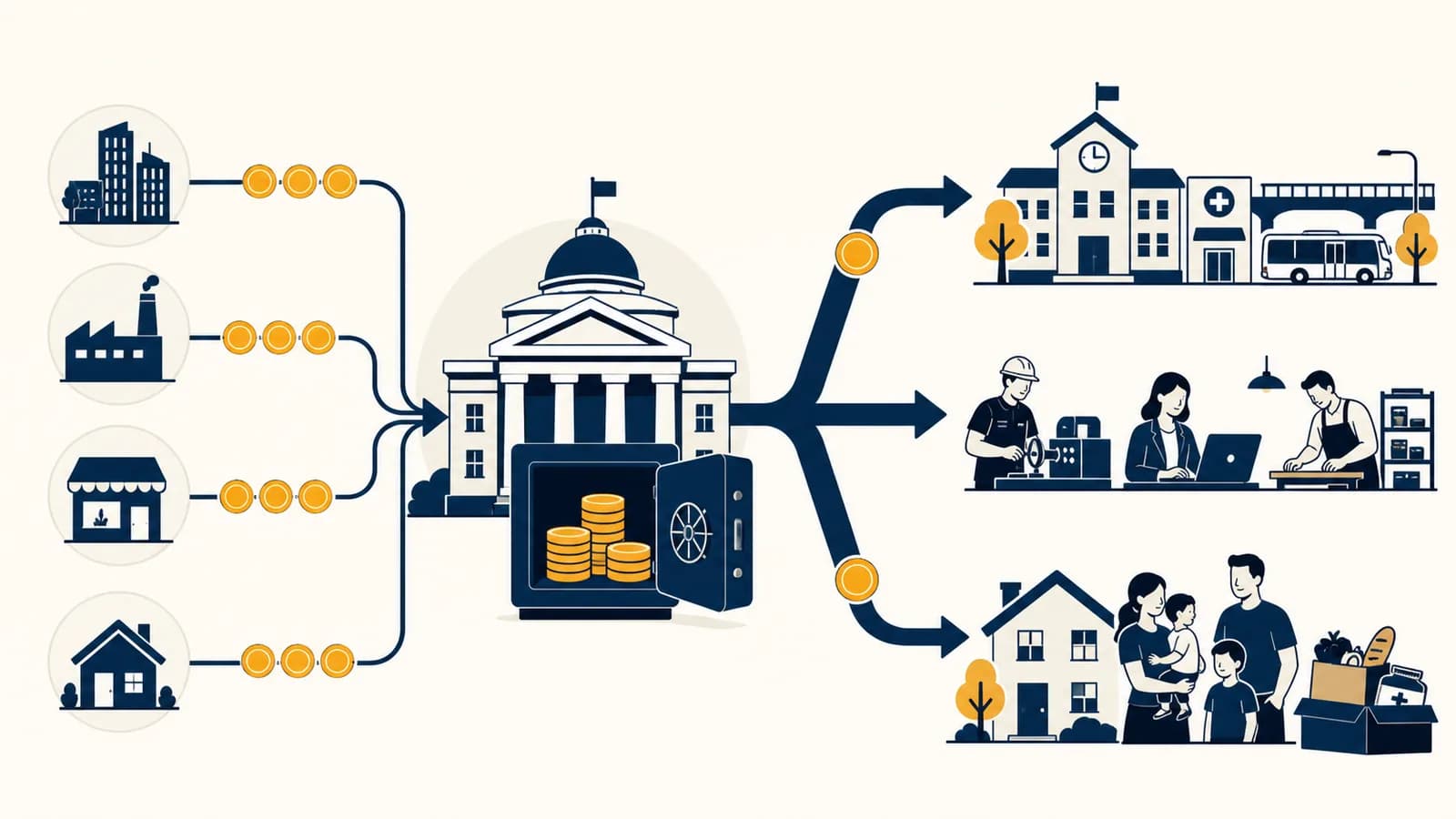
Fiscal policy is a government policy that changes public spending and taxation to influence economic activity, in the context of a national or regional economy. In plain terms, fiscal policy means using the government budget to affect total demand, employment, inflation, growth, and the distribution of income. It exists because private spending can fall too sharply, prices can rise too quickly, and markets may undersupply shared services.
A budget is more than an accounting document. When a government hires nurses, builds a railway, raises an income tax, or sends support to households, it changes who can spend, what firms expect to sell, and which resources are used. Those changes spread through paychecks, orders, prices, and tax receipts.
What fiscal policy actually is
Fiscal policy is the set of choices a government makes about spending, taxes, and transfers in order to alter the economy or provide public services. It operates through the budget, and its effects depend on timing, scale, financing, and economic conditions.
The main instruments fall into three groups:
- Government purchases pay for goods and services, such as roads, school staff, medical equipment, courts, and defense. These purchases count directly as demand for current production.
- Taxes collect part of household and business income or spending. Changing a tax changes disposable income, incentives, or the price attached to an activity.
- Transfers move money without buying a current good or service. Pensions, unemployment payments, and income support are examples. They affect demand when recipients spend some of the money.
A government may use these instruments to steady the business cycle, but stabilization is only one purpose. Budgets also fund courts, sanitation, education, infrastructure, and goods that markets struggle to provide collectively. Fiscal decisions also distribute costs and benefits across income groups, industries, places, and generations.
Fiscal policy always has two sides. A program changes activity now, and someone must finance it through current taxes, future taxes, spending cuts elsewhere, money creation, or government borrowing.
The word fiscal refers to government revenue and expenditure. A private company changing its investment plan is not conducting fiscal policy. A central bank changing an interest rate is not conducting fiscal policy either. The defining actor is a government, and the defining tools are its budget choices.
How fiscal policy works
Fiscal policy works by changing spending power and demand, which changes firms' sales, production, hiring, and prices. It can also change the economy's productive capacity by affecting infrastructure, education, health, technology, and the incentives attached to work and investment.
Legislators or ministers approve a purchase, transfer, or tax change. Some changes take effect immediately, while construction and administrative programs can take months or years.
A contractor receives an order, a worker receives wages, a household receives a payment, or a taxpayer keeps more or less income.
Recipients decide how much to spend, save, repay, or use on imports. Firms respond to stronger sales by using spare capacity, raising output, hiring, increasing prices, or some combination.
One person's spending becomes another person's revenue. Taxes, saving, imports, supply limits, and interest rates reduce or redirect each later round.
The short path can be pictured as a chain:
Suppose a town pays a local firm to repair a bridge. The purchase is immediate demand for engineering and construction. The firm pays workers and suppliers. Some recipients buy groceries or repair their homes, creating further sales. Some save, pay taxes, or buy imported goods, so the local effect gets smaller at each stage.
The result depends heavily on unused capacity. If construction workers and equipment are idle, the bridge project may raise real production and employment. If every suitable worker and machine is already busy, the same project may mostly bid up wages, materials, and contract prices. Fiscal policy can increase nominal spending without increasing real output by the same amount.
Expansionary versus contractionary fiscal policy
Expansionary fiscal policy raises total demand through higher spending, larger transfers, or lower taxes, while contractionary fiscal policy reduces total demand through lower spending, smaller transfers, or higher taxes. The suitable direction depends on the economy's problem and available capacity.
The budget pushes demand upward. It is commonly considered during a recession, when weak sales and idle resources leave output below its sustainable level. The risks include inflation, poor targeting, and added borrowing.
The budget pulls demand downward. It can reduce inflationary pressure when spending outruns the economy's ability to produce. The risks include unemployment, weaker services, and cutting demand after the economy has already slowed.
Imagine an economy can sustainably produce 1,000 units of goods and services, but current demand supports only 900. An expansion does not mechanically fill the 100 unit gap, yet it can move orders and employment toward unused capacity. Now imagine demand is already 1,050 against the same capacity. Extra spending cannot conjure factories, skilled labor, or electricity immediately. Buyers compete for a limited output, so prices are more likely to rise.
A restaurant loses customers during a broad downturn and cuts staff hours. A temporary tax reduction gives households more disposable income, but each household chooses how much to spend. A government meal contract reaches the restaurant more directly because it is a purchase. The tax change is faster to administer if the system already exists, while the contract can target demand more precisely.
Expansionary does not mean good, and contractionary does not mean bad. These terms describe direction. A badly timed expansion can add inflation when factories are full. A carefully designed contraction can cool demand with less damage if it removes low value spending or collects more tax from people likely to reduce saving rather than essential consumption.
Fiscal policy versus monetary policy
Fiscal policy changes taxes, spending, and transfers through government budgets; monetary policy changes financial conditions through a central bank. Both can influence demand and inflation, but they use different institutions, reach people through different channels, and distribute effects differently.
| Feature | Fiscal policy | Monetary policy |
|---|---|---|
| Main decision-maker | Elected government and legislature | Central bank |
| Main tools | Purchases, transfers, and taxes | Policy interest rates, asset operations, and banking conditions |
| Immediate channel | Changes particular cash flows or purchases | Changes borrowing costs, asset prices, credit, and exchange rates |
| Distribution | Can target named groups, services, and places | Usually reaches the economy through financial markets and lenders |
| Typical constraint | Legislation, administration, and public finance | Inflation goals, transmission through finance, and institutional mandate |
A lower central bank interest rate can encourage households to borrow for homes and firms to invest. A fiscal program can instead buy insulation for public housing in a named region. Both may raise demand, but the first changes the price of credit across the economy, while the second places a specific order.
The policies can reinforce or offset each other. If the government expands demand while the central bank raises rates to control inflation, borrowers face tighter credit even as public spending rises. If both support demand during a slump, the combined effect may be larger. Coordination does not erase separate responsibilities, and neither institution can guarantee the other's desired result.
How spending and tax multipliers work
A fiscal multiplier measures how much total economic output changes after a change in government spending, taxes, or transfers. It captures direct and later effects, but it is an estimated relationship, not a fixed constant that applies everywhere and at every time.
If a 100 million unit spending increase is followed by a 150 million unit rise in real GDP attributable to the policy, the estimated multiplier is 1.5.
A multiplier above one means later rounds added more output than the initial fiscal change. A multiplier below one means leakages or offsetting responses limited the total. A negative multiplier is possible for a tax increase or spending cut when the fiscal change reduces output. Economists must estimate what output would have been without the policy, which is difficult because that alternative cannot be directly observed.
A simple classroom model shows the repeated spending mechanism. Assume the government buys 100 units of newly produced services. Recipients spend 80 percent of every extra unit of income on domestic output and save the rest. The rounds are 100, then 80, then 64, continuing as a geometric series.
In this stripped-down model, 100 units of initial spending eventually support 500 units of output.
The answer of 500 is arithmetic, not a forecast. Real economies have income taxes, imports, debt repayment, price changes, supply limits, changing interest rates, and expectations. Each can reduce the next round. On the other hand, policy that prevents a business failure or preserves a worker's skills may avoid damage that the simple model misses.
Tax cuts usually have a less direct first round than purchases. A government purchase of 100 adds 100 to demand immediately. A household receiving a 100 tax cut may spend 60, save 30, and repay 10. The exact split varies. Transfers to cash constrained households can have a faster spending effect because those households may need food, rent, transport, or heating immediately.
How fiscal policy shows up in recessions and inflation
During a recession, fiscal policy can replace missing private demand and protect productive capacity; during high inflation, it can remove demand or ease specific supply limits. Success depends on diagnosing the cause, because weak demand and restricted supply call for different responses.
A recession can become self-reinforcing. Households spend less, firms lose sales, workers lose hours, and those workers spend less in turn. Government purchases or transfers can interrupt that loop. Support may keep otherwise viable employers operating and prevent families from sharply cutting necessities.
Timing creates a serious problem. Officials must recognize the downturn, agree on a response, administer it, and wait for spending to spread. These are recognition, decision, implementation, and effect lags. A bridge may be useful for decades but too slow to stop layoffs next month. Existing payment systems and ready projects can act faster.
Inflation also needs diagnosis. If broad demand is running above productive capacity, higher taxes or lower public spending can reduce the pressure. If energy supply has been cut, reducing demand may lower inflation only by suppressing other activity. Targeted investment in power generation can expand supply later, but extra construction demand may add pressure before new capacity is ready.
One policy can work on two clocks. Building an electricity network adds demand during construction, then increases supply capacity after completion. The near-term and long-term effects can point in different directions.
Fiscal authorities therefore look beyond a single inflation rate or growth number. They examine vacant jobs, unemployment, factory use, wage growth, household spending, supply bottlenecks, and which prices are rising. The logic connects to how shortages and demand shifts move prices, but an entire economy contains many linked markets rather than one simple graph.
How automatic stabilizers work
Automatic stabilizers are budget rules that support demand during downturns and restrain it during expansions without a new vote each time. Progressive taxes and unemployment support are common examples because payments and collections respond automatically when household incomes change.
Suppose a worker loses a job. Their income tax payment falls because taxable earnings fall, and they may qualify for unemployment support. Their disposable income still declines, but by less than their wages. This softens the cut in grocery, rent, and transport spending. When the worker is rehired, support ends and tax payments rise again.
An existing rule changes payments or collections as income changes. It can begin before lawmakers have confirmed that a recession is under way.
Officials make a new decision, such as approving a construction package or a temporary tax credit. It can be tailored, but debate and administration take time.
Automatic stabilizers do not require officials to forecast every turning point. Their speed is valuable, but their scale reflects rules written earlier. A mild downturn may trigger enough support, while an unusually deep shock may call for an additional discretionary response. Program design also affects who qualifies, how quickly money arrives, and how much income is replaced.
How fiscal policy shows up in jobs, businesses, and daily life
Fiscal policy reaches daily life through paychecks, public services, prices, tax bills, benefits, contracts, and borrowing costs. Its effects appear in particular places and occupations before they appear in national statistics, so the same policy can help one group and burden another.
A public contract becomes private revenue
Government procurement creates customers for firms. A school district buying computers raises revenue for a supplier, which may order components and hire technicians. Contract requirements can shape wages, training, location, and environmental standards. If the supplier was already at full capacity, it may raise its price or turn away another customer instead of producing much more.
A tax changes both cash and incentives
A tax can reduce disposable income, change the return on an activity, or change a product's final price. A payroll tax affects the cost of employing labor and the pay workers keep. A tax on pollution makes a damaging activity more expensive. An investment allowance changes the after-tax cost of equipment. People do not respond identically, so the legal payer and the person bearing the economic cost may differ.
A benefit cushions a household shock
Transfers can keep consumption from collapsing after unemployment, illness, disability, or retirement. The first effect is personal, such as a bill being paid. The next effect reaches the landlord, shop, or utility receiving that payment. Eligibility rules matter because a payment that arrives after eviction cannot prevent the eviction.
A budget changes local labor demand
A hospital expansion needs builders first and medical staff later. A public spending cut can reverse the sequence. To trace these effects, examine the occupations required, the skills available nearby, and the time needed to train workers. Wages, vacancies, and hiring all respond to these local conditions.
Your city proposes a bus network. Ask who builds it, who operates it, who saves time, which businesses gain access to customers, how fares are set, and which tax or borrowing source pays for it. Then ask what else those workers, materials, and funds could have produced. That is fiscal analysis at street level.
How deficits and debt relate to fiscal policy
A budget deficit is the amount by which government spending exceeds revenue during a period, while government debt is the accumulated stock of outstanding borrowing. Fiscal choices change both, but deficits can also move automatically when the economy changes tax receipts and benefit payments.
If revenue is 480 units and spending is 520 units, the balance is negative 40, so the deficit is 40 units.
A deficit normally requires borrowing, while a surplus can reduce outstanding debt or build financial assets. Debt can also change through interest, valuation changes, and accounting boundaries. This is why a flow for one year and a stock measured at a date must not be treated as the same number.
Borrowing can spread the cost of a long-lived asset across future taxpayers who also use it. It can also preserve demand during a recession, when raising taxes immediately might deepen the fall. Yet debt creates interest obligations and refinancing risk. If creditors demand higher interest, more future revenue goes to debt service rather than programs or tax reductions.
The size of debt alone does not settle whether it is sustainable. Analysts compare interest costs with government revenue, examine the currency and maturity of the debt, and consider economic growth, inflation, investor confidence, and the quality of spending. The distinctions are developed further in how public borrowing accumulates and is repaid.
Four mistakes people make with fiscal policy
Most errors about fiscal policy come from ignoring timing, resources, behavioral responses, or financing. A budget figure shows an authorized amount, but economic analysis asks when it is spent, what it buys, how people react, and what changes elsewhere as a result.
1. Treating every dollar of spending as equally effective
A fast transfer to a household behind on bills and a road project awaiting permits do not affect demand on the same schedule. A useful program can still be a poor emergency response if it cannot start in time. A quick program can still waste resources if it buys low value output.
2. Assuming the government can buy output that does not exist
Money can place an order, but it cannot instantly produce a trained surgeon, a power station, or a shipment blocked at sea. If supply cannot respond, stronger demand raises prices or displaces another buyer. The binding question is often which real resources are free.
3. Reading a larger deficit as proof of deliberate stimulus
A recession can enlarge the deficit without a new policy because tax revenue falls and support payments rise. Conversely, a government can pass an expansionary measure while the total deficit shrinks because rapid income growth raises revenue. Analysts separate policy choices from automatic changes.
4. Counting the visible benefit but not the opportunity cost
A new stadium creates construction work, but workers, land, steel, and public funds have other possible uses. The right comparison is not the project against nothing. It is the project against the best realistic alternative, including leaving resources with taxpayers or funding a different service.
That comparison is called a counterfactual. It explains why evaluation is hard. Output may rise after a tax cut because recovery was already beginning, or it may fall after a spending program because the program prevented an even larger fall. Researchers use historical comparisons, models, phased rollouts, and regional variation to estimate the missing alternative.
Can fiscal policy raise long-term growth?
Fiscal policy can raise long-term growth when it expands useful capacity, skills, health, infrastructure, or innovation more than its taxes and financing costs reduce productive activity. It can also lower growth when projects waste resources, rules deter useful work, or debt service crowds out better uses.
Consider a port upgrade. During construction it adds demand for labor and materials. After completion it may reduce shipping time and damage, allowing firms to trade more efficiently. These are separate effects. The first is mainly cyclical; the second concerns potential output, the amount the economy can sustainably produce.
Education, vaccination, basic research, courts, and transport can support private production even when the government does not manufacture the final goods. Design still matters. A project with political appeal but little use ties up resources. A tax can finance productive services while also changing incentives, so analysis must compare the full package rather than discussing spending and revenue in isolation.
Who decides fiscal policy, and why does timing matter?
Elected executives and legislatures usually decide fiscal policy through budgets and tax law, while agencies administer it and courts enforce legal limits. Timing matters because economic conditions may change between diagnosis, authorization, delivery, and the final response of households and firms.
The institutional details differ across countries and levels of government. A national government may borrow more readily than a city that must balance its operating budget. Regional authorities may control schools and transport but not income tax. A policy recommendation is incomplete unless the responsible institution has the legal power and administrative capacity to carry it out.
Expectations can move before cash does. A firm may hire after a credible infrastructure law is passed, anticipating orders. It may wait if funding can be reversed. A household may save a temporary tax cut but spend more from a permanent one. Credibility, duration, and clarity change the response.
Does fiscal policy have to choose between fairness and efficiency?
Fiscal policy does not always face a simple choice between fairness and efficiency, because some measures can improve both and others can damage both. Still, taxes and spending distribute gains, losses, risks, and opportunities, so value judgments cannot be removed from budget decisions.
A child nutrition program may improve health and learning while directing resources to families with low incomes. A badly designed subsidy may mainly reward activity that would have happened anyway. A broad consumption tax may collect revenue efficiently but take a larger share of income from poorer households unless benefits or exemptions offset it.
Incidence is the study of who ultimately bears a tax or receives a benefit. A landlord may be legally responsible for a property tax but recover part through rent if the market allows it. A wage subsidy paid to an employer may benefit workers through higher pay, firms through lower labor cost, or both. Labels on the budget do not reveal the final distribution.
Fiscal policy makes economic tradeoffs visible
Fiscal policy turns economic choices into budgets that can be inspected: who pays, who receives, what is produced, and when. It links national demand to individual jobs and services, making scarcity, distribution, incentives, and opportunity cost visible in public decisions.
To analyze a budget announcement, first identify the instrument. A headline saying “support” may mean a purchase, loan, guarantee, transfer, or tax reduction, and each follows a different path. Next, separate the short-term effect on demand from the long-term effect on productive capacity. Then test the plan against current conditions. Idle resources, stretched supply, and a bottleneck are different starting points.
Finally, follow both the money and the resources. Find the first recipient, estimate what they can actually do, trace later spending, and identify the financing. Compare the proposal with a realistic alternative. This habit connects fiscal policy to the wider set of ideas used to study economic choices.
The takeaway: Fiscal policy is the government's use of spending, taxes, and transfers to change economic activity and provide services. When you meet a new proposal, ask what cash flow changes first, which real resources respond, what happens later, and who carries the cost.