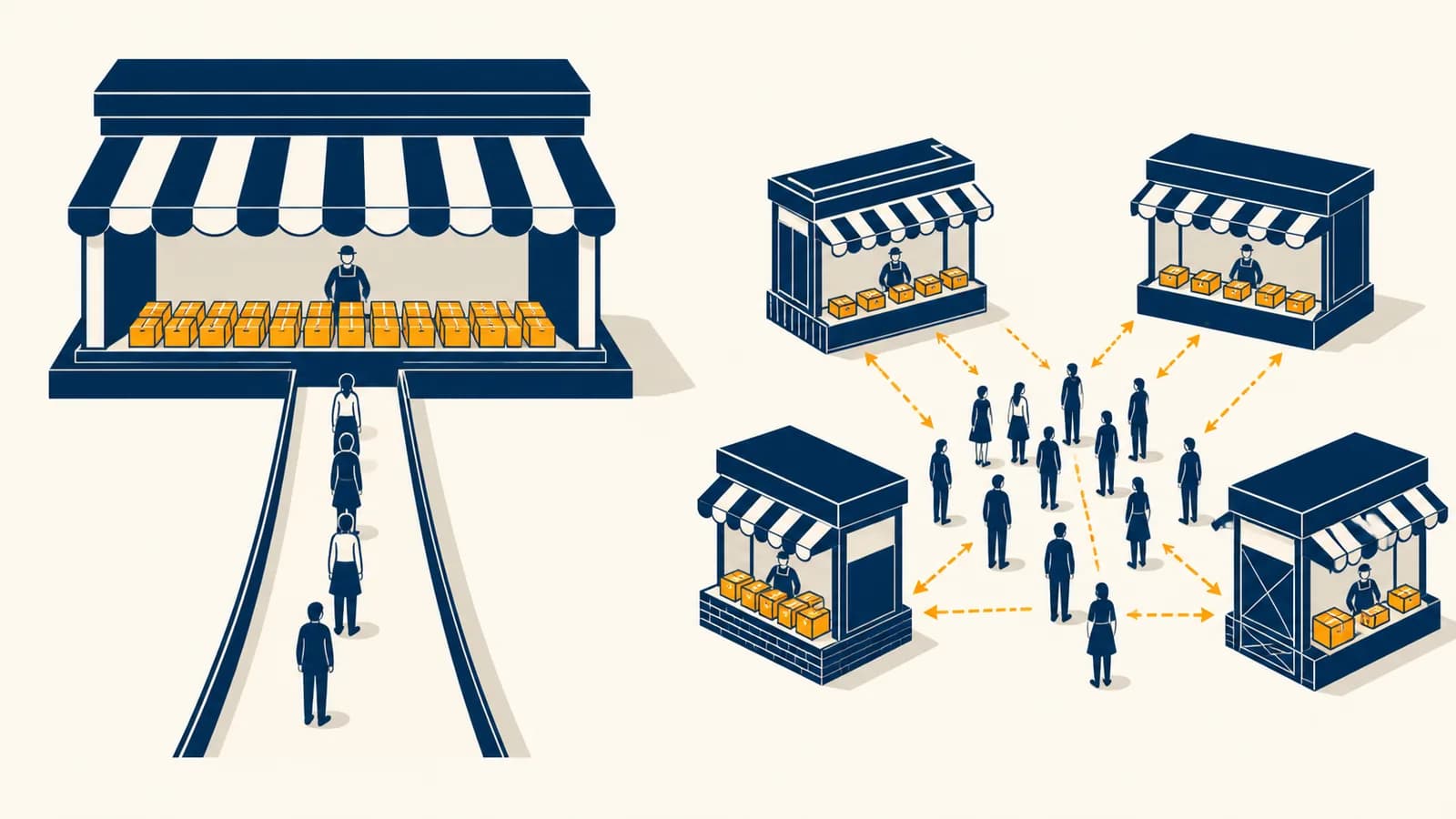
Monopoly and oligopoly are market structures that describe how one seller or a small group of sellers controls supply and competition, in the context of economics. A monopoly has one effective seller in a defined market, while an oligopoly has a few major sellers whose decisions affect one another. Both can create market power, meaning a firm can raise price, restrict output, or shape terms without immediately losing every customer. These ideas exist because the number of realistic choices available to buyers changes how prices, production, profit, innovation, and regulation work.
What a monopoly actually is
A monopoly is a market with one effective supplier, no close substitute for its product, and barriers that keep new rivals from entering. The word describes control of a market, not simply a company that is large, famous, or highly profitable.
Every part of that definition matters. First, economists define the relevant market. A town may have one cinema, but that cinema competes with streaming, games, live events, and cinemas in nearby towns to some degree. It may be a monopoly in local cinema screenings without being a monopoly in entertainment. The boundary depends on what buyers see as substitutes and how far they can practically travel or switch.
Second, monopoly requires an entry barrier. A high price alone normally attracts competitors. If a new seller can rent a shop, buy the same inputs, and begin trading, the original seller cannot protect monopoly profit for long. A barrier makes that response slow, costly, legally impossible, or technically difficult.
Market definition changes the answer. One coffee cart may be the only cart inside a stadium, yet compete with every drink stall there. Count realistic substitutes, not just products with the same name.
Common barriers include exclusive control of a scarce input, a patent or licence, very high setup costs, network effects, and economies of scale. A network effect exists when a service becomes more useful as more people join it. Economies of scale exist when average cost falls as output grows. Both can make an established supplier hard to challenge, even when entry is legally open.
A monopolist faces the market demand curve
A competitive firm can often sell at the market price and has little control over that price. A monopolist is the market supplier, so selling an extra unit usually requires a lower price. If it charges more, fewer buyers purchase. It therefore chooses a price and quantity along the market demand curve rather than accepting a price set by many rivals.
What an oligopoly actually is
An oligopoly is a market dominated by a small number of substantial firms, each large enough that its choices alter the conditions facing the others. Its defining feature is strategic interdependence: every major firm must anticipate how rivals will respond.
There is no universal number of firms that automatically makes a market an oligopoly. Four tiny sellers and hundreds of strong rivals do not form one. Four firms supplying almost the whole relevant market probably do. Economists therefore examine market shares, entry barriers, buyer options, product differences, and evidence about how firms respond to each other.
Those figures are a constructed example, so their arithmetic is visible rather than presented as a statistic about a real industry. The three named firms supply 90 percent between them. If Firm A cuts its price, B and C cannot treat the move as irrelevant. If they match it, all three may sell similar quantities at lower margins. If they do not, A may take many of their customers.
Oligopolies can sell identical or differentiated products
Some oligopolies sell products buyers consider nearly identical, such as a standardized industrial input. Competition then concentrates on price, capacity, reliability, and delivery. Others sell differentiated products, such as mobile plans or cars. Brand, design, location, service, and switching costs then matter alongside price.
A concentrated market need not be static. A few firms can compete fiercely through price cuts, product launches, advertising, and investment. They can also avoid aggressive competition because each understands that rivals may retaliate. Oligopoly names the structure and the strategic problem. It does not, by itself, tell us the final behavior.
How market power works
Market power works by weakening the customer loss that normally follows an unfavorable price or product decision. A firm with few effective rivals can reduce output and raise price until the gain on remaining sales no longer covers the profit lost from forgone sales.
Consider a hypothetical single-price seller with no fixed cost and a constant marginal cost of $20 per unit. At $50 it can sell 100 units. At $40 it can sell 140 units. The first option produces $5,000 of revenue and $2,000 of variable cost, leaving $3,000. The second produces $5,600 of revenue and $2,800 of variable cost, leaving $2,800. The lower price raises sales and revenue, yet reduces profit in this example.
At $50 for 100 units: .
The calculation does not prove that $50 is the best possible price. It shows what the firm must compare. A profit-maximizing monopolist expands output while the extra revenue from the next unit exceeds the extra cost of producing it. It stops where marginal revenue equals marginal cost, provided producing at all covers the avoidable costs.
The missing trades create deadweight loss. Some buyers value another unit more than it costs society to produce, but less than the monopoly price. They do not buy, even though production would have created a net benefit. Part of the buyer surplus becomes producer profit, which is a transfer. The value of mutually beneficial trades that never happen is the social loss.
Demand responsiveness limits market power
A seller has less room to raise price when buyers can switch easily, delay the purchase, repair an old product, import an alternative, or stop buying. Economists describe this responsiveness with price elasticity of demand. A product can have few direct competitors but still face elastic demand if customers can do without it.
Market power also affects non-price terms. A firm may reduce service quality, collect more data, shorten warranties, offer inconvenient contract terms, or slow product improvement. If analysis watches only the sticker price, it can miss these costs.
Monopoly versus perfect competition
Perfect competition is a benchmark in which many small firms sell an identical product and cannot individually set the market price, while monopoly has one effective seller that chooses output with the market demand curve in view. Real markets often lie between them.
Many sellers, easy entry, a standardized product, strong price pressure, and output where market price matches marginal cost.
One effective seller, protected entry, no close substitute, price above marginal cost in the standard model, and lower output than the competitive benchmark.
The benchmark is useful even though few markets satisfy every assumption. It isolates the effect of market power. Imagine demand for 1,000 units at a competitive price of $10, with the last unit costing $10 to supply. If a monopolist instead sells 700 units at $16, buyers pay more and 300 potential sales vanish. These quantities are illustrative, but the direction follows from the model.
Competition also puts pressure on costs. A firm that wastes materials or runs a poor service can lose customers to a better rival. A protected monopolist may face weaker pressure, a problem sometimes called productive inefficiency. Yet a monopolist is not guaranteed to be inefficient. Management incentives, regulation, the threat of future entry, and the wish to expand demand can still produce cost control and innovation.
Monopoly profit is not guaranteed
A sole seller can still lose money. Demand may be too small to cover research, equipment, maintenance, and staffing. A monopoly describes the competitive structure, not its accounts. Profit depends on revenue and cost, while market power concerns the ability to alter terms without losing all demand.
This distinction also separates market structure from a firm’s effect on the wider economy. A firm’s sales can add to Gross Domestic Product even when its market power makes some potential trades disappear.
How oligopoly works through strategic interdependence
Oligopoly works as a repeated strategic contest in which each major firm’s best action depends on expected rival actions. Prices, capacity, advertising, product design, and entry plans become signals that can provoke matching, retaliation, accommodation, or no response.
Suppose two petrol stations face each other on an isolated road. Each can post a high price or a low price. If both post high prices, each earns a comfortable margin. A station that alone cuts price may attract more traffic. If both cut, neither gains much market share and both earn less per litre. Each has a reason to undercut, even though both might earn more if neither did.
Station A expects Station B to keep a high price. A low price may then win customers. B sees the loss and matches A. The result can be two low prices, even though the owners would jointly prefer two high prices. These are incentives, not evidence about any named business.
This is the logic behind a prisoner’s dilemma. Individually sensible decisions can produce a joint outcome that all firms dislike. Repetition complicates the result. Firms observe one another over time, recognize patterns, and may avoid moves that trigger costly responses. They do not need a written agreement to understand that a price war harms margins.
Collusion changes rivalry into coordination
Collusion occurs when firms coordinate instead of making independent competitive decisions. They may agree to fix prices, divide customers, limit production, or rig bids. A cartel is an organized group attempting such coordination. In many legal systems, agreements among competitors to fix prices or divide markets are prohibited because they reproduce monopoly behavior.
Cartels are unstable for an economic reason as well as a legal one. Each member can gain by secretly selling more than its assigned amount or offering a hidden discount. Monitoring is difficult when products vary, demand changes, or sales contracts are private. New entrants can also attack the cartel’s high price.
Tacit coordination is harder to identify
Tacit coordination means firms reach a less competitive pattern without an explicit agreement that investigators can point to. Similar prices are not enough to prove it. Rivals may independently respond to the same fuel cost, tax, exchange rate, or demand shock. Evidence must distinguish conscious agreement from rational parallel behavior.
Imported inputs can make a shared cost move with currencies, which is why how exchange rates alter import prices is relevant before treating synchronized price changes as proof of coordination.
How monopoly and oligopoly show up in daily markets
Monopoly and oligopoly show up wherever buyers have few practical alternatives, including local utilities, transport routes, digital platforms, patented products, payment networks, and concentrated manufacturing. The correct classification depends on the buyer’s real options in a defined place and time.
Describe what is bought closely enough to identify substitutes. “Transport” may be too broad; “weekday rail travel into one city before 9 a.m.” is more useful.
A supermarket can face many rivals nationally but be the only practical grocery option in a remote district.
Ask what buyers would do after a modest lasting deterioration in price or quality. Switching reveals competitive pressure.
Check licences, infrastructure, access to inputs, customer networks, switching costs, scale economies, and the time required to enter.
A water pipe network is a standard example. Building several sets of pipes to every home would duplicate roads, digging, maintenance, and pumping systems. One network may therefore supply the area at lower average cost. The monopoly problem remains, since households cannot respond to poor terms by installing a competing citywide pipe system.
Digital markets raise different barriers. A platform with many users can attract sellers because the buyers are there, then attract more buyers because the sellers are there. Data, default settings, compatibility, and the inconvenience of moving contacts or purchases can reinforce that loop. Competition may occur for control of the market during rapid growth, then weaken once one system becomes established.
Local conditions matter just as much as global brands. A single pharmacy open at night may have temporary market power over someone who needs medicine immediately, even if the city contains many pharmacies. Time can be part of the market definition because a substitute available tomorrow may not constrain tonight’s price.
Jobs inside concentrated markets reveal the mechanism
Competition economists define markets and test merger effects. Regulators set allowable prices or service standards. Procurement officers design tenders that make bid rigging harder. Product managers study switching costs. Lawyers assess patents and competition rules. Journalists compare ownership, pricing behavior, and barriers before calling a market monopolized.
Households meet the same ideas while choosing a broadband contract, changing a phone ecosystem, paying a utility bill, or finding only two airlines on a route. The practical question is not “How many companies have I heard of?” It is “How many suppliers can serve this purchase on acceptable terms?”
How governments respond to market power
Governments respond to market power by protecting competition where rivalry can work, regulating prices or service where one network is efficient, and sometimes providing the service publicly. The policy should address the source of power without destroying useful scale, investment, or invention.
Competition law can prohibit price fixing, market sharing, bid rigging, and exclusionary conduct. Merger review asks whether combining firms would substantially weaken competition. A proposed merger can create efficiencies, such as removing duplicate distribution costs, while also removing a close rival. Investigators must compare both effects rather than treating firm size alone as the answer.
The United States Sherman Act of 1890 is a documented early federal antitrust law. Its age also shows that concentrated private power is not a new digital problem. The legal tests and agencies differ by country, but the economic questions recur: what is the market, what constrains the firms, and what would happen without the challenged conduct?
High concentration is a screening clue, not a verdict. A concentrated market may reflect strong scale economies, recent innovation, or weak competition. Investigators need evidence about entry, substitution, conduct, and likely effects.
Price regulation is common where duplicating a network would be wasteful. A regulator may cap prices, set an allowed return, demand service standards, or compare performance across regions. Each method changes incentives. A cap can encourage cost savings, but a poorly designed cap can also encourage quality cuts. Reimbursing every cost can preserve service, but may weaken the reason to control spending.
Public ownership can remove the private monopolist’s profit objective, yet it does not remove scarcity, cost, or management problems. Public providers still need budgets, performance measures, maintenance plans, and accountability. A serious appraisal uses the tools of comparing social costs with social benefits rather than assuming one ownership form always wins.
Breaking up a firm is only one possible remedy
Structural remedies change ownership or organization, for example by blocking a merger or separating business units. Behavioral remedies govern future conduct, for example by requiring access on fair terms or forbidding discriminatory contracts. Structural remedies can be clearer to enforce, but separation may sacrifice genuine integration savings. Behavioral rules preserve integration, but require monitoring.
What a natural monopoly actually is
A natural monopoly is a market in which one supplier can serve total demand at lower cost than two or more suppliers, usually because fixed infrastructure costs are large and average cost falls across the relevant output range.
Suppose a local network costs $1,000,000 to build and has a small additional cost for each customer. Two parallel networks would each need much of the same construction before serving anyone. If 10,000 households share one network, the fixed construction cost averages $100 per household. If two duplicate networks split customers equally, each serves 5,000 households and the same assumed fixed cost averages $200 per household.
One network: dollars per household. The figures are a worked example.
Natural describes the cost structure, not anything morally good, permanent, or free of policy choices. Technology can change the answer. Mobile networks altered parts of telecommunications that once depended entirely on fixed lines. A market can also contain a natural-monopoly network while competitive firms use it, as when multiple retailers sell service through shared infrastructure.
How price discrimination works
Price discrimination works when a seller charges different prices for the same underlying product and the difference is not explained by cost. It requires market power, a way to sort buyers, and limits on resale between low-price and high-price customers.
A cinema may charge students less when identification separates a group thought to have more price-sensitive demand. An airline may offer different conditions and prices for seats on the same flight. Some differences reflect real costs or product differences, so observing two prices is not enough. A refundable ticket provides an option that a nonrefundable ticket does not.
Price discrimination can increase profit by collecting more from buyers willing to pay more while still selling to buyers willing to pay less. Its effect on total welfare is mixed. If lower prices bring additional customers into the market, output can rise. If the scheme mainly extracts more money from people who would have bought anyway, buyers lose surplus without a matching expansion in trades.
Express delivery costs more because it uses extra transport and tighter handling. This is not price discrimination in the economic sense.
Two buyers create the same cost but pay different prices because the seller can identify different willingness to pay and prevent resale.
Personalized offers add a behavioral layer. The way a price is framed, the default package, and the difficulty of comparison can change decisions even when the money amounts are visible. The page on how framing and biases affect economic choices develops those mechanisms.
Five mistakes people make with market structure
Most mistakes about monopoly and oligopoly come from skipping market definition, treating size as proof, or assuming one structure always produces one behavior. Good analysis separates the number of sellers, the barriers they face, their conduct, and the resulting effects.
1. Calling every large company a monopoly
A large company may face strong rivals, easy customer switching, or rapid entry. It can dominate one narrow product while competing hard in a broader one. Evidence of size starts the inquiry. It does not complete it.
2. Counting brands instead of independent competitors
A supermarket shelf can display many brands owned by a few parent companies. The reverse can also occur, with many independent businesses trading under one franchise name. Ownership and control matter because two labels do not make independent pricing decisions if one company sets both.
3. Assuming a monopolist can charge any price
Demand constrains even a sole seller. At an extreme price, buyers reduce use, seek substitutes, delay purchase, or go without. Regulation, political response, and potential entry may add further constraints. Market power is a matter of degree, not unlimited command.
4. Treating identical price moves as automatic proof of collusion
Competitors exposed to the same wholesale cost or tax can change prices together without communicating. Proof of illegal agreement requires more than parallel movement. Investigators examine contacts, internal records, bidding patterns, unexplained conduct, and other evidence under the relevant law.
5. Assuming more firms always produce a better result
Extra rivalry often lowers margins and improves choice, but duplicating infrastructure can waste resources. Tiny firms may also lack scale for research or safety systems. The useful comparison is between realistic arrangements, including their prices, costs, quality, innovation, resilience, and enforcement needs.
That test prevents most category errors. It keeps attention on substitution and entry, the two forces that can discipline a seller even before a regulator acts.
Market structure turns economics into something you can observe
Monopoly and oligopoly connect scarcity, incentives, costs, strategy, and public policy by showing how the available alternatives shape behavior. Watching prices is useful, but watching switching, entry, output, quality, and rival responses reveals the mechanism more clearly.
Choose one purchase you make regularly and define its market narrowly enough to test. List the suppliers you could actually use this week. Note what switching would cost in money, time, lost data, compatibility, travel, or risk. Then ask what a new supplier would need before it could compete. The result will be more informative than counting logos.
This habit also shows how market structure fits into the wider study of economics: models become useful when they organize evidence and expose tradeoffs. A label such as monopoly is the beginning of analysis, followed by a testable account of who has power, where it comes from, and what it changes.
The takeaway: A monopoly has one effective seller; an oligopoly has a few strategically interdependent sellers. In both, the practical task is to define the market, test buyer substitution, identify entry barriers, and trace the effects on price, output, quality, and innovation.