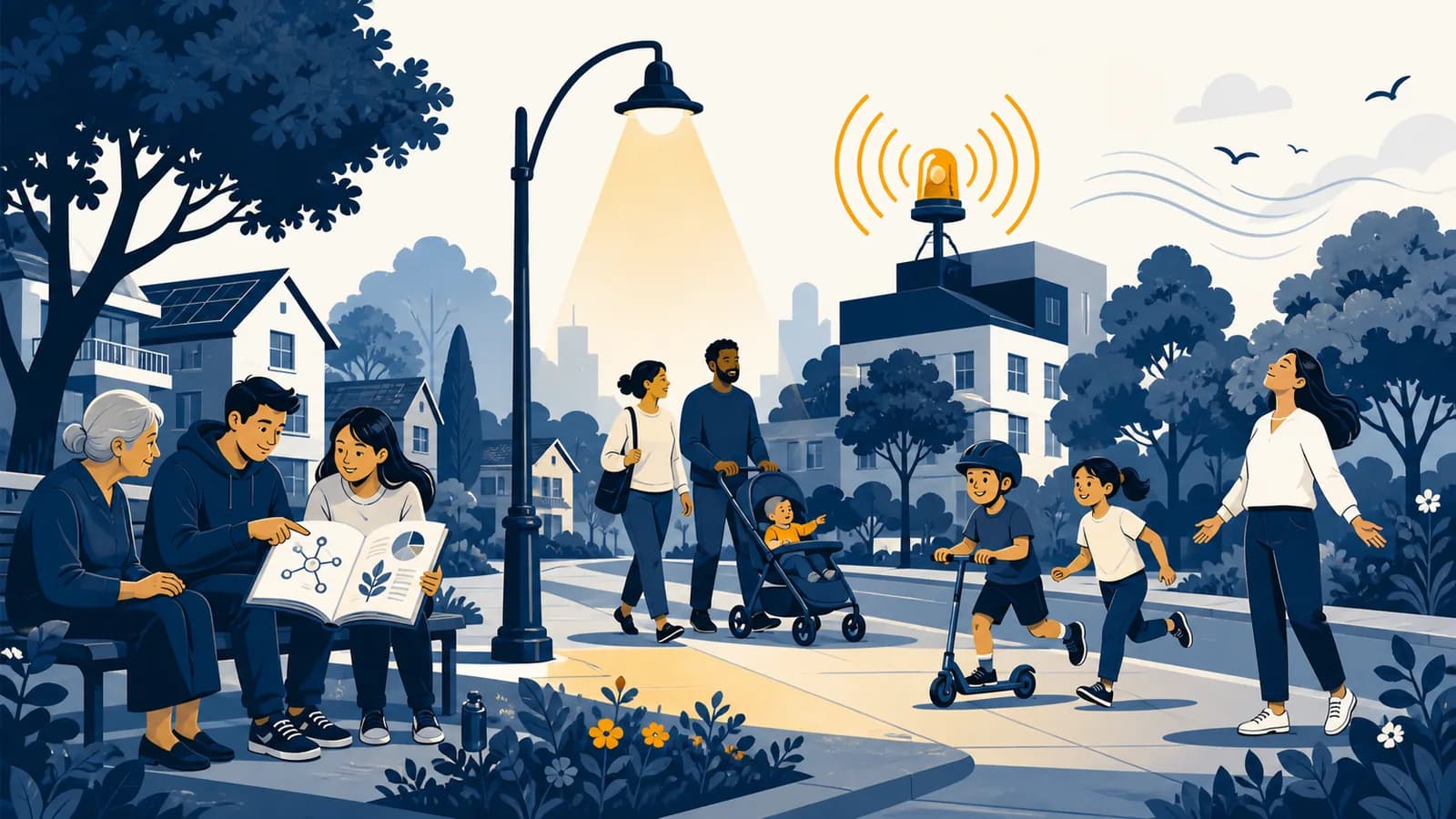
Public goods are resources or services that people cannot feasibly be excluded from using and that one person can use without reducing another person’s use, in the context of economics. If you search “what is a public good,” the short answer is: a good that is non-excludable and non-rival. Classic public goods examples include national defense, basic scientific knowledge, and a lighthouse signal. These traits create the free-rider problem because people can benefit without paying. The idea exists to explain why ordinary markets may supply too little of something that many people value.
What public goods actually are
A public good is defined by two properties, not by who produces it or by whether it seems socially valuable. People are difficult to exclude from its benefits, and an extra user does not meaningfully reduce what remains for everyone else.
Non-excludable means the provider cannot easily stop a nonpayer from benefiting. A missile defense system protects people inside its coverage area without checking who paid a fee. An open warning siren can be heard by anyone nearby. Exclusion may be technically possible in some cases, but so costly or impractical that charging each user does not make sense.
Non-rival means one person’s use does not leave less for someone else. Your learning the Pythagorean theorem does not erase it from another student’s mind. A radio broadcast can reach one more receiver without weakening the signal reaching existing receivers. Economists focus on the cost of serving an additional user. For a pure public good, that marginal cost is zero or close to zero once the good exists.
| Type of good | Can nonpayers be excluded? | Does use subtract from what remains? | Example |
|---|---|---|---|
| Private good | Usually yes | Usually yes | A sandwich |
| Public good | Usually no | Usually no | A tornado warning siren |
| Common resource | Usually no | Usually yes | Fish in an open-access fishery |
| Club good | Usually yes | Not until congestion | A subscription stream |
The word public can mislead. A city bus run by a government is excludable because a rider can be required to buy a ticket. It is also rival when seats or standing space fill. By contrast, privately created mathematical knowledge can become a public good once it is openly shared. Classification follows the properties of use, not the producer’s name.
Use the two-test rule. Ask, “Can a nonpayer be kept out?” Then ask, “Does one person’s use leave less for others?” A pure public good receives “no” on both tests.
Pure public goods sit at one corner of a broader classification. Many real goods are mixed. A park may be open to everyone on a quiet morning but rival on a crowded afternoon. A road may be non-rival at 3 a.m. and heavily rival during rush hour. The model still helps because it identifies which feature creates a pricing or congestion problem.
How non-excludability and non-rivalry work
The two defining properties work together to break the usual link between receiving a benefit and paying for it. Non-excludability weakens the seller’s ability to collect revenue, while non-rivalry means excluding extra users would waste benefits that cost almost nothing to share.
Imagine a harbor signal that costs $12,000 to install and operate for the season. Each of 200 boat owners values the safer navigation at $100. The total benefit is therefore , which exceeds the $12,000 cost. Providing the signal creates a net social benefit of $8,000.
A private seller still faces a problem. Once the signal shines across the harbor, it is difficult to let paying boats see it while hiding it from nonpaying boats. Each owner has a reason to wait for others to fund it. If too many do that, the seller cannot recover the cost, even though the group’s combined willingness to pay is high enough.
If three residents value one more streetlight at $4, $3, and $2 per month, the combined marginal benefit is . Supplying it is efficient if its marginal cost is no more than $9 per month.
For a private good, economists add individual quantities demanded at each price because each buyer consumes a different unit. For a public good, economists add individual willingness to pay for the same shared unit. Everyone receives the streetlight’s illumination at once, so their marginal benefits are stacked vertically.
This distinction matters for pricing. A price above the marginal cost blocks some people whose use would add more benefit without adding much cost. Yet a price of zero may provide no revenue for creation. Public-good policy often tries to separate the funding decision from the access decision: collect funds through taxes, grants, memberships, or donations, then allow broad use.
Public goods versus common resources
Public goods and common resources are both difficult to fence off, but they have opposite consumption problems. A public good can be shared without depletion, while a common resource is reduced or congested when another person takes or uses part of it.
People can benefit without paying, so too little may be produced. The central question is how to finance enough provision.
People can take from a shared stock, so too much may be consumed. The central question is how to prevent depletion or crowding.
Fish in an open ocean area illustrate the difference. It may be difficult to exclude boats, but a fish caught by one boat cannot be caught by another. The stock is rival. A navigation warning broadcast over that same ocean does not disappear when one captain receives it. The warning is non-rival.
This is why the free-rider problem should not be confused with the tragedy of the commons. Free riding leads people to underfund a shared benefit. Open access can lead people to overuse a shared resource. The remedies differ. Public goods may need collective funding, while common resources may need quotas, property rights, access rules, or prices that reflect depletion.
The same object can switch categories as conditions change. A public beach has plenty of space when almost empty, so an extra visitor imposes little cost on others. At high attendance, another visitor adds crowding and makes the beach rival. Economic categories describe conditions, not permanent labels stamped onto objects.
How the free-rider problem works
The free-rider problem occurs when a person can enjoy a shared benefit without paying toward its cost, giving each individual a private incentive to withhold payment even though the group would be better off funding the good together.
Ten shop owners each value protection from seasonal flooding at $1,500. A barrier costs $10,000. The combined value is $15,000, but no owner wants to be the one who pays while every neighboring shop receives protection for free.
The barrier should be built under a simple benefit-cost test because in net group benefit. Voluntary bargaining can still fail. If one owner asks the other nine for $1,000 each, an owner may claim to value the barrier less, hoping everyone else will cover the bill. If several owners do this, funding remains below the cost.
This behavior is individually understandable. Paying $1,000 or paying nothing produces the same physical protection if the barrier is built. The preferred private outcome is to keep the money and receive the benefit. But if every owner follows that logic, the barrier is not built and each loses a benefit valued above the requested payment.
The total willingness to pay across the group exceeds the cost of provision.
Each person decides how much to contribute, while expecting to receive the benefit if others fund it.
A person can save money by claiming little interest and letting others pay.
The project is cancelled, reduced, or supplied later than the group would collectively prefer.
Free riding does not mean nobody ever contributes. People donate because they care about the result, value social approval, follow moral commitments, or receive selective benefits such as recognition. Small groups can monitor contributions and negotiate more easily. Repeated interaction also matters: a person who refuses every shared expense may lose trust and cooperation later.
Large, anonymous groups make the problem harder. One person’s contribution is a tiny part of the total, neighbors may never learn who paid, and agreement requires many separate decisions. This helps explain why local volunteer projects can succeed while national defense is not normally financed by a donation box.
The choice to contribute also connects to how incentives and social cues shape economic decisions. A message saying that most neighbors paid can change behavior even when the formal price and benefit remain identical. Human motives do not erase the free-rider problem, but they change its size.
How governments decide how much to provide
Governments estimate the combined marginal benefit of a public good, compare it with marginal cost, choose a quantity, and collect taxes or fees to fund it. The economic rule is simple, but hidden preferences and political bargaining make measurement difficult.
Suppose a town is considering one, two, or three warning sirens. Residents gain a large benefit from the first siren because it covers the busiest area. A second adds coverage to outer streets. A third reaches a small remaining zone, so its extra benefit is lower. Meanwhile, each siren has an installation and maintenance cost.
| Additional siren | Combined marginal benefit | Marginal cost | Decision |
|---|---|---|---|
| First | $18,000 | $10,000 | Install |
| Second | $12,000 | $10,000 | Install |
| Third | $6,000 | $10,000 | Do not install |
These are worked-example figures, not survey results. The rule says to install the first two because each adds more total benefit than cost. Installing the third would use $10,000 of resources to create only $6,000 of additional benefit. The efficient quantity is two.
Finding the true benefit is harder than doing the arithmetic. Market prices reveal what buyers are willing to pay for private goods. A public good has no ordinary checkout line. Surveys can ask residents what they would pay, but a respondent may exaggerate to encourage provision or understate value to reduce a possible tax bill. Economists use voting, observed behavior, property values, experiments, and stated-preference surveys, each with limits.
Tax funding solves the collection problem by making contributions compulsory. It does not guarantee good choices. Officials may misjudge benefits, choose projects for political reasons, or allow costs to rise. Voters may know little about a technical program because learning every detail takes time. Public provision corrects one incentive problem while creating questions about information, accountability, and distribution.
Efficient does not mean fair. A project can create benefits greater than its costs while placing most of the tax burden on people who receive little benefit. Efficiency and distribution require separate judgments.
The resources used for a public good also have an alternative use. Money and skilled labor devoted to a new highway warning system cannot simultaneously repair a water system. The guide to what economists mean by opportunity cost explains why the real cost is the best forgone alternative, not just the amount printed on an invoice.
How public goods show up in daily life
Public goods appear in daily life as shared information, safety systems, legal institutions, and environmental conditions whose benefits spread beyond individual buyers. Many familiar services are mixed goods, so the two defining tests must be applied to each benefit separately.
Street lighting creates a shared zone of visibility
Street lighting is close to a local public good because passersby benefit from the same illuminated area and a nonpayer cannot easily be placed in darkness. Yet the lamp, pole, and electricity are private inputs purchased by a city or property owner. Public goods are often produced with rival labor and equipment.
Emergency alerts turn information into shared protection
A tornado, wildfire, or contaminated-water alert can reach another phone or radio at very low marginal cost. Broad access improves the response because warned people can leave danger and avoid blocking emergency workers. Subscription-only access would exclude people even though sharing the warning adds little cost.
Rules and enforcement support exchange
Courts, property records, and contract enforcement create general confidence that agreements can be enforced. A particular court case is congestible and uses scarce staff time, so it is not a pure public good. The wider predictability produced by a functioning legal system is more broadly shared and difficult to confine to selected residents.
Disease surveillance shares information across a population
Monitoring outbreaks produces knowledge that helps hospitals, employers, schools, and households respond. One clinic’s use of a published warning does not prevent another from using it. Medical appointments and vaccine doses are rival private goods, while surveillance information and some disease control benefits have public-good features.
A fire station is not itself non-rival because its engines and crews can be busy. The reduced chance of an uncontrolled neighborhood fire has a shared component because containing one building’s fire protects nearby buildings. Careful analysis separates the physical service, its capacity limits, and the spillover benefit.
How public goods show up in research, security, and climate policy
Large-scale public goods often cross city and national borders, so no single buyer or government captures all the gains from paying for them. Basic knowledge, national security, and climate stability show how the funding problem grows with the benefit area.
Basic research creates knowledge others can reuse
A proven theorem, published measurement method, or verified scientific finding can be copied and applied repeatedly. The research process costs money and may fail, but the resulting knowledge can be non-rival. Patents and secrecy make some knowledge temporarily excludable, which can generate revenue but also limit use.
This creates a design choice. Public grants, university budgets, prizes, patents, and private research contracts distribute costs and access differently. Patents offer a time-limited legal right to exclude, allowing a creator to charge. Public funding can support open results. Neither arrangement fits every field because the cost of copying, need for follow-on research, and difficulty of identifying useful discoveries differ.
National defense protects an area rather than individual subscribers
Deterring an attack protects residents across the defended territory, and one resident’s protection usually does not reduce another’s. Selling individual defense subscriptions would be impractical because a provider cannot leave one nonpaying house undefended while protecting the houses around it. Tax funding connects the territorial benefit to a territorial payment system.
Climate stability creates a global contribution problem
Reducing greenhouse gas emissions contributes to a more stable climate, and the benefit cannot be reserved for the country that paid. Each government may prefer others to bear more of the cost. Agreements therefore need reporting rules, repeated negotiation, and incentives that make cooperation more attractive.
Two neighboring countries share an airshed. A power plant’s pollution controls cost its home country money, while cleaner air benefits residents on both sides. If the neighboring country pays nothing, the home country may choose less control than the combined benefits justify.
International public goods lack a single global tax authority with the powers of a national government. Countries rely more heavily on treaties, matching commitments, trade rules, shared research, monitoring, and reputation. The economic problem remains familiar: benefits spill beyond the payer, so separate national decisions may produce too little collective action.
What club goods actually are
Club goods are excludable but mostly non-rival until they become crowded. A provider can charge for access, and one more user initially imposes little cost, so membership or subscription pricing can finance benefits that resemble public goods inside the group.
A streaming service can block non-subscribers with a login while allowing many subscribers to watch the same program. A private road can use gates or electronic tolling, though traffic makes it rival at busy times. A swimming club can restrict entry, but extra swimmers eventually reduce space and comfort.
Club goods matter because exclusion changes the funding options. If access can be limited cheaply, a seller can connect payment to use and rely on demand. The subscription price can cover the fixed cost of creating a service whose cost per additional user is small. The result may be financially sustainable, but some people who value access above its marginal cost can still be excluded by the price.
Open access is difficult to prevent, and added users do not deplete the benefit. Voluntary sales tend to collect too little revenue.
Access can be restricted, while added users impose little cost until capacity binds. Subscriptions, tolls, or membership dues can fund provision.
The border between the categories can move. Encryption can turn an open broadcast into an excludable subscription. A crowded online service can become rival when servers slow. A government can remove a paywall and make a data set broadly accessible. Institutions and technology help determine the economic properties people face.
How technology changes excludability
Technology can turn exclusion on or off by changing the cost of identifying users, blocking access, copying information, or collecting payment. The underlying benefit may stay the same while its economic category and available business models change.
Broadcast television once sent the same signal freely across an area, making exclusion difficult. Cable systems, encrypted satellite signals, and account-based streaming can restrict access. Digital rights controls can make a copyable file excludable, at least imperfectly. On the other side, cheap internet distribution can make publicly funded reports available to anyone with a connection.
Exclusion is rarely absolute. A toll road can identify cars but still provide noise barriers, less traffic on nearby streets, or emergency access that benefits nonusers. A paywalled research paper can be shared without permission. Economists ask how costly enforcement is, how often it fails, and which parts of the benefit spill outward.
The cost structure affects prices. Creating accurate software or a digital course can require substantial fixed cost, while serving one more user may cost little. A seller may use subscriptions, licenses, advertising, or bundles to recover the fixed cost. The analysis of how prices coordinate supply and demand still applies, but zero or near-zero marginal cost makes ordinary per-unit pricing less informative.
If verified software costs $10,000 to create and $1 per user to serve, average cost is $101 at 100 users and $11 at 1,000 users. The arithmetic is .
Falling average cost can support one large provider, but it does not settle who should own the service or how access should be priced. A public agency, nonprofit, cooperative, or business can each operate a low-marginal-cost service. The better arrangement depends on accuracy, innovation, privacy, access, and accountability.
How voluntary groups can supply public goods
Voluntary groups can supply public goods when contributors value the outcome itself, receive side benefits, observe one another, or expect continued cooperation. These mechanisms work best when groups can communicate clearly and the required contribution is manageable.
Neighborhood associations fund gardens, cleanups, and seasonal decorations that nonmembers may enjoy. Open-source programmers create code that anyone can copy. Charities finance research and public information. In each case, some people free ride, yet enough contributors may remain to produce a useful amount.
Selective benefits help. A public radio donor might receive event access, a name in a program, or satisfaction from supporting a mission. The broadcast remains broadly available, while the extra benefit is reserved for contributors. Matching grants also change the perceived effect of a donation by adding money when a person contributes.
Repeated interaction can support cooperation without formal taxation. Members remember who helps, reward reliable partners, and may withdraw future help from persistent free riders. Clear boundaries make monitoring easier. A block association knows which homes are inside the project area; a global population is harder to organize.
Voluntary provision can succeed without reaching the efficient quantity. A park cleanup may happen because committed residents donate time, while still occurring less often than the neighborhood’s total willingness to contribute would justify.
The relevant comparison is not government versus a perfect voluntary system. It is the likely performance of available institutions. Taxes improve collection but can be poorly targeted. Donations respect choice but may be unstable. Contracts work when beneficiaries can be identified. Mixed systems often combine public funding, private production, user fees, and charitable support.
Five mistakes people make with public goods
Most errors come from treating “public” as a moral label or a synonym for government service. Accurate analysis checks exclusion and rivalry, separates production from consumption, identifies spillovers, and compares the real institutional options.
1. Calling every government service a public good
A government may provide private goods, common resources, or club goods. A publicly operated train can exclude riders without tickets and becomes rival when crowded. Government provision is a policy choice; public-good status is a description of how use and exclusion work.
2. Calling every beneficial thing a public good
Food, housing, and medical treatment can be extremely valuable while remaining excludable and rival. Importance does not determine the category. The label predicts a specific market problem, so stretching it to mean “good for society” removes its explanatory value.
3. Assuming non-rival means free to produce
A satellite warning system may share one more alert cheaply after launch, but satellites, sensors, engineers, and maintenance still cost resources. Fixed production cost and marginal sharing cost are different. Funding must cover the first even when the second approaches zero.
4. Treating free riders as proof that nobody will contribute
Free riding lowers the private incentive to pay. It does not eliminate generosity, reputation, moral commitments, or selective benefits. The correct prediction is usually underprovision relative to total willingness to pay, not automatic provision of exactly zero.
5. Assuming government provision is automatically efficient
Collective funding can overcome nonpayment, but officials still need information about benefits and costs. Bad estimates, weak oversight, or political favoritism can produce too much of one project and too little of another. Market failure identifies a reason to consider intervention, not a guarantee that every intervention passes a benefit-cost test.
The takeaway: Name the benefit, test exclusion and rivalry, total the gains across everyone affected, compare those gains with the real opportunity cost, then ask which funding rule can collect enough without creating larger problems.
Public goods reveal what markets can and cannot coordinate
Public goods show that markets coordinate well only when sellers can connect payment to benefits and buyers face the costs of their choices. When benefits spread freely, economics turns to collective decisions, institutional design, and evidence about costs and values.
The concept belongs beside externalities, common resources, taxation, and political incentives because all ask who bears a cost and who receives a benefit. It also corrects a common shortcut: observing that a market did not sell enough does not by itself identify the best remedy. A solution must fit the good’s properties and the scale of the group.
When you encounter a streetlight, weather alert, research result, park, subscription service, or clean river, do the two tests. Then look for capacity limits, spillovers, and the rule used to collect money. Those details reveal why a price works in one case and fails in another.
For the larger framework connecting scarcity, incentives, markets, and government choices, see how these ideas fit into the study of economics. Public goods are one clear reminder that good analysis begins with the mechanism: identify what people can exclude, what they can share, and what each person has reason to pay.