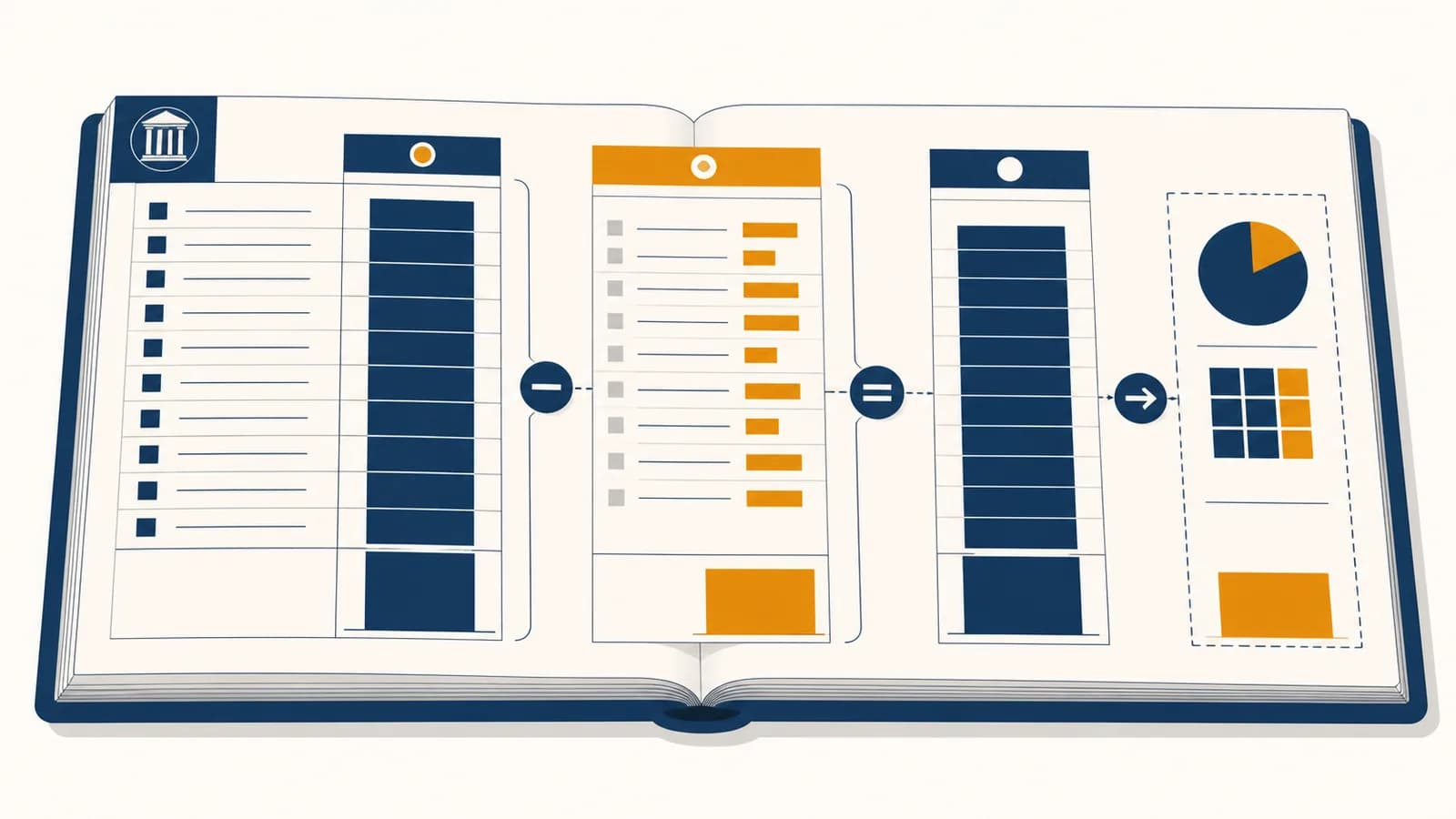
Corporate taxation is a system that taxes the profits and related transactions of legally incorporated businesses, in the context of public finance and economic policy. Also called corporation tax or corporate income tax, it starts with company revenue, subtracts permitted costs and deductions, and applies a corporate tax rate to taxable profit. The idea exists because corporations use public institutions, earn income under legal protection, and provide governments with a practical point at which to collect revenue. The final tax bill depends on the tax base, not simply on sales or cash in the bank.
What corporate taxation actually is
Corporate taxation is the set of rules that determines which company receipts count as taxable income, which expenses may be deducted, when items are recognized, what rate applies, and how the resulting liability is reported and paid to a government.
A corporation is a legal person separate from its owners. It can own property, sign contracts, borrow money, hire workers, and owe tax in its own name. Corporate tax therefore begins with a legal boundary: the corporation has its own accounts and tax return even though human shareholders ultimately own it.
The main target is usually profit, not revenue. Revenue is the money earned from selling goods and services. Profit is what remains after eligible costs are subtracted. If a bakery corporation sells $500,000 of bread but spends $440,000 on ingredients, wages, rent, energy, and other allowed costs, its starting profit is $60,000. Taxing the full $500,000 would ignore what it cost to produce the bread.
Corporate taxation includes more than a single percentage. Rules define the tax year, filing duties, advance payments, treatment of business assets, use of past losses, taxes withheld from cross-border payments, and penalties for inaccurate returns. A headline rate tells only what percentage may apply after all those rules have produced a taxable amount.
Governments use corporate tax to raise revenue and to assign some tax liability directly to businesses. They also use deductions and credits to influence activity, such as investment or research. Those choices have costs: a special deduction narrows the tax base, complicates returns, and may favor companies able to arrange their affairs around it.
How taxable corporate profit works
Taxable corporate profit is calculated by taking taxable business income, subtracting expenses the law allows, then applying required additions, deductions, loss rules, and timing rules. It is a legal calculation built from accounts, not a simple copy of accounting profit.
The process starts with records of invoices, payroll, inventory, loan interest, equipment, and other transactions. Financial accounts organize these records for owners, lenders, and regulators. A tax return then adjusts the accounting result according to tax law.
If taxable revenue is $900,000, allowed deductions are $700,000, and required additions are $20,000, taxable profit is $220,000.
A receipt can be business income even if the customer has not paid by the filing date, depending on the accounting and tax rules used. A cost can be real but non-deductible. A machine can be paid for today but deducted over several years. These timing differences explain why a company can report cash, accounting profit, and taxable profit figures that do not match.
The tax base also answers questions about place and ownership. A country must decide which corporations are resident there, which local activities of foreign corporations it may tax, and how to treat transactions between related companies. The answer can depend on incorporation, management, a fixed place of business, or detailed treaty rules.
A rate without a base is incomplete. A 20 percent rate applied to $1 million of taxable profit raises $200,000. The same rate applied after a $300,000 deduction raises $140,000.
That arithmetic is why arguments over corporate tax often focus on the definition of taxable profit. Two countries can publish the same rate while allowing different deductions, credits, or loss relief. Companies with equal accounting profits can also owe different amounts because their assets, locations, and past losses differ.
Accounting profit versus taxable profit
Accounting profit measures business performance under financial reporting rules, while taxable profit measures the amount subject to tax under legislation. They often begin with the same transactions, but different purposes and timing rules cause temporary or permanent differences between them.
Financial reporting aims to present the company’s performance and position to investors, lenders, and other users. Expenses are matched to activity under accounting standards.
Tax law aims to define and collect a legal liability. Legislatures may deny certain expenses, accelerate deductions, postpone them, or grant credits for selected activity.
Suppose a company earns $300,000 before considering a $50,000 expense. Its accounts recognize the full expense, producing accounting profit of $250,000. Tax law allows only $20,000 of that item this year. The tax return adds back $30,000, producing taxable profit of $280,000. The unused amount might become deductible later, or it might never be deductible, depending on the rule.
A temporary difference reverses over time. Different schedules for depreciating a machine are a common example. Accounts might spread the machine’s cost evenly across its expected useful life, while tax rules allow a larger deduction in early years. Total deductions may eventually be equal, but their timing changes the tax paid each year.
A permanent difference does not reverse. If a fine for breaking the law is recorded as an accounting expense but tax law prohibits its deduction, accounting profit falls and taxable profit does not. The tax system is refusing to make the public share part of that penalty through a deduction.
Investors use both figures for different questions. Accounting profit helps them assess operations. Current tax expense and cash tax paid show different pieces of the tax picture. A low cash payment in one year does not by itself prove avoidance; the company may have paid installments earlier, used an allowed loss, or received a timing deduction. Repeated differences deserve investigation, but the records must be read before a conclusion is drawn.
How corporate tax is calculated and paid
A company calculates corporate tax by completing its tax base, applying the relevant rate or rate bands, subtracting permitted credits and earlier payments, and filing a return. Payment may occur through installments during the year and a final settlement afterward.
The company totals income and expenses for the tax period, checks invoices and payroll, and prepares accounts or a tax computation.
Staff add back prohibited costs, calculate tax depreciation, identify exempt income, and apply any available loss rules.
The applicable corporate tax rate is multiplied by taxable profit. Some systems use one rate, while others vary by company size, income type, or activity.
Eligible tax credits reduce the calculated liability. Advance payments and tax already withheld reduce the amount still due.
The corporation submits its return, pays the balance by the legal deadline, and keeps records in case the authority checks the calculation.
Consider a fictional company, River Tools Ltd. It has $1,200,000 of taxable revenue and $900,000 of allowed deductions. A required addition of $40,000 gives taxable profit of $340,000. Using a hypothetical 25 percent rate makes the tax before credits $85,000. A permitted $10,000 credit reduces liability to $75,000. If $60,000 was already paid in installments, the final balance is $15,000.
River Tools: .
A tax credit and a deduction are not interchangeable. A $10,000 deduction removes $10,000 from taxable profit, so at a 25 percent rate it cuts tax by $2,500. A $10,000 credit normally cuts tax by $10,000, subject to the credit’s own limits. Some credits can produce a refund if they exceed liability; others can only reduce liability to zero or be carried to another period.
Tax authorities can review returns, request records, change assessments, charge interest, and impose penalties where the law permits. Companies may challenge a decision through an objection, tribunal, or court process. Corporate tax is therefore both an arithmetic system and an administrative system supported by evidence and legal procedure.
How deductions, depreciation, losses, and credits change the bill
Deductions reduce taxable profit, depreciation allocates asset costs across tax periods, losses may offset profit under set conditions, and credits reduce calculated tax. Each device changes either the tax base, the timing of tax, or the final liability.
A deduction connects a cost to earning income
A business deduction is an expense tax law permits the company to subtract from income. Wages, materials, rent, and ordinary operating costs are common categories, although exact rules vary. The company usually needs records showing the amount, business purpose, and correct period.
Limits prevent a corporation from turning every payment into a deduction. Personal spending by an owner, hidden distributions to shareholders, some entertainment, fines, and excessive related-party charges may be denied or restricted. The boundary protects the tax base and separates business activity from private consumption.
Depreciation spreads or accelerates investment costs
Tax depreciation is the scheduled deduction of a long-lived asset’s cost. A delivery van helps earn income for several years, so many systems do not treat its entire price like this month’s electricity bill. The law may prescribe asset classes, rates, immediate allowances, or declining deductions.
A manufacturer buys a $100,000 machine. One tax rule allows $20,000 of deductions in each of five years. Another allows $40,000 in year one and the remaining $60,000 later. Both may eventually deduct $100,000, but the second schedule postpones more tax and improves early cash flow.
Earlier deductions are usually more valuable because a dollar kept today can pay wages, reduce debt, or earn a return before tax is due later. This is the time value of money. An accelerated allowance can therefore encourage investment even if the total nominal deduction never exceeds the asset’s cost.
A tax loss can have value without creating current tax
A tax loss arises when allowed deductions exceed taxable income for a period. It usually produces no ordinary corporate income tax for that period. Depending on local law, the loss may offset profit from another year or another company in the same group, often with limits.
A credit acts after the rate calculation
A tax credit is an amount subtracted from calculated tax rather than from profit. Governments use credits for purposes such as research, investment, employment, or tax already paid abroad. Eligibility rules matter because labels in company accounts do not establish a legal claim.
These provisions make the effective burden differ from the headline rate. They can also change behavior. A factory allowance may bring investment forward, while a narrow credit can prompt companies to relabel activity or spend resources proving eligibility. Good policy analysis asks what new activity the rule causes, what activity would have happened anyway, and what revenue the government gives up.
How corporate taxation shows up in business decisions
Corporate taxation affects business decisions by changing after-tax cash flows, the timing of costs, and the relative return on locations, assets, financing methods, and legal structures. Managers compare projects after tax because tax changes what owners can ultimately keep.
A project that earns an attractive return before tax can be weak after tax, and a tax allowance can reverse that comparison. Analysts forecast sales and operating costs, then add depreciation deductions, credits, loss use, and expected tax payments. They discount future cash flows to compare money arriving at different times.
Produces $80,000 before tax and receives no special allowance. At a hypothetical 25 percent rate, its simplified after-tax return is $60,000.
Produces $74,000 before tax and receives a $20,000 tax credit. At the same rate, its simplified after-tax return is $75,500.
The example isolates tax to show the ranking change. Real decisions also include risk, financing, operating life, resale value, and uncertainty about future rules. A credit may arrive only after filing, carry conditions, or be lost if the company lacks enough tax liability.
Financing creates another choice. Interest on genuine business debt may be deductible, while dividends paid to shareholders usually are not. That difference can make debt financing look cheaper after tax. Governments often limit interest deductions to stop companies loading debt into high-tax entities mainly to shrink taxable profit.
Legal form matters too. A sole trader may report business income directly on a personal return, while a corporation reports its own taxable profit. Incorporation can change rates, timing, compliance costs, access to investors, and legal liability. Choosing a form on tax alone ignores ownership needs and business risk.
Tax also appears in prices, wages, and budgets, but no manager controls the whole adjustment. A business facing a new tax cost may try to raise prices, accept a lower profit, reduce other spending, or change investment. Competition, customer demand, contracts, and labor markets determine which responses are possible.
How corporate taxation shows up in global business
International corporate taxation assigns profit among countries when a company earns income, owns assets, or has related businesses across borders. Residence rules, source rules, tax treaties, foreign tax relief, and transfer-pricing rules determine which government may tax which amount.
A corporation can be connected to one country because it is incorporated or managed there and to another because it has a factory, office, customers, or other taxable presence there. If both claim the same profit, double taxation can arise. Domestic law and treaties may respond with an exemption or a credit for foreign tax paid.
Related companies commonly trade with one another. A parent might license software to a subsidiary, lend it money, or sell it components. Transfer pricing is the pricing of those related-party transactions for tax purposes. The usual policy aim is to approximate terms independent businesses would have agreed, though applying that idea to unique technology or services can be difficult.
A component costs a group’s factory $60 to make and is sold to a related distributor for $70. The distributor sells it to a customer for $110 and incurs $20 of local selling costs. The chosen transfer price places $10 of profit at the factory and $20 at the distributor. A different related-party price would move reported profit between them without changing the group’s total $30 profit.
Tax authorities examine such prices because a group may have an incentive to report more profit where tax is lower. Documentation should explain the functions performed, assets used, risks assumed, and comparable market evidence. This work is part economics, part accounting, and part law.
Cross-border production is also shaped by tariffs, labor costs, exchange rates, and market access. The guide to how globalization links firms and national economies provides the wider setting for these location decisions.
International rules continue to change as governments respond to mobile capital, digital activity, and profit shifting. For any live business decision, the current law and applicable treaty must be checked. The stable economic problem remains the same: governments want to tax profit connected to their economies without taxing one amount repeatedly or making ordinary cross-border trade unworkable.
Corporate income tax versus shareholder tax
Corporate income tax is charged to the company on taxable profit, while shareholder tax is charged to owners on dividends, capital gains, or other returns. The two legal liabilities are separate, even though both can arise from the same business earnings.
Suppose a company earns $100 before tax and faces a hypothetical corporate rate of 25 percent. It has $75 left. If it distributes all $75 as a dividend and the shareholder pays a hypothetical 20 percent tax on that dividend, shareholder tax is $15 and the owner keeps $60.
The combined tax is $40, not 45 percent of the original profit. The shareholder rate applies to the $75 dividend remaining after corporate tax, so the calculation is . The effective combined rate in this simplified example is 40 percent.
Some tax systems reduce this double layer by giving shareholders a credit for corporate tax, taxing dividends at a lower rate, exempting certain dividends, or allowing selected businesses to pass income directly to owners. Other systems retain two distinct layers. Capital gains rules can create further timing differences because a shareholder may pay tax only when shares are sold.
Retaining profit inside a corporation postpones a dividend but does not make the economic value disappear. The money can fund equipment, repay debt, acquire another business, or sit as cash. If successful reinvestment raises the share price, a shareholder may later face capital gains tax. Rules often target attempts to turn what is really labor income or a dividend into a more lightly taxed form.
Who actually bears corporate tax?
The legal taxpayer is the corporation, but the economic burden can fall on shareholders through lower returns, workers through lower compensation, or customers through higher prices. The division depends on competition, mobility, bargaining power, and the time allowed for adjustment.
This difference is called the distinction between statutory incidence and economic incidence. Statutory incidence identifies who sends money to the tax authority. Economic incidence asks whose real purchasing power falls after prices, wages, investment, and returns respond.
A neighborhood shop in a competitive market may be unable to raise prices because customers can buy elsewhere. Its owners may then absorb more of a tax increase. A company selling a product with few substitutes may pass more into prices. Over a longer period, lower expected returns can reduce investment, which can affect productivity and wages. No universal split applies to every industry or country.
This question links corporate tax to how income and wealth are distributed. A policy can look progressive because corporations are owned disproportionately by wealthier households, yet part of its eventual burden may reach workers or consumers.
Do not confuse payment with burden. A corporation signs the tax return, but corporations act through contracts and markets. Finding who ends up with less requires evidence about prices, wages, profits, and investment.
Economists study incidence with models and data, and results depend on assumptions about how easily capital crosses borders, how workers respond, and how competitive markets are. A careful claim therefore names the place, industry, period, and tax change being studied.
What happens when a corporation makes a loss?
A corporation with a tax loss generally owes no ordinary income tax on profit for that period, but the loss does not automatically produce cash. Law may allow it to offset profit in another period or group company, often subject to limits.
Imagine a new firm loses $120,000 in year one and earns $200,000 in year two. If the full loss can be carried forward, year two taxable profit becomes $80,000 before other adjustments. At a hypothetical 25 percent rate, the firm pays $20,000 rather than $50,000. Across both years, it has earned a net $80,000, so loss relief moves the tax calculation closer to the firm’s multiyear result.
Restrictions may limit how long a loss survives, how much later profit it can offset, or whether it transfers after a major ownership change. Those rules try to balance fair measurement across time against trading in companies mainly to acquire their unused losses.
A tax loss also differs from a cash loss. A company can have positive cash flow while tax depreciation creates a tax loss. It can have accounting profit but little cash because customers have not paid. Insolvency concerns the ability to meet debts, not the sign of one tax calculation.
4 mistakes people make with corporate taxation
Common errors treat revenue as profit, apply the headline rate to accounting income without adjustments, assume the company alone bears the burden, or read one year’s cash payment as the whole tax story. Each mistake skips a different part of the mechanism.
1. “The tax rate applies to every dollar of sales”
Corporate income tax generally applies to taxable profit, not total sales. A retailer with large sales and nearly equal costs can have a thin profit margin. A separate sales tax, turnover tax, customs duty, or payroll charge may use a different base, but it should not be called corporate income tax.
2. “Accounting profit times the rate equals the final bill”
That shortcut ignores permanent differences, timing rules, past losses, rate bands, credits, foreign tax relief, and prepayments. It can be a rough starting estimate only when the user states the assumptions. A proper calculation reconciles the accounts to the tax return.
3. “Only shareholders can bear the tax”
Shareholders often bear some burden because tax reduces profit available for distribution or reinvestment. They need not bear all of it. Price increases can reach customers, and changes in investment or bargaining can reach workers. Incidence is an empirical question, not a fact settled by the name on a form.
4. “A low cash payment proves wrongdoing”
Cash tax for one year can be low because of lawful loss relief, accelerated depreciation, credits, installment timing, or refunds of earlier overpayments. It can also be low because income was hidden or rules were exploited. The payment alone cannot distinguish those explanations. Investigators need returns, accounts, jurisdictional details, and several periods of evidence.
The takeaway: Trace revenue into taxable profit, identify every adjustment, apply the rate, subtract credits and payments, then ask who bears the cost. Skipping one stage creates most corporate tax misunderstandings.
Another mistake sits behind all four: treating every country’s system as interchangeable. Rates, deductions, filing deadlines, group rules, and enforcement differ. A worked example teaches the structure, but an actual tax return requires the law for the correct place and period.
Corporate taxation turns economic choices into public consequences
Corporate taxation connects production, investment, ownership, public revenue, and income distribution. It shows economics working through legal rules: a change to the tax base alters cash flows, incentives, market responses, and sometimes the location or timing of business activity.
Governments face tradeoffs when setting the rate and base. A broad base with fewer exceptions may raise a given amount at a lower rate and reduce special treatment. Targeted relief can support activity that creates wider benefits, but it can also reward activity that would have happened anyway. Enforcement can protect compliant firms from competitors that hide income, while excessive complexity consumes time and favors businesses that can afford specialized advice.
Corporate tax revenue becomes one input to a government budget alongside personal taxes, consumption taxes, borrowing, and other receipts. The relationship with government borrowing and national debt depends on spending as well as revenue, so a corporate tax cut does not reveal the budget result by itself.
The subject also connects microeconomics and macroeconomics. At the firm level, tax changes the return on a machine or financing plan. Across an economy, those separate responses can alter investment, productivity, prices, wages, and government finances. Measuring those effects requires comparison with what probably would have happened without the policy.
A practical way to read any corporate tax story is to mark five items: the legal taxpayer, the tax base, the rate, the time period, and the claimed bearer of the burden. Then test the arithmetic and look for omitted deductions or credits. This habit works for company reports, election promises, and news about international tax disputes.
For the surrounding ideas and methods, see how this topic fits into the wider study of economics. The next corporate tax number you encounter should become the start of a calculation, not the end of one: ask what amount the rate applies to, why that base was chosen, and whose choices change afterward.