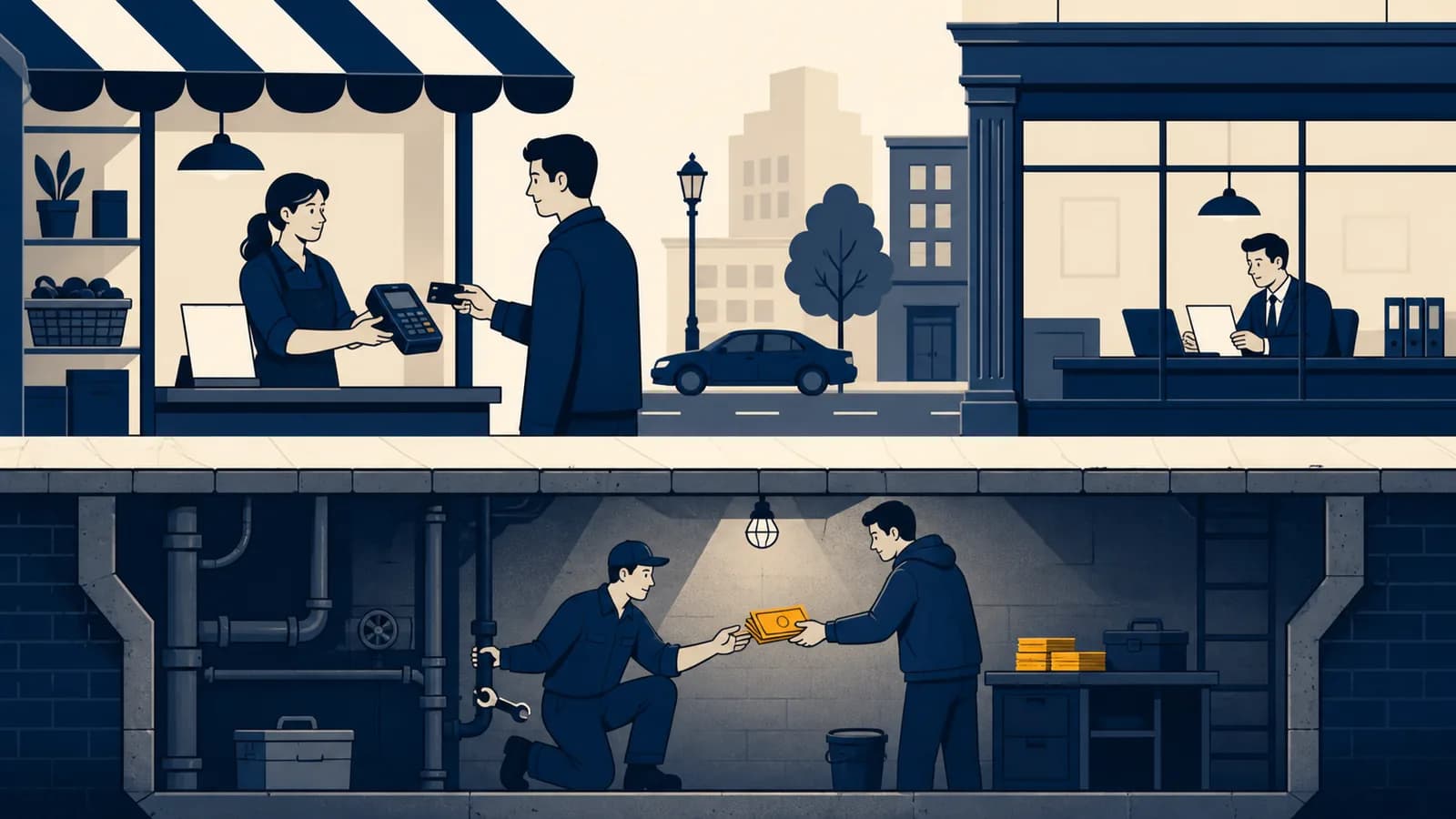
The shadow economy is a category of economic activity that people deliberately hide from public authorities, in the context of production, work, trade, tax, and regulation. Also called the informal, underground, hidden, or unobserved economy, it exists because avoiding tax or rules can benefit participants, while formal compliance costs time and money.
A cash payment is not automatically part of the shadow economy. Paying a gardener in cash and recording the income is formal activity. Paying the same gardener cash on the shared understanding that neither side will report it is hidden activity. The difference lies in concealment, not in the banknote.
The defining test is deliberate concealment. Ask whether an activity that should be reported to a tax office, regulator, benefits agency, or statistical authority has been intentionally kept out of view.
What the shadow economy actually is
The shadow economy is legal or illegal market production concealed from authorities to avoid taxes, labour rules, licensing duties, benefit limits, or other official requirements. It includes hidden sales and wages, but it does not include every unpaid, unrecorded, or criminal act.
Economists usually draw the boundary around productive transactions. A mechanic repairs a car, a landlord supplies a room, a factory makes clothing, or a seller distributes a banned product. Something with economic value is produced and exchanged, even if the transaction is missing from official records.
The category contains very different activities. A registered restaurant may hide part of its cash sales. An unregistered cleaner may work for several households. A licensed employer may pay some wages off the books. An illegal market may sell prohibited goods. These cases share concealment, but their harms, causes, and suitable policy responses are not identical.
Housework done for your own household is productive, but it is normally outside the shadow economy because no market transaction is being hidden. A parent cooking dinner is not secretly selling a meal. Theft is also usually treated separately because it transfers an existing asset rather than producing a good or service, though selling stolen goods creates a market transaction.
How an ordinary transaction moves into the shadows
A transaction enters the shadow economy when a buyer, seller, worker, or employer creates value and intentionally prevents the required record from reaching an authority. Concealment changes the paper trail, the reported price, or the identity attached to the activity.
Consider a painter who quotes a customer 540 currency units with an invoice or 500 in unreported cash. Suppose the invoiced price includes a tax of 40. The hidden deal creates a possible gain of 40 that the parties can divide. The customer saves 40, while the painter receives the same pre-tax amount. The public budget loses 40, and the honest competitor charging the recorded price looks more expensive.
If 40 in tax is avoided, concealment costs 4, and the expected penalty is 6, the expected private saving is 30.
The expected penalty is not the largest possible fine. It combines the chance of detection with the consequence if detected. In a simple example, a 10 percent chance of a 60-unit penalty creates an expected penalty of 6 units: . People may estimate these values badly, but the relation explains why detection probability matters alongside the legal fine.
A sale, wage, rental payment, or business registration should enter an official record.
They compare the money and time saved with the risk of non-payment, discovery, and punishment.
They may omit an invoice, split a payment, use another identity, understate a price, or keep a worker off payroll.
Tax returns, employment files, business registers, and national statistics now describe less activity than actually occurred.
Cash can help concealment because it does not automatically create a bank record, but digital payments can also be hidden through false accounts, unregistered platforms, or misleading descriptions. Technology changes the trail. It does not change the definition.
Shadow economy versus informal economy, black markets, and tax evasion
The shadow economy stresses intentional concealment, the informal economy stresses activity outside full official coverage, black markets trade prohibited or controlled goods, and tax evasion hides a tax liability. The categories overlap, but none is a complete substitute for another.
Informal activity can be visible but unregistered
The informal economy often describes work and firms operating outside full legal or administrative coverage. Informality can result from deliberate concealment, but it can also result from exclusion, weak institutions, or impractical registration systems.
A registered shop records only some sales so that it can understate taxable revenue. The business has access to the formal system and hides part of its activity.
A street vendor works without registration where permits are costly, unavailable, or poorly administered. The work is visible locally even though it is outside formal protection.
Words vary across institutions and research papers. Some writers use shadow, underground, and informal as near synonyms. Others reserve the informal economy for legal goods and services, then discuss illegal production separately. A careful reader checks the definition used before comparing estimates.
The distinction affects policy. A firm hiding profit despite easy access to registration calls for a different response from a worker who cannot obtain identification, open a bank account, or afford a licence. One case may need enforcement. The other may need a simpler path into legal work and enforceable rights.
Black markets and tax evasion cover narrower acts
A black market trades goods or services that are prohibited or tightly controlled, while tax evasion illegally hides a tax liability. Both can sit inside the shadow economy, but the shadow economy also includes legal products sold through deliberately unreported transactions.
An unreported haircut is shadow activity and may involve tax evasion, but haircuts are not prohibited goods. An illegal drug sale belongs to a black market because the product or its sale is banned. A taxpayer who hides overseas investment income commits tax evasion, though that income may be treated differently from hidden domestic production in a particular economic estimate.
| Activity | Is the product legal? | Is the transaction hidden? | Best description |
|---|---|---|---|
| Recorded cash haircut | Yes | No | Formal economy |
| Unreported cash haircut | Yes | Yes | Shadow economy and possible tax evasion |
| Sale of a prohibited drug | No | Yes | Black market and shadow economy |
| False deduction on a tax return | The underlying purchase may be legal | A liability is disguised | Tax evasion, not necessarily hidden production |
Tax avoidance is different again. Avoidance arranges affairs within the law to reduce tax, although lawmakers may later close the route. Evasion breaks the law through concealment or false reporting. The legal boundary can be technical, but the conceptual boundary is clear: lawful planning is not shadow production merely because it lowers a tax bill.
How economists measure activity they cannot directly see
Economists estimate the shadow economy by combining direct evidence, such as confidential surveys and audits, with indirect clues in cash use, labour, electricity, tax records, and national accounts. Every method captures a different slice, so estimates depend strongly on definitions and assumptions.
Direct methods ask or inspect
Anonymous surveys can ask households or firms about off-the-books work. Tax audits can compare reported information with receipts, inventories, bank records, and third-party reports. These methods provide detail about who participates and how, but respondents may hide illegal conduct and audits may focus on suspicious cases rather than a representative sample.
Indirect methods look for a missing piece
A labour comparison can set the number of people who say they are working against the number appearing in registered employment. A national accounts comparison can examine gaps between independently estimated income and spending. A currency approach may treat unexplained demand for cash as a clue, although people hold cash for many lawful reasons.
A survey finds that a person reports working 30 hours during a week, while an employer payroll records 20. The 10-hour difference is a clue, not proof. A second job, reporting error, timing difference, or hidden work could explain it.
Electricity methods start from the idea that production usually uses energy. If measured output grows slowly while electricity consumption grows faster, a model may assign part of the gap to hidden production. The weakness is easy to see: weather, energy efficiency, home working, data centres, and changes in industry can all alter electricity use without any change in concealment.
Official statistical agencies may adjust gross domestic product for activity that standard surveys miss, including some hidden and illegal production. This improves completeness, but an adjustment in national accounts is not the same thing as tax authorities identifying individual offenders. Statistical estimation asks how much production occurred. Enforcement asks who broke a rule and what evidence proves it.
How hidden production changes GDP, tax, and competition
Hidden production can make recorded GDP and taxable income too low, reduce public revenue, and give non-compliant firms a cost advantage. It also distorts productivity and employment data, which makes economic conditions harder for governments, firms, and households to judge.
Gross domestic product aims to measure production within an economy, not simply production reported on tax returns. If a cleaner performs a paid service, value has been produced even if the income is hidden. Statistical agencies try to estimate missing activity, but some remains unmeasured. For a broader view of output, incentives, and public choices, see how the subject's main economic ideas fit together.
Tax loss is not equal to the full value of the hidden transaction. If 1,000 units of sales go unreported and the applicable tax would have been 10 percent of sales, the direct sales-tax gap in this simplified case is 100 units: . Income tax and payroll charges would require separate calculations based on profit and wages, not gross sales.
Competition changes because compliance has a cost. A formal builder may pay for insurance, training, safe equipment, payroll administration, and tax. An unregistered rival can quote less by skipping those costs. The lower price may look like greater efficiency, even when it comes from shifting risks onto workers, customers, and the public.
Do not add every avoided payment together without checking the tax base. Sales, profit, and wages are different quantities. Applying several rates to the same gross sale can exaggerate the revenue gap.
The effect resembles a type of market failure caused by costs shifted onto other people. A firm saves money by ignoring a safety rule, but an injured worker or public hospital may bear the cost. The private price no longer reflects the full social cost of production.
How the shadow economy shows up in work and daily purchases
People meet the shadow economy through off-the-books jobs, cash discounts without receipts, unregistered rentals, undeclared online sales, counterfeit goods, and firms that hide part of their payroll. The warning signs concern missing records and rights, not cash alone.
A café offers a teenager regular shifts but asks them to sign no contract, accepts no record of hours, and pays an envelope of cash below the agreed amount. The missing payroll record helps the employer conceal wages. It also makes the worker's claim harder to prove.
Hidden work can offer immediate income and flexible entry, especially to people blocked from formal jobs. Yet the same arrangement may remove sick pay, insurance, pension contributions, injury protection, proof of earnings, and a reliable way to recover unpaid wages. The worker bears risks that a formal employment system normally spreads or regulates.
Consumers also give up protection. A receipt links a seller to a product, date, price, and promise. Without it, a buyer may struggle to enforce a warranty, prove that a repair happened, or show that an unsafe service caused damage. A cheap price partly reflects missing recourse.
Online trade does not automatically formalize a sale. A platform can create messages and payment records, but a seller can still misstate business income, trade through changing accounts, or present commercial sales as occasional personal disposals. Authorities may compare platform, payment, customs, and tax data, subject to local law.
Some shadow transactions cross borders. Misstated invoices, undeclared imports, or smuggled goods can hide value and bypass customs rules. Those mechanisms connect the topic to how tariffs and border controls change trade incentives, because a larger legal price gap can increase the reward for concealment.
How governments change the incentives
Governments can reduce hidden activity by making legal participation easier, improving detection, matching penalties to harm, protecting workers, and building trust that rules are fair. Enforcement works best when registration and payment systems are realistic enough for people to use.
A government has several control points. It can simplify business registration, reduce unnecessary licence delays, offer clear tax thresholds, require transaction records, inspect high-risk workplaces, protect whistleblowers, and compare reports from buyers, sellers, employers, banks, or platforms where the law permits. Each measure changes either the benefit of hiding or the chance and cost of detection.
Enforcement alone can misfire. If registration takes months, fees exceed a tiny firm's income, or legal status is inaccessible, punishment may remove livelihoods without creating formal jobs. A transition route can include simple registration, basic accounts, staged contributions, and a period to correct records. Serious coercion, trafficking, fraud, and organized crime still require targeted investigation.
Tax rates matter, but they are not the only cause. Complex forms, corruption, weak services, low trust, scarce formal jobs, restrictive permits, and little chance of detection can all influence behaviour. Changes to spending and taxation belong to the tools and trade-offs of fiscal policy, including the feedback between revenue, public services, and willingness to comply.
Digital records can make sales easier to verify and can lower bookkeeping costs. They can also exclude people without accounts, reliable internet, or accepted identification. Good design provides accessible payment choices while focusing scrutiny on inconsistent records and high-risk conduct, rather than treating every cash user as an offender.
Three mistakes people make with the shadow economy
Three common mistakes are treating all cash as suspicious, assuming every unrecorded activity belongs in GDP, and reading an estimate as an exact count. Each error blurs a boundary that economists need in order to explain causes and compare evidence.
1. Treating cash as proof of concealment
Cash is a payment method, not evidence of an offence by itself. People use it for privacy, budgeting, access, habit, or resilience during technical failures. The relevant evidence is a deliberately missing or false record where reporting was required. A cash sale entered in the books is formal.
2. Counting every unpaid task as shadow production
Cooking for your family, helping a friend move, and caring for your own child create value, but they normally have no market transaction to conceal. Economists study unpaid household production because GDP misses much of it. That omission does not automatically place the activity in the shadow economy.
3. Treating a model estimate as a precise observation
A model can turn clues into a useful range or trend, but it cannot make hidden transactions directly visible. Small changes in the definition, data, or assumptions may change the result. Responsible comparison asks what was counted, which method was used, and how uncertainty was reported.
Does the shadow economy ever help people?
Shadow activity can provide income, cheap services, and a route into work when formal institutions exclude people, but those private benefits come with weaker rights, lost revenue, unfair competition, and greater exposure to coercion. Benefit to a participant does not settle the social judgment.
A person without recognized documents may find that informal work is the only available work. A tiny seller may test demand before affording registration. Neighbours may solve urgent needs quickly through local exchange. These are real benefits, and policy that ignores them can punish people whose choices are tightly constrained.
The trade-off changes if a business uses hidden work to avoid safe conditions, or if an employer can threaten a worker who has no documented status. A useful analysis separates survival activity from organized exploitation, then asks who receives the saving and who carries the risk.
Is the shadow economy the same in rich and poor countries?
No. Hidden and informal activity exists at every income level, but its typical forms and causes differ with state capacity, job structure, banking access, tax design, social protection, and trust. The same label can cover a side job or an entire unregistered livelihood.
In a place with widespread formal payrolls, hidden work may appear as undeclared side income or understated business sales. Where many workers lack contracts and firms face difficult registration, informal employment can be the normal entry point to the labour market. Comparing countries without matching definitions can therefore mislead.
Can the shadow economy disappear?
The shadow economy is unlikely to disappear completely because concealment can always offer a private reward, and no monitoring system sees every exchange. Its size and harm can still fall when formal work is accessible, records are credible, and enforcement focuses on serious violations.
Zero hidden activity would require either perfect voluntary compliance or complete observation of economic life. Neither is realistic or desirable at any cost, since surveillance itself can damage privacy and freedom. Policy therefore aims to reduce harmful concealment while keeping compliance proportionate and lawful.
The takeaway: The useful question is not simply how large the shadow economy is. Ask what is hidden, why participants hide it, who gains, who bears the risk, and which change would make formal participation workable.
The shadow economy reveals how incentives meet institutions
The shadow economy shows a central economic fact: rules shape incentives, but people's options shape their response. Prices, taxes, enforcement, trust, and access determine which transactions enter official records and which remain hidden, with consequences for output, fairness, and public decisions.
When you meet an unusually cheap quote, an off-the-books job, or a confident claim about hidden GDP, inspect the mechanism. Identify the good or labour produced. Find the record that should exist. Calculate the private saving, then trace the cost transferred to workers, competitors, consumers, or taxpayers. That habit turns a vague idea about an underground world into ordinary economic analysis.