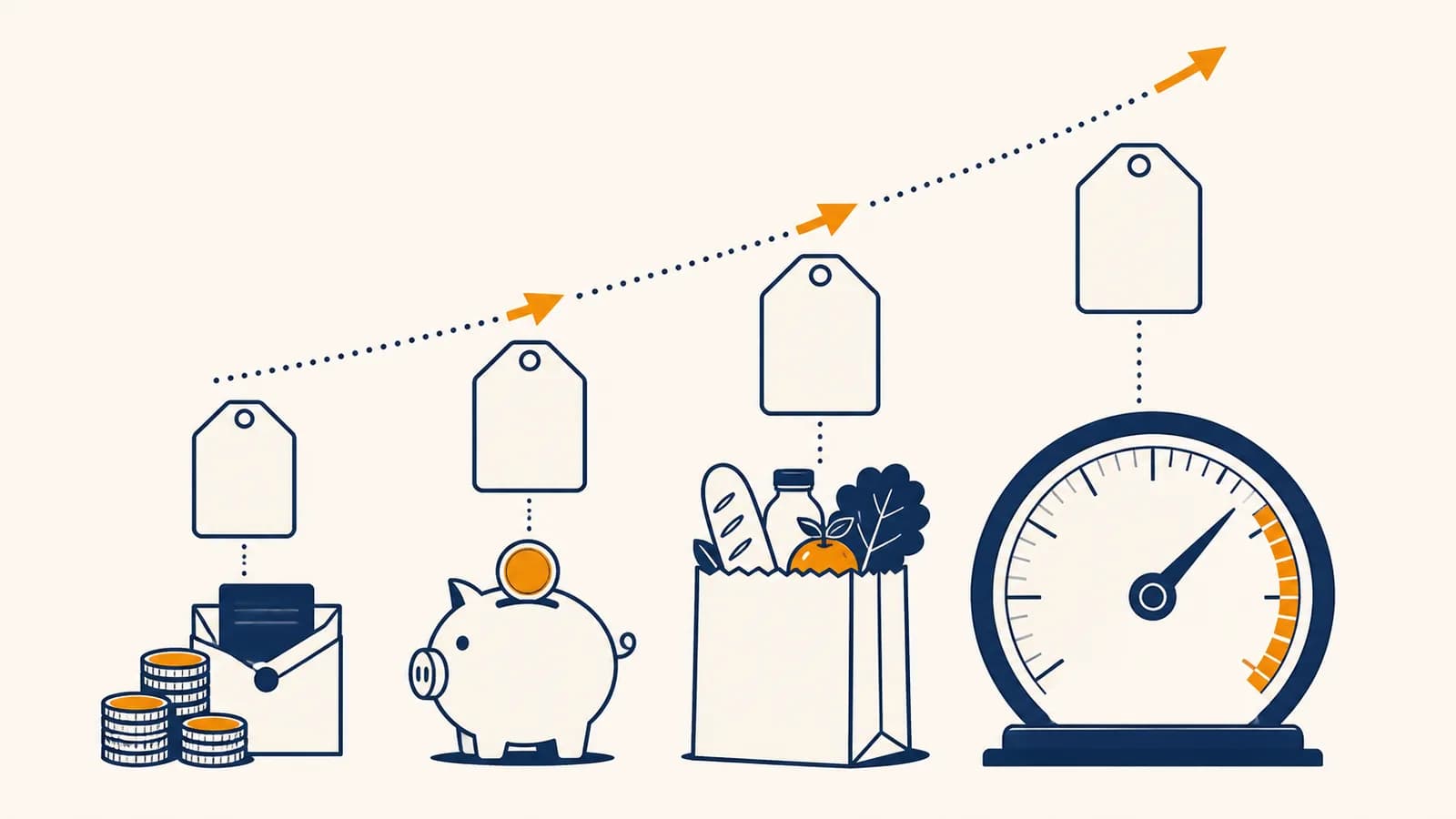
Inflation is a sustained rise in the general price level that reduces what each unit of money can buy, in the context of an economy. The inflation rate measures how quickly that price level changes, while the cost of living describes the money a household needs for its own purchases. Inflation exists as an idea because thousands of prices move at different times and people need one summary measure to compare money across dates. It affects wages, savings, loans, taxes, business plans, government budgets, and daily choices at the supermarket.
What inflation actually is
Inflation is an increase in an economy's overall price level over time, not simply a higher price for one product. It is usually reported as a percentage change in a price index that tracks a defined basket of goods and services.
Suppose coffee becomes expensive after a poor harvest, but laptop prices fall and rents stay level. That is a change in relative prices: coffee has become costly compared with other things. There may be little change in the overall price level. Inflation describes a broader movement across many categories, even though no rule requires every individual price to rise.
A storm destroys part of the orange crop. Orange juice costs more because its supply has fallen. This price change can happen without economy wide inflation.
Food, rent, transport, haircuts, and many other purchases become more expensive on average. A broad price index records inflation.
Inflation also has a time dimension. A price level is like a photograph of prices at one date. The inflation rate compares photographs. If an index rises from 120 to 126 over a year, the price level is higher and the inflation rate is 5 percent. If the index then stays at 126, inflation has stopped, but prices have not returned to 120.
Lower inflation does not mean lower prices. It means the price level is still rising, but more slowly. A fall in the general price level is called deflation.
The loss of purchasing power is the same relationship viewed from the money side. If the same basket rises from $120 to $126, then $120 no longer buys the full basket. Money buys less than before.
How a price index measures inflation
A price index measures inflation by pricing a defined basket at different dates, combining its items according to their importance, and comparing the totals. Statistical agencies build indexes from many observed prices because no single shop, product, or household represents an economy.
Choose the goods and services the index will represent, such as housing, food, transport, medical care, and recreation.
Give more influence to categories that account for more spending. A large rent change should usually matter more than the same percentage change in pencils.
Observe prices for the same or suitably adjusted products and services across locations and dates.
Combine the weighted prices into an index, then compare its value with an earlier period.
The standard percentage change calculation is simple once the index exists.
If an index moves from 200 to 208, the rate is .
The comparison period matters. A monthly rate compares one month with the previous month. A twelve month rate compares a month with the same month one year earlier. The second comparison avoids confusing a normal seasonal change, such as holiday travel prices, with a lasting acceleration.
A small basket shows what weighting does
Imagine a household that buys four bus trips and two lunches each week. Bus trips rise from $2 to $2.50, while lunches stay at $8. The old basket costs $24. The new basket costs $26, so this basket's inflation rate is about 8.3 percent. Averaging the two item rates, 25 percent and zero, would give 12.5 percent and would be wrong because it ignores spending quantities.
| Item | Quantity | Old price | New price | Old cost | New cost |
|---|---|---|---|---|---|
| Bus trip | 4 | $2.00 | $2.50 | $8 | $10 |
| Lunch | 2 | $8.00 | $8.00 | $16 | $16 |
| Total | $24 | $26 |
Real indexes face harder problems. Shoppers substitute toward cheaper products. New products appear. Quality changes, so a higher price may partly pay for a better camera or safer car. Owners receive housing services from homes they own even though they do not pay themselves rent. Different indexes solve these questions differently, which is why two official inflation measures can disagree without either being dishonest.
How inflation starts and spreads
Inflation starts when total spending persistently outruns the economy's ability to supply goods and services, when important production costs jump, or when both forces interact. It spreads as firms reset prices, workers renegotiate pay, and expectations alter present decisions.
Demand can grow faster than output
Households, businesses, governments, and foreign buyers all contribute to demand. If their combined spending rises while factories, workers, energy systems, and transport networks cannot expand output as quickly, sellers face more orders than they can fill at existing prices. Some raise prices. Buyers with the strongest willingness and ability to pay obtain the limited output.
This mechanism does not mean every increase in demand creates the same inflation. An economy with unemployed workers and idle machines can initially produce much more. An economy already near its practical capacity has less room. Supply responsiveness determines how much of extra spending becomes output and how much becomes higher prices.
Supply can contract
A rise in energy, shipping, raw material, or imported input costs can make many products more expensive to supply. A failed harvest can raise food prices. A closed port can delay components. Firms may absorb part of the cost through lower profit, redesign production, or pass it to customers. The outcome depends on contracts, competition, inventories, and how long the disruption lasts.
Flour and gas become more expensive. The bakery first accepts a smaller margin because changing menus has a cost. If the inputs remain expensive, it raises bread prices. Workers then face dearer groceries and seek higher pay. The bakery's wage bill rises, adding a second source of pressure.
One cost shock does not automatically create continuing inflation. It can lift the price level once and then fade from the inflation rate. Continuing inflation requires repeated shocks or a process that keeps generating price and wage increases.
Expectations can carry inflation forward
Expected inflation affects contracts written now. A worker expecting prices to rise asks for a larger wage increase. A landlord sets a higher renewal. A lender demands more interest to protect future purchasing power. If many people act this way, expected inflation can help produce actual inflation.
Expectations are not magic and cannot raise all prices without supporting demand. A firm that raises prices too far can lose customers. A worker's bargaining power may be weak. Expectations matter because they change the terms people accept and the speed at which shocks pass through the economy.
Demand pull inflation versus cost push inflation
Demand pull inflation comes from spending that grows faster than productive capacity, while cost push inflation begins with a reduction in supply or an increase in production costs. Real inflation episodes often contain both, so the distinction identifies forces rather than separate boxes.
Orders are strong across the economy. Firms can sell more, hire more, and raise prices. Output and employment may rise until capacity becomes tight.
Producing the same output becomes harder or dearer. Firms raise prices while output may weaken, creating a difficult mix for policy.
The clues differ. Strong retail demand, crowded order books, rapid hiring, and broad capacity pressure fit a demand explanation. Production interruptions, lost harvests, or sharply dearer essential inputs fit a supply explanation. Neither list proves causation by itself. Economists compare timing, categories, wages, output, employment, and measures of expected inflation.
Government choices can affect demand. Tax cuts or higher public spending can support household and business purchases, especially when financed without an equal reduction elsewhere. The size and timing depend on who receives the money and what resources are idle. The guide to how taxes and public spending shape demand explains that channel in more detail.
International prices matter too. A country that imports fuel, machinery, or food may experience higher domestic costs when foreign prices rise or its currency loses value. Tariffs can also raise the domestic price of covered imports and inputs, though their effect on the overall inflation rate depends on scope and responses. See how border taxes change prices and production for that mechanism.
Inflation versus the cost of living
Inflation is the change in a broad statistical price index, while a person's cost of living is the expense of maintaining that person's particular pattern and standard of life. The two are related, but no national average matches every household.
A renter spends a large share on housing. A homeowner with a fixed loan payment has a different exposure. A commuter who drives far cares more about fuel than someone who walks. A family paying for childcare has a basket unlike that of a retired couple. Their personal price changes can sit above or below the published average.
Those illustrative rates can all occur together because people buy different baskets. They are arithmetic examples, not claims about a particular country or year. A household can estimate its own experience by listing major spending categories, recording comparable prices, and weighting changes by its actual spending.
Quality and substitution complicate the comparison
If a computer costs 5 percent more but works much faster, treating the full price rise as inflation would ignore improved quality. Statistical agencies estimate adjustments, but quality has no perfectly observable price. Substitution creates another gap. When beef becomes expensive, some households buy chicken. A fixed basket captures the beef increase but can overstate what a flexible shopper must pay. A basket updated too quickly can miss part of the loss caused by being pushed away from a preferred product.
These measurement choices do not make inflation meaningless. They define what a measure can answer. A broad consumer index is useful for changes in typical consumer prices. It is not a precise bill for every person, a measure of happiness, or a complete account of living standards.
How inflation changes wages, savings, and debt
Inflation changes economic outcomes by separating money amounts from purchasing power. A wage, savings balance, or loan can rise in dollars while falling in real value, so comparisons across time require an adjustment for the price level.
Nominal pay is not real pay
Nominal means measured in current money. Real means adjusted for prices. If annual pay rises from $40,000 to $41,200, the nominal increase is 3 percent. If prices rise 5 percent over the same period, the worker can buy less than before.
With 3 percent nominal pay growth and 5 percent inflation, real pay growth is approximately negative 2 percent.
The exact calculation divides the change in pay by the change in prices. In this example, . The shortcut is close when rates are modest.
Unexpected inflation redistributes between borrowers and lenders
A fixed rate loan promises future money payments. If inflation turns out higher than both sides expected, those payments buy less. The borrower repays in money with reduced purchasing power, while the lender receives less real value than planned. Lower than expected inflation shifts the surprise in the other direction.
A borrower receives $10,000 and later repays $10,500. The money return is 5 percent. If prices rise 7 percent in that interval, the lender's purchasing power falls despite receiving more dollars. Using the exact adjustment, the real return is .
Variable rate debts can adjust, and new lenders can build expected inflation into interest rates. Savers can hold assets whose values or payments respond differently to inflation. None offers automatic protection in every episode. Cash has a fixed face value, so its real value falls as the price level rises.
Unequal baskets and bargaining power make the burden uneven
Two workers facing the same published inflation can have different outcomes. One may have a contract that adjusts pay with a price index. Another may wait a year for a review. A household holding property and shares has a different balance sheet from one holding cash and owing variable rate debt. Price changes, asset changes, and income adjustments interact.
This is one connection between inflation and how income and wealth are distributed. Inflation does not have a single effect on rich or poor households. The result depends on spending baskets, debts, assets, public benefits, tax rules, and the ability to negotiate higher income.
How central banks respond to inflation
Central banks usually respond to persistent inflation by tightening monetary conditions, often through higher policy interest rates. Higher borrowing costs and stronger incentives to save reduce demand over time, which eases pressure on prices but can also slow output and hiring.
The chain takes time and is not mechanical. Banks choose how much of a rate change to pass on. Some households have fixed borrowing costs. A business will still invest if expected sales make the project worthwhile. Exchange rates, confidence, and asset prices can transmit policy as well.
Higher rates cannot harvest wheat, unload a blocked port, or produce gas. They address the spread and persistence of inflation by limiting demand and keeping expectations anchored. This creates a hard choice after a supply shock: tolerating all secondary inflation risks an enduring process, while suppressing demand too sharply adds unemployment to the original loss of supply.
Policy has a tradeoff. Reducing inflation quickly can require weaker spending and employment. Waiting can allow inflation expectations and contracts to adjust upward, making later action more costly.
Credibility affects that tradeoff. If people believe a central bank will restore stable inflation, they may treat a price shock as temporary and avoid building it fully into long contracts. Credibility comes from understandable objectives and repeated behavior, not a slogan.
How inflation shows up in jobs, shops, and contracts
Inflation appears outside classrooms whenever someone sets a price, agrees to a future payment, compares results across years, or decides how much cash to hold. It changes routine work in retail, finance, government, accounting, labor bargaining, and household planning.
Retailers separate volume from price
A shop's sales revenue can rise even if it sells fewer items. If last year's 1,000 units sold for $10 each, revenue was $10,000. If this year's 950 units sell for $11, revenue is $10,450. The money total rose 4.5 percent, but volume fell 5 percent. Managers need both facts to judge demand.
Accountants compare money from different dates
A project that earned $1 million years ago cannot be compared fairly with a current project using face values alone. Analysts convert amounts into constant prices with a suitable deflator. The same adjustment helps governments distinguish higher tax receipts caused by growth from higher receipts caused by rising nominal incomes and prices.
Contracts decide who bears inflation risk
Rent agreements, pensions, wages, subscriptions, construction contracts, and government benefits may be fixed in money or indexed to a price measure. Full indexing protects one side's purchasing power but transfers the risk to the payer. Delayed or partial indexing shares the risk differently.
A contract must state the index, comparison dates, revision schedule, and treatment of later data corrections. Vague phrases such as “adjusted for inflation” leave room for disagreement because several valid indexes and time windows may exist.
Households notice cash flow before averages
A household meets inflation through renewed rent, a changed grocery bill, a wage review, loan interest, or a larger insurance premium. A useful response starts with cash flow, not panic. Separate essentials from optional spending, identify debts that can reprice, and compare income growth with the household's own main costs.
What core inflation actually is
Core inflation is a measure that removes or downweights selected volatile price categories to reveal more persistent price pressure. It is an analytical signal, not the inflation rate people literally pay, because excluded food or energy purchases still affect household budgets.
Food and energy prices can move sharply because of weather, harvests, conflict, or commodity markets. Removing them in a common core measure can make the underlying direction easier to see. Other measures look at the middle of the price change distribution or downweight extreme movements instead of excluding fixed categories.
Includes the full defined consumer basket. It best describes the average price change measured by that index.
Filters some short lived volatility. It can help estimate persistence, but the filter can also hide a lasting change if an excluded category keeps rising.
Policymakers examine several measures because no filter can identify persistent inflation perfectly in real time. Headline inflation matters for purchasing power. Core measures help with forecasting. Wage growth, service prices, expectations, output, and the distribution of individual price changes provide further evidence.
What deflation and disinflation actually are
Deflation is a sustained fall in the general price level, while disinflation is a decline in the positive inflation rate. Under disinflation prices still rise on average; under deflation the measured price level itself falls.
Take an index at 100. If it rises to 110, inflation is 10 percent. If it then rises to 115.5, inflation has slowed to 5 percent, so disinflation has occurred. If it instead falls from 110 to 108.9, the economy has 1 percent deflation.
Deflation may sound attractive because goods become cheaper, but broad deflation can create problems. The real burden of fixed debts rises. People may delay purchases if they expect further price falls. Falling revenue makes wages and employment harder to maintain, especially because money wages can be difficult to cut. A temporary fall in a narrow set of prices is not enough to establish this process.
Five mistakes people make with inflation
Common inflation mistakes confuse a price with a price level, a slower rate with falling prices, an average basket with a personal budget, money gains with real gains, or a cause with a coincidence. Each error leads to a different bad conclusion.
1. Treating every price increase as inflation
A concert ticket can rise because the performer is more popular, while the overall price level barely changes. Ask how broad the increase is and whether other prices moved in the opposite direction.
2. Thinking lower inflation reverses past increases
If inflation falls from 8 percent to 3 percent, average prices are rising more slowly from an already higher base. Returning to the old price level would require deflation, not just disinflation.
3. Using the national average as every person's experience
A broad index answers a broad question. Personal inflation depends on the household's basket and location. It is reasonable for a person to report costs rising faster than the index, but that experience alone does not disprove the index.
4. Comparing nominal amounts across time
A larger wage, profit, budget, or house price does not necessarily represent a larger real value. Divide by an appropriate price index or compare the nominal growth rate with inflation before claiming an improvement.
5. Assigning inflation to one cause without tracing the chain
Money creation, government spending, wages, profits, imports, and supply shocks can each enter an explanation, but a label is not a mechanism. Trace who spent more, what limited supply, how prices were set, and what allowed the process to continue.
The takeaway: Follow the price level, the rate of change, the basket being measured, and the reason demand or costs moved. Those four checks resolve most arguments that use the word inflation loosely.
Inflation connects prices to the whole economy
Inflation connects individual price decisions with economy wide spending, production, money, and policy. Reading it well means separating levels from rates, nominal values from real values, and a temporary shock from a process that can sustain itself.
The next time an inflation figure appears in the news, identify the index, the comparison period, the largest category movements, and what happened to wages and output. Then ask what mechanism could produce those facts together. That habit turns one headline number into an economic explanation.
Inflation also shows why economics studies relationships rather than isolated numbers. Prices coordinate buyers and sellers, contracts carry expectations into the future, and policy changes spending under real resource limits. The wider set of guides to economic choices and systems places those relationships beside markets, public policy, trade, and distribution.
One further question is behavioral: people often remember visible price increases more readily than stable or falling prices, and they judge losses against familiar past prices. These patterns help explain why perceived inflation can differ from a carefully weighted index. Notice both. Personal experience reveals real pressure, while a defined index makes experiences comparable.