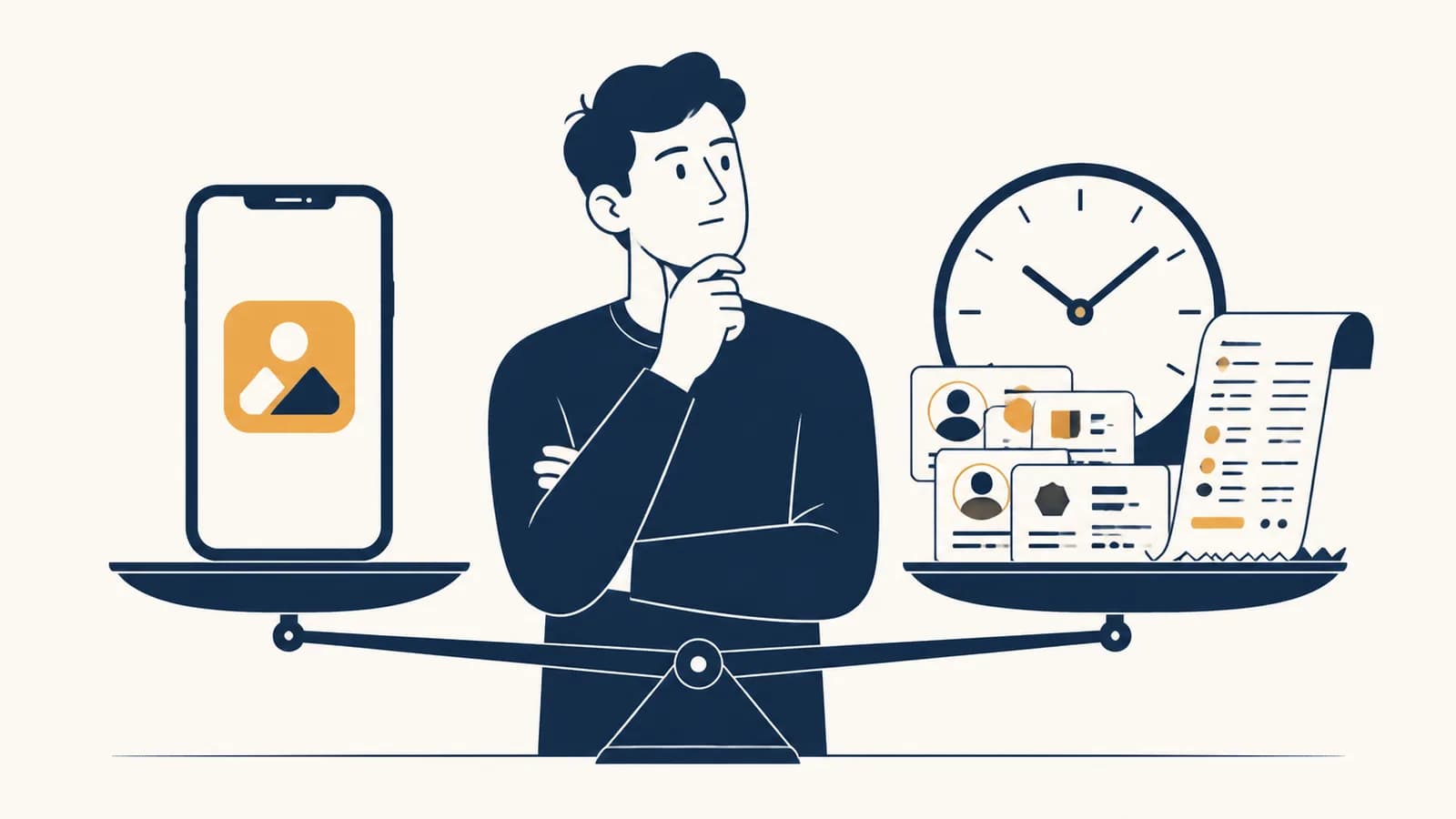
Why can a free product still have a price?
A free digital product can be expensive because its money price is zero while its attention cost is large. The economics of attention explains how apps, platforms and media compete for scarce human focus, and how to calculate what a free service actually costs you.
Price is what a buyer gives up to get something. Money is one form of payment, but it is not the only one. A free video app may require ten minutes of advertising, permission to observe what you click, and enough repeated use to shape a daily habit. Those costs do not appear on a receipt, yet they use resources that cannot be spent twice.
You pay no money. The app supplies videos, messages, search results or games.
You supply time, attention, behavioural data and opportunities to influence a future choice.
This does not mean every free product is a trick. A library website, an open textbook and a family group chat may create far more value than they consume. The useful question is not, “Is free bad?” It is, “Who pays, what do they buy, and what behaviour makes the system profitable?” Those questions reveal the business model.
A zero money price is still a price. It means the seller has chosen to collect value through another part of the transaction.
Economists study choices under scarcity. Once attention is treated as scarce, familiar tools such as incentives, exchange and the interaction of supply and demand become useful. The product may be a feed, but the scarce input is a person willing to look at it.
What makes attention an economic resource?
Attention is an economic resource because it is limited, useful and transferable between competing activities. Giving focused time to one task prevents you from giving the same time to another, so every choice carries an opportunity cost.
A day contains a fixed number of hours. More important, focused attention is narrower than clock time. You can let music play while washing dishes, but you cannot carefully read two different arguments at once. Tasks that require language, memory or judgement compete for the same mental capacity.
If 30 minutes on a feed replaces 30 minutes of paid work worth $12, the immediate opportunity cost is $12.
The formula does not claim that leisure must earn money. Rest, friendship and amusement have real value even when no market prices them. It simply asks for the best alternative you gave up. If the feed replaced a walk you would have valued more, the cost is the lost walk, not a wage.
Scarcity also explains why attention becomes more valuable when information becomes abundant. Printing another digital page is cheap. Reading it still takes a person. When millions of pages, clips and messages can be produced, the bottleneck moves away from content and toward the limited number of eyes and hours available to receive it.
The arithmetic is simple on purpose. In this example, messages take one third of the hour, leaving two thirds. The harder problem is measurement: checking a message can leave part of the mind occupied after the screen closes, so clock time may understate the loss of concentration.
How does a free platform turn attention into money?
An ad-funded platform joins two groups. It gives users a service, gathers opportunities to show them messages, and sells advertisers access to those opportunities. The platform earns more when it can produce valuable ad placements at a cost below what advertisers pay.
This is a two-sided market. Users want useful or entertaining content. Advertisers want a chance to affect what users know, remember or buy. The platform stands between them, setting rules for both sides. A newspaper with advertisements does this too, but software can measure and adjust the exchange much faster.
An advertiser is not buying a guaranteed sale. It is buying a probability: a chance that a suitable person sees a message and later acts. A placement becomes more attractive when the platform can estimate who is likely to care, when they are receptive, and what result followed.
The user’s actions help make those estimates. A pause, replay, search, follow or purchase can become a signal. One signal may say little. Many signals can sort people into useful groups or help a system predict the next action. Studying how computers learn patterns from data makes the selection process less mysterious: the system adjusts predictions from examples rather than reading a person’s mind.
Other free business models exist. A company may offer a limited free tier to attract paying subscribers, subsidise a service with sales elsewhere, accept donations, or provide software that volunteers maintain. Follow the payment. If revenue does not rise with time spent, the provider may have less reason to maximise time spent.
Why do feeds keep producing one more thing to see?
Many feeds remove stopping cues and make the next item almost effortless to reach. Because continued use can create more ad opportunities and more behavioural signals, the product has a measurable incentive to reduce the moments when a user might choose to leave.
A printed chapter ends. A television programme has credits. An infinite feed can request another item before the current one leaves the screen. Autoplay makes continuation the default, notifications bring the product back into mind, and variable rewards make the next item uncertain enough to invite another check.
You open an app to answer one message. A badge points to another update. The feed loads a clip, the next clip starts automatically, and the original task disappears from working memory. No single step forced you to stay. Each step removed a small reason to stop.
Defaults matter because active decisions require effort. If a video stops, continuing requires a choice. If another video starts, leaving requires the choice. That small reversal changes who must act. Repeated across hundreds of sessions, it can change a large amount of time without any single dramatic decision.
Recommendation systems also learn from the behaviour they help cause. Suppose a system predicts that sensational posts will hold attention, shows more of them, and then observes more attention on sensational posts. The new data can strengthen the original prediction. This feedback loop does not prove that the system understands what a user values after reflection. It shows that the system has found behaviour it can repeatedly produce.
The distinction between immediate response and considered welfare matters. A person can want to watch one clip now and also want to sleep well tonight. Both preferences are real, but only the first produces an instant click that a platform can easily observe. What is easiest to measure can become what the system optimises.
How can a small interruption create a larger cost?
An interruption costs more than its duration when it breaks the mental state needed for complex work. The total loss can include the interruption itself, time spent reconstructing context, and errors caused by returning with an incomplete picture of the task.
Imagine writing an essay while checking a notification. The check takes 20 seconds, but the essay depends on remembering a claim, the evidence supporting it and the next sentence. Returning requires rebuilding that structure. The notification’s visible duration is only one part of the cost.
If the interruption takes 20 seconds, recovery takes 100 seconds and correcting an error takes 60 seconds, then seconds.
This worked example is not a universal estimate. Recovery varies with the person and the task. It demonstrates why counting only screen time can miss the mechanism. A routine chore has little context to rebuild; debugging code or following a proof may have much more.
There is also a switching cost before any notification arrives. If you expect an alert, part of your attention may monitor for it. Frequent checking can become a learned response to boredom or difficulty, so the difficult moment in a task starts to trigger escape. The platform then competes not only for spare time but also for the exact moment when sustained thought feels uncomfortable.
Screen time is an incomplete measure. Ten uninterrupted minutes and ten one-minute interruptions use the same clock time but can have very different effects on demanding work.
This is also a biological problem. Attention, sleep and habit involve bodies as well as markets, which is why the wider study of biology and living systems can clarify what an economic model leaves outside its boundary. Economics explains incentives; it does not replace neuroscience.
How do you calculate the true price of a free service?
Calculate the true price by adding direct time, displaced alternatives, recovery after interruptions, unwanted purchases and privacy costs that matter to you. Then compare that total with the value the service creates, using the same period for both sides.
No single number fits everyone. An hour on a language exchange may build a friendship and practise a skill. The same hour on a feed may leave another person rested and amused. Valuation is personal, but arithmetic can still expose a trade that vague feelings hide.
Use one ordinary week. A defined period prevents a memorable bad day from standing in for the whole pattern.
Record intentional sessions, accidental overrun and time spent on advertisements.
Identify what the time actually replaced, such as sleep, study, paid work or another form of leisure.
Include recovery time, avoidable purchases and any privacy exposure you personally treat as a cost.
Count useful information, pleasure, connection, saved money and work completed. A fair account includes both sides.
Suppose a free app takes four hours in a week. You judge two hours as chosen entertainment worth the time. The other two replace tutoring work that pays $18 an hour. You also buy an advertised item for $25 that you would not otherwise have bought.
The two hours of valued entertainment are treated as a benefit, so they are not charged again as lost work.
The $61 result belongs only to this example and these assumptions. Change the displaced activity and the answer changes. Its value lies in making the assumptions visible. Someone can disagree about the value of an hour or the cause of a purchase, then recalculate instead of arguing about the word “addictive.”
When does the attention market fail?
An attention market can fail when the chooser cannot observe the full cost, when harm falls on other people, or when the platform knows far more about the transaction than the user. Private incentives then produce results that buyers and sellers would not knowingly choose.
Hidden cost is one problem. A user sees a free service now but may not see how design choices alter later behaviour. Unequal information is another. A platform can test many versions of a button across a large population, while each user sees only the version on one screen and cannot compare the experiment.
Some costs fall outside the transaction. Misleading content can consume the time of people who never used the original platform. A distracted driver can endanger others. Poor information can damage shared decision-making. Economists call these spillover effects externalities because the person creating the effect does not bear its full cost.
The platform compares the extra revenue from another minute with the extra cost of serving it.
Society also counts lost sleep, disrupted classrooms, fraud exposure and effects on people outside the transaction.
Markets also underprovide some goods when it is hard to exclude non-payers or when one person’s use does not reduce another’s. The economics of shared goods and the free-rider problem helps explain why reliable public information cannot always depend on attention-maximising advertising alone.
Possible responses include clearer controls, limits on certain data uses, subscription options, public funding and product designs with natural stopping points. Each has trade-offs. A subscription can align revenue with user value, but it can exclude people who cannot pay. Regulation may reduce a harm, but a poorly drawn rule can protect established firms by making entry more expensive.
Attention becomes cheaper when you set its terms
You cannot remove every attempt to capture attention, but you can change the terms of exchange. Make valuable uses easy, make unwanted continuation harder, and judge a product by the life it supports after the screen closes.
Start with incentives rather than guilt. If an app profits from repeated checking, expecting willpower to defeat every prompt gives one tired person the harder side of the contest. Change the environment: disable nonessential alerts, remove shortcuts, turn off autoplay where possible, and keep distracting devices away from demanding work.
A student needs a video platform for a chemistry lesson but loses time in recommendations. They open the assigned link on a computer, use full-screen mode, take notes on paper, and close the tab when the lesson ends. The useful content remains, while fewer cues compete for the next click.
Payment can sometimes improve alignment. If customers pay for a tool because it saves time, the maker has a reason to protect time. Yet a paid product can still chase attention, and a free product can respect it. Inspect the revenue model and the design rather than treating the price tag as proof.
Measure outcomes over a defined period. Ask what you intended to do, what happened, and what the activity displaced. Keep services that reliably create more value than they consume. Restrict or remove those that repeatedly win the next minute by stealing from goals you chose more carefully.
The takeaway: Free products are expensive when their hidden attention costs exceed the value they provide. Price the time, identify the displaced alternative, follow the revenue, and redesign the default.
Attention is not sacred because it is rare. It is valuable because every lesson learned, relationship maintained, wage earned and rest taken requires some share of it. A free product earns its place when it helps those purposes. It becomes costly when its business model quietly substitutes its objective for yours.