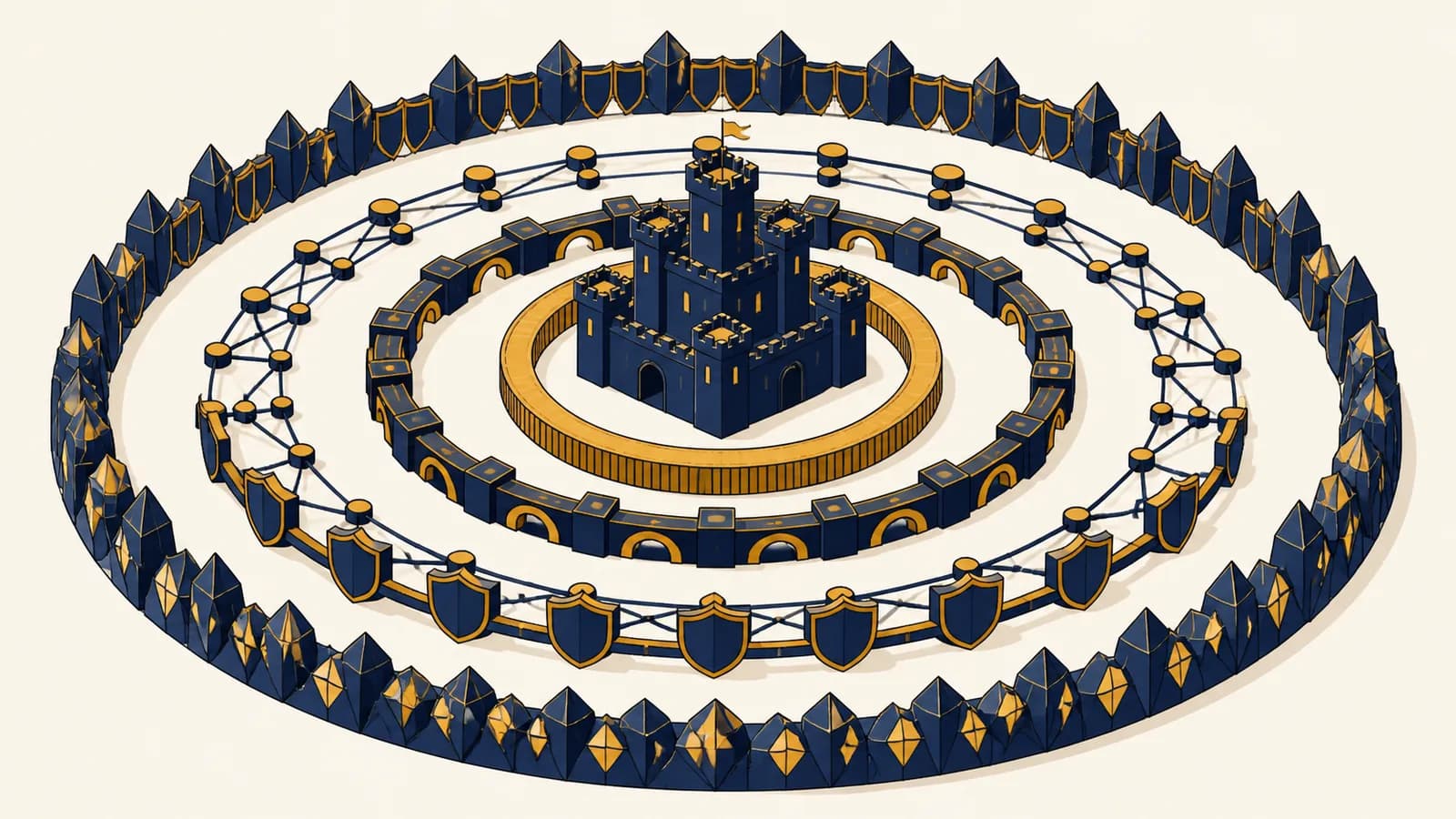
A moat is a mechanism that resists competition
A Warren Buffett moat is a durable competitive advantage that lets a business defend attractive profits from competitors for many years. The word does not mean popularity, fast growth, or a rising share price. It means a customer, cost, network, legal, or physical mechanism that rivals cannot easily copy. By the end, you can use a moat checklist to identify that mechanism, test it against evidence, and separate a strong business from an expensive stock.
Buffett's image is an economic castle protected by a moat. The castle is the stream of cash a business can produce for its owners. Competitors want that cash. If returns are unusually good, they cut prices, copy products, hire staff, open nearby stores, or invent a substitute. A moat is whatever makes those attacks slow, costly, or unattractive.
High profit, fast sales growth, loyal customers, or a famous product. These may be signs of an advantage, but they are outcomes rather than defenses.
The cause that keeps producing good results after rivals notice them and respond. It must survive competition, customer pressure, and sensible mistakes by management.
This distinction explains why Buffett focuses on business economics rather than a stock chart. In Berkshire Hathaway's 2007 shareholder letter, he wrote that the firm sought long-term competitive advantage in a stable industry. He used See's Candies to show why: a trusted product could support higher prices without demanding a matching increase in factories, inventory, or other operating assets. The example links customer preference to cash generation.
Buffett never published one official document called “The Moat Checklist.” The checklist below is a practical synthesis of questions that recur in his shareholder letters: Is the business understandable? Does it have favorable long-term economics? Can it retain customers or keep costs low? How much new capital does growth consume? Can the advantage endure? Is the purchase price sensible?
A moat is causal. “Customers love it” is an observation. “Customers will not risk switching because failure would cost far more than the product” identifies a possible defense.
What makes an advantage durable?
An advantage is durable when the force protecting profits strengthens with use, changes slowly, or costs more to attack than a rival can reasonably expect to earn. Durability belongs to the mechanism, not to the age, size, or fame of the company.
Competition usually follows a simple sequence. An attractive return draws attention. Rivals supply more of the product or offer a substitute. Customers gain choices. Prices and profit margins fall toward ordinary levels. Basic economic reasoning about incentives and scarcity explains why high returns invite the action that tends to erase them.
A real moat interrupts that pipeline. A low-cost producer may stay profitable after everyone cuts prices. A network may become more useful as more participants join it. A brand may reduce the risk a customer feels before buying. A regulated license may block entry. A deeply installed system may make switching painful because data, staff habits, and other software depend on it.
Time is part of the test. A patent expires. A fashionable product can lose attention. A temporary shortage ends when factories increase production. Even a strong current position can be fragile if its defense depends on one contract, one celebrity, or one technical feature that a competitor can reproduce.
Stability also matters because prediction becomes harder when the field changes quickly. Buffett has repeatedly favored businesses whose future economics can be estimated with some confidence. That is not a claim that change is bad. It is a limit on what an investor can know. A brilliant product in a rapidly shifting market may be difficult to value because both the winner and the rules can change.
Which moat mechanisms pass first inspection?
Five mechanisms deserve an initial test: lower structural costs, customer switching costs, network effects, scarce assets or legal rights, and trusted brands. Each can protect cash flow, but only if the business captures part of the value instead of giving all of it away.
A cost advantage must be structural. Scale can spread fixed costs across more units. A dense delivery route can reduce travel per package. A superior process can waste less material. Cheap wages alone are weak protection because another firm can hire in the same labor market, and workers can demand more pay.
Switching costs appear when changing suppliers creates retraining, conversion work, downtime, or failure risk. Business software is a common example. A company may store years of records in one system and connect payroll, reporting, and sales tools to it. Learning how databases and AI systems organize information helps reveal why moving data is only one part of the switching problem.
A network effect exists when each additional participant can make the service more useful to others. A marketplace with more serious buyers attracts sellers; more sellers can attract buyers. Size by itself is not a network effect. A factory does not become more useful to each customer merely because it makes more units. That is usually scale.
Scarcity can come from a license, a unique location, a difficult physical network, or rights to content and resources. Legal protection deserves close reading. A patent with little customer demand protects little value. A license can also carry price controls that prevent the owner from earning exceptional returns.
A brand is a moat only when it changes behavior in an economically useful way. It might support a higher price, reduce the cost of winning a customer, or make selection easier where a bad choice carries risk. Recognition without buying preference is fame, not protection.
Can financial statements reveal the moat?
Financial statements can show the footprint of a moat, not prove its cause. Look for attractive returns on the capital actually required, steady customer economics, cash conversion, and limited reinvestment needs. Then connect each pattern to an observable business mechanism.
Return on invested capital is a useful starting relation. Definitions vary by analyst, so consistency matters more than pretending there is one perfect version. A simple operating form divides after-tax operating profit by the debt and equity capital committed to operations.
If a business earns $18 after tax on $120 of operating capital, its simplified ROIC is .
A high number is a clue. It may come from a moat, but it may also reflect a boom, old assets recorded at low accounting values, risky borrowing, or underinvestment that will later require repair. Compare several years, read the notes, and ask what physical or customer behavior produced the result.
Incremental returns are often more revealing than averages. Suppose a company increases operating capital from $120 to $150 and after-tax operating profit rises from $18 to $24. The extra $30 of capital produced $6 of extra profit, so the incremental return was . That calculation tests what recent expansion earned, rather than mixing new projects with old ones.
Two firms each report $10 of extra annual profit. Firm A needed a new $80 plant to produce it. Firm B needed $15 for software, sales support, and working capital. Before judging either one, ask if the profit will persist. If it will, Firm B has more cash left for owners or further growth.
Buffett's See's Candies example makes this capital test concrete. Berkshire's 2007 letter reported that, between purchase in 1972 and the end of 2007, the operating capital required by See's rose far less than its cumulative pretax earnings. Those figures were presented to show a business that could raise earnings without continually feeding most of them back into physical assets.
Useful supporting checks include gross margin stability, customer retention, inventory needs, receivable collection, and maintenance spending. None should be treated as a magic threshold. A grocer and a software supplier have different normal margins and capital needs. Compare the company with its own history and with businesses that share its economics.
How do you test pricing power without fooling yourself?
Pricing power exists when a business can raise price enough to offset rising costs without causing damaging customer loss. Test it through actual price changes, unit volume, customer retention, product quality, and competitor responses, not through management's claim that the brand is premium.
Begin with a bridge between price and volume. Suppose a product sells 100 units at $10, producing $1,000 of revenue. The company raises the price to $11 and sells 95 units. Revenue becomes . That does not settle the question, because costs, customer mix, and future defections still matter, but it reveals the trade.
Separate a genuine price rise from customers buying larger packages, premium versions, or a different product mix.
Check unit volume, renewals, cancellations, and complaints after the change. A delayed reaction can matter more than the first month.
Ask what competitors charged and offered at the same time. Industry-wide inflation is weaker evidence than a company-specific increase.
Confirm that higher revenue became durable operating profit instead of being consumed by service failures, advertising, or replacement costs.
Pricing power can hide a decline. A newspaper losing readers may raise subscription prices on the loyal remainder, briefly protecting revenue while its audience shrinks. A supplier may impose a rise during a shortage, then give it back when capacity returns. The moat test asks how repeatable the action is under normal conditions.
Customer interviews help if questions focus on behavior. Ask what would trigger a switch, what conversion would involve, who approves the purchase, and what happened the last time prices rose. “Do you like the brand?” produces a soft answer. “What did you do after the renewal price increased?” produces evidence.
What can destroy an apparently strong moat?
A moat can shrink through substitution, regulation, customer concentration, technical change, neglected service, or management that spends the protected profits badly. The threat often attacks the source of the advantage before it appears clearly in reported earnings.
Substitution is broader than direct competition. A railway can lose freight to trucks even if no new railway is built. A paid information service can lose attention to free sources. The right question is not “Who sells the same product?” It is “How else can the customer solve this problem?”
Technical change can reverse switching costs. A new standard may make data portable. A simpler product may remove the training that once trapped customers. Open tools may reduce the cost of reproducing a feature. The habit of finding faults by testing causes one at a time transfers well to moat analysis: isolate the claimed defense, design a way it could fail, and look for evidence.
Do not count management quality twice. Skilled managers can strengthen a moat, but a defense that disappears as soon as one executive leaves may belong to that person rather than to the business.
Regulation can protect and limit at the same time. Permission to operate may exclude new entrants, while rate rules cap the owner's return. Customer concentration creates another trap. A supplier might report excellent margins because one buyer has not renegotiated yet. If that buyer represents the path to most revenue, bargaining power may sit with the customer.
Management can also turn a good business into a poor investment by pouring its cash into weak acquisitions or expansion with low returns. The operating moat may remain intact while owners receive little benefit. Capital allocation therefore belongs beside competitive analysis.
How should price change the decision?
A great business can be a bad purchase if its price assumes more growth and durability than the business can deliver. Value depends on future owner cash, its timing, and its risk. A moat improves the forecast, but it does not remove the need to pay sensibly.
The underlying idea is discounted cash flow. Cash expected far in the future is worth less today because money available now can be used elsewhere, and forecasts can fail. The calculation is sensitive to assumptions, so its best use is to expose what a market price requires rather than to produce a magically exact answer.
At a 10% annual discount rate, $121 received in two years has a present value of .
A wider moat can justify confidence that cash lasts longer, but confidence must be earned. Write down the expected growth, margin, reinvestment, and life of the advantage. Then ask what happens if each is weaker. If a small change destroys the case, the price offers little room for error.
Buffett's discipline joins quality and price. Berkshire's letters repeatedly separate an excellent company from an excellent investment at the price offered. This prevents a common mistake: finding a persuasive business story, then treating any valuation as acceptable because the company is admired.
A moat earns trust through repeated evidence
The strongest moat conclusion is a chain of evidence: a named defense changes customer or competitor behavior, that behavior appears in business results, and the results survive time and pressure. No slogan, ratio, or single successful year can replace that chain.
Use the checklist in order. First, explain how the company makes money in plain language. Second, name the exact defense. Third, describe the rival's best attack. Fourth, find operating and financial evidence that the attack has failed. Fifth, identify erosion signals. Sixth, estimate how much capital future growth requires. Finally, compare a conservative value with the asking price.
The takeaway: A Buffett moat is not excellence in general. It is a specific, durable barrier that protects owner cash from competition, and it counts only when customer behavior, operating facts, financial records, and a sensible purchase price support the same conclusion.
A short written case is better than a long collection of flattering facts. State the mechanism in one sentence, list evidence that could disprove it, and update the case when prices, customers, costs, or competitors change. This turns “great company” from an impression into a claim that can be tested.
The final judgment should admit uncertainty. Some businesses are too young, complex, or changeable to assess with confidence. Passing is a valid result. Buffett's framework gains much of its force from that restraint: an investor does not need an opinion on every company, only sound reasoning about the few that fall within a knowable range.