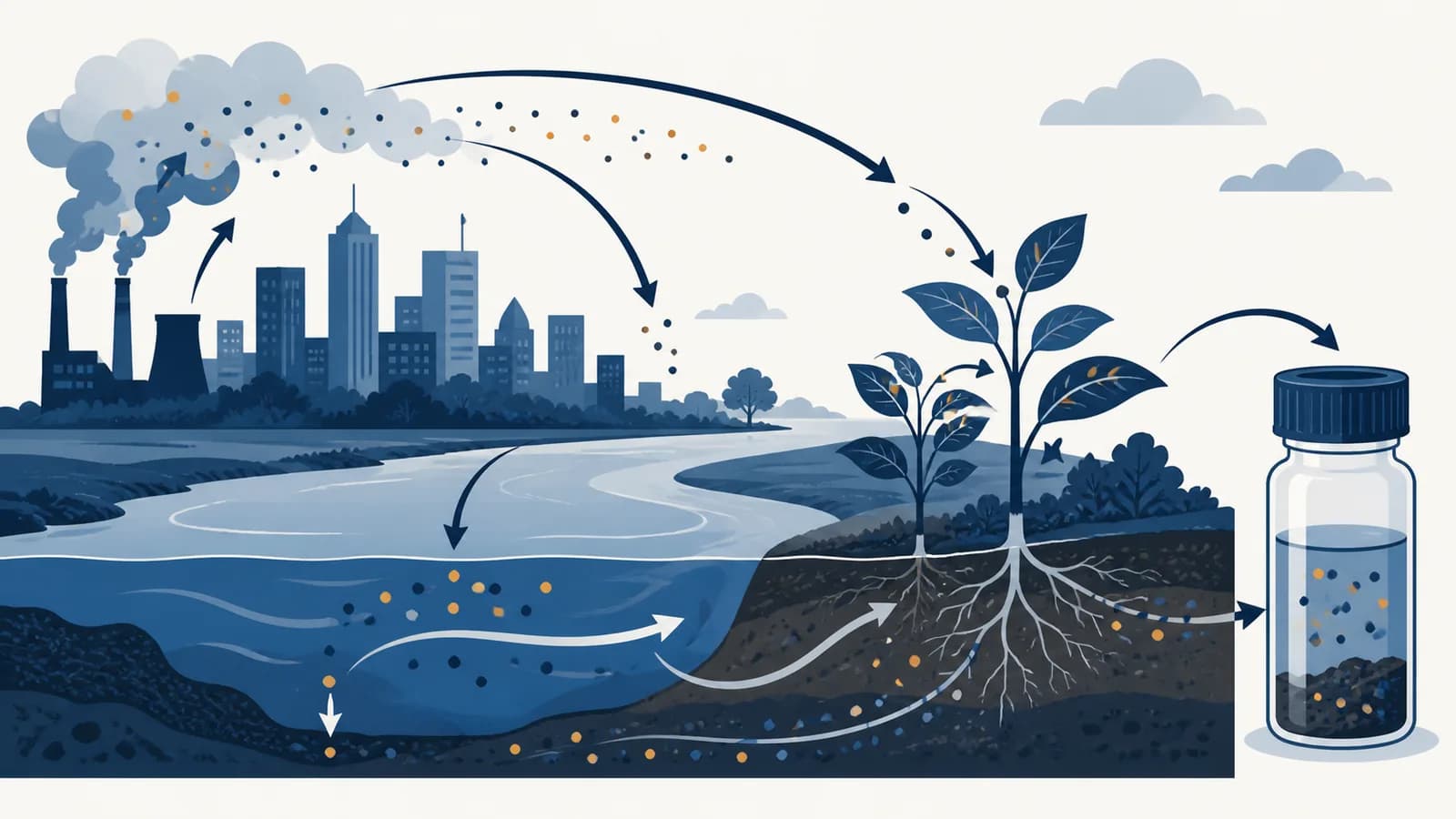
Environmental chemistry is a branch of chemistry that explains the sources, reactions, movement, effects, and removal of chemicals, in the context of air, water, soil, living things, and human environments. It answers practical searches such as “what is environmental chemistry,” “how pollution works,” and “what happens to chemicals in nature.” The field exists because releasing a substance is only the start of its story: sunlight can transform it, water can carry it, minerals can trap it, microbes can consume it, and organisms can concentrate it. Understanding those changes lets people identify hazards, trace pollution, design treatment, and prevent damage.
What environmental chemistry actually is
Environmental chemistry studies a chemical from its source through its transformations, transport, exposure pathways, and final sinks. It combines laboratory measurements with knowledge of natural systems to explain which chemical forms are present, where they go, how long they remain, and what they can affect.
A useful investigation begins with six questions. What substance entered the environment? In what amount? In which chemical form? Through which medium did it travel? What reactions changed it? Which organisms or people encountered it? A complete answer needs all six because the name of a substance alone rarely predicts its behavior.
Consider mercury. Elemental mercury is a volatile liquid, many inorganic mercury salts dissolve to different degrees, and methylmercury is an organic form that accumulates efficiently in food webs. These species contain the same element but have different mobility, exposure routes, and biological effects. Environmental chemists therefore measure speciation, the distribution of an element among chemical forms, rather than reporting only a total concentration when the distinction matters.
Form controls behavior. Oxidation state, charge, molecular shape, and bonding can change a chemical’s solubility, reactivity, and ability to cross a cell membrane.
The field sits inside the wider study of matter, bonding, and chemical change, but its laboratory has open boundaries. Wind crosses a city. Groundwater flows beneath property lines. A river receives substances from rock weathering, farms, sewage plants, roads, and rainfall. The job is to separate these overlapping inputs without pretending that nature is a sealed beaker.
Sources can be natural, human-made, or both
A source is the process or place that releases a chemical. Volcanoes release sulfur compounds, rocks release metals as they weather, and plants emit volatile organic compounds. Vehicles, mines, farms, factories, fires, and wastewater systems also release chemicals. Lead occurs naturally in rock, for example, but mining, smelting, old paint, and industrial dust can create exposure far above a local natural background.
Environmental chemists use patterns to distinguish sources. A mixture of compounds may act like a fingerprint. Ratios among isotopes can sometimes separate lead from different ores or nitrate from different processes. Location and timing add evidence: a concentration that rises downstream of one discharge point or after fertilizer application has a more specific explanation than a single isolated result.
Receptors are what the chemical can reach
A receptor is a person, organism, population, or ecosystem component that can be exposed. A chemical buried in sealed rock presents a different immediate risk from the same chemical dissolved in drinking water. Hazard describes the capacity to cause harm. Risk also depends on dose, exposure route, frequency, duration, and susceptibility.
An inherent ability to cause harm under some conditions, such as corrosiveness, toxicity, or flammability.
The chance and severity of harm under a stated pattern of exposure, including how much reaches a receptor.
This distinction explains why environmental decisions consider both chemical properties and contact. It does not mean that a hazardous substance is harmless at a low exposure, or that every detectable amount creates the same risk. It means that a useful assessment must connect the source to a plausible route and a dose.
How chemicals move through the environment
Chemicals move by flowing with air or water, settling with particles, diffusing from high concentration to low concentration, and transferring between gas, liquid, solid, and biological phases. Their molecular properties and local conditions determine which route dominates and how far transport can continue.
Transport begins with a medium. A gas may be carried by wind. A dissolved ion can follow a river or groundwater. A water-repelling organic molecule may attach to sediment or organic matter and move when particles erode. A metal can ride on airborne dust, settle onto soil, dissolve after acidification, and enter drainage water. The medium can change several times.
Three molecular tendencies help predict the route. Water solubility indicates how readily a substance enters water. Vapor pressure helps describe its tendency to enter the gas phase. Affinity for organic material indicates whether it is likely to partition into soil carbon, sediment, fat, or cell membranes. These tendencies are not fixed travel instructions because temperature, pH, salinity, and the composition of the surrounding material also matter.
Advection carries chemicals with a moving fluid
Advection is transport by the bulk motion of air or water. Dye released into a flowing stream moves mainly because the stream moves. Smoke crosses a region mainly because an air mass moves. The chemical can spread or react during that trip, but the carrying fluid determines the main direction.
Diffusion and dispersion spread a plume
Diffusion is net molecular movement caused by a concentration gradient. Dispersion is spreading caused by variations in flow speed and direction. Groundwater travels faster through some pores than others, so a compact release develops into a broader plume. A sample taken at the plume edge can be much less concentrated than one taken along its centerline.
Sorption can slow movement without destroying a chemical
Sorption is attachment to a solid surface or absorption into solid material. Clay minerals can attract charged species, while soil organic matter tends to retain many nonpolar organic molecules. Retention may delay groundwater transport, but the chemical still exists. Changing pH or ionic conditions can release it later.
A solvent leaks onto soil above an aquifer. Some evaporates from pore spaces, some dissolves into rainwater, and some remains as a separate liquid. The dissolved fraction moves with groundwater, spreads into a plume, and may transform as microbes use it. One spill has become several linked chemical problems.
Hydrology and meteorology are therefore part of the chemical explanation. A compound cannot reach a well without a transport route, and a smokestack emission cannot create a ground-level exposure without atmospheric mixing, reaction, and movement. Mapping flow is often as important as identifying the molecule.
How chemical fate works
Chemical fate is the set of physical, chemical, and biological processes that change a substance or place it in a long-term reservoir. The main pathways are photolysis, hydrolysis, oxidation and reduction, biodegradation, volatilization, precipitation, sorption, and burial.
State its charge, oxidation state, molecular form, and phase because each can alter the available reactions.
Measure or estimate pH, oxygen, light, water, temperature, minerals, organic matter, and microbial activity.
Ask which reactions are thermodynamically possible, which are fast enough, and which phase transfers can occur.
Determine whether treatment destroys the original molecule, changes its form, or only moves it somewhere else.
Sunlight can break bonds directly through photolysis or create reactive intermediates that attack other molecules. Water can split susceptible bonds through hydrolysis. Oxygen and other electron acceptors support oxidation, while oxygen-poor sediments favor reducing conditions. Microbes accelerate many reactions by using chemicals as food, electron donors, or electron acceptors.
Learning how acids, bases, buffers, and pH behave is especially useful here. pH changes protonation, and protonation changes charge. A charged form may dissolve readily in water while a neutral form crosses membranes or volatilizes more easily. pH can also determine whether a metal stays dissolved, binds to a mineral, or precipitates as a solid.
Transformation can reduce or increase harm
A transformation product is a new substance, not a vanished pollutant. Complete mineralization of an organic compound converts its carbon into simple inorganic products such as carbon dioxide under aerobic conditions. Partial transformation produces intermediate molecules. Those products may be less persistent or less toxic, but that outcome must be measured rather than assumed.
Disinfection illustrates the tradeoff. An oxidant can damage microbial cells and make water safer from pathogens. The same oxidant may also react with naturally occurring organic matter and halide ions, forming unwanted byproducts. Treatment design controls dose, contact time, precursor removal, and later polishing so that one hazard is not exchanged carelessly for another.
Mass balance reveals what really happened
A mass balance accounts for chemical inputs, outputs, accumulation, and reaction. If a treatment tank receives 100 grams of a contaminant and its water outlet carries 10 grams, removal from water is 90 percent. That result does not prove destruction. The missing 90 grams might be in sludge, in exhaust gas, or in reaction products.
For an inlet of 40 mg/L and an outlet of 6 mg/L, removal is .
The formula compares concentrations only when the relevant flow conditions are compatible. If inlet and outlet flow rates differ, the chemist compares mass per time by multiplying concentration by flow. Rain dilution can lower a measured concentration while the total contaminant load remains large.
Pollution versus contamination
Contamination means a substance is present where it is unwanted or above a chosen background, while pollution usually means that its presence causes or is likely to cause harmful effects. The terms overlap, but detection alone does not establish source, exposure, or damage.
Modern instruments can detect very small quantities. A reported detection answers “was the instrument’s signal consistent with this analyte above its reporting rule?” It does not automatically answer “is the site dangerous?” Interpreting the result requires units, sampling quality, chemical form, uncertainty, comparison values, and a realistic exposure pathway.
Describes an amount per amount of air, water, soil, tissue, or another sampled material.
Combines the result with background, toxicity, exposure, legal standards, ecological evidence, and uncertainty.
Natural does not mean harmless, and synthetic does not mean harmful. Arsenic can enter groundwater from natural minerals. A designed polymer can be stable and safe in its intended use but problematic if fragments persist in habitats. Origin matters for tracing and control, while molecular form, dose, route, and persistence matter for effects.
How environmental chemistry shows up in air
Air chemistry links emissions to the substances people and ecosystems finally encounter. Gases and particles disperse, react with sunlight and atmospheric oxidants, enter cloud droplets, and deposit on land or water. Some harmful air pollutants are emitted directly, while others form after release.
Primary pollutants leave a source in the form being considered. Carbon monoxide from incomplete combustion and soot particles are examples. Secondary pollutants form in the atmosphere. Ground-level ozone forms through a sunlight-driven network involving nitrogen oxides and volatile organic compounds. It is not emitted as a simple stream of ozone by a vehicle exhaust pipe.
Ozone chemistry shows why reducing one precursor does not always produce a proportional local response. The reaction network depends on sunlight, radical chemistry, the mixture of volatile compounds, nitrogen oxide levels, and transport. Air-quality models combine chemical equations with weather because a windy afternoon and a stagnant sunny afternoon process the same emissions differently.
Particles are mixtures, not one chemical
Airborne particles can contain sulfate, nitrate, ammonium, mineral dust, sea salt, elemental carbon, organic compounds, metals, and water. Their size affects how long they remain suspended and where they deposit in the respiratory tract. Their composition helps investigators infer sources and predict reactions.
Cloud and fog droplets act as tiny reaction vessels. Gases dissolve, ions react, and water later evaporates, leaving altered particles. Deposition then returns gases and particles to surfaces. Rainout and washout can clean the air while transferring acidity, nitrogen, metals, or organic substances into soil and water.
How environmental chemistry shows up in water and soil
Water and soil chemistry determine which substances dissolve, which particles carry them, which reactions occur, and which treatments can remove them. pH, oxygen, minerals, organic matter, and microbes shape chemical behavior across lakes, pipes, aquifers, treatment tanks, farm fields, and contaminated land.
Water is an effective solvent for ions and polar molecules, but “in the water” does not always mean truly dissolved. A sample may contain dissolved molecules, colloids too small to settle quickly, suspended particles, droplets, and living cells. Filtering a sample changes what is measured, so reports must state the operational definition used.
The principles of dissolving, concentration, and saturation explain many field observations. Groundwater passing through limestone gains calcium and bicarbonate. Water reaching saturation with a mineral may deposit scale. Acidification can dissolve certain mineral phases and release associated metals.
Dissolved oxygen records a balance of supply and demand
Dissolved oxygen is molecular oxygen present in water. It enters from the atmosphere and photosynthesis, then leaves through respiration, chemical oxidation, and exchange with air. Warm water generally holds less dissolved gas than cold water under otherwise comparable conditions.
Waste rich in biodegradable organic matter can increase microbial respiration. Microbes consume oxygen while oxidizing that material. If oxygen demand exceeds resupply, oxygen-sensitive organisms lose habitat and reducing chemistry develops in water or sediment. The original organic matter may be nontoxic, yet its decomposition can still cause harm through oxygen loss.
Nitrogen and phosphorus support rapid algal growth. When much of that biomass dies, microbes decompose it and consume oxygen. Poor mixing can isolate deep water from the atmosphere, so oxygen falls there first. The chain is nutrient input, biological production, decay, then oxygen depletion.
Nutrient chemistry is not simply “fertilizer equals algae.” Growth depends on which nutrient limits production, the nutrient’s chemical form, light, grazing, mixing, residence time, and temperature. Phosphate can bind to iron minerals under oxygen-rich conditions and be released when sediment becomes reducing, creating internal recycling even after outside inputs decline.
Drinking-water treatment uses a sequence of chemical jobs
Coagulation destabilizes small particles so they can collide and form larger flocs. Settling and filtration remove those solids. Adsorbents capture selected dissolved chemicals on high-area surfaces. Ion exchange swaps unwanted ions for others. Membranes separate species by size, charge, and pressure-driven transport. Disinfection inactivates disease-causing organisms.
No unit process removes every substance equally. A filter that captures suspended clay may do little to a dissolved solvent. Activated carbon can retain many organic compounds but has finite capacity. Reverse osmosis rejects many dissolved species but creates a concentrated waste stream. Treatment is a designed chain based on the source water and the required outcome.
Soil stores chemicals and can release them again
Soil chemistry controls storage, release, and transformation at the boundary among air, water, rock, and life. Mineral surfaces, organic matter, pore water, gases, roots, and microbes create small zones with different pH and oxygen conditions, so neighboring grains can host different reactions.
Soil is not an inert sponge. Clay minerals often carry surface charge and exchange ions with pore water. Organic matter provides binding sites and fuel for microbes. Iron and manganese minerals can adsorb metals and phosphate, then dissolve under reducing conditions. Carbonate minerals can neutralize added acid until their buffering capacity is used.
Mobility changes with chemical form
A positively charged metal ion may bind to negatively charged surfaces. If pH falls, hydrogen ions compete for those sites and the metal may become more mobile. In other cases, higher pH encourages precipitation as a hydroxide or carbonate. The answer depends on the element, oxidation state, ligands, and minerals present.
Organic contaminants follow different rules. Many nonpolar molecules prefer soil organic matter over water, which slows their movement. Some are then degraded by microbes; others remain because the bonds are difficult to break or because strong sorption makes them unavailable to cells. Digging and aerating soil can stimulate one pathway while spreading dust or volatile material through another.
Remediation can remove contaminated soil, isolate it under a cap, wash particles, immobilize metals, heat volatile compounds, or support biological degradation. Each method changes a different part of the source, pathway, and receptor chain. Immobilization reduces mobility but leaves mass on site, so future land use and monitoring still matter.
How measurements turn samples into evidence
Environmental measurement is a chain of sampling, preservation, preparation, instrumental analysis, calibration, quality control, and interpretation. A precise instrument cannot rescue an unrepresentative sample, and a numerical result is meaningful only when its units, detection limits, uncertainty, and sampling context are clear.
A river concentration changes across the channel, with depth, after rain, and over a day. Soil can vary over centimeters. Air changes with wind and traffic. A sampling plan therefore defines where, when, how often, and from what depth material will be collected. Composite samples can estimate an average, while grab samples can reveal short events.
Calibration connects signal to concentration
An instrument often measures a signal such as absorbance, ion current, fluorescence, or electrical conductivity. Analysts prepare standards with known concentrations and use them to relate signal to amount. Blanks reveal contamination from containers or reagents. Replicates reveal variability. Spiked samples test whether the matrix suppresses recovery.
To make 100 mL of a 5 mg/L standard from a 50 mg/L stock, use , then dilute to 100 mL.
That calculation is simple, but small handling errors can propagate through a dataset. Clean containers, correct preservation, traceable labels, chain-of-custody records, and documented methods make the result defensible. Field blanks can reveal contamination during transport, while equipment blanks can reveal residue from sampling tools.
Concentration, load, and dose answer different questions
Concentration is an amount divided by a volume or mass. Load is the total amount transported during a period. Dose is an amount that reaches an organism, often normalized to body mass and time. Confusing them can produce a poor decision.
Suppose a stream carries 2 milligrams per liter at 100 liters per second. Multiplication gives 200 milligrams per second, before any unit conversion for a daily load. A second stream at 1 milligram per liter but 1,000 liters per second carries five times the mass per second. Its concentration is lower, yet its load is larger.
The mole relationships in mole ratios and chemical quantities let analysts compare reactions on a particle basis. Mass alone can mislead when substances have different molar masses or react in different ratios. Treatment dose calculations, oxygen demand estimates, and reaction yields all depend on balanced chemical equations.
Four mistakes people make with environmental chemicals
Four recurring mistakes are treating detection as proof of danger, assuming dilution destroys matter, confusing removal with destruction, and describing every chemical with one permanent property. Each mistake breaks a link between measured concentration, chemical mechanism, transport, and actual exposure.
1. Detection means danger
A detection establishes presence under a stated analytical method. It does not by itself establish a harmful dose. A proper interpretation checks the result against blanks, uncertainty, background, relevant standards, exposure duration, chemical form, and route of contact. Dismissing every small detection is also an error because persistent inputs can accumulate or signal a failed barrier.
2. Dilution makes a chemical disappear
Dilution lowers concentration by mixing a fixed amount into a larger volume. It does not destroy mass. Ten milligrams mixed uniformly into one liter gives 10 milligrams per liter. The same ten milligrams in ten liters gives 1 milligram per liter, but the system still contains ten milligrams unless reaction, capture, or export changes the total.
3. Removal means destruction
A scrubber can transfer a gas into liquid. Activated carbon can transfer dissolved molecules onto a solid. Wastewater treatment can transfer metals into sludge. Each process removes a substance from one stream while creating another material that must be handled. Destruction requires chemical transformation and evidence about the products.
4. A chemical has one fixed environmental behavior
Properties are conditional. Ammonia exists in equilibrium with ammonium, and their proportions depend strongly on pH. Metals change oxidation state and ligands. Organic acids gain or lose protons. Temperature alters reaction rates and phase transfer. Environmental descriptions should therefore state the conditions behind words such as soluble, volatile, mobile, or persistent.
Read the units before comparing results. A value per liter cannot be compared directly with a value per kilogram, and a total concentration may not match a dissolved concentration.
Good questions repair these mistakes. What exactly was measured? In which medium and chemical form? At what location and time? What was the reporting limit? Which pathway connects that result to an organism? What reaction or transfer explains the change? These questions turn a dramatic number into testable evidence.
How does toxicity depend on dose and exposure?
Toxicity describes harmful effects a substance can cause, while exposure describes contact and dose describes how much reaches a target over time. Environmental health assessment connects all three by identifying the route, frequency, duration, chemical form, affected organ or organism, and relevant response.
Inhalation, ingestion, and skin contact are different routes. A compound that is poorly absorbed through skin may be readily absorbed through lungs. A swallowed chemical may be transformed by stomach conditions, gut microbes, or the liver. Children, developing embryos, older adults, and people with particular health conditions can respond differently to the same external concentration.
Acute exposure occurs over a short period, while chronic exposure continues or repeats over a longer period. The labels do not determine severity. A brief high exposure can cause immediate injury, and repeated lower exposure can allow accumulation or slowly damage a biological process. Toxicologists use dose-response evidence, metabolism studies, epidemiology, and uncertainty factors to develop protective values.
Ecotoxicity adds population and ecosystem questions. A chemical can affect reproduction, growth, behavior, or food supply without causing immediate death. Mixtures complicate interpretation because chemicals may act independently, add their effects, or interact. Field evidence must also separate chemical stress from habitat loss, temperature, disease, and other pressures.
How long does pollution last?
Persistence is the length of time a chemical remains before transformation or permanent removal under specified conditions. It is not one universal number: light, temperature, oxygen, moisture, microbes, pH, and the surrounding material can make the same substance disappear quickly in one setting and slowly in another.
For many processes, scientists describe a half-life, the time required for an amount or concentration to fall by half under a stated model. If 80 grams declines with a half-life of 10 days, 40 grams remains after 10 days, 20 after 20 days, and 10 after 30 days. The arithmetic assumes the same first-order behavior continues.
With mg/L and days, after 30 days mg/L.
Environmental curves may depart from this ideal. A rapidly available fraction may degrade first, leaving material trapped inside pores or strongly bound to solids. New inputs may replace what disappears. A transformation product may persist after the parent compound falls below detection. Field estimates should state which material, compartment, and model they describe.
Bioaccumulation occurs when an organism takes in a substance faster than it eliminates or transforms it. Biomagnification is an increase in concentration across trophic levels of a food web. Persistent, bioavailable substances that are poorly eliminated are the clearest candidates, but accumulation is not an automatic property of every persistent chemical.
How can chemistry prevent environmental damage?
Chemistry prevents damage by changing products and processes before release, selecting less hazardous reagents, reducing waste, recovering materials, controlling emissions, treating unavoidable residues, and monitoring barriers. Prevention starts with a mass balance and a clear account of the function the chemical must perform.
Substitution works only when the replacement is evaluated across its use and disposal. A solvent with lower toxicity may require more energy, react to form harmful products, or persist after release. A biodegradable material may break down only under industrial composting conditions. The functional comparison must include realistic conditions rather than a favorable property in isolation.
Process controls include closed transfer systems, leak detection, corrosion control, careful storage, and recovery loops. Product design can reduce the amount used or make separation easier. Treatment sits later in the sequence because it usually consumes materials and energy and produces a residual stream.
Environmental chemists work in water utilities, analytical laboratories, consulting firms, manufacturing plants, public health agencies, universities, waste facilities, forensic laboratories, and regulatory bodies. One person may design sampling, another run instruments, another model groundwater, and another translate results into permit limits or cleanup decisions. Their shared task is to connect molecular evidence to an action.
The takeaway: Follow the substance. Name its form, account for its mass, map its route, identify its reactions, and connect the resulting concentration to a real exposure. That sequence turns a vague pollution claim into chemistry that can be tested and used.
Environmental chemistry makes ordinary chemical change visible
Environmental chemistry shows that bonding, equilibrium, kinetics, oxidation, solubility, and molecular structure continue outside the laboratory. The surroundings are less controlled, but the same chemical rules apply. Careful observation reveals which rule is dominating at a particular place and time.
Notice the next stain below a metal pipe, warning on a household cleaner, air-quality alert, cloudy stream after rain, or mineral crust on a tap. Ask what substance is present, which phase carries it, what reaction could change it, and where its mass goes next. Those questions connect visible evidence to invisible particles and make environmental claims testable.