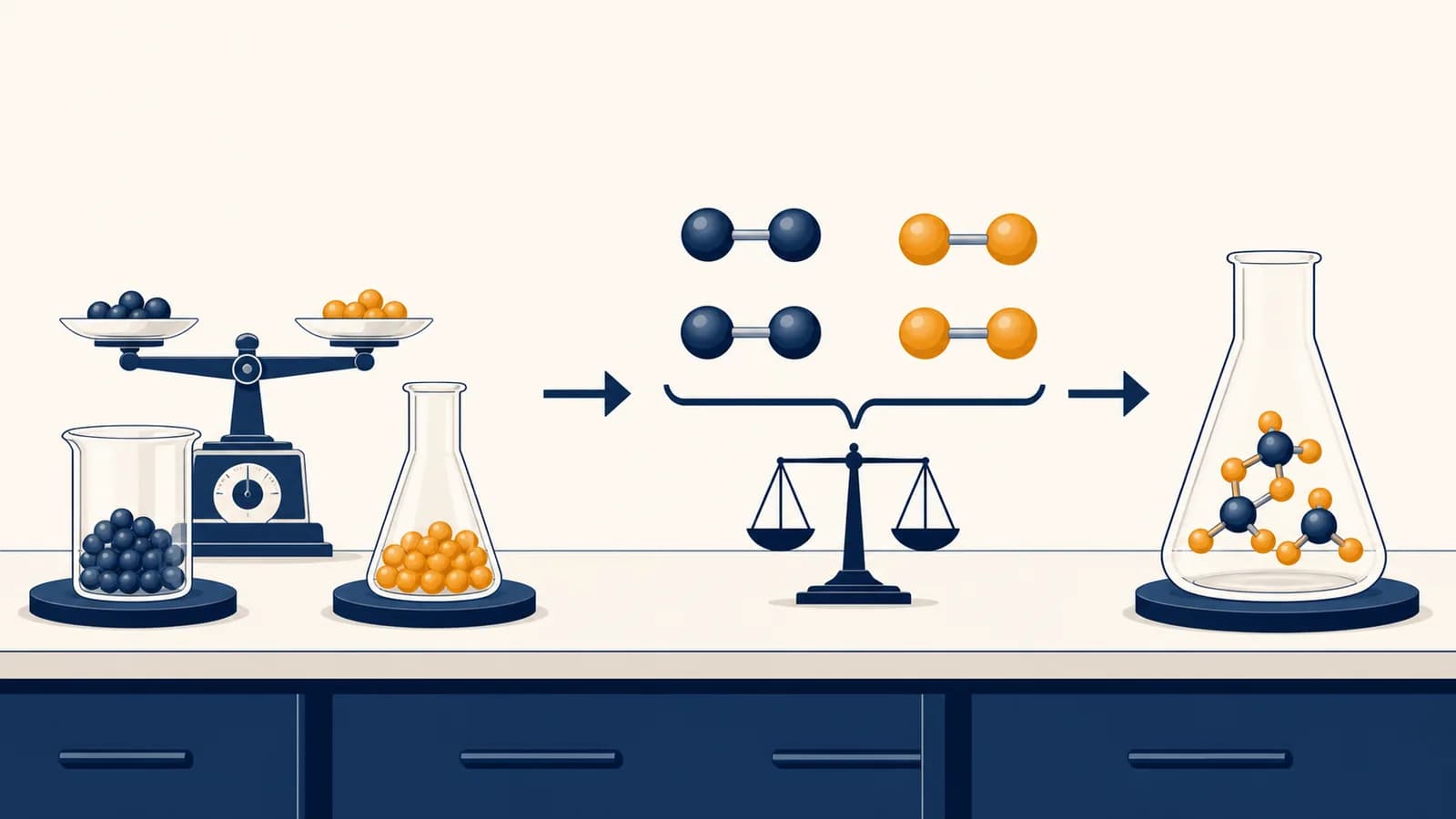
Stoichiometry is a quantitative method that uses balanced chemical equations to calculate the amounts of reactants consumed and products formed, in the context of chemical reactions. In plain terms, stoichiometry calculations connect grams, moles, particles, gas volumes, and solution concentrations. The method exists because atoms are conserved: a reaction rearranges them in fixed numerical ratios rather than creating or destroying them. A chemist can therefore use a measured amount of one substance to predict how much of another substance is needed or produced.
The central idea is simple, but it has several layers. A correct calculation needs a valid chemical formula, a balanced equation, a conversion into moles, and a conversion into the unit the situation requires. Each layer answers a different question. Together, they turn a symbolic equation into a plan for mixing chemicals, checking a product, or controlling waste.
What stoichiometry actually is
Stoichiometry is the accounting system for matter in a chemical reaction. It reads the coefficients in a balanced equation as ratios, then uses those ratios to relate a known quantity of one substance to an unknown quantity of another.
Consider the formation of water:
Two moles of hydrogen react with one mole of oxygen to form two moles of water.
The equation states a ratio of . It can describe two molecules of hydrogen reacting with one molecule of oxygen, or two dozen hydrogen molecules reacting with one dozen oxygen molecules. In laboratory work, it usually describes two moles of hydrogen reacting with one mole of oxygen. The scale changes, but the ratio does not.
Stoichiometry does not say how fast the reaction will occur, what mechanism it follows, or whether it needs a catalyst. It states the quantitative relationship among substances if the reaction occurs as written. Questions about electron sharing and the forces holding atoms together belong to how chemical bonds form and break; stoichiometry starts with the resulting formulas and counts them.
Balanced coefficients are conversion factors. In the water equation, and are both valid ratios. Choose the orientation that cancels the unit you already have.
This counting method is part of the broader study of Chemistry because composition, reactions, energy, and measurement all depend on keeping track of matter. Stoichiometry is where those ideas become numerical and testable.
How balanced equations become counting rules
A balanced chemical equation becomes a counting rule when each coefficient is treated as a relative number of particles or moles. Balancing makes the number of atoms of every element equal on both sides, which preserves matter during the calculation.
Take the combustion of propane:
One mole of propane requires five moles of oxygen and can produce three moles of carbon dioxide plus four moles of water.
Count the atoms to check it. The left side has three carbon atoms, eight hydrogen atoms, and ten oxygen atoms. The right side has three carbon atoms in , eight hydrogen atoms in , and ten oxygen atoms across both products. No atom has disappeared.
The coefficients create several usable mole ratios. One mole of propane corresponds to five moles of oxygen. One mole of propane corresponds to three moles of carbon dioxide. Five moles of oxygen correspond to four moles of water. All come from the same equation, but a calculation normally needs only the ratio connecting its given substance to its requested substance.
The first node matters. Balancing cannot repair a wrong formula. Carbon dioxide is , so changing it to would describe a different species, not a clever way to balance oxygen. Write correct formulas first, then adjust coefficients placed in front of entire formulas.
How the mole connects particles to measurable mass
The mole connects microscopic particles to laboratory quantities by defining a fixed count of entities. One mole contains exactly specified entities, and molar mass gives the measurable mass of one mole of a particular substance in grams.
The number is exact in the International System of Units definition of the mole. The entities can be atoms, molecules, ions, electrons, or formula units, but they must be named. A mole of oxygen atoms and a mole of oxygen molecules contain the same number of entities, yet the oxygen molecules contain twice as many oxygen atoms.
Molar mass comes from adding atomic masses according to the formula. Using standard periodic table values, water has two hydrogen atoms and one oxygen atom per molecule:
Rounded suitably, one mole of water has a mass of about .
This creates a bridge between a balance and an equation. Mass converts to moles through , where is amount in moles, is mass, and is molar mass. Moles convert back to mass through . The chemical equation governs the middle of the calculation because its coefficients compare moles, not grams.
How a stoichiometric calculation works
A stoichiometric calculation follows one dependable route: balance the equation, convert the known amount to moles, apply the coefficient ratio, and convert the result into the requested unit. Units expose errors by showing what cancels and what remains.
Use correct chemical formulas, then change coefficients until each element has the same atom count on both sides.
For a mass, divide by molar mass. For a solution, multiply concentration by volume in litres. Use the relationship suited to the given measurement.
Multiply by a ratio made from the balanced coefficients. Put the known substance on the bottom so its mole unit cancels.
Change product moles into grams, particles, gas volume, or concentration. Check units, scale, significant figures, and physical meaning.
Here is the full route for heating calcium carbonate, the main compound in pure limestone:
One mole of calcium carbonate can form one mole of calcium oxide and one mole of carbon dioxide.
Suppose of pure calcium carbonate decomposes completely. Its molar mass is approximately , so the starting amount is:
The coefficients are all one, so of calcium carbonate gives a theoretical of calcium oxide. Calcium oxide has a molar mass of about :
The same starting amount can theoretically form of carbon dioxide. Multiplying by its approximate molar mass, , gives of carbon dioxide. The product masses add to , matching the reactant mass within rounding. That mass check supports the arithmetic.
A kiln operator needs to estimate how much quicklime, , a limestone feed can produce and how much carbon dioxide the decomposition releases. The balanced equation supplies the theoretical ratio; measured purity and actual yield then make the estimate realistic.
A chain of conversion factors can put the whole calculation on one line. This technique is often called dimensional analysis. It is more than tidy notation: if grams of the starting substance fail to cancel, the setup cannot end in grams of product.
Coefficients versus subscripts
Coefficients count whole chemical entities, while subscripts define the composition of each entity. Changing a coefficient changes quantity without changing identity. Changing a subscript changes the substance itself, so only coefficients may be adjusted when balancing an equation.
This means two water molecules or two moles of water. Altogether they contain four hydrogen atoms and two oxygen atoms.
This means hydrogen peroxide. One molecule contains two hydrogen atoms and two oxygen atoms, and its chemical behavior differs from water.
Suppose hydrogen and oxygen form water. Writing leaves two oxygen atoms on the left but one on the right. Placing a 2 before water gives , which fixes oxygen but produces four hydrogen atoms on the right. Placing a 2 before hydrogen completes the balance: .
Multiplying every coefficient by the same number creates an equivalent ratio. is balanced, but convention uses the smallest whole number coefficients, . Fractions may help during balancing, especially in combustion equations, but the final equation is usually scaled to whole numbers.
Never balance by editing a subscript. Turning into does not add oxygen to water. It replaces water with hydrogen peroxide.
Parentheses and polyatomic ions require the same care. In , the outside subscript applies to the entire nitrate group, so one formula unit contains one calcium atom, two nitrogen atoms, and six oxygen atoms. Accurate atom counting must come before any mole ratio.
Limiting reagent versus excess reagent
The limiting reagent is the reactant consumed first and therefore sets the maximum product amount. An excess reagent is supplied beyond the required ratio, so some remains after the limiting reagent is used up. The smaller starting mass need not be limiting.
Return to . Suppose a system contains of hydrogen and of oxygen. The equation requires two moles of hydrogen for each mole of oxygen. Reacting all of oxygen needs of hydrogen. Since is available, oxygen is limiting and hydrogen is in excess.
The product must be calculated from the limiting reagent:
The reaction can form at most of water under the stated assumptions.
The reaction consumes of the available of hydrogen, leaving unreacted. Calculating product from all the hydrogen would predict of water, but there is not enough oxygen to make it.
A reliable test calculates how much product each reactant could make independently. The reactant predicting less product is limiting. Comparing masses directly fails because different substances have different molar masses and coefficient requirements.
Manufacturing processes often use one reactant in planned excess. Extra oxygen can help a fuel burn more completely, for example. The choice is practical, but the unused material may need recovery, separation, treatment, or safe release. Stoichiometry shows the ideal consumption before engineers account for those operating details.
How yield and purity change the ideal answer
Theoretical yield is the maximum product predicted by stoichiometry, while actual yield is the amount recovered. Percent yield compares them. Purity corrects the starting amount because a sample may contain material that does not participate in the target reaction.
The relationship for yield is:
If a reaction should make but is isolated, the percent yield is .
Actual yield can be lower because a reaction stops before completion, a competing reaction forms something else, product remains dissolved during separation, or material is lost during transfer and purification. Stoichiometry provides the ideal ceiling. Experimental technique and chemical behavior determine how closely the process approaches it.
Purity belongs at the beginning of the calculation. If of a mineral sample is calcium carbonate by mass, then only is calcium carbonate:
Using the full as though it were pure would overstate every predicted product amount. After correcting the reactant mass, the balanced equation gives theoretical yield. An actual production figure can then be compared with that result.
Adjusts how much reactive substance was present before the reaction. Multiply sample mass by the mass fraction of the desired component.
Compares product recovered after the reaction with the theoretical product. Do not use percent yield as though it were reactant purity.
A calculated yield above is a warning sign, not proof that matter was created. The recovered solid may still contain solvent, water, salts, or another impurity. The balance may be miscalibrated, or the assumed product formula may be wrong. Measurement methods from chemical analysis and quantitative testing help identify which explanation fits.
How stoichiometry shows up in laboratories and production
Stoichiometry shows up wherever people must choose chemical quantities, predict outputs, or account for material after a reaction. Laboratory preparation, industrial feed control, medicine manufacturing, combustion, water treatment, and emissions calculations all use the same mole relationships.
A laboratory recipe starts with the desired product
A laboratory synthesis works backward from a target amount to the reactants required. If a chemist wants a certain number of moles of product, the balanced equation gives the needed moles of each reactant. Molar mass or solution concentration turns those amounts into masses and volumes that instruments can measure.
The planned quantities may differ slightly from the exact ratio. A cheap reactant can be used in modest excess to drive consumption of an expensive one. Purity, solution strength, expected yield, and safe handling all modify the practical recipe, but each modification begins with the stoichiometric requirement.
A technician must prepare silver chloride by mixing solutions containing silver ions and chloride ions. The net ionic equation, , gives a one to one mole ratio. Concentrations and volumes reveal which ion limits the precipitate and how much solid can form.
After isolation, the product mass provides evidence. A result far below theoretical yield can point to incomplete precipitation or loss during filtration. A result above it suggests wet or contaminated solid. The number does not diagnose the cause alone, but it tells the technician where to investigate.
A production line treats coefficients as material balances
Industrial reactors handle continuous flows or large batches, but the coefficients do not change with scale. For ammonia synthesis, , the inlet materials are compared on a mole basis. Three moles of hydrogen are consumed for each mole of nitrogen that reacts, while two moles of ammonia are formed.
Real plants also account for incomplete conversion, recycled gases, impurities, energy use, and reactions that produce unwanted compounds. These are additional terms in the material balance, not replacements for stoichiometry. Engineers must know the ideal ratios before they can measure departures from them.
Combustion links fuel use to exhaust composition
A balanced combustion equation relates fuel to oxygen demand and carbon dioxide formation. For complete methane combustion, . Each mole of methane consumed corresponds to two moles of oxygen and one mole of carbon dioxide.
Air supplies oxygen along with nitrogen and smaller amounts of other gases, so a real burner handles more gas than the oxygen term alone suggests. Too little oxygen can allow carbon monoxide or soot to form. Excess air can reduce incomplete combustion but carries additional gas through the equipment. Measurement and reaction models refine the simple equation.
Daily products still obey mole ratios
Baking, battery charging, pool treatment, antacid neutralization, and rust removal all involve chemical quantities. A home user rarely calculates moles, because manufacturers turn the chemistry into directions, doses, and concentration labels. Those instructions still rest on controlled amounts and known reactions.
More chemical is not automatically more effective. Once the target substance is consumed, extra reactant can remain unused or cause damage. This is why labels specify both concentration and amount, and why mixing household cleaners is unsafe. Stoichiometry can predict quantities for a known reaction, but it does not make an unknown mixture safe.
How gas stoichiometry works
Gas stoichiometry converts between moles and volume by accounting for temperature and pressure. At the same temperature and pressure, ideal gas volumes follow the balanced coefficient ratio directly, because equal gas volumes contain equal numbers of molecules under matching conditions.
For , one volume of nitrogen reacts with three volumes of hydrogen to form two volumes of ammonia gas if all gas volumes are compared at the same temperature and pressure and ideal behavior is a suitable approximation. Thus of nitrogen would require of hydrogen under matching conditions.
Gas volume has conditions attached. A mole of gas does not occupy one universal volume. Heating a flexible gas sample expands it, and raising pressure compresses it, so temperature and pressure must accompany any molar volume.
When conditions differ or a direct volume ratio is not enough, the ideal gas law connects pressure, volume, amount, and absolute temperature:
Solve for to enter the mole ratio, then use the final gas conditions to calculate a product volume.
Units must match the chosen value of the gas constant , and temperature must be in kelvins. Real gases can depart from ideal behavior, especially at high pressure or near condensation. In an introductory problem, the stated model determines whether the coefficient volume ratio or is appropriate.
Gas calculations are common in combustion, air pollution measurement, breathing systems, fermentation, and reactions that release gas. They require the same balanced equation as mass problems, with an additional physical relationship connecting moles to volume.
How solution stoichiometry works
Solution stoichiometry finds reacting moles from concentration and volume, then applies the balanced equation. Molar concentration is moles of solute per litre of solution, so multiplying molarity by volume in litres gives the amount of dissolved solute.
A solution with a volume of contains of solute.
Suppose of hydrochloric acid is neutralized by sodium hydroxide:
First convert to . The acid amount is . The equation gives a one to one ratio, so neutralization needs of sodium hydroxide. If the sodium hydroxide is also , its required volume is , or .
A one to one shortcut would fail for sulfuric acid and sodium hydroxide:
One mole of sulfuric acid corresponds to two moles of sodium hydroxide in this complete neutralization equation. Concentration and volume alone do not supply that factor; the balanced equation does. The broader behavior of mixtures is covered through concentration, dissolving, and solution behavior.
A measured solution is added until it has reacted with the analyte in a known ratio. The delivered volume and known concentration give moles of titrant. The balanced equation converts those moles into the amount of analyte that was originally present.
Titration does not depend on acid and base reactions alone. Redox reactions, precipitation, and metal complex formation can also provide known stoichiometric relationships. The reaction must be sufficiently complete and selective, and the endpoint measurement must correspond closely to the required reacting amount.
5 mistakes people make with stoichiometry
Most stoichiometry errors come from using an unbalanced equation, comparing masses as though they were moles, choosing the wrong mole ratio, ignoring a limiting reagent, or reporting an answer with missing units and unrealistic precision. Each error can be caught systematically.
1. Using coefficients from an unbalanced equation
An unbalanced equation does not conserve atoms, so its ratios cannot describe the reaction. Balance before inserting any numbers. Then recount each element independently, including elements inside parentheses and compounds with coefficients greater than one.
A quick atom table can help with complex equations. List each element, count it on the reactant side, and count it on the product side. The two counts must match before the equation becomes a quantitative tool.
2. Applying the mole ratio directly to grams
Coefficients compare particles or moles, not masses. In , two grams of hydrogen do not react with one gram of oxygen. The substances have different molar masses, so grams must be converted to moles first.
Using approximate molar masses, of hydrogen corresponds to , while of oxygen corresponds to . Those masses reflect the coefficient ratio in mole form.
3. Flipping the conversion factor
The useful mole ratio must cancel the known substance. If the calculation starts with moles of oxygen and seeks moles of water, oxygen belongs in the denominator and water in the numerator. Writing units beside every number makes the orientation visible.
For the water equation, leaves moles of water. Reversing the fraction leaves oxygen units uncancelled or produces a numerical factor with the wrong meaning.
4. Calculating product from the reactant in excess
Only the limiting reagent determines maximum product. If two reactant amounts are supplied, test both unless the problem explicitly identifies the limiting one. Calculate the product possible from each; the smaller product prediction governs the reaction.
After finding the limiting reagent, use it consistently for theoretical yield. The excess amount matters when calculating how much reactant remains, but it cannot force more product to form after the limiting material is gone.
5. Letting the calculator hide an impossible answer
A long decimal is not evidence of accuracy. Report units, use significant figures suited to the given measurements, and perform a scale check. A product that contains all the reactant's atoms cannot require those atoms to appear from nowhere.
Mass conservation is a useful check in a closed system, but compare all reactants with all products. A solid can lose mass when a gas escapes from the measured container, even though total mass is conserved. Likewise, a solid can gain mass by reacting with a gas from the surroundings.
The takeaway: Balance first, move through moles, let units cancel, and use the limiting reagent. Then ask whether the size and physical meaning of the answer fit the reaction.
Stoichiometry makes chemical equations testable
Stoichiometry makes a chemical equation testable by turning its coefficients into predicted amounts. A measured mass, concentration, or gas volume can be compared with that prediction, revealing incomplete reaction, material loss, contamination, or an incorrect model.
This is the numerical thread connecting formulas to experiments. A formula states what a substance contains. A balanced equation states how substances relate during a reaction. Stoichiometry states how much should be consumed or formed. Measurement then shows what actually happened.
The next time you see a reaction equation, do more than check whether it balances. Choose one coefficient ratio and say it in words. Convert one available measurement into moles, predict one product amount, and check the units. That small habit turns symbols on a page into a claim that a laboratory, factory, or ordinary observation can confirm.