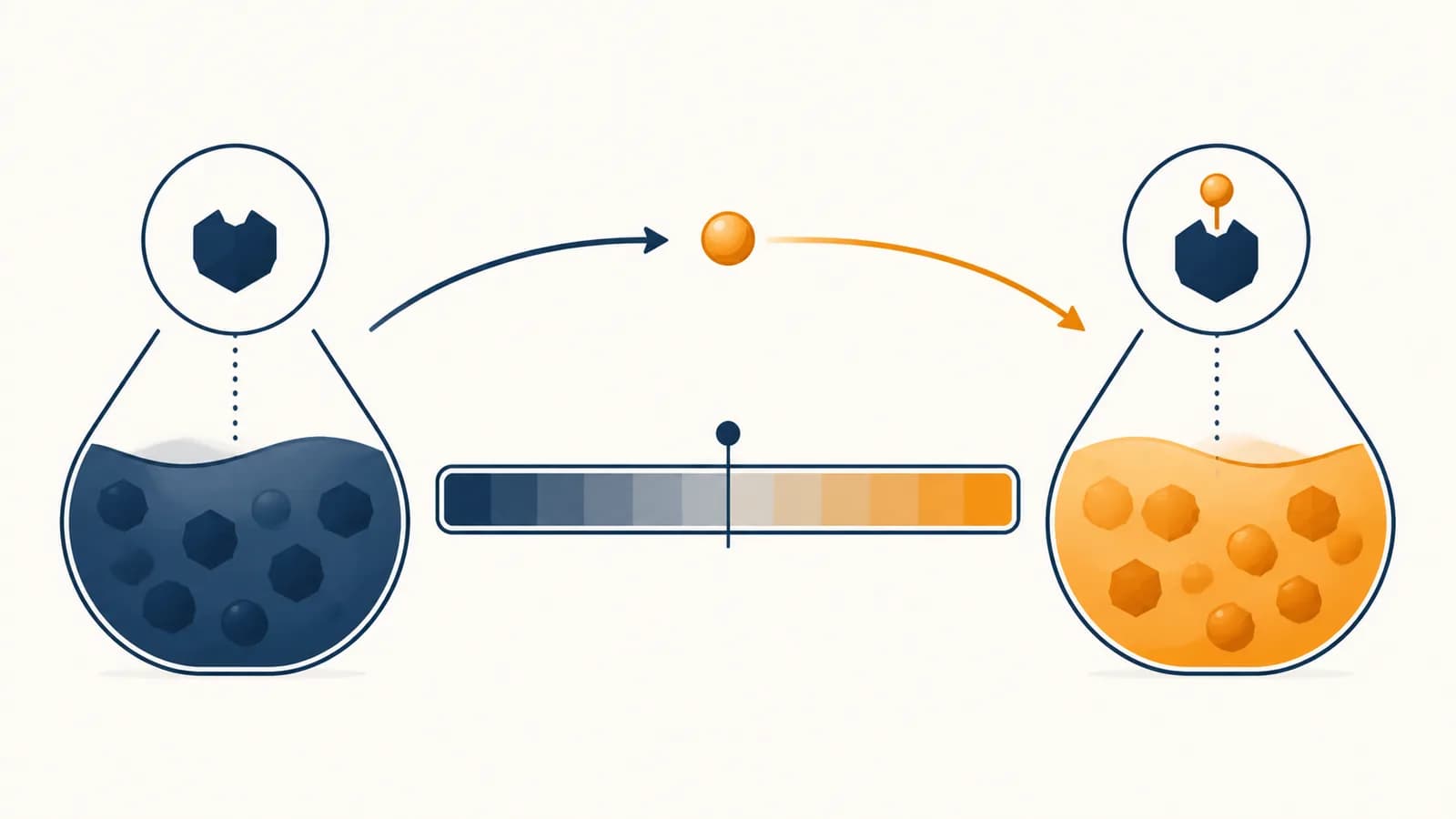
Acid-base chemistry is a framework that classifies substances by how they transfer protons or electron pairs, in the context of chemical reactions. An acid donates a proton or accepts an electron pair, while a base accepts a proton or donates an electron pair. The pH scale describes acidity in water, strong and weak acids react to different extents, and neutralization joins acidic and basic partners. These ideas exist because proton transfer changes charge, molecular shape, solubility, reaction speed, and biological function. They explain what acids and bases are, how pH works, and why antacids, cleaners, batteries, soil tests, and blood chemistry behave as they do.
What acids and bases actually are
An acid is a species that can donate a proton, and a base is a species that can accept one, according to the Brønsted-Lowry definition. A broader Lewis definition tracks electron pairs instead, covering reactions in which no proton moves.
A proton in this setting is a hydrogen nucleus, written . In water it does not remain bare for long. It attaches to a water molecule to form hydronium, , and can be shared through larger clusters of water molecules. Chemists often write as shorthand when the solvent is understood.
An acid gives ; a base receives . Hydrochloric acid transfers a proton to water.
An acid accepts an electron pair; a base donates an electron pair. Boron trifluoride accepts a pair from ammonia even though no proton is transferred.
The Brønsted-Lowry model handles most school examples involving water. When hydrogen chloride dissolves, it donates a proton to water:
HCl is the acid, water is the base, is the conjugate acid, and is the conjugate base.
The word conjugate means related by one proton. After an acid loses , what remains is its conjugate base. After a base gains , the result is its conjugate acid. Every proton-transfer reaction therefore contains two linked pairs. This bookkeeping predicts which species can react in the reverse direction.
Arrhenius definitions are narrower. An Arrhenius acid increases hydronium in water, while an Arrhenius base increases hydroxide, . That model describes hydrochloric acid and sodium hydroxide well, but it does not express as clearly why ammonia is basic even though contains no hydroxide ion.
How proton transfer works
Proton transfer occurs when an acid and a base collide in an orientation that lets an electron pair on the base form a bond to hydrogen while the acid's original hydrogen bond breaks. Charge and solvent molecules determine which direction is favored.
Consider ammonia in water. The nitrogen atom in ammonia has a lone pair of electrons. It uses that pair to bond to a proton from water. Water loses the proton and becomes hydroxide:
Ammonia and ammonium are one conjugate pair; water and hydroxide are the other.
The double arrow matters. Only part of the dissolved ammonia becomes ammonium and hydroxide. Forward and reverse transfers continue, but at equilibrium their rates match, so the overall concentrations remain steady. The position of that equilibrium reflects the relative tendencies of the two acids to give up a proton.
Water can act in either role. It accepts a proton from HCl, so it is a base there. It donates a proton to ammonia, so it is an acid there. A substance able to act as both is called amphiprotic. Bicarbonate, , is another common example.
Acid and base are roles in a reaction. A molecule is not acidic or basic in complete isolation. Its behavior depends on what it meets and on the solvent around it.
This reaction-centered view is part of chemistry as the study of matter and change. It replaces a list of sour and slippery substances with a mechanism that can predict products, equilibrium, and measurable properties.
How the pH scale works
pH measures the effective concentration of hydronium ions on a base-ten logarithmic scale. Lower pH means greater hydronium activity, and a change of one pH unit corresponds to a factor of ten under the same conditions.
In a dilute classroom solution, activity is often approximated by molar hydronium concentration: .
Activity corrects for the fact that ions interact, especially in concentrated solutions. Introductory calculations usually use concentration because the approximation is good enough for dilute mixtures. If an ideal solution has , its pH is 3. If the concentration rises to , the pH becomes 2. That one-unit drop represents ten times as much hydronium, not one extra unit of acidity.
Water itself undergoes a small amount of proton transfer:
At neutrality, the two concentrations are equal, so each is and pH is 7 at 25 °C.
Neutral does not always mean pH 7. It means equal activities of hydronium and hydroxide. The value of changes with temperature, so the neutral pH changes too. A solution can therefore have a pH slightly below 7 at a higher temperature and still be neutral.
Indicators estimate pH because their protonated and deprotonated forms absorb different wavelengths of light. A pH meter instead measures an electrical potential across a glass membrane that responds to hydrogen ion activity. Indicator paper is quick and approximate. A calibrated meter gives a numerical reading but needs clean electrodes and suitable calibration solutions.
Strong acids versus concentrated acids
Strength describes how completely an acid or base reacts with water, while concentration describes how much solute occupies a given volume. A dilute strong acid can contain less total acid and be less hazardous than a concentrated weak acid.
Hydrochloric acid is classified as strong because its proton transfer to water is essentially complete in ordinary dilute aqueous solutions. Ethanoic acid, also called acetic acid, is weak because a substantial fraction remains as neutral molecules at equilibrium. The equilibrium constant measures acid ionization:
A larger means the products are favored more strongly for .
Concentration uses units such as moles per litre. A ideal solution of HCl supplies approximately hydronium, giving pH 2. A weak acid at the same formal concentration supplies less hydronium because it ionizes only partly. Its pH is higher, although plenty of unionized acid remains available to react as hydronium is consumed.
An equilibrium property. It asks what fraction transfers protons or produces hydroxide in a given solvent.
An amount-per-volume property. It asks how many moles of dissolved substance are present in each litre.
The same distinction applies to bases. Sodium hydroxide is a strong base because dissolved formula units separate into sodium and hydroxide ions. Ammonia is a weak base because only part of it accepts protons from water. None of these labels alone gives a complete safety judgment. Concentration, exposure route, temperature, oxidizing ability, and tissue penetration also matter.
How neutralization works
Neutralization is a reaction in which an acid and a base consume each other's reactive species, often producing water and a salt. The final solution is neutral only when the amounts, strengths, and resulting ions produce equal hydronium and hydroxide activities.
For a strong acid mixed with a strong base in water, spectator ions can be removed from the equation. What remains is the net ionic reaction:
Sodium and chloride stay dissolved when HCl and NaOH react, so the salt is aqueous sodium chloride.
Amounts must be counted in moles. Suppose of HCl is mixed with of NaOH. The acid contains hydronium equivalents; the base contains hydroxide equivalents. After reaction, acid remains in . The ideal remaining hydronium concentration is , giving pH about 1.95.
Use , with volume in litres, for each reacting species.
Compare acid and base equivalents. Polyprotic acids and bases may require more than a one-to-one ratio.
Subtract the consumed amount, divide excess moles by total volume, then calculate pH or pOH.
This mole logic is the same method developed in calculating reacting quantities from balanced equations. In an acid-base titration, a solution of known concentration is delivered until it has reacted with the analyte. An indicator or pH probe helps locate the equivalence point, where stoichiometric amounts have reacted.
The equivalence point is not automatically pH 7. A weak acid titrated with a strong base leaves its conjugate base at equivalence, and that ion reacts with water to make hydroxide. The equivalence solution is basic. The reverse pairing, a weak base with a strong acid, gives an acidic equivalence solution.
How buffers resist a change in pH
A buffer is a mixture containing a weak acid and its conjugate base, or a weak base and its conjugate acid, that consumes added hydronium or hydroxide before either can accumulate enough to shift pH sharply.
Take a mixture of ethanoic acid and ethanoate. Added hydroxide reacts mainly with the weak acid:
Added hydronium reacts mainly with ethanoate:
In each case, a strongly pH-changing ion becomes a member of the weak conjugate pair. The pH still changes, but less than it would in unbuffered water. A buffer works best when both members are present in substantial and similar amounts.
If , the ratio is 1, its logarithm is 0, and .
The equation follows from the expression and is most useful when the buffer assumptions hold. If hydroxide consumes nearly all the weak acid, the mixture has exceeded its buffer capacity. Calling something a buffer does not mean its pH is fixed. It means a defined reservoir can absorb a limited disturbance.
A laboratory protocol requires an enzyme to stay near its working pH. The solution includes a conjugate acid-base pair whose is near that target. Small acidic products are then absorbed by the base member instead of immediately changing the enzyme's surroundings.
Buffers matter in cells because the charge and shape of proteins depend on which groups carry protons. They also matter in calibration standards, fermentation, medicines, and manufactured products. Buffer selection is chemical design: choose a suitable conjugate pair, ratio, total concentration, and compatibility with the rest of the system.
How acids and bases show up in bodies and ecosystems
Living systems use acid-base reactions to control molecular charge, enzyme activity, gas transport, mineral availability, and waste removal. Organisms regulate pH within local ranges because proton gain or loss can change a molecule's bonding and behavior.
Digestion uses acid, then neutralizes it
Stomach fluid is acidic, which supports protein digestion and creates a hostile environment for many swallowed microbes. When acidic contents enter the small intestine, bicarbonate-rich secretions neutralize much of that acid. This protects tissue and gives intestinal enzymes conditions in which they can function.
Antacids contain bases that consume acid. Calcium carbonate, for example, reacts with hydronium to form calcium ions, carbon dioxide, and water. The fizz that can accompany carbonate neutralization is carbon dioxide leaving the solution. Dose matters because a finite number of base equivalents can consume only a finite number of acid equivalents.
Breathing and kidneys share pH control
Carbon dioxide participates in aqueous equilibria connected to carbonic acid and bicarbonate. Changing how rapidly carbon dioxide is exhaled can therefore shift acid-base balance. Kidneys act more slowly by handling hydrogen ions and bicarbonate. The full physiology is regulated and interconnected, so blood pH cannot be interpreted as a simple beaker calculation.
Soil and water chemistry control access to nutrients
Soil pH affects the chemical forms and solubilities of mineral nutrients. It can also influence microbial processes. Farmers and gardeners test soil before adding lime or other amendments because the same treatment can help one soil and overshoot another. In lakes and oceans, carbonate equilibria help resist pH change, but that capacity is limited and chemically specific.
How acids and bases show up in kitchens, cleaning, and industry
Outside the laboratory, acids and bases dissolve deposits, alter food texture, drive manufacturing reactions, treat water, and prepare surfaces. Their usefulness comes from specific chemical reactions, while their risks depend on concentration, contact, heat release, and other properties.
Cooking changes molecules with pH
Baking soda, sodium bicarbonate, releases carbon dioxide when it reacts with an acid in batter. The gas expands bubbles, helping the baked structure rise. Baking powder packages bicarbonate with one or more dry acid ingredients, so water and heat can initiate gas production without a separate acidic food.
Acidity also changes pigments and proteins. Anthocyanin pigments in foods such as red cabbage have structures whose protonation changes with pH, altering the wavelengths they absorb. Marinades can change surface proteins, but acid does not magically penetrate thick food at unlimited speed. Time, cut size, salt, and temperature still matter.
Cleaning targets a particular kind of dirt
Acidic cleaners can dissolve carbonate mineral scale. Basic cleaners can help break down fats and alter oily residues, and some strong bases hydrolyze fats into more water-compatible products. The correct cleaner depends on the deposit and the surface. Acid that removes scale can also attack carbonate stone or metal.
Never mix household cleaners unless the label explicitly directs it. Acidifying hypochlorite bleach can release toxic chlorine-containing gas, and mixing products can also cause heat, splashing, or other hazardous reactions.
Labels and safety data, not a casual pH guess, determine handling. Guidance on safe handling of corrosive and reactive substances explains why goggles, compatible containers, ventilation, and correct dilution order matter.
Factories measure acidity as a process variable
Industrial operators track pH during water treatment, metal finishing, dyeing, food production, fermentation, and chemical synthesis. A reading can signal whether a reaction has reached a desired condition or whether wastewater needs treatment. Operators also measure total acidity or alkalinity because two samples with the same pH can require different amounts of reagent to neutralize. Their buffer capacities may differ.
Acid-base reactions can change solubility by changing charge. Protonating an anion may make it less attracted to water, while protonating an amine can turn a neutral organic molecule into a water-soluble ion. This is why pH adjustment helps separate compounds during extraction and purification. The underlying solvent behavior connects with how substances dissolve and form solutions.
Five mistakes people make with acids and bases
Most acid-base errors come from treating labels as complete descriptions. The reliable checks are to identify the reacting species, track proton or electron-pair movement, distinguish equilibrium from amount, count moles, and state the solvent and conditions.
1. Calling every hydrogen-containing substance an acid
An acid must be able to donate a proton to the reaction partner under the stated conditions. Methane contains hydrogen, but its carbon-hydrogen bonds do not make it an ordinary acid in water. Molecular structure controls how stable the conjugate base would be after proton loss.
2. Treating low pH as a complete hazard scale
pH describes hydrogen ion activity in a solution. It does not directly report oxidizing power, toxicity, penetration, temperature, or how much reserve acid is present. Two liquids with the same measured pH can behave differently on skin or materials because their concentrations and chemistries differ.
3. Assuming strong means concentrated
A strong acid ionizes extensively, while a concentrated solution contains a large amount per volume. These properties can vary independently. The distinction also explains why dilution changes concentration but does not turn a strong acid into a weak acid.
4. Averaging pH values
Because pH is logarithmic, directly averaging two pH numbers usually does not describe the mixed solution. Convert pH to hydronium or hydroxide amounts, account for reaction and total volume, then convert the remaining concentration back to pH. Buffers and weak species require equilibrium analysis as well.
5. Assuming neutralization always ends at pH 7
Stoichiometric equivalence tells how many acid and base equivalents reacted. Final pH also depends on the products, dilution, temperature, and equilibria. A conjugate ion left by a weak reactant may hydrolyze water, making the equivalence solution acidic or basic.
Can pH be below zero or above fourteen?
pH can fall below zero or rise above fourteen in sufficiently concentrated solutions because it is a logarithmic measure, not a scale with fixed walls. Simple concentration calculations become less accurate there, so activity and measurement method need careful treatment.
The familiar range of 0 to 14 follows from dilute aqueous examples at 25 °C. A hypothetical ideal hydronium activity of 10 relative to the standard state gives . Real concentrated acids have strong ion interactions, so inserting formal molarity into the dilute formula can misstate the pH.
Non-aqueous solvents also have their own leveling behavior and acid-base windows. A substance described as strong in water may behave differently in another solvent. The number is meaningful only with the solvent, temperature, concentration range, and measurement basis understood.
Why can water act as both an acid and a base?
Water can act as both because each molecule has hydrogen atoms it can donate as protons and lone electron pairs on oxygen that can accept a proton. Its role changes according to the acid-base strength of the species reacting with it.
Two water molecules can even react with each other. One donates a proton and becomes hydroxide; the other accepts it and becomes hydronium:
This autoionization is small but never irrelevant to the definition of neutrality. It also shows why acid-base labels describe a relationship. Against HCl, water is the proton acceptor. Against ammonia, water is the proton donor. Against another water molecule, it can take either role.
The same reasoning applies to bicarbonate and dihydrogen phosphate. Each can lose a proton to a stronger base or gain one from a stronger acid. Biological buffer systems often benefit from exactly this reversible behavior.
Acid-base chemistry turns proton movement into predictions
Acid-base chemistry connects molecular structure to observable changes in pH, charge, solubility, reaction direction, and material behavior. Once proton donors, proton acceptors, amounts, and equilibria are identified, many reactions become calculations instead of lists to memorize.
A useful habit is to inspect the next acidic or basic product you meet. Read its ingredients, identify the likely acid-base pair, and ask what species actually moves or changes. For a calculation, write the balanced reaction before touching the pH formula. For a practical decision, check concentration and hazard information rather than relying on the words acid, base, natural, or strong.
The takeaway: Track the proton, then track the moles and the equilibrium. That sequence explains what reacted, how far it reacted, what remains, and what a pH reading can honestly tell you.
These habits extend across chemistry. The same electron pairs that accept protons also form bonds, the same equilibria govern solubility and complex ions, and the same mole ratios govern analysis. Acid-base chemistry is therefore a compact way to see structure, energy, equilibrium, and measurement working together in matter you can test.