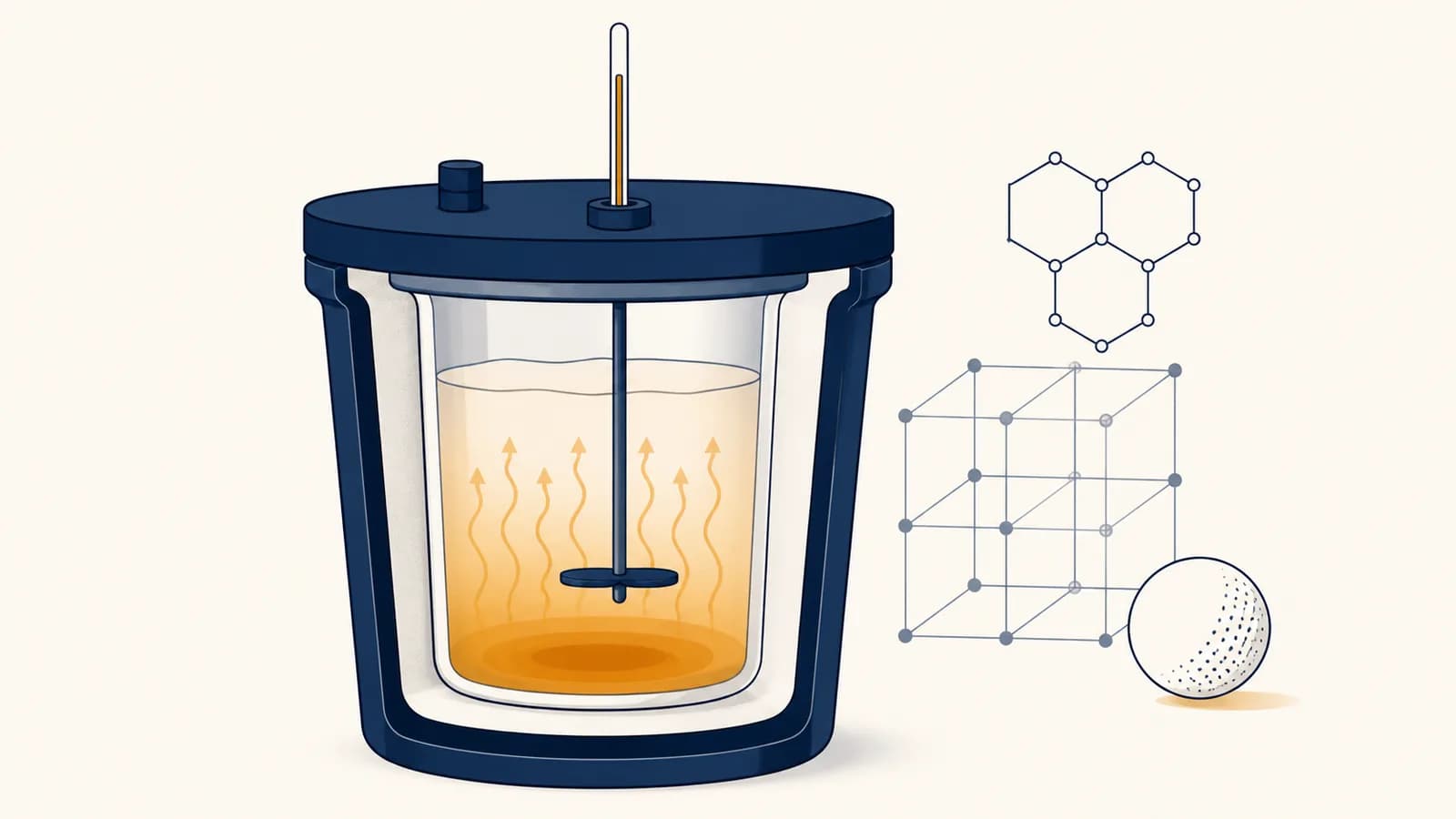
Thermochemistry is a branch of chemistry that measures and explains energy transferred as heat during chemical reactions and physical changes, in the context of chemical systems and their surroundings. It answers the common questions behind reaction heat, enthalpy change, exothermic and endothermic reactions, calorimetry, Hess's law, and bond energy. The subject exists because a balanced chemical equation identifies substances and amounts, but does not by itself tell us whether a process warms its surroundings, needs a continuous energy supply, or could release heat dangerously. Thermochemistry adds that missing energy account.
What thermochemistry actually is
Thermochemistry is the quantitative study of heat associated with chemical reactions, changes of state, mixing, and dissolving. It treats a chosen collection of matter as the system, everything outside it as the surroundings, and energy as something conserved while it moves or changes form.
A reaction rearranges atoms. Bonds in the reactants are disrupted, new bonds form in the products, and the electrons settle into a different energy arrangement. The energy difference does not disappear. It may pass into molecular motion, light, electrical work, expanding gas, or heat transferred across the system boundary.
Thermochemistry is part of the wider study of Chemistry, but its accounting rules are useful far beyond a laboratory. They describe fuel burning in an engine, water freezing in a pipe, an instant cold pack dissolving a salt, and food being oxidized in the body.
Heat is energy in transit. A substance does not contain a quantity called heat. It has internal energy, and heat is one way energy crosses a boundary because of a temperature difference.
Three words keep the account clear. The system is what is being studied, such as chemicals inside a flask. The surroundings include the flask, air, bench, and anything else that can exchange energy with the system. The universe in this model means system plus surroundings, not necessarily every object in astronomy.
How energy moves between a system and its surroundings
Energy crosses a system boundary as heat or work, while the total energy of system and surroundings remains constant. Chemists normally call heat entering the system positive and heat leaving it negative, so every sign reports a direction as well as an amount.
The first law of thermodynamics is the formal energy account. With the chemistry sign convention, it is:
If a system absorbs 120 J of heat and does 35 J of work on the surroundings, then , , and .
Internal energy, written , includes molecular motion and the potential energy of interactions among particles. A change in internal energy can be measured even though an absolute value for all the energy inside a sample is not normally useful. Thermochemistry therefore works with differences, .
Work often appears when a gas changes volume against external pressure. A reaction that produces gas can push back the atmosphere. With the convention above, work done by the system is negative because energy leaves the system. Electrical cells provide another route: chemical energy can cross the boundary as electrical work, a connection developed further in the chemistry of batteries and electrolysis.
What enthalpy actually is
Enthalpy is a state function defined as internal energy plus pressure multiplied by volume. At constant pressure, with only pressure volume work, the system's enthalpy change equals the heat it absorbs, making enthalpy the most convenient energy quantity for open-flask reactions.
At constant pressure under the usual restriction to pressure volume work, .
A state function depends only on the initial and final states, not on the route between them. Altitude is a useful analogy. The change in altitude between two locations is fixed even if one path winds around a hill and another climbs directly. In the same way, the enthalpy change for converting specified reactants into specified products is fixed when their amounts, physical states, temperature, and pressure are fixed.
Enthalpy is also extensive: doubling the balanced reaction doubles its enthalpy change. Reversing the reaction reverses the sign. These are not arbitrary equation tricks. Twice as much reacting matter undergoes twice as many molecular rearrangements, while a reversed process transfers energy in the opposite direction.
A thermochemical equation must include physical states because melting, vaporizing, and dissolving have energy effects. Forming liquid water from hydrogen and oxygen does not have the same enthalpy change as forming water vapor. The gaseous product still has energy that would be released if it condensed.
Exothermic versus endothermic change
An exothermic process transfers heat from system to surroundings and has a negative enthalpy change at constant pressure. An endothermic process absorbs heat from surroundings and has a positive enthalpy change. The labels describe energy transfer, not reaction speed or safety.
Products lie lower in enthalpy than reactants. Combustion and freezing are familiar examples. The surroundings tend to warm while the change occurs.
Products lie higher in enthalpy than reactants. Melting and many thermal decompositions are examples. The surroundings tend to cool unless a heater replaces the energy absorbed.
Temperature is evidence of heat transfer, but it is not the definition. An exothermic reaction can run in a refrigerated vessel whose measured temperature remains constant because cooling equipment removes the released energy. An endothermic reaction can occur in a hot furnace because the furnace supplies energy faster than the reaction absorbs it.
Freezing is a useful test of the language. Liquid water becomes a more ordered solid and releases energy to its surroundings, so freezing is exothermic. Melting reverses that change and requires energy, so it is endothermic. A process can therefore feel associated with cold and still be exothermic.
An instant cold pack can become cold when an internal pouch breaks and a solid dissolves in water. If dissolving absorbs more energy than the accompanying interactions release, heat enters the pack from your hand. Your hand cools because it is part of the surroundings.
Activation energy is a separate idea. A fuel and oxygen mixture can have lower-enthalpy products and still remain unchanged until a spark starts the reaction. The spark helps molecules cross an energy barrier; it does not turn an endothermic reaction into an exothermic one. A catalyst lowers that barrier for both directions but does not change .
How calorimetry measures heat
Calorimetry measures heat by placing a process in an insulated setup and observing a known material's temperature change. Its mass and specific heat capacity convert that temperature change into energy, then energy conservation gives the heat gained or lost by the process.
State whether the reaction, solution, or entire calorimeter is the system. The sign of heat depends on this boundary.
Record the material being warmed or cooled, its mass, and the initial and final temperatures.
Use specific heat capacity, or a calibrated heat capacity for the complete apparatus.
In an ideally insulated setup, heat lost by the reaction equals heat gained by its surroundings.
For a substance whose specific heat capacity stays nearly constant over the measured interval, the basic relation is:
Heating 100.0 g of water by 5.0 degrees Celsius gives .
The accepted textbook value for liquid water is appropriate near room temperature for school calculations. The temperature difference has the same numerical size in degrees Celsius and kelvins. A positive makes positive for the water, meaning the water gained energy.
Suppose a reaction warms that 100.0 g of water by 5.0 degrees Celsius and heat absorbed by the cup is neglected. The water gains about 2.1 kJ, so the reaction loses about 2.1 kJ. If 0.050 mol reacted, the measured molar enthalpy is approximately . The minus sign belongs to the reaction, not to the warming water.
A coffee-cup calorimeter operates near constant atmospheric pressure, so it is commonly used to estimate reaction enthalpy in solution. A sealed bomb calorimeter holds volume constant and measures the change in internal energy of combustion more directly. Corrections connect that result to enthalpy when gases are consumed or produced.
How Hess's law builds an enthalpy change
Hess's law states that a reaction's total enthalpy change equals the sum of enthalpy changes for any sequence of steps with the same initial and final states. It works because enthalpy is a state function and intermediate states cancel from the energy account.
Consider finding the enthalpy change for turning carbon as graphite and oxygen into carbon monoxide:
Use these documented standard thermochemical equations, with values commonly tabulated near 298 K:
Reverse the second equation so carbon dioxide cancels. Reversal changes its enthalpy sign to positive. Adding it to the first equation cancels and leaves the target reaction:
The calculated result matches the standard enthalpy of formation of carbon monoxide to the displayed precision.
The algebra must follow the chemical equations. Reverse an equation, reverse the sign. Multiply every coefficient by a factor, multiply by that factor. Add equations only after checking that unwanted substances cancel with matching physical states.
Standard enthalpies of formation make Hess's law compact. A standard enthalpy of formation is the enthalpy change when one mole of a compound forms from its elements in their standard states under stated standard conditions. By definition, an element in its standard state has . This does not claim that the element contains no energy. It establishes a reference zero.
Each tabulated value is multiplied by its stoichiometric coefficient , then reactant terms are subtracted from product terms.
Bond enthalpy versus reaction enthalpy
Bond enthalpy is the energy required to break a specified covalent bond in gaseous species, while reaction enthalpy is the net enthalpy difference between complete reactant and product states. Average bond enthalpies estimate reaction heat, but measured formation data are usually more specific.
Breaking a bond requires energy. Forming that same bond releases energy. A reaction estimate therefore adds the energy needed to break reactant bonds and subtracts the energy released when product bonds form:
Positive breaking terms and negative forming terms prevent the common error of treating bond breaking as energy release.
For , use representative average bond enthalpies of 436 kJ/mol for H to H, 243 kJ/mol for Cl to Cl, and 431 kJ/mol for H to Cl. The visible arithmetic is for the reaction as written. This estimate is close to values obtained from formation data, but the method has limits.
A bond's exact energy depends on the rest of the molecule, so a table often reports an average taken across several compounds. Gas-phase bond values also omit phase changes and intermolecular effects unless those are added separately. The deeper electronic reason bonds differ begins with electron arrangements and atomic structure.
Bonds store energy like stretched springs, so breaking them releases that stored energy.
Separating bonded atoms requires energy. A reaction releases net energy only when forming product interactions releases more than breaking reactant interactions absorbs.
That distinction explains why combustion releases heat without violating the cost of breaking fuel bonds. Energy is absorbed while bonds in fuel and oxygen are disrupted. More energy is released as strong bonds form in carbon dioxide and water. The final balance is negative.
How thermochemistry shows up in work and daily decisions
Thermochemistry guides settings where chemical energy becomes useful heat, controlled cooling, electrical work, or metabolic energy. Engineers and technicians combine reaction enthalpy with reaction rate, heat transfer, material limits, and efficiency to decide what equipment can operate safely and economically.
Fuel values compare energy per chosen amount
A fuel value states energy released per mass, mole, or volume under specified conditions. The basis matters because fuels have different densities and formulas. A molar enthalpy helps compare chemical equations, while energy per kilogram or litre may fit transport and storage decisions better.
Complete combustion calculations assume carbon forms carbon dioxide and hydrogen forms water. Real flames can lose heat, form carbon monoxide or soot, and send hot exhaust away. The tabulated reaction enthalpy is therefore not identical to useful heat delivered to a pan, turbine, or room.
Food Calories are energy units measured through combustion
A food Calorie, written with a capital C in nutrition, is a kilocalorie. Its defined energy equivalent is 4.184 kJ. A bomb calorimeter can measure gross combustion energy, while nutrition labels use established methods that account for how protein, fat, carbohydrate, and other components contribute usable food energy.
The body does not burn food in a flame. Enzymes channel oxidation through many reactions, capturing part of the available chemical energy in molecules and ion gradients while releasing part as heat. Hess's law still applies because the overall enthalpy change does not depend on the biochemical route.
Industrial reactors need an energy balance
A reactor energy balance compares heat generated or absorbed by reaction with heat carried by incoming and outgoing materials, transferred through walls, and associated with phase changes. An exothermic reactor may need cooling coils. An endothermic reactor may need a furnace or heated feed.
Scale changes the practical problem. A small sample has relatively much surface area through which heat can escape. A larger vessel has more reacting volume compared with its surface, so generated heat may accumulate. Process designers cannot safely assume that behavior in a test tube transfers unchanged to a production tank.
Safety and environmental decisions need energy boundaries
Thermochemical data help identify heat release, cooling demand, fire load, decomposition risk, and energy use, but they do not alone predict how fast an event occurs. Safe decisions require both the amount of possible energy and the rate and route by which it can be released.
A large negative enthalpy change signals that much heat could be released per reaction amount. Risk becomes acute if the reaction accelerates as temperature rises, gas is produced, cooling fails, or reactants accumulate. These interacting effects can produce thermal runaway. Measurements of heat flow, pressure, reaction rate, and decomposition onset inform controls.
Thermodynamically favorable does not mean instantly dangerous. Rate barriers can keep an energy-releasing change slow. Once heat, a spark, contamination, or mixing removes that barrier, the rate can change sharply.
Fire extinguishing methods interfere with the energy and reaction pathways. Water can absorb substantial heat because of its heat capacity and vaporization, but it is unsuitable for some burning metals, energized electrical equipment, or chemicals that react with water. Practical choices belong within chemical hazard and laboratory safety guidance, not enthalpy arithmetic alone.
Environmental comparisons also need boundaries. A combustion equation can give heat released and carbon dioxide produced at the point of use. A broader assessment includes extraction, processing, transport, equipment losses, and other emissions. Thermochemistry supplies part of that account, especially energy requirements and reaction yields, but it does not replace a complete life-cycle study.
Two materials can have similar stored chemical energy but different hazards. A finely divided powder may react much faster than a solid block because more surface contacts oxygen. Enthalpy estimates the possible heat; particle size, ignition conditions, ventilation, and containment help determine how quickly pressure and temperature could rise.
4 mistakes people make with thermochemistry
Most thermochemistry errors come from confusing system with surroundings, losing signs while manipulating equations, ignoring reaction amounts, or treating heat and temperature as the same quantity. A written boundary and a unit check prevent many errors before any calculator work begins.
1. Calling every temperature rise endothermic
A warming solution has absorbed heat, but the reaction inside it may have released that heat and therefore be exothermic. Name the system before assigning the sign. In ideal calorimetry, .
2. Forgetting that the equation sets the amount
An enthalpy written beside a balanced equation applies to the reaction exactly as written. If is divided by two, its enthalpy must also be divided by two. Units such as kJ/mol must say which mole is meant.
3. Changing an equation without changing its enthalpy
Reversing a reaction changes the sign of . Multiplying coefficients multiplies . Physical states cannot be silently changed because liquid, solid, and gas phases have different enthalpies.
4. Treating heat capacity as temperature
Temperature reflects average particle motion, while heat capacity states how much energy changes an object's temperature by a given amount. A bathtub of warm water can transfer more energy than a small cup of hotter water because mass belongs in .
What standard conditions and symbols actually mean
A superscript degree on an enthalpy symbol means all substances are in specified standard states, commonly at the standard pressure of 1 bar, with temperature stated separately. It does not mean zero degrees, and standard data must match the reaction's substances and phases.
Tables are often presented for 298.15 K, which is 25 degrees Celsius, but standard state and standard temperature are different ideas. For a gas, the standard state uses a pressure of 1 bar. For a pure liquid or solid, it is the pure substance at the stated pressure and temperature. For a solute, the adopted standard state must be identified.
The symbols answer different questions. describes formation of one mole from elements in their standard states. describes complete combustion of a stated amount. describes dissolving, and describes melting. Subscripts make the process explicit.
Uncertainty should travel with measurements. A temperature probe has limited resolution, masses have measurement error, and heat can leak. Reporting more decimal places than the inputs support does not improve the experiment. It only disguises the limit.
Can a reaction be spontaneous but endothermic?
A reaction or physical change can be spontaneous and endothermic because spontaneity depends on both enthalpy and entropy through Gibbs free energy. Heat absorption opposes spontaneity under many conditions, but a sufficiently favorable increase in entropy can outweigh that positive enthalpy term.
A process is thermodynamically favorable under specified constant temperature and pressure conditions when .
Ice melting above its equilibrium melting temperature is an accessible example. Melting absorbs heat, so is positive, but the liquid has greater entropy than the ordered solid. Above the melting point at the stated pressure, the entropy term makes melting favorable.
Spontaneous still says nothing about speed. A favorable process may be slow because its activation barrier is high. Thermodynamics gives the energy difference and direction of equilibrium; kinetics gives the pathway and rate.
Does a catalyst change the heat of reaction?
A catalyst does not change reaction enthalpy because it leaves the initial reactants and final products unchanged. It supplies a different sequence of steps with a lower activation barrier, increasing rate while preserving the same total enthalpy change and equilibrium thermodynamics.
An energy diagram for a catalyzed route has lower peaks but the same starting and ending levels. Each intermediate is created and later consumed, just as intermediates cancel in a Hess's law calculation. Adding the step enthalpies still gives the uncatalyzed reaction's .
A catalyst can change the observed temperature pattern indirectly. A faster reaction may release the same total heat in less time, so heat escapes less effectively during the event and the measured peak temperature can be higher. That is a rate and heat-transfer effect, not a larger reaction enthalpy.
Thermochemistry turns chemical change into an energy account
Thermochemistry connects molecular rearrangement to measurable heat without confusing heat, temperature, rate, or spontaneity. Its discipline is simple: define the system, track signs and amounts, preserve physical states, and compare the same initial and final conditions.
The next time water condenses on a window, a battery warms, fuel burns, or a salt dissolves, identify the system and surroundings. Ask which bonds and interactions change, where energy crosses the boundary, and what measurement could test the account. Those questions turn an everyday temperature change into chemical evidence.
The takeaway: A balanced equation counts matter, while thermochemistry accounts for the energy that matter exchanges. Use enthalpy for the total change, calorimetry for measurement, Hess's law for indirect routes, and kinetics when the question is speed.