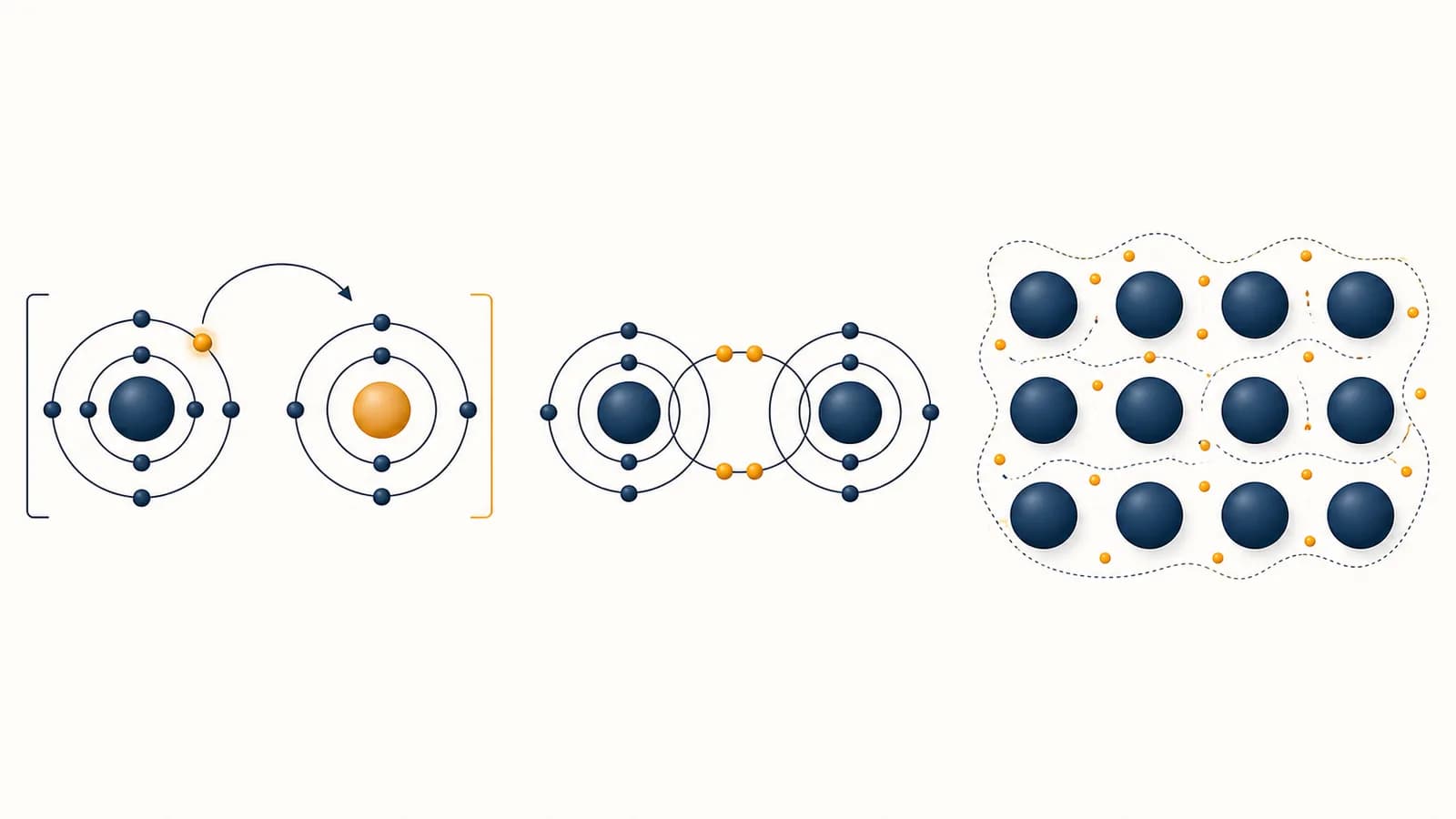
Chemical bonding is an electrostatic interaction that holds atoms or ions together in substances, in the context of chemistry.
Chemical bonds form when arrangements of electrons and nuclei have lower potential energy than the separated particles. Ionic bonds, covalent bonds, and metallic bonds are the main models used to explain how atoms combine, while polarity and intermolecular forces explain many differences in melting point, solubility, conductivity, and strength. Bonding exists because positive nuclei attract negative electrons, and systems tend to settle into stable, lower-energy arrangements. The idea connects electron structure to the materials people handle every day: salt crystals, water, medicines, metals, plastics, batteries, and ceramics.
What a chemical bond actually is
A chemical bond is a stable attraction between atoms or ions caused by interactions among positively charged nuclei and negatively charged electrons. A bond forms at a separation where attractive and repulsive forces balance and the combined system has less energy than separated particles.
An isolated atom contains a positive nucleus surrounded by electrons. Bring two atoms closer and several interactions begin at once. Each nucleus attracts the other atom's electrons. The two nuclei repel one another, and the electrons also repel one another. The net result depends on distance and on how the electrons can be arranged under quantum rules.
At a suitable distance, attraction can outweigh repulsion. The energy drops, producing an energy minimum. Moving the atoms farther apart loses that stabilizing attraction. Pushing them too close makes repulsion rise sharply. The distance at the minimum is the bond length, and the energy needed to separate the bonded atoms is related to the bond energy.
If separated atoms have an assigned energy of 0 and the bonded pair has an energy of -436 kJ per mole, then bond formation changes the energy by -436 kJ per mole.
A negative energy change means the bonded arrangement is lower in energy. Separating the atoms requires energy to be supplied. This is why breaking a bond always requires energy, while forming a bond releases energy. A reaction can still absorb energy overall if breaking the reactant bonds costs more than forming the product bonds releases. The energy accounting belongs to the wider study of heat and energy changes in chemical reactions.
A bond is not a physical rod. Lines in structural formulas record which atoms share a bonding interaction. The actual bond is a stable electron and nucleus arrangement described by a probability distribution and an energy minimum.
How valence electrons control bonding
Valence electrons are the outer electrons most involved in chemical bonding because they are held less tightly than inner electrons and can be transferred or shared. Their number and available orbitals largely determine how many bonds an atom forms and what geometry results.
The periodic table helps predict valence electrons for main-group elements. Carbon has four, nitrogen five, oxygen six, and fluorine seven. Noble gases already have especially stable filled outer shells, so they are generally less reactive. Other atoms can approach similar arrangements by sharing electrons or by gaining and losing them.
The familiar octet rule says that many main-group atoms tend to reach eight valence electrons in compounds. It is a useful pattern, not the cause of bonding and not a universal law. Hydrogen is stable with two electrons. Boron often has only six around it. Elements in period 3 and below can appear with more than eight in Lewis structures, and many molecules contain an odd total number of electrons.
This flow is a prediction method, not a claim that atoms consciously seek octets. The underlying explanation is electrostatic attraction combined with quantum restrictions on electron states. The arrangement of electrons in orbitals explains why only certain energy states and bonding patterns are allowed.
Lewis symbols make the valence count visible by placing dots around an element symbol. In a Lewis structure, a pair of dots or a line between atoms represents a shared electron pair. Dots on one atom are lone pairs. Counting these marks is useful because bonding pairs and lone pairs both occupy space and influence molecular shape.
How ionic bonding works
Ionic bonding is the electrostatic attraction among oppositely charged ions in an extended solid. It commonly begins with electron transfer between a metal and a nonmetal, but the bond itself is the collective attraction throughout the ionic lattice, not the transfer event.
A sodium atom can lose one electron to become Na+, while a chlorine atom can gain one electron to become Cl-. Creating isolated ions has energy costs and gains that must be counted.
The positive and negative ions attract. Their electrostatic potential energy becomes lower as they approach, until short-range repulsion prevents collapse.
Each ion attracts several oppositely charged neighbors. A sodium chloride crystal is therefore a repeating three-dimensional array, not a collection of separate NaCl molecules.
The force between two idealized point charges follows Coulomb's law. It grows with the size of the charges and becomes weaker as their separation increases.
Doubling the distance between the same two charges reduces the force to one quarter because the distance is squared.
Ionic solids tend to have high melting points because many strong attractions must be disrupted to let ions move past one another. They are brittle because shifting a layer can place like charges beside each other; the resulting repulsion splits the crystal. A solid ionic crystal does not conduct electricity because its ions are fixed. Once molten, or dissolved in water, mobile ions can carry charge.
A conductivity tester placed in pure water may show little current. After table salt dissolves, hydrated sodium and chloride ions move toward opposite electrodes, so the solution conducts. Sugar can dissolve too, but intact neutral sugar molecules do not provide the same mobile charges.
How covalent bonding works
Covalent bonding occurs when atomic orbitals combine and electrons are shared between nuclei, creating electron density that attracts both nuclei. One, two, or three shared pairs are represented as single, double, or triple bonds, although real electron density is continuous.
Consider hydrogen. Each hydrogen atom contributes one electron. As the atoms approach, their atomic orbitals combine into molecular orbitals. Two electrons can occupy the lower-energy bonding orbital with opposite spins. Electron density concentrates between the nuclei, and both nuclei are attracted toward it. At the equilibrium distance, this attraction balances nuclear and electron repulsions.
A bond has both length and strength. For the same pair of elements, a higher bond order is usually shorter and stronger. The carbon to carbon bond in ethane is single, in ethene it is double, and in ethyne it is triple. The added shared electron density pulls the nuclei closer, although bond strengths do not increase as a simple whole-number multiple.
Some covalent substances consist of small, separate molecules. Water and carbon dioxide are examples. Others form network covalent solids. In diamond, each carbon bonds to four others in a continuous three-dimensional network. Breaking or reshaping the solid requires many covalent bonds to be broken, which helps explain diamond's hardness and high melting temperature.
A coordinate covalent bond is formed when both electrons in a shared pair originally come from the same species. After formation, it behaves like an ordinary covalent bond. For example, ammonia donates a lone pair to H+ to form ammonium, NH4+. The origin of the pair helps track the reaction, but it does not mark a permanently different kind of line inside the product.
Ionic versus covalent bonding
Ionic and covalent bonding are limiting models on a continuum of electron distribution. Ionic descriptions emphasize charged particles held by attraction, while covalent descriptions emphasize shared electron density. Many real bonds have both characters, so the best model depends on the question.
| Feature | Ionic model | Covalent model |
|---|---|---|
| Electron description | Transfer produces cations and anions | Atoms share electron pairs |
| Typical elements | Metal with nonmetal | Nonmetal with nonmetal |
| Basic structural unit | Extended ion lattice | Separate molecule or covalent network |
| Electrical behavior | Conducts when ions can move | Often a poor conductor, with important exceptions |
| Directionality | Attraction acts in every direction | Orbitals produce directional bonds |
Electronegativity, an atom's tendency to attract shared electron density, helps choose between the models. A large difference usually means greater ionic character. A small difference usually means greater covalent character. There is no single electronegativity cutoff that changes nature abruptly; cutoff values in textbooks are classification aids.
A metal plus a nonmetal makes an ionic compound, while two nonmetals make a covalent compound.
Composition offers a useful first prediction, but electron density and measured properties reveal a continuum. Polyatomic ions also contain covalent bonds internally and form ionic attractions with other ions.
Ammonium chloride illustrates both models in one substance. Nitrogen and hydrogen share electrons within NH4+. The ammonium cations and chloride anions attract one another in a lattice. Calling the whole compound simply ionic is useful for predicting bulk behavior, but it does not erase the covalent bonds inside the polyatomic ion.
How metallic bonding works
Metallic bonding holds metal atoms together through attraction between positive atomic cores and valence electrons delocalized across the solid. Because these electrons are not confined to one bond, metals can conduct charge and heat, reflect light, and deform without immediately separating.
In a metal crystal, many atomic orbitals overlap across enormous numbers of atoms. Their energy levels form closely spaced bands. In a conductor, electrons have accessible empty states nearby, so an applied electric field can shift their motion and produce current. The phrase “sea of electrons” captures delocalization, but band theory gives the more complete explanation.
Metallic bonding is also less directional than ordinary covalent bonding. When layers of metal atoms slide, the delocalized electrons can continue attracting the rearranged positive cores. This makes many metals malleable and ductile. Ionic crystals respond differently because sliding brings equal charges together and triggers strong repulsion.
An electrician bends a copper wire around a terminal. Copper can change shape while keeping a conducting path because its atoms remain bound through delocalized electrons. A salt crystal under the same kind of strain is likely to fracture instead of bending.
Alloys change the arrangement and movement of atoms in a metal. Substitutional alloy atoms replace some host atoms, while small interstitial atoms can fit into gaps. These changes can obstruct the motion of defects called dislocations, making the material harder. Steel uses carbon in iron to change mechanical behavior, although its detailed structures also depend on composition and heat treatment.
How polarity and molecular shape work together
Bond polarity comes from unequal sharing of electrons, while molecular polarity is the combined result of every bond dipole and the molecule's three-dimensional shape. A molecule can contain polar bonds yet have no overall dipole if the bond effects cancel by symmetry.
In hydrogen chloride, chlorine attracts the shared electron pair more strongly than hydrogen. Chlorine carries a partial negative charge, written , and hydrogen a partial positive charge, . These are not full ionic charges. They describe an uneven probability distribution for the shared electrons.
Geometry decides whether several bond dipoles reinforce or cancel one another. Carbon dioxide has two polar carbon to oxygen bonds. The molecule is linear, and the equal dipoles point in opposite directions, so the net dipole is zero. Water also has two polar oxygen to hydrogen bonds, but its bent shape prevents cancellation, making the molecule polar.
Valence-shell electron-pair repulsion theory, usually shortened to VSEPR, predicts many shapes by placing electron groups as far apart as practical. Two electron groups around a central atom give a linear arrangement. Three give trigonal planar, and four give tetrahedral electron geometry. Lone pairs occupy space too and usually repel more strongly than bonding pairs, changing bond angles and molecular shape.
Polarity influences how substances mix. Polar water stabilizes ions and many polar molecules through ion-dipole attractions and hydrogen bonding. Nonpolar liquids better accommodate nonpolar molecules. This “like dissolves like” rule is a useful start, but size, temperature, crystal energy, and all competing attractions still matter. The balance is developed further in how solutions form and substances dissolve.
Intermolecular forces versus chemical bonds
Chemical bonds hold atoms together within a particle or extended structure, while intermolecular forces attract separate molecules. Both are electrical in origin, but confusing their locations leads to wrong explanations of boiling, melting, dissolving, and chemical reaction.
London dispersion forces arise from momentary fluctuations in electron distribution. An instantaneous dipole in one particle can induce a dipole in a neighbor. Every atom and molecule has dispersion forces. They generally grow stronger as electron clouds become more polarizable and as molecular surfaces make greater contact.
Dipole-dipole attractions operate between polar molecules. Hydrogen bonding is a particularly strong, directional case involving hydrogen covalently bonded to nitrogen, oxygen, or fluorine and attracted to a lone pair on such an atom nearby. Hydrogen bonds help water remain liquid across ordinary outdoor temperatures and help organize proteins and DNA, but each hydrogen atom remains covalently attached within its own molecule or molecular unit.
If boiling broke the covalent bonds, water would chemically decompose into different substances.
Added energy overcomes enough intermolecular attraction for intact water molecules to enter the gas phase.
Melting and boiling are physical changes because molecular identity usually remains intact. A chemical reaction rearranges bonds and changes which atoms are connected. This distinction also explains why a molecular substance can have strong internal covalent bonds yet boil at a modest temperature: boiling separates molecules rather than pulling their atoms apart.
That question identifies the relevant attraction. Boiling a molecular liquid challenges intermolecular forces. Melting an ionic solid disrupts a lattice. Stretching a polymer may straighten chains, overcome attractions between chains, or break covalent backbones, depending on the load and material.
How bonding shows up in materials, medicines, and living cells
Chemical bonding determines a substance's structure, and structure constrains its properties and uses. Engineers, pharmacists, biochemists, geologists, and cooks all meet bonding when they control hardness, conductivity, solubility, reaction rate, flexibility, or molecular recognition.
Materials engineers connect bonds to performance
A material's response begins with its bonding network and continues through larger-scale structure. Diamond is hard because directional covalent bonds connect carbon atoms throughout a rigid network. Graphite also contains carbon, but each atom bonds in sheets. Strong covalent bonds run within a sheet, while weaker attractions act between sheets, allowing layers to slide. The same element produces sharply different materials because its atoms are connected differently.
Ceramics often combine ionic and covalent character. Their strong bonds can tolerate high temperatures and resist deformation, but cracks may travel rather than being blunted by easy plastic flow. Polymers contain covalently bonded chains whose flexibility, branching, cross-links, and intermolecular attractions control whether a plastic is soft, elastic, or rigid.
Pharmacists connect molecular shape to binding
A medicine works only if its molecules reach the right place and interact with biological targets. Ionic groups can improve water interaction. Nonpolar regions can fit into hydrophobic pockets. Hydrogen-bond donors and acceptors can help orient a molecule at a protein binding site. Position matters: the same groups arranged in a different three-dimensional shape may bind poorly or affect another target.
Many drug molecules are weak acids or bases, so their charge changes with pH. The charged and neutral forms can differ in solubility and in their ability to cross lipid membranes. Chemical bonding therefore connects molecular design to formulation, absorption, and elimination. In the chemistry of proteins and living cells, covalent structure and weaker attractions work together to create selective biological behavior.
Batteries move electrons through bond-changing reactions
A battery separates an oxidation reaction from a reduction reaction. Electrons released at one electrode travel through the external circuit, while ions move through an electrolyte to maintain charge balance. At each electrode, atoms and ions enter new bonding environments. The voltage reflects an energy difference between chemical states, while material choice controls how safely and repeatedly those states can be reached.
Salt lowers the freezing point of water on a path because dissolved ions make it harder for water molecules to organize into an ice crystal. The salt does not “melt ice” by producing heat. Dissolving, ion hydration, temperature, and phase equilibrium together determine what happens.
Bonding is also present in cooking. Heat unfolds proteins by disrupting many interactions that maintain their shapes, then new interactions form as proteins aggregate. Browning reactions create new molecules through bond rearrangements. Cleaning agents surround grease with molecules that have water-friendly and oil-friendly regions, allowing oily material to disperse in water.
4 mistakes people make with chemical bonding
Most bonding errors come from treating models as literal pictures or applying one rule beyond its range. Four corrections prevent many mistakes: bond breaking costs energy, octets are patterns, ionic solids are lattices, and intermolecular attractions are not bonds within molecules.
1. Saying that breaking bonds releases energy
Pulling bonded atoms apart requires work, so bond breaking absorbs energy. Reactions such as combustion release energy because the bonds formed in the products release more energy than is required to break bonds in the reactants. The overall energy change is a difference between both sets of steps.
If breaking bonds costs 500 kJ per mole and forming new bonds releases 650 kJ per mole, the estimate is 500 minus 650, or -150 kJ per mole.
2. Treating the octet rule as a force
An atom does not bond because it “wants” eight electrons. Bonding follows from the energy of electrons and nuclei under quantum rules. The octet rule summarizes many stable arrangements for main-group elements, but exceptions are expected when other arrangements have accessible energies.
3. Drawing ionic compounds as isolated pairs
A formula such as MgCl2 gives the simplest whole-number ratio of ions, not the shape of a molecule. In the solid, magnesium and chloride ions occupy a repeating lattice. Each ion interacts with multiple neighbors, and the entire arrangement contributes to stability.
4. Calling every attraction a chemical bond
Hydrogen bonds, dipole attractions, and dispersion forces act between particles, though similar interactions can also occur between distant parts of a large molecule. Use the structural question: does the attraction define which atoms are connected in the chemical species, or does it organize already bonded units?
What determines bond length and bond strength?
Bond length is the equilibrium distance between bonded nuclei, and bond strength measures the energy needed to separate them under stated conditions. Atomic size, bond order, orbital overlap, polarity, resonance, and the surrounding molecular structure all influence both quantities.
Down a periodic-table group, atoms generally grow larger because their valence electrons occupy shells farther from the nucleus. Bonds to larger atoms are often longer. Between the same two elements, double bonds are usually shorter and stronger than single bonds, and triple bonds shorter and stronger than double bonds. Better orbital overlap concentrates more stabilizing electron density between nuclei.
Bond energy values in tables are often averages taken across several compounds. A carbon to hydrogen bond does not have exactly one universal strength because neighboring atoms alter electron distribution. Using average energies to estimate reaction enthalpy is therefore useful but approximate. Measurements or formation enthalpies can provide more specific results.
Shorter does not automatically mean stronger in every comparison. The trend works best for bonds between the same elements. Comparing unrelated bonds also requires atomic size, orbital type, polarity, and molecular environment.
Can a substance contain more than one type of bonding?
Most substances require more than one bonding description because different attractions operate at different structural levels. A compound can contain covalent bonds within polyatomic ions, ionic attraction between those ions, and intermolecular forces involving surrounding solvent molecules.
Calcium carbonate is a clear example. Carbon and oxygen are covalently bonded within each carbonate ion, with electron density delocalized across the ion. Calcium ions and carbonate ions are held in a crystal by electrostatic attraction. Put the solid in an acidic aqueous environment and new ion-dipole attractions, proton transfers, and covalent bond rearrangements enter the description.
Classifications should therefore answer a stated question. “Ionic” may accurately predict that a solid contains ions and can conduct when molten. “Covalent” may accurately describe bonds inside one of those ions. Neither word alone supplies every structural detail.
How can a Lewis structure be checked?
A Lewis structure can be checked by counting all valence electrons, giving each atom a plausible shell, minimizing reasonable formal charges, and testing alternatives such as multiple bonds or resonance. The drawing must conserve both the total electrons and the overall charge.
Add the valence electrons from every atom. Add one for each negative charge and subtract one for each positive charge.
Choose a central atom, usually the least electronegative element other than hydrogen, and connect atoms with single bonds.
Place remaining electrons on terminal atoms first, then on the central atom. Hydrogen receives two; many other main-group atoms are tested against eight.
If the central atom lacks an octet, try multiple bonds. Calculate formal charges and include equivalent resonance structures when electrons can be placed in more than one valid way.
Formal charge is bookkeeping, not a measured partial charge. It assigns shared electrons equally between bonded atoms, even when electronegativity makes the real distribution uneven.
For oxygen with six valence electrons, four nonbonding electrons, and four bonding electrons, FC = 6 - 4 - 4/2 = 0.
The sum of all formal charges must equal the species' total charge. Preferred structures often minimize charge separation and place negative formal charge on more electronegative atoms, but those are guides rather than replacements for experimental evidence or a fuller quantum model.
Chemical bonding connects atomic structure to observable matter
Chemical bonding is the bridge between electron arrangements and the properties of matter studied across the wider subject of Chemistry. Tracking particles, charge, geometry, and energy turns a bond diagram into predictions that can be tested in substances and reactions.
When you meet an unfamiliar material, identify its particles first. Ask whether electrons are localized in bonds, transferred into ions, or delocalized through a solid. Then ask what must move or separate for the observed change to occur. Those questions predict why copper conducts, salt shatters, water dissolves ions, and diamond resists scratching.
The same reasoning scales into reaction equations. Bond diagrams show connections, chemical formulas count particles, and energy changes reveal which arrangements are more stable. Calculating the amounts in a reaction then connects those microscopic rearrangements to masses and volumes that can be measured in a laboratory or factory.
The takeaway: Do not memorize a material property without tracing it to structure. Name the particles, locate the electrons, identify the attractions, and decide what must be separated or rearranged. Chemical bonding then becomes a working explanation rather than a set of labels.