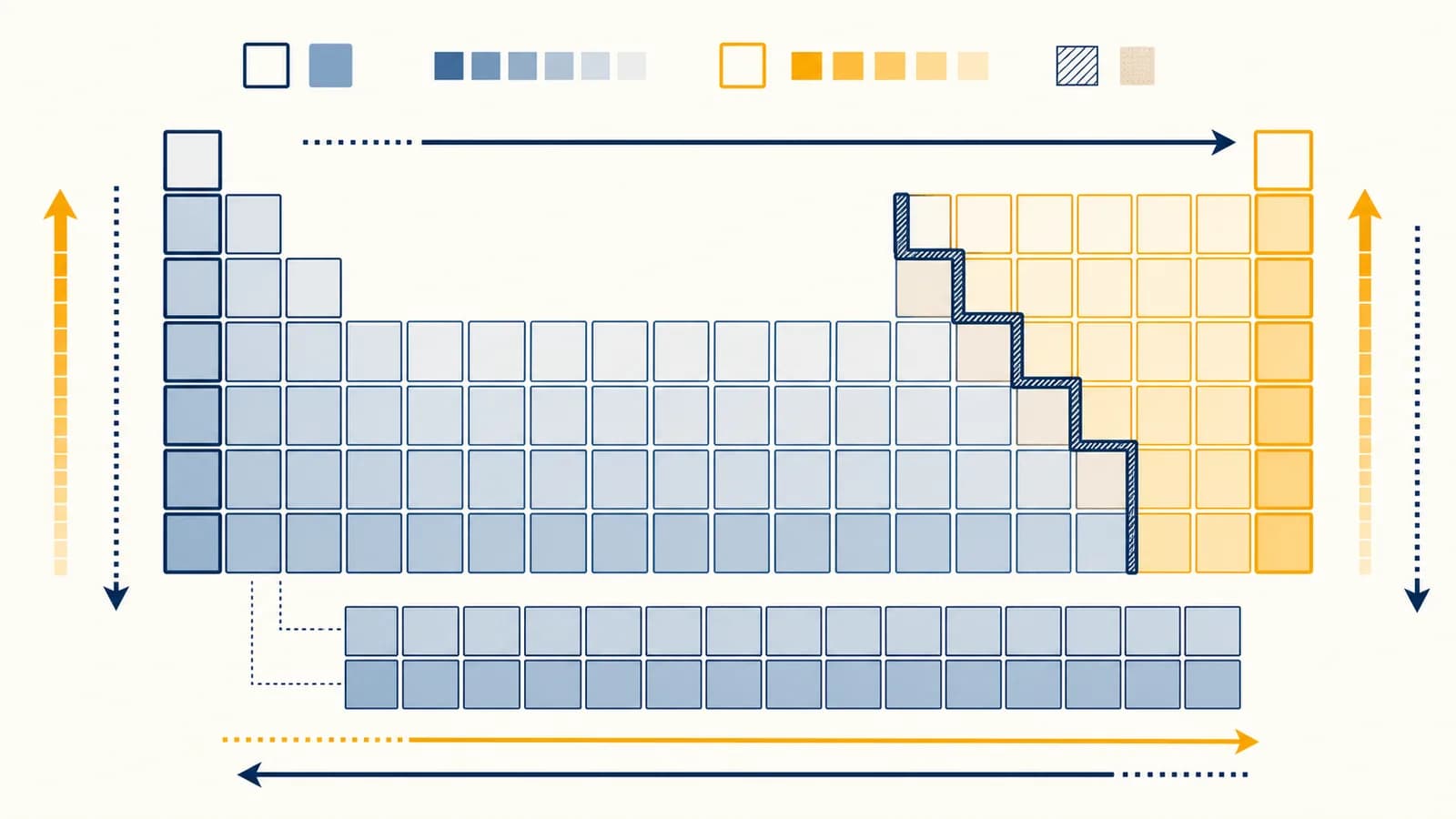
The periodic table is a chart that organizes chemical elements by atomic number and repeating electron patterns, in the context of chemistry. It shows what each element is, how elements are related, and why their chemical properties repeat in predictable cycles. The periodic table exists because scientists need a compact way to predict how atoms will behave, bond, and react. A periodic table of elements usually gives every element's symbol, atomic number, and relative atomic mass. Its rows track electron shells, while its columns group elements with similar outer electrons and often similar chemistry.
Atomic number sets the order. Hydrogen is first because it has 1 proton, helium is second because it has 2, and element 118 is last because it has 118.
This arrangement turns a list of names into a predictive tool. A technician can choose a corrosion resistant metal, a doctor can interpret an electrolyte result, and an engineer can select a semiconductor by reading patterns that begin inside atoms.
What the periodic table actually is
The periodic table is a two-dimensional arrangement of all known chemical elements in increasing atomic number. Each box identifies one element, while its position connects atomic structure to recurring properties such as reactivity, bonding, metallic character, and ion formation.
An element is a substance whose atoms all have the same number of protons. Carbon atoms have 6 protons. Oxygen atoms have 8. Changing the proton count changes the element itself, so an atom with 7 protons is nitrogen even if someone expected to find carbon.
A typical element box contains several pieces of information:
- Atomic number: the number of protons in the nucleus. In a neutral atom, it also equals the number of electrons.
- Chemical symbol: a one or two letter abbreviation, such as C for carbon or Na for sodium. The first letter is uppercase and the second, if present, is lowercase.
- Element name: the standard name used in scientific communication.
- Relative atomic mass: an isotope-weighted mean based on the natural abundances and masses of the element's isotopes. It is often a decimal.
The value 12.011 does not mean every carbon atom has 12.011 particles or that one atom has a fractional mass number. It summarizes a natural mixture dominated by carbon 12, with smaller amounts of other isotopes. Tables may display atomic weights with slightly different precision, and elements without a standard atomic weight are often shown with the mass number of a selected isotope in brackets.
How periods and groups organize the elements
Periods are horizontal rows that track the filling of electron shells, while groups are vertical columns whose elements often have related outer electron arrangements. Position therefore records both an element's proton count and the electron structure behind much of its chemistry.
A period records progress through an electron shell
A period is one horizontal row. The table has seven periods. Moving one box to the right adds one proton to the nucleus and, for a neutral atom, one electron. The properties change across the row because the nuclear charge rises while electrons occupy related energy levels.
Period 3 runs through sodium, magnesium, aluminium, silicon, phosphorus, sulfur, chlorine, and argon. Sodium begins the row as a reactive metal. Silicon near the middle is a metalloid and semiconductor. Chlorine is a reactive nonmetal, and argon ends the row as a largely unreactive noble gas. The sequence is a chemical progression, not a random inventory.
A group identifies a recurring outer pattern
A group is one vertical column, numbered 1 through 18. For the main-group elements, members of a group have the same number of valence electrons, with helium as the familiar special case. Those outer electrons largely control ordinary bonding and reactions.
| Group | Common name | Outer electron pattern | Typical behavior |
|---|---|---|---|
| 1 | Alkali metals | 1 valence electron | Often lose one electron to form ions |
| 2 | Alkaline earth metals | 2 valence electrons | Often lose two electrons to form ions |
| 17 | Halogens | 7 valence electrons | Often gain one electron to form ions |
| 18 | Noble gases | Full outer shell | Usually very unreactive under ordinary conditions |
Transition metals occupy groups 3 through 12. Their partly filled d subshells allow more complicated behavior, including several possible ion charges. Iron commonly forms and , so group position alone does not supply one universal charge for every transition metal.
How atomic structure creates periodic patterns
Periodic patterns arise because electrons occupy quantized shells and subshells, and similar outer electron configurations recur as atomic number increases. Chemical behavior repeats when a new element reaches an outer electron arrangement resembling one found in an earlier period.
Electrons do not circle the nucleus on neat tracks like planets. Quantum mechanics describes orbitals, regions associated with particular electron energies and probability distributions. School-level configurations group these orbitals into s, p, d, and f subshells. Each orbital can hold no more than two electrons with opposite spins.
Consider lithium and sodium. Lithium has the configuration . Sodium has . Sodium has more occupied shells, but each atom has one electron in its outer s subshell. Both tend to lose that electron and form a ion.
A neutral sodium atom loses its outer electron. Its nucleus still has 11 protons, but the ion now has 10 electrons and a net charge of .
The table's shape follows subshell capacity. The s block is two columns wide because an s subshell holds two electrons. The p block is six columns wide because its three orbitals hold six. The d block is ten columns wide, and the f block is fourteen columns wide. The two detached rows belong to periods 6 and 7. They are printed below mainly to keep the chart from becoming too wide.
How to read an element box without mixing up the numbers
Read the atomic number as an exact proton count and the displayed atomic mass as an isotope weighted average unless the table states otherwise. Use proton, neutron, and electron relationships to reconstruct a particular atom or ion from its notation.
The atomic number gives the proton count and identifies the element. An atom with atomic number 17 is chlorine.
Use the mass number if one is supplied. For chlorine 37, the mass number is 37, so the neutron count is .
A neutral chlorine atom has 17 electrons. A chloride ion, , has gained one, so it has 18 electrons.
The compact isotope notation packages all of this information. The lower left number is atomic number, the upper left is mass number, and the upper right is charge.
For , the calculation is neutrons.
Rounding the periodic table's decimal atomic mass can sometimes suggest the mass number of the most abundant isotope, but that is a shortcut, not a definition. It can fail, and it cannot tell you which isotope a sample contains. Use an explicit isotope label whenever an exact neutron count is required.
Atomic number versus atomic mass
Atomic number counts protons and fixes an element's identity, whereas relative atomic mass compares the average mass of its naturally occurring isotope mixture with one twelfth of a carbon 12 atom's mass. One is an integer identifier, while the other is usually a decimal average.
Carbon's atomic number is always 6 because every carbon nucleus has 6 protons. If the proton count changes, the atom is no longer carbon.
Carbon's standard atomic weight is about 12.011 because natural carbon contains isotopes in unequal proportions. The value describes a population, not one atom.
Isotopes are atoms of one element with different neutron counts. Carbon 12 has 6 neutrons, carbon 13 has 7, and carbon 14 has 8. Their chemistry is broadly similar because neutral atoms of all three have the same electron arrangement. Their nuclear stability and mass differ.
A weighted mean explains the decimal. Suppose a fictional element exists as 75% isotope A with relative mass 10 and 25% isotope B with relative mass 11. Its average is visible in the calculation below.
A table would show 10.25 for this invented mixture, even though no individual atom has a mass number of 10.25.
Relative atomic mass has no unit because it is a ratio. Molar mass is numerically related but carries units such as grams per mole. This connection lets a chemist move from the table to measurable laboratory quantities, a calculation developed further in using mole ratios and stoichiometric calculations.
How periodic trends work across the table
Periodic trends are predictable changes in atomic size, ionization energy, electron attraction, and metallic character across periods and down groups. They result from competition between increasing nuclear charge, electron shielding, and the distance of valence electrons from the nucleus.
Atomic radius generally shrinks across a period
Moving left to right, the nucleus gains protons while added electrons enter the same main shell. Inner electron shielding changes less than nuclear charge does. The stronger effective attraction pulls the electron cloud inward, so atomic radius generally decreases.
Atomic radius generally grows down a group
Moving down adds an occupied electron shell. The outer electrons sit farther from the nucleus and are shielded by more inner electrons. Even though the nucleus contains more protons, the increased distance and shielding usually make the atom larger.
Ionization energy generally rises across a period
First ionization energy is the energy required to remove one electron from each atom in a mole of gaseous atoms. Stronger attraction between nucleus and valence electrons makes removal harder, so the general trend rises across a period and falls down a group. Subshell structure creates real exceptions.
Electronegativity points toward fluorine
Electronegativity describes an atom's tendency to attract shared electrons in a bond. It generally increases toward the upper right of the table, excluding noble gases in many classroom treatments. Fluorine has the strongest attraction on the commonly used Pauling scale.
Trends are directions, not flawless staircases. Electron pairing, subshell energies, oxidation state, and the definition used for atomic radius produce exceptions. Use a trend to explain a comparison, then check actual data when a decision depends on the value.
These trends make predictions possible. Potassium lies below sodium in group 1, so its valence electron is farther from the nucleus and easier to remove. Potassium is therefore generally more reactive than sodium with water. Chlorine lies above bromine in group 17, so its smaller atoms attract an added electron more strongly in many reactions.
Metals versus nonmetals and metalloids
Metals usually conduct heat and electricity and tend to lose electrons, nonmetals are generally poorer conductors and often gain or share electrons, and metalloids show intermediate or condition-dependent properties. The categories occupy broad regions, not perfectly sharp borders.
Metals cover the left side and center of the table. Their valence electrons can often move through a solid lattice, which helps explain electrical conductivity, metallic shine, and the ability to deform without shattering. These are broad patterns. Mercury is liquid at ordinary room conditions, and some metals are brittle.
Nonmetals occupy the upper right, with hydrogen placed at the upper left because of its electron configuration even though it is a nonmetal. Nonmetals include gases such as oxygen, a liquid such as bromine under ordinary room conditions, and solids such as carbon and sulfur. Their diverse structures produce diverse physical properties.
Metalloids sit near the stepped boundary between metals and nonmetals. Lists differ slightly, but silicon and germanium are standard examples. Their conductivity can be controlled by temperature and by adding small amounts of other elements. That behavior makes silicon useful in electronic devices.
A chip manufacturer adds carefully controlled dopants to silicon. Phosphorus, with one more valence electron than silicon, can supply mobile electrons. Boron, with one fewer, can create mobile electron vacancies called holes. Periodic table position predicts why each dopant changes conductivity.
Labels do not replace measurements. Carbon as diamond is an electrical insulator, while carbon as graphite conducts along its layers. The element is the same, but the atoms connect in different structures. Periodic position predicts tendencies; bonding and structure determine the final material.
How periodic table patterns predict bonds and reactions
Periodic table position predicts the number and behavior of valence electrons, which helps identify likely ion charges, bond types, formulas, and reaction partners. The prediction works best for main group elements and must be refined for transition metals and unusual compounds.
Sodium in group 1 tends to lose one electron. Chlorine in group 17 tends to gain one. The transfer gives and , whose opposite charges attract in an ionic crystal. Charge balance requires one of each, producing .
Magnesium in group 2 tends to form . Chloride remains . Two chloride ions are needed to balance one magnesium ion, so the neutral formula is .
The subscripts record the smallest whole number ratio that gives zero overall charge.
Two nonmetals often share electrons in covalent bonds instead of transferring them completely. Oxygen has six valence electrons and commonly forms two bonds. Hydrogen has one electron and commonly forms one bond. These tendencies support the familiar formula , though molecular shape and bond polarity require more information than a simple group rule.
The table helps propose reactants and products, but it does not show reaction rate, temperature, concentration, or activation barrier. Those factors decide whether a possible process happens under the conditions present. The next layer is how chemical reactions rearrange atoms, where equations track the same elements before and after change.
How the periodic table shows up in labs, medicine, and technology
The periodic table guides the selection, detection, and control of elements in real materials. Laboratory analysts use elemental signatures, clinicians monitor biologically active ions, and engineers combine elements whose electron structures give useful conductivity, strength, color, or resistance to corrosion.
Laboratories identify elements by characteristic signals
Atoms absorb and emit particular energies because their electron energy levels are quantized. In atomic spectroscopy, a sample's spectral lines can reveal which elements are present. Instruments can also separate ions by mass-to-charge ratio, allowing analysts to distinguish elements and isotopes. These measurement methods turn periodic identity into evidence about an unknown sample.
Medicine depends on element-specific behavior
Sodium and potassium ions help establish electrical gradients across cell membranes. Calcium is involved in bone mineral, muscle contraction, and cellular signaling. Iron in hemoglobin helps bind and transport oxygen. These functions depend on ion charge, size, electron structure, and molecular surroundings, not on an element name alone.
A blood test reports sodium concentration because sodium ions help regulate fluid balance and nerve signaling. The periodic table explains why sodium commonly exists as ; clinical interpretation also needs physiology, concentration ranges, symptoms, and the laboratory method.
An element can be useful in one chemical form and dangerous in another. Chloride is a normal electrolyte, while elemental chlorine is a reactive gas. The table identifies chlorine in both substances, but oxidation state, bonding, dose, and route of exposure determine their effects.
Engineers choose elements by periodic properties
Copper conducts electricity well and can be drawn into wire. Aluminium combines low density with a protective oxide surface. Chromium added to steel helps produce a passive oxide layer that resists further corrosion. Lithium's small mass and electrochemical behavior make it useful in rechargeable cells, a connection developed in electron transfer in batteries and electrochemical cells.
Materials design rarely selects one element in isolation. Alloy composition, crystal structure, heat treatment, impurities, and surface conditions all matter. The periodic table narrows the possibilities by showing which atoms have related sizes and electron behavior. Testing then establishes whether the material meets the job.
4 mistakes people make with the periodic table
Most periodic table errors come from treating a compact pattern as a set of absolute rules. The common failures are confusing mass with identity, treating group trends as guarantees, reading group number as universal valence, and assuming an element's properties carry unchanged into every compound.
1. Treating relative atomic mass as a particle count
A decimal such as chlorine's standard atomic weight near 35.45 is an isotope weighted average, not the proton plus neutron count of one atom. A specific chlorine atom has a whole number mass number. Use isotope notation to count its neutrons.
2. Assuming every trend has no exceptions
Trends summarize the dominant effects of nuclear charge, shielding, and distance. Real electron configurations introduce departures. If a question asks for a general comparison, explain the trend. If a laboratory choice depends on an exact melting point or ionization energy, consult measured data.
3. Converting every group number directly into a charge
The simple charge rules work well for many main-group ions, such as group 1 metals forming ions. They do not mean carbon always forms , or that every transition metal has one charge. Bonding context matters.
4. Confusing an element with its compounds
Sodium metal reacts strongly with water, and chlorine gas is toxic. Sodium chloride is a stable ionic compound used as table salt. A compound has a new structure and new properties. It is not a physical blend of the elemental substances.
The periodic table gives a complete recipe for how every substance behaves.
It gives atomic identity and powerful trends. Bonding, structure, quantity, and conditions complete the explanation.
A good prediction names both the periodic clue and its limit. For example: potassium should lose its outer electron more easily than sodium because that electron is farther from the nucleus, but an actual reaction comparison must use controlled conditions.
Why are hydrogen and helium unusual?
Hydrogen and helium sit in period 1 because their electrons occupy the first shell, but each has chemistry that does not fit every feature of its column. Their positions reflect electron configuration while also exposing the limits of simple family labels.
Hydrogen has one electron, , so it appears above group 1. It can lose that electron as alkali metals do, but it is a nonmetal and can also gain an electron or share electrons in covalent bonds. Some alternative tables display hydrogen separately or show its relationship to group 17.
Helium has two electrons, , which fills the first shell completely. It appears in group 18 because its closed shell and low reactivity resemble the noble gases, even though its configuration lacks the pattern found in the other members.
Why are the lanthanides and actinides placed below?
Lanthanides and actinides are displayed below the main table to save horizontal space, not because they belong outside periods 6 and 7. They form the f block, where electrons are added mainly to 4f and 5f subshells.
Lanthanum or lutetium and actinium or lawrencium are placed differently in some table designs because scientists use different conventions for the boundaries of the f block and group 3. The underlying atomic numbers do not change. A layout choice should not be mistaken for uncertainty about the elements' identities.
Lanthanides have closely related chemical behavior because their differentiating electrons occupy inner 4f orbitals. Their subtle differences matter in magnets, lighting materials, catalysts, and optical devices. Actinides are all radioactive. Uranium and plutonium are familiar examples, but radioactivity is a nuclear property rather than a consequence of ordinary valence bonding.
How are new elements named and added?
A claimed new element must be produced and identified with convincing experimental evidence before international scientific bodies accept its discovery. After review, a proposed name and symbol pass through a formal process, and the accepted element receives its permanent place by atomic number.
Very heavy elements are made through nuclear reactions, often by accelerating nuclei into targets. The products may exist for only a short time, so researchers identify them through characteristic chains of radioactive decay rather than by collecting a visible lump. Independent scrutiny matters because the events can be rare and difficult to distinguish from background signals.
The International Union of Pure and Applied Chemistry, commonly called IUPAC, standardizes element names and symbols. Before a permanent name is accepted, systematic temporary names can be used. A new element does not create a spare slot wherever its discoverers prefer. Its proton count fixes its position.
Dmitri Mendeleev organized known elements mainly by atomic weight and chemical behavior, leaving gaps for elements not yet discovered.
Henry Moseley's X-ray measurements connected element identity to nuclear charge, establishing atomic number as the basis of the modern sequence.
IUPAC approved the names nihonium, moscovium, tennessine, and oganesson for elements 113, 115, 117, and 118.
Mendeleev's success was not that his first layout looked exactly like today's table. He treated periodic behavior as evidence strong enough to reveal gaps and correct some doubtful values. Modern nuclear physics changed the ordering variable from atomic weight to atomic number, while preserving the larger insight that properties recur systematically.
The periodic table turns atomic structure into chemical predictions
The periodic table connects the proton count that defines each element with the electron arrangements that govern bonding and reactivity. Reading those connections turns a chart of symbols into a working model for explaining substances throughout the wider study of Chemistry.
Start any unfamiliar element with four checks: locate its atomic number, identify its group and period, decide whether it is a metal, nonmetal, or metalloid, and infer its likely valence behavior. Then test the inference against the actual compound and conditions.
The takeaway: Position is compressed evidence. Across a row, rising nuclear charge reshapes electron attraction. Down a column, added shells change size and shielding. Those two directions explain much of the repeating chemistry.
Look at an ingredient label, a battery specification, a laboratory report, or the metal markings on a tool. Find one element on the table and explain its use through proton count, electron configuration, likely ion, or periodic trend. That move, from location to mechanism to evidence, is what makes the table useful.