Solutions and solubility is a branch of chemistry that explains how substances mix uniformly and how much solute can dissolve in a solvent under stated conditions. A solution contains particles dispersed at the molecular or ionic scale, while solubility is the maximum concentration possible at equilibrium. People searching for “what is a solution,” “solute versus solvent,” or “how temperature affects solubility” are asking about the same particle process. The idea exists because mixing changes which particles can meet and react, so it helps us predict medicines, drinks, water treatment, laboratory tests, and many other chemical systems.
What a solution actually is
A solution is a homogeneous mixture in which one or more solutes are distributed as molecules or ions throughout a solvent. Every small sample has the same composition, provided the solution has been mixed and no material is settling or separating.
The solvent is the component that acts as the dissolving medium. The solute is the substance dissolved in it. In salt water, water is the solvent and sodium chloride is the solute. These roles describe the mixture, not a permanent identity. Water can be a solute when a small amount of it dissolves in another liquid.
A solution does not have to be a liquid. Air is a gas solution containing nitrogen, oxygen, argon, carbon dioxide, and other gases. Brass is a solid solution in which zinc atoms are distributed through copper. The shared feature is uniformity at the scale being considered, not the physical state.
Dissolved particles are individual molecules or ions. They do not settle under gravity, and ordinary filter paper cannot separate them from the solvent.
Particles remain as larger pieces. Muddy water can settle, and a suitable filter can trap the solid particles.
Milk and fog add a third case: a colloid. Its particles are larger than dissolved molecules but small enough to remain dispersed for a long time. A beam of light can become visible as colloid particles scatter it. Sugar water does not show that same scattering under ordinary conditions because its sugar molecules are much smaller.
How dissolving works
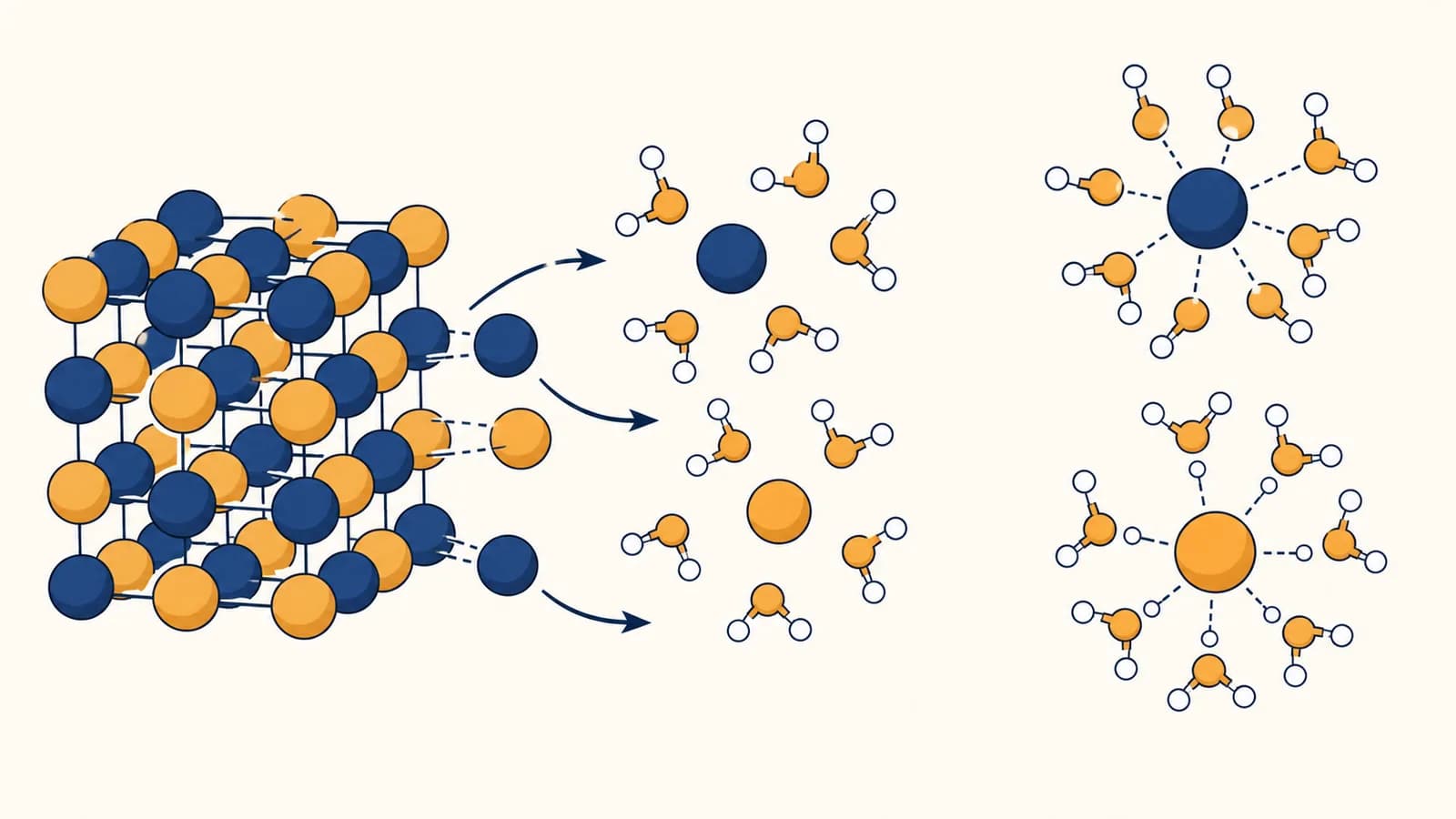
Dissolving occurs when attractions between solute and solvent particles compensate for the attractions that must be broken within the pure substances. Solvent particles surround separated solute particles, spread them through the mixture, and keep them moving in random thermal motion.
Consider sodium chloride entering water. In the crystal, positive sodium ions and negative chloride ions attract one another. Water molecules are polar: their oxygen ends carry a partial negative charge, and their hydrogen ends carry partial positive charges. Water molecules collide with the crystal surface and orient around exposed ions.
Some attractions holding the solute together must be overcome. For an ionic crystal, ions must be pulled away from the crystal lattice.
Solvent particles move apart locally. This also requires energy because solvent particles attract one another.
New attractions form as solvent particles surround each solute particle. This process is called solvation, or hydration when water is the solvent.
Random molecular motion carries solvated particles away from the surface, allowing more solute to contact fresh solvent.
The energy balance helps explain the rough rule “like dissolves like.” Polar solvents tend to dissolve ionic and polar solutes because they can make strong charge based attractions. Nonpolar solvents tend to dissolve nonpolar solutes through weaker temporary attractions. The rule predicts tendencies, not certainties. Molecular size, temperature, crystal structure, and the exact balance of attractions also matter.
Oil and water separate because water molecules attract one another strongly through hydrogen bonding, while oil molecules are mostly nonpolar. Replacing contacts between water molecules with contacts between water and oil is unfavorable. Soap changes the situation. Each soap ion has a water compatible head and an oil compatible tail, so many soap particles can surround an oil droplet and carry it through water as an emulsion.
Solubility versus concentration
Solubility is the greatest equilibrium amount of a solute that can dissolve under specified conditions, while concentration is the amount currently present per quantity of solution or solvent. A concentrated solution can be unsaturated, and a dilute solution can be saturated.
A solution is unsaturated if more solute can dissolve at the current temperature and pressure. It is saturated when dissolved solute is in dynamic equilibrium with undissolved solute. At saturation, particles continue leaving and returning to the solid surface, but the two rates are equal, so concentrations no longer change.
The word concentrated only compares the amount of solute with the amount of solution. It does not say how close the mixture is to its solubility limit. Suppose substance A can dissolve up to 100 grams per litre but is present at 40 grams per litre. Substance B can dissolve only 2 grams per litre and is present at that limit. A is more concentrated, but B is saturated.
Saturation is conditional. A solution is not simply “saturated.” It is saturated with a named solute at a stated temperature and pressure.
Solubility is usually reported with units, such as grams of solute per 100 grams of water at a given temperature, or moles per litre under stated conditions. The choice changes the numerical value. Always read the units before comparing substances or using a solubility graph.
How temperature and pressure control solubility
Temperature changes solubility by shifting the energy balance of dissolving, while pressure strongly affects gases because gas particles can be compressed. Most solid solutes become more soluble as temperature rises, but exceptions exist because each dissolving process has its own energy change.
If dissolving absorbs heat overall, heating generally favors more dissolved solute. If dissolving releases heat overall, heating can favor the undissolved state and lower solubility. This is an application of energy accounting in chemical systems. A solubility curve is evidence for a particular substance, not permission to assume that every curve slopes upward.
Gases usually become less soluble in liquids as temperature rises. Faster moving dissolved gas molecules escape the liquid more readily, and many gas dissolving processes release heat. Warm carbonated drink loses carbon dioxide faster than the same drink kept cold. Warm water also tends to hold less dissolved oxygen, which can affect aquatic organisms.
For a gas that does not react strongly with its solvent, Henry’s law states that dissolved gas concentration is proportional to the gas pressure above the liquid at constant temperature.
If pressure doubles while temperature and the gas solvent pair remain unchanged, the equilibrium dissolved concentration doubles.
A sealed bottle of carbonated drink has carbon dioxide at elevated pressure above the liquid. Opening it lowers that pressure. The old dissolved concentration is now above the equilibrium amount, so gas leaves as bubbles. Shaking provides many small bubble surfaces where carbon dioxide can collect, which speeds the visible release after opening.
A scuba diver breathes compressed air at depth, where higher gas pressure causes more nitrogen to dissolve in body tissues. A slow ascent gives that nitrogen time to leave gradually. A rapid pressure drop can allow bubbles to form in tissues and blood, producing decompression sickness.
Pressure has little effect on the solubility of most solids and liquids because their particles are already packed closely and their volumes change very little under ordinary pressure changes. Heating, pressure, and stirring therefore cannot be treated as three interchangeable ways to “make more dissolve.”
How concentration is measured and calculated
Concentration measures solute amount relative to solution volume, solvent mass, or total mixture amount. Molarity is common in laboratories because it connects measurable volume to moles of reacting particles, while mass percent and parts per million suit products and trace contaminants.
Molarity is moles of solute divided by litres of total solution. The denominator is not litres of solvent. A chemist preparing a solution dissolves the solute first, then adds solvent until the final solution reaches the marked volume.
Dissolving 0.50 mol of glucose to make 2.00 L of solution gives .
Moles connect concentration to particle count and reaction ratios. If 25.0 millilitres of a 0.200 molar solution is used, first convert the volume to 0.0250 litres. The amount is . A reaction equation can then connect those moles to another substance through mole ratios and stoichiometric calculations.
Mass percent is useful when masses are easier to measure than volumes. It compares solute mass with total solution mass.
Mixing 10 g of salt with 90 g of water makes 100 g of solution, so the concentration is by mass.
For very small concentrations, parts per million provides a convenient scale. On a mass basis, one part per million means one part solute per one million parts mixture. In dilute water solutions with density close to one gram per millilitre, one milligram per litre is approximately one part per million. The approximation should not be carried into concentrated or unusually dense liquids.
Dilution lowers concentration by adding solvent without changing the moles of solute. The starting and final amounts of solute are equal, which gives the standard dilution relation.
To make 250 mL of 0.100 M solution from 1.00 M stock, use of stock, then dilute to 250 mL.
How solutions show up in laboratories, medicine, and daily products
Solutions provide controlled compositions, transport dissolved substances, and bring reacting particles into contact. Laboratories use them for measured reactions, medicine uses them to deliver doses, and households rely on them in cleaners, drinks, dyes, fuels, and metal treatments.
In a laboratory, a standard solution has an accurately known concentration. It can be delivered from calibrated glassware to measure an unknown amount through titration. Indicators or electronic sensors reveal when the reacting amounts match. The calculations depend on both concentration and the balanced equation, not on colour change alone.
Medical solutions require control of chemical identity, concentration, purity, and sterility. An intravenous liquid also needs a suitable dissolved particle concentration so that water does not move dangerously into or out of blood cells by osmosis. A label such as mass per volume must be read according to its stated units, because a percentage without a basis can be ambiguous.
Cleaning products use solubility in several ways. Water dissolves many ionic and polar soils. Alcohols can dissolve some substances that water handles poorly, while surfactants help disperse grease. Builders bind metal ions that would otherwise interfere with cleaning. Product instructions matter because mixing cleaners can cause reactions, not simply stronger dissolving.
Water treatment operators adjust conditions so unwanted material either stays dissolved for controlled removal or becomes an insoluble solid that can be filtered. They also measure dissolved ions because water that looks clear can still contain substantial solute. Clarity reports the absence of large suspended particles, not chemical purity.
Never taste an unknown solution. A clear, colourless liquid may contain corrosive, toxic, or otherwise harmful dissolved substances.
Food preparation offers familiar evidence. Sugar dissolves faster in hot tea, but cooling may allow crystals to form if the mixture contains more dissolved sugar than the cooler liquid can support. Salt changes flavour and also affects water movement in foods. Extracting coffee depends on dissolving selected compounds from ground beans, so temperature, contact time, particle size, and solvent amount all alter the result.
How precipitation and selective solubility work
Precipitation occurs when dissolved ions combine to form a solid whose solubility limit is exceeded. Chemists use differences in solubility to identify ions, purify materials, soften water, treat waste, and separate a desired product from a reaction mixture.
Mixing two clear solutions can produce a cloudy solid. For example, silver ions and chloride ions form sparingly soluble silver chloride. The other dissolved ions may remain in solution as spectators. A net ionic equation shows only the particles that change:
The symbols identify dissolved ions as aqueous and the precipitate as solid.
At a deeper level, precipitation competes with dissolving. For a sparingly soluble salt, the ion product depends on the concentrations of its ions. If that product exceeds the equilibrium solubility product, solid formation is favored until equilibrium returns. Adding an ion already present in the solid can therefore reduce solubility, an effect called the common ion effect.
Acidity can also change solubility. Carbonate minerals dissolve more readily when acid removes carbonate ions by converting them into other species. This connection is developed further through proton transfer and pH. The result explains why a solubility statement without chemical conditions can be incomplete.
A technician testing water can add a reagent that forms a low solubility solid with a target ion. The precipitate may be filtered and weighed, or its cloudiness may be compared with standards. Interfering ions and incomplete precipitation must be controlled for a trustworthy result.
Crystallization uses the same equilibrium in reverse. A hot solution is prepared with a solute whose solubility falls substantially on cooling. As the liquid cools, excess solute forms ordered crystals while many soluble impurities remain in the liquid. Washing and drying the crystals completes the separation.
Four mistakes people make with solubility
Most mistakes about solubility come from confusing rate with capacity, ignoring conditions, or treating all mixtures as if their particles behaved alike. Correct reasoning separates how fast dissolving happens, how much can dissolve, and what equilibrium state the mixture reaches.
1. Stirring increases the solubility limit
Stirring usually increases the rate of dissolving, not the equilibrium solubility. It moves saturated liquid away from a solid surface and brings fresh solvent into contact. Once equilibrium is reached at unchanged temperature and pressure, stirring does not create a larger final dissolved amount.
2. Crushing a solid makes more of it soluble
Crushing increases surface area, so more solvent particles can collide with the solid each second. The solid generally dissolves faster, but the final equilibrium concentration remains the same if temperature, pressure, and chemical conditions stay fixed. Fine sugar and a sugar cube illustrate rate, not capacity.
3. A disappearing solid has vanished
Dissolved matter remains present as particles and still contributes mass. If 5 grams of salt dissolves in 95 grams of water without loss, the solution has a mass of 100 grams. Evaporating the water can recover the salt, provided no reaction or physical loss occurs.
4. Every clear liquid is a pure substance
Uniform appearance cannot distinguish pure water from a colourless solution. Dissolved salt is invisible to the unaided eye, yet it changes conductivity, boiling behavior, and evaporation residue. Identifying purity requires measurements tied to composition, not a visual judgment.
Stir the mixture, crush the solid, or increase contact between solute and solvent. These actions affect how quickly equilibrium is approached.
Change temperature, gas pressure, solvent identity, or a chemical condition such as pH. These actions can change the equilibrium itself.
A good diagnostic habit is to name the variable before predicting the result. Ask whether the change affects collision rate, particle attractions, energy balance, or equilibrium composition. That single distinction prevents many incorrect explanations.
What electrolytes actually are
Electrolytes are substances that produce mobile ions when dissolved or melted, allowing the liquid to conduct electric current. Strong electrolytes form ions almost completely in solution, while weak electrolytes form ions only partially and nonelectrolytes remain mainly as neutral molecules.
Solid sodium chloride does not conduct through moving ions because its ions are locked in a crystal lattice. Once dissolved, hydrated sodium and chloride ions can move toward oppositely charged electrodes. That particle motion carries charge through the liquid. The electron transfer at electrodes belongs to cells, electrodes, and electrochemical reactions.
Sugar dissolves well in water but its molecules remain neutral, so sugar solution conducts poorly compared with a salt solution of similar concentration. Solubility and conductivity therefore answer different questions. Solubility asks how much enters solution. Conductivity asks how many mobile charged particles are present and how freely they move.
Particle comparison: one formula unit of sodium chloride separates into two ions in dilute water, while one glucose molecule remains one neutral dissolved molecule.
Ion concentration also affects boiling point, freezing point, and osmotic pressure. These colligative properties depend mainly on the number of dissolved particles rather than their chemical identity in an ideal dilute solution. Actual ionic solutions can depart from ideal behavior because charged particles interact with one another.
How supersaturated solutions store an unstable excess
A supersaturated solution contains more dissolved solute than the stable equilibrium amount at its current conditions. It can persist temporarily if crystals have no suitable place to begin growing, but a seed crystal or disturbance may trigger rapid crystallization.
One preparation method dissolves a large amount of solid in hot solvent, then cools the clear solution carefully. If the container is clean and undisturbed, the excess solute may remain dispersed even though the cooler equilibrium favors a solid. The solution is metastable, meaning it is caught in a temporary state rather than at the lowest available free energy.
Crystallization requires nucleation, the formation of a tiny organized starting structure. A scratch, dust particle, or seed crystal can provide a surface on which solute particles align. Once a stable nucleus forms, additional particles attach and the crystal can grow quickly.
Reusable hand warmers containing sodium acetate demonstrate the process. Flexing a metal disc initiates crystallization, and the phase change releases heat to the surroundings. Heating the pack dissolves the crystals again so the cycle can be repeated. The device links solubility, energy transfer, and phase equilibrium in one visible event.
How gas bubbles differ from boiling
Gas bubbles can form because a dissolved gas leaves solution, because a chemical reaction produces gas, or because the liquid boils. These processes may look similar, but pressure, temperature, bubble composition, and the source of the gas distinguish them.
Opening carbonated water releases dissolved carbon dioxide because the pressure above the liquid falls. Dropping an effervescent tablet into water produces gas through chemical reactions. Boiling creates bubbles of the liquid’s own vapor when its vapor pressure matches the external pressure. Only the third process requires the boiling condition.
Small bubbles seen while cold tap water warms are often dissolved air leaving solution before the water boils. As temperature rises, gas solubility falls and bubbles collect at scratches on the container. Observing where bubbles begin, when they appear, and whether the liquid is at its boiling temperature helps identify the mechanism.
Solutions connect particle behavior to usable chemistry
Solutions turn microscopic attractions and random motion into measurable concentration, conductivity, reaction rate, and equilibrium. Learning to track particles, conditions, and units makes solution behavior predictable across the wider study of Chemistry and in practical decisions.
The next time a solid dissolves, a drink fizzes, scale forms on a tap, or crystals appear after cooling, separate four questions. What particles are present? What attracts them? Has the system reached equilibrium? Which condition changed? Those questions lead from an observation to a mechanism.
The takeaway: dissolving is a particle level rearrangement, solubility is an equilibrium limit under stated conditions, and concentration tells how much solute is actually present. Keep those three ideas separate, then reconnect them to explain what the mixture does.
Practice with something safe and familiar: compare how equal spoonfuls of sugar dissolve in equal volumes of cold and warm water while keeping stirring and crystal size the same. Record time separately from final capacity. The experiment makes the distinction between dissolving rate and solubility visible.