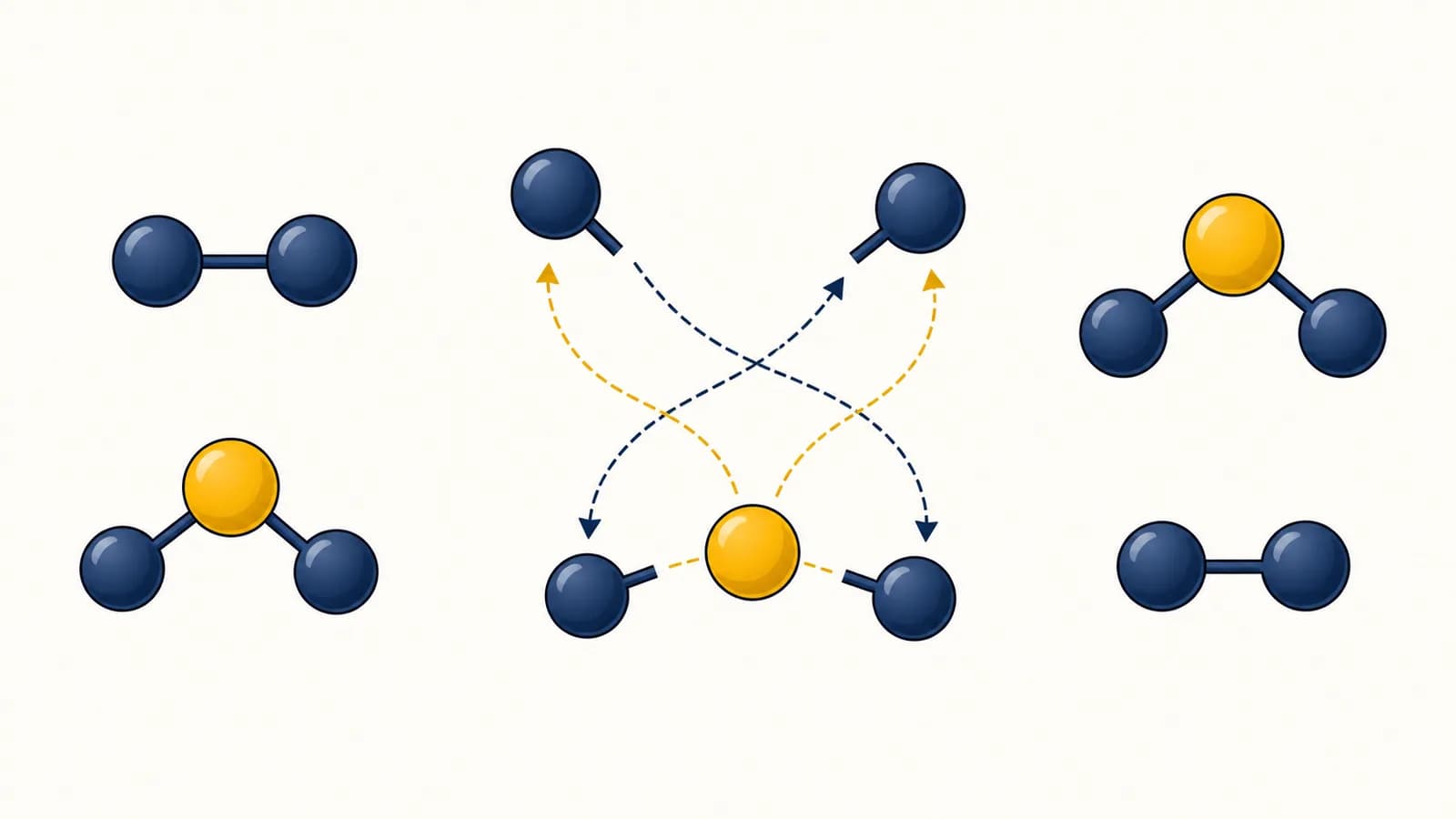
A chemical reaction is a process that rearranges atoms by breaking and forming chemical bonds, in the context of chemistry and material change. A chemical reaction turns reactants into products without creating or destroying atoms. It explains how fuel burns, iron rusts, food cooks, batteries deliver current, and cells release energy. Chemical equations describe these changes, while reaction types, rates, energy transfers, and equilibrium explain how they actually happen. The idea exists because chemists need a precise way to track matter as substances become other substances.
A reaction can be dramatic, like a flame, or almost invisible, like dissolved oxygen slowly corroding a pipe. The reliable clue is not noise, color, or heat by itself. It is a change in chemical identity: the atoms have new partners and the resulting substances have different structures and properties.
What a chemical reaction actually is
A chemical reaction is a transformation in which the nuclei of atoms remain the same but their electrons and bonds are reorganized. The starting substances are reactants, the resulting substances are products, and every atom present before the reaction remains accounted for afterward.
Consider hydrogen burning in oxygen. Hydrogen molecules contain pairs of hydrogen atoms, and oxygen molecules contain pairs of oxygen atoms. During the reaction, bonds inside those molecules are broken and new oxygen to hydrogen bonds form. The product is water, whose molecules behave very differently from either gas.
The symbols in an equation summarize this particle story. A plus sign separates substances on the same side, and an arrow means “reacts to form.” State symbols add useful physical information: (s) means solid, (l) means liquid, (g) means gas, and (aq) means dissolved in water.
Two hydrogen molecules and one oxygen molecule contain four hydrogen atoms and two oxygen atoms, exactly matching the two water molecules produced.
The coefficients describe ratios, not a compulsory batch size. The equation also means two moles of hydrogen react with one mole of oxygen to produce two moles of water. A mole is a counting unit for particles, so the same ratio works at the molecular scale and on a laboratory balance.
The bonds involved make sense through how chemical bonds form. A reaction is possible only if the new arrangement of electrons is accessible under the conditions, and its observable outcome also depends on energy, rate, and competing reactions.
How atoms and electrons move during a reaction
Atoms move during collisions, while valence electrons shift between or around them to make new bonds. A successful collision must bring the right particles together with enough energy and a suitable orientation, after which the system can pass through an unstable transition arrangement.
Random thermal motion brings molecules, ions, or atoms close enough for their electron clouds to interact.
The collision distorts existing bonds. If the particles lack sufficient energy or meet in an unhelpful orientation, they separate unchanged.
At the transition state, old bonds are partly broken and new bonds are partly formed. This high energy arrangement exists too briefly to isolate in an ordinary reaction vessel.
The atoms settle into new bonding arrangements, and energy is transferred between chemical stores and the surroundings.
Electron transfer is especially clear in oxidation and reduction. When magnesium burns, each magnesium atom loses two electrons and becomes a magnesium ion. Oxygen atoms gain those electrons and become oxide ions. The oppositely charged ions assemble into solid magnesium oxide.
Multiplying the magnesium half equation by two makes four electrons lost and four gained, so charge as well as atoms is conserved.
Many reactions do not transfer electrons completely. In a reaction between covalent molecules, electron density may shift as bonds break and form. Chemists draw curved arrows to track electron pairs because those electrons determine which bonds change. The nuclei follow the changing electrical attractions.
How chemical equations keep matter and charge accounted for
A balanced chemical equation has the same number of atoms of each element and the same total charge on both sides. Balancing changes coefficients in front of formulas, never subscripts inside formulas, because a subscript change would name a different substance.
Take the combustion of propane, a component of bottled fuel. Begin with the correct formulas: propane is , oxygen is , carbon dioxide is , and water is . Then balance one element at a time.
Three carbon atoms in propane require three carbon dioxide molecules.
Eight hydrogen atoms require four water molecules.
The products now contain ten oxygen atoms, so the reactants require five oxygen molecules.
This sequence fixes one element count at a time while leaving each compound intact. A final recount is essential because balancing a later element can affect totals established earlier.
Count both sides: 3 carbon atoms, 8 hydrogen atoms, and 10 oxygen atoms.
Balancing expresses conservation of mass. In a closed vessel, the total mass does not change during an ordinary chemical reaction. If a burning candle seems to lose mass, gaseous products have escaped into the room and oxygen from the room has entered the reaction. The candle alone is not a closed system.
Do not fix an equation by changing a subscript. Turning into changes water into hydrogen peroxide. Put whole number coefficients in front of intact chemical formulas instead.
For ionic equations, charge must balance too. In the reaction , a positive and a negative ion combine into a neutral solid. Ions that remain unchanged can be removed from a complete ionic equation as spectator ions.
Physical change versus chemical reaction
A physical change alters state, shape, size, or mixture without changing molecular identity, while a chemical reaction produces substances with new bonding arrangements. Melting ice is physical because its molecules remain water; splitting water into hydrogen and oxygen is chemical.
Liquid water boiling into steam changes spacing and motion between water molecules. Each molecule still contains two hydrogen atoms bonded to one oxygen atom.
An electric current passing through suitable water can produce hydrogen and oxygen gases. Bonds within water molecules break and different molecules form.
Observations can provide evidence, but none is an infallible test by itself. Bubbles may mean a gas has formed in a reaction, or they may simply be a dissolved gas escaping when a bottle is opened. A temperature change may come from a reaction, dissolving, or an external heater. A color change may reflect a new substance, dilution, or a change in lighting.
| Observation | Possible chemical explanation | Nonreaction alternative |
|---|---|---|
| Gas bubbles | A gaseous product forms | Boiling or dissolved gas escapes |
| Solid appears | An insoluble precipitate forms | A dissolved substance crystallizes as water evaporates |
| Temperature changes | Reaction transfers energy as heat | Heating, cooling, or dissolving causes the change |
| Color changes | A product absorbs different wavelengths | Concentration or illumination changes |
The strongest conclusion combines several observations with identification of the substances. A chemist might filter a new solid, measure its melting behavior, or analyze the wavelengths of light it absorbs. Evidence supports a chemical reaction when it shows that chemical identity changed.
How energy and collision conditions control reactions
Energy changes determine what a reaction transfers to its surroundings, while collision conditions and activation energy influence how quickly it proceeds. Bond energies explain the overall transfer; temperature, concentration, surface area, pressure, and catalysts change the frequency of successful molecular events.
How reaction energy works
Reaction energy is the net result of energy absorbed to break or weaken reactant bonds and energy released when product bonds form. An exothermic reaction transfers energy to the surroundings overall, while an endothermic reaction takes in energy from the surroundings overall.
Breaking a bond requires energy because bonded atoms attract each other. Forming a bond releases energy because the bonded arrangement has lower potential energy than the separated atoms. The sign of the overall enthalpy change depends on the difference between these totals, not on a rule that bond breaking releases stored energy.
If breaking the reactant bonds requires 800 kJ per mole and forming product bonds releases 950 kJ per mole, , so the reaction is exothermic.
A negative means the reacting system loses enthalpy as the surroundings gain it. A positive value means the system gains enthalpy. The linked topic on measuring energy changes in reactions develops calorimetry, enthalpy cycles, and the distinction between heat and temperature.
The difference between the energy levels of reactants and products determines whether the overall reaction is exothermic or endothermic.
The energy barrier on the route from reactants to products controls how readily collisions can start the reaction. It does not determine the overall energy change.
Fuel can release energy overall and still sit unchanged beside oxygen. It needs an ignition source to cross the activation barrier. Once burning begins, energy released by some reacting particles heats nearby fuel and helps more particles cross. Removing fuel, oxygen, or sufficient heat interrupts that feedback.
How reaction rate works
Reaction rate measures how quickly a reactant is consumed or a product is formed. Rate rises when successful collisions occur more often, which can result from higher concentration, greater gas pressure, higher temperature, more exposed surface, or a suitable catalyst.
For a product whose concentration changes from to in 60 seconds, its average formation rate is calculated directly.
The positive sign describes product formation. Reactant concentration decreases, so its raw concentration change would be negative.
Temperature has two related effects. Particles move faster, so they collide more frequently, but the larger effect in many reactions is that a greater fraction of collisions exceed the activation energy. Concentration and gas pressure mainly change how many particles occupy a given volume, which changes collision frequency.
Crushing a solid exposes more particles at its surface. Powdered calcium carbonate therefore reacts with acid faster than an equal mass of large chips under the same conditions. The final amount of product can be the same even though one sample reaches it sooner.
A catalyst changes the route, not the destination. It provides a mechanism with lower activation energy, participates in reaction steps, and is regenerated. It speeds both forward and reverse reactions without changing the equilibrium composition.
Enzymes are biological catalysts whose active sites bring particular reactants together in a favorable arrangement. Catalytic converters in vehicle exhaust use solid surfaces to help harmful gases react. Industry often depends on catalysts because a lower operating temperature can reduce energy demand, although pressure, catalyst cost, purity, and production rate still matter.
Reaction types reveal recurring patterns
Reaction types group transformations by shared changes in bonding, ions, or electrons. The categories overlap, but they help predict products and select calculations: synthesis joins substances, decomposition splits them, combustion uses an oxidant, acid base reactions transfer protons, and redox reactions transfer electrons.
Synthesis and decomposition reverse a structural pattern
A synthesis reaction combines simpler reactants into a more complex product, while decomposition produces simpler substances from one reactant. Calcium oxide and carbon dioxide can form calcium carbonate: . Strong heating can drive calcium carbonate in the reverse direction under suitable conditions.
Combustion is rapid oxidation
Combustion is a redox reaction in which a fuel reacts rapidly with an oxidant and releases energy. Complete combustion of a hydrocarbon produces carbon dioxide and water when oxygen is plentiful. Limited oxygen can lead to carbon monoxide and soot, so a yellow smoky flame signals different chemistry from a clean blue flame.
Acid base reactions transfer protons
In a Brønsted acid base reaction, an acid donates a proton and a base accepts it. Hydrochloric acid and sodium hydroxide in water have the net ionic equation . This same proton transfer model explains buffers, indicators, and pH changes.
Precipitation reactions remove ions from solution
A precipitation reaction forms a poorly soluble solid when two ionic solutions mix. Combining aqueous calcium ions and carbonate ions produces calcium carbonate: . Water treatment and qualitative analysis use such selective solid formation.
Redox reactions move electrons
Oxidation is electron loss and reduction is electron gain, and they occur together because lost electrons need a recipient. Batteries separate the paired processes so electrons travel through an external circuit. Corrosion, bleaching, respiration, metal extraction, and combustion all involve redox chemistry.
How equilibrium works in reversible reactions
Dynamic equilibrium occurs in a closed system when forward and reverse reaction rates are equal. Reactant and product concentrations then remain constant, but particles continue reacting in both directions; equilibrium does not require equal concentrations or mean that reactions have stopped.
Suppose a reversible reaction begins with reactants only. The forward rate is initially high because reactant concentration is high, while the reverse rate is zero because no product exists. Products accumulate, the forward rate falls, and the reverse rate rises. Equilibrium is reached when the two rates match.
At equilibrium there are equal amounts of reactants and products, and nothing is happening.
Concentrations are constant but not necessarily equal. Forward and reverse molecular events continue at equal rates.
Changing conditions disturbs an equilibrium. Adding a reactant can make the forward rate temporarily exceed the reverse rate, so the system moves toward products until the rates become equal again. Increasing pressure favors the side with fewer gas particles for equilibria where the two sides contain different total amounts of gas.
Temperature changes the equilibrium position because heat transfer is part of the reaction energy balance. A catalyst does not move the equilibrium position. It lowers activation barriers in both directions, allowing the same equilibrium composition to be reached faster.
How chemical reactions show up in work and daily decisions
Chemical reactions shape decisions wherever materials change: cooks control browning and protein changes, clinicians interpret test reactions, engineers prevent corrosion, technicians manage batteries, and plant operators adjust temperature, pressure, mixing, and catalysts to make products consistently.
Cooking controls several reactions at once
Browning on bread or roasted food involves networks of reactions between amino compounds and reducing sugars. Heat speeds those reactions and water at a wet surface can hold the temperature down until it evaporates. This is why drying a surface often improves browning, while steaming produces a different texture and color.
A cut apple darkens after exposure to air. Damaged cells allow an enzyme, oxygen, and phenolic compounds to meet, producing colored products through oxidation. Lower temperature slows the enzyme, and acidic lemon juice changes conditions around it. The useful question is not simply “Did it change color?” but “Which reactants met, and what changed their rate?”
Corrosion is an electrochemical reaction
Rusting involves iron oxidation coupled to oxygen reduction in the presence of water. Different spots on the metal surface can act as tiny electrochemical regions, with electrons moving through the iron and ions moving through moisture. Paint blocks contact, sacrificial metals oxidize in place of iron, and alloy choice changes corrosion behavior.
Batteries turn separated redox reactions into current
A working battery has oxidation at one electrode and reduction at the other. Electrons travel through the external circuit because the reactants cannot exchange them directly inside the cell. Ions move through the electrolyte to prevent charge buildup. Charging a rechargeable battery drives the chemistry away from its discharge direction using electrical energy.
Factories control rate, yield, and purity
A chemical plant rarely maximizes one variable in isolation. Higher temperature may speed a reaction but worsen an equilibrium yield, increase unwanted side reactions, or damage a catalyst. Engineers select a compromise, monitor feed composition and pressure, remove heat, separate products, and recycle unreacted material.
Scale changes risk. A small exothermic reaction can lose heat through its container relatively easily. A larger vessel contains more reacting material relative to its surface area, so heat removal and mixing require deliberate engineering.
Laboratory and workplace choices also depend on hazards, not just reaction success. Labels, concentration, ventilation, incompatible storage, protective equipment, and waste routes matter. The page on rules for safe chemical handling explains how risk controls follow from chemical properties and exposure routes.
Four mistakes people make with chemical reactions
Most errors come from confusing the visible event with the particle mechanism. Correct reasoning keeps four distinctions clear: atoms versus formulas, energy change versus activation energy, reaction speed versus product amount, and observation versus proof of a new substance.
1. Treating coefficients as subscripts
A coefficient counts complete formula units or moles, while a subscript states the composition of one formula unit. In , the coefficient gives two water molecules and the formula contains four hydrogen atoms total. Changing it to names a different compound.
2. Saying bond breaking releases energy
Separating bonded atoms requires energy input. A reaction releases energy overall only when forming product bonds releases more energy than breaking reactant bonds absorbs. This distinction explains why an ignition spark may be required even for a strongly exothermic fuel reaction.
3. Confusing a faster reaction with a larger yield
Rate describes change per unit time; yield describes how much desired product is obtained. A catalyst can reach equilibrium sooner without changing the equilibrium yield. Crushing a solid can shorten reaction time without changing the final moles produced when every other amount and condition stays the same.
4. Calling every visible change a reaction
Melting, boiling, dissolving, and mixing can create striking observations without new substances. Evidence becomes persuasive when it identifies a product or rules out physical alternatives. Careful conclusions state what was measured instead of turning one clue into certainty.
How can you tell which reactant runs out first?
The limiting reactant is the substance consumed first according to the balanced equation, and it sets the maximum possible product. To find it, convert each available amount to moles, divide by its coefficient, and identify the smaller reaction amount.
For , suppose a vessel contains 6 moles of hydrogen and 2 moles of oxygen. The hydrogen can support reaction units, while oxygen supports . Oxygen is limiting. Two reaction units consume 4 moles of hydrogen and form 4 moles of water, leaving 2 moles of hydrogen.
The theoretical yield assumes the limiting reactant follows the desired equation completely. Actual yield may be lower because a reaction is incomplete, side products form, material is lost during separation, or measurements contain uncertainty. Percent yield compares actual and theoretical amounts using the same units.
If calculation predicts 10.0 g and isolation gives 8.2 g, the percent yield is .
Can a chemical reaction be reversed?
Some chemical reactions can run in both directions under attainable conditions, while others are effectively one way in a given setting. Reversing a reaction requires a viable mechanism and an energy source or changed conditions; it does not happen merely because the equation arrow is rewritten.
Rechargeable cells are designed so an external voltage can drive major discharge reactions backward. Electrolysis can split water into hydrogen and oxygen by supplying electrical energy, while burning those gases forms water and releases energy. Neither process violates energy conservation because energy crosses the system boundary in different forms.
Other reactions are difficult to reverse because products escape, form a stable solid, or disperse energy into the surroundings. Carbon dioxide leaving an open drink shifts the relevant equilibria because the gas is no longer confined. Ash and gases from a burned log cannot be turned back into a log by cooling because rebuilding its ordered biological structure would require many controlled reactions and material inputs.
Do chemical reactions ever change atoms into different elements?
Ordinary chemical reactions do not change one element into another because they rearrange electrons and bonds while atomic nuclei remain intact. Nuclear reactions can change nuclei and therefore elements, but they involve different forces, energy scales, notation, and safety concerns.
An iron atom remains iron as it becomes an iron ion in rust. It may lose electrons and bond to oxygen, yet its nucleus still contains 26 protons, the defining feature of iron. Chemical equations therefore conserve the count of each element.
Radioactive decay, fission, and fusion are nuclear changes. In beta decay, a change inside a nucleus can alter its proton count, producing a different element. Those processes are not exceptions to chemical conservation rules. They belong to a different class of transformation in which nuclei, not only electron arrangements, change.
The takeaway: Track atoms, charge, energy, and conditions separately. A balanced equation tells you what is conserved and in what ratio; the mechanism, activation barrier, and surroundings tell you whether the change happens, how fast it proceeds, and what you observe.
Chemical reactions connect structure to observable change
Chemical reactions connect the microscopic structure of matter to measurable changes across Chemistry. Once you can track atoms and electrons, a flame, battery, rust patch, medicine, or factory vessel becomes a system whose products, energy transfer, rate, and limits can be investigated.
When you next see food brown, a tablet fizz, or metal tarnish, write down the likely reactants and products. Then ask four testable questions: which bonds change, where energy goes, what controls the rate, and what evidence distinguishes a reaction from a physical change. Those questions turn an observation into chemistry.