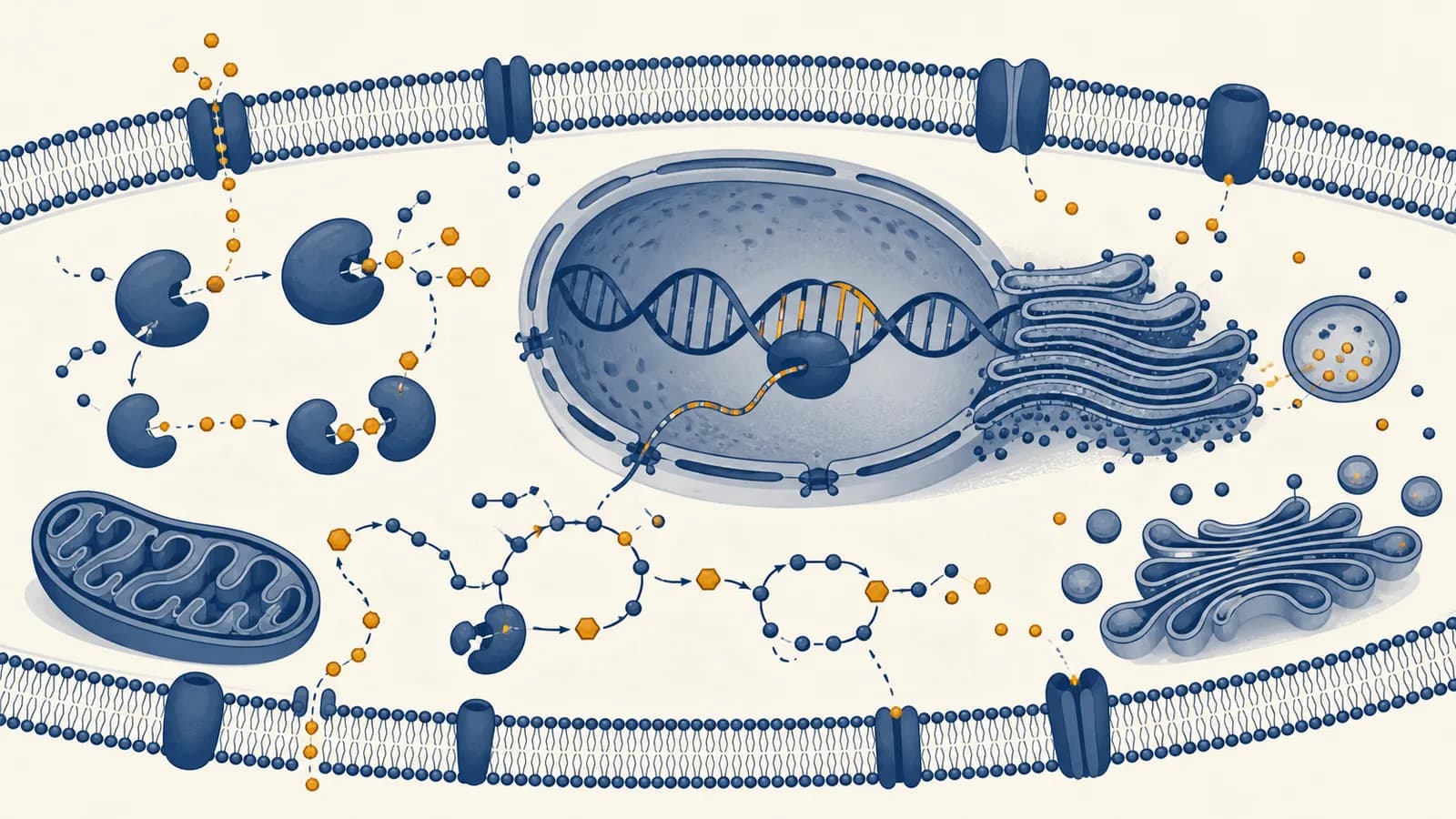
Biochemistry is a branch of chemistry that explains how molecules react, store information, and transfer energy in living systems. A useful answer to “what is biochemistry?” therefore connects chemical structure and reaction mechanisms to cells, enzymes, DNA, metabolism, health, and food. The field exists because life must perform ordinary chemical tasks under unusual limits: reactions happen in water, within narrow temperature and pH ranges, and without destroying the cell that runs them. Biochemistry shows how molecular shape, charge, concentration, and energy make that possible.
What biochemistry actually is
Biochemistry is the study of the substances and reactions that let organisms grow, repair damage, reproduce, sense their surroundings, and use energy. It applies chemical rules to living material, from one enzyme in a bacterium to metabolism across a human body.
A cell is not made from a special kind of matter. Its carbon, hydrogen, oxygen, nitrogen, phosphorus, sulfur, and other elements obey the same rules as matter in a flask. The difference lies in organization. Thousands of reactions occur in small spaces, and each reaction must happen at a useful rate without interfering with too many others.
This places biochemistry inside the wider study of chemical matter and change. Chemical bonding explains why a protein folds. Acids and bases explain why an enzyme changes activity. Equilibrium explains why a reaction can reverse. Thermodynamics explains which changes are energetically possible, while kinetics explains how quickly they occur.
Life does not break chemical laws. It controls conditions, couples reactions, and uses catalysts so that useful reactions happen in the right place and at the right time.
Consider a muscle cell breaking down glucose. The cell does not burn glucose in one uncontrolled step. It transfers electrons and rearranges bonds through a sequence of enzyme-controlled reactions. Small portions of the released energy are captured in molecules such as ATP. This controlled sequence limits damaging heat and makes the energy available for contraction, transport, and synthesis.
What biomolecules actually are
Biomolecules are carbon-based or inorganic substances that take part in living processes. The main large classes are carbohydrates, lipids, proteins, and nucleic acids, but water, mineral ions, gases, vitamins, and small metabolites are also necessary biochemical participants.
Carbon can form four covalent bonds, including stable bonds with itself. A carbon skeleton can therefore be a chain, a branch, or a ring. Attached functional groups change its behavior. A hydroxyl group can help a molecule interact with water. A carboxyl group can donate a proton. An amino group can accept one. A phosphate group often contributes negative charge and can participate in energy transfer or molecular recognition.
Large biomolecules are often assembled from smaller units. Amino acids join to make polypeptides, and nucleotides join to make DNA or RNA. Many carbohydrates are built by linking monosaccharides. The bonds usually form through condensation reactions that release water, and hydrolysis can reverse the process by adding water across a bond.
Lipids do not all follow one repeating polymer pattern. A triglyceride, for example, contains glycerol joined to three fatty acids by ester bonds. A phospholipid has a water-attracting head and water-avoiding tails. In water, many phospholipids arrange themselves into a bilayer, with heads facing the water and tails sheltered inside. That self-assembly gives cells a boundary.
How enzymes work
Enzymes are biological catalysts that speed reactions by providing a lower-energy route from reactants to products. They bind selected molecules, stabilize the transition state, and release products without being permanently consumed, but they cannot make an energetically impossible reaction possible.
A reacting molecule must pass through an unstable arrangement called the transition state. Reaching it requires activation energy. An enzyme’s active site positions reactants, strains particular bonds, transfers protons, or provides a local chemical environment that makes this state easier to reach. More molecules then react per second at the same temperature.
Random molecular motion brings the substrate and enzyme together. Compatible shape, charge, and chemical groups favor binding.
The enzyme may shift shape around the substrate. Catalytic groups place reacting atoms in useful positions and stabilize developing charges.
The enzyme lowers the activation barrier, so conversion to product happens more often. It does not change the overall energy difference between reactants and products.
The products fit or interact differently, so they detach. The enzyme can begin another catalytic cycle.
Enzyme specificity is selective, not always absolute. Lactase strongly favors lactose because its active site matches that sugar and places the relevant bond beside catalytic groups. A change in pH can alter the charges on those groups. High temperature can disrupt the interactions that maintain the enzyme’s folded shape. Either change can reduce activity.
If , then . The model describes many simple enzyme reactions, though not every enzyme follows it.
At low substrate concentration, adding substrate increases the chance that an active site is occupied. At high concentration, most active sites are already busy, so the rate approaches a maximum set by enzyme amount and turnover. Competitive inhibitors slow a reaction by occupying the active site. Other inhibitors bind elsewhere and change enzyme behavior. This is why many medicines can alter one biochemical pathway at a controlled dose.
How cells move and store energy
Cells manage energy by coupling energy-releasing reactions to energy-requiring work. Electron carriers move high-energy electrons, ion gradients store potential energy across membranes, and ATP transfers phosphate in reactions that drive synthesis, movement, and active transport.
A reaction’s Gibbs free-energy change indicates whether the forward change is thermodynamically favorable under stated conditions. A negative value means the forward process can occur without a net energy input, but it says nothing about speed. A favorable reaction can remain slow if its activation barrier is high.
A reaction can become more or less favorable as temperature and the balance between enthalpy and entropy change.
Cells couple reactions by making them share an intermediate. ATP hydrolysis is often paired with an unfavorable reaction through phosphate transfer. The combined pathway can have a negative overall free-energy change even if one component is unfavorable alone. The chemistry of heat and energy is developed further in how reactions exchange and transform energy.
During aerobic respiration, carbon atoms from glucose are oxidized, and electron carriers such as NADH deliver electrons to a chain of membrane proteins. As electrons pass along the chain, released energy pumps protons across the inner mitochondrial membrane. The resulting difference in proton concentration and electrical charge stores potential energy. Protons flow back through ATP synthase, and the protein uses that flow to make ATP.
Photosynthetic organisms build a gradient with light. Pigments absorb photons, excited electrons pass through carriers, and proton movement supports ATP production. Other reactions use the electrons to help reduce carbon dioxide into carbon-containing molecules. Respiration and photosynthesis differ in inputs and overall direction, yet both depend on electron transfer, membranes, gradients, and catalysts.
How genetic information becomes chemical action
Genetic information controls cell chemistry through nucleotide sequences that are copied into RNA and translated into proteins. A protein’s amino acid sequence guides its folding, and its resulting shape and chemical groups determine what it can bind or catalyze.
DNA stores information in the order of four bases. Complementary base pairing allows each strand to guide the construction of another strand during replication. The sequence does not directly perform most cell tasks. A gene is first transcribed into RNA. For a protein-coding gene, a ribosome reads messenger RNA in three-base codons and links the specified amino acids.
The arrow sequence is useful, but regulation surrounds every stage. Cells can expose or compact regions of DNA, control transcription, process RNA, change its lifetime, alter translation, and chemically modify a finished protein. A phosphate added to a protein can switch its activity or change its binding partners. One genome can therefore support different cell types because different genes and proteins are active.
In sickle cell disease, a change in the gene for the beta chain of hemoglobin replaces one amino acid with another. The altered surface encourages hemoglobin molecules to associate under low-oxygen conditions. Red blood cells can then become rigid and curved, obstructing small vessels and breaking down early. A DNA change becomes a protein-surface change, then a cell and tissue problem.
Not every DNA change affects a protein. Some occur outside a gene, some do not change the encoded amino acid, and some change an amino acid without strongly affecting folding or function. The chemical consequence depends on location and context. The relevant question is not simply whether a mutation exists, but what molecular interaction it changes.
Biochemistry versus organic chemistry
Organic chemistry studies carbon compounds and their reactions broadly, while biochemistry focuses on molecules and reaction networks in living systems. They share bonding and mechanism, but biochemistry adds enzymes, aqueous conditions, membranes, regulation, information flow, and organized metabolism.
It asks how carbon compounds are structured, named, synthesized, and transformed. A reaction may use a chosen solvent, strong reagent, pressure, or heat to produce a target compound.
It asks how molecular reactions operate inside or around organisms. Conditions are usually water-based and mild, so enzymes and coupled pathways provide selectivity and control.
The boundary is porous. Understanding peptide bonds requires organic chemistry. Understanding why a peptide is made at one time, transported to one location, cut by an enzyme, and used as a signal requires biochemistry. Physical chemistry contributes energy, equilibrium, and kinetics. Analytical chemistry provides methods for identifying and measuring molecules.
Biochemistry is also different from cell biology. Cell biology often begins with structures such as nuclei, membranes, and organelles, then asks what they do. Biochemistry can begin with a molecule or reaction and ask how its mechanism produces the cellular behavior. The two views meet because molecules build every cell structure and perform every cell process.
How biochemistry shows up in medicine
Medicine uses biochemistry to connect symptoms with molecules, measure organ function, design drugs, and explain inherited disease. A blood result or treatment becomes meaningful only after its concentration, reaction pathway, molecular target, and effect on tissues are understood together.
Clinical laboratories measure substances such as glucose, electrolytes, enzymes, hormones, antibodies, and metabolic waste. A value is interpreted against a method-specific reference interval and the person’s situation. Food intake, exercise, hydration, medicines, sample handling, and timing can all influence a result. A laboratory number is evidence, not a diagnosis by itself.
A test strip contains an enzyme that reacts with glucose. The reaction transfers electrons, directly or through a mediator, to an electrode. The meter measures the resulting electrical signal and uses calibration to estimate glucose concentration. The display hides a chain of recognition, electron transfer, measurement, and calculation.
Drug action also depends on molecular fit and concentration. An inhibitor may reduce an enzyme’s activity, an agonist may activate a receptor, or an antibody may bind a selected protein. After administration, absorption moves the drug into the body, distribution carries it among tissues, metabolism changes it, and excretion removes it. Liver enzymes can sometimes convert a drug into an inactive form, an active form, or a harmful product.
Dose matters because binding is concentration-dependent and no molecule behaves in isolation. A compound selective for one target at a low concentration may affect other targets at a higher one. Two drugs can compete for metabolism or change each other’s transport. Safe laboratory practice and hazard reasoning belong to handling chemicals and controlling exposure, including substances that are useful at one dose and harmful at another.
“Natural” does not mean harmless, and “synthetic” does not mean harmful. Toxicity depends on molecular action, dose, route, timing, and susceptibility, not on whether people or organisms made the substance.
Inherited metabolic disorders show why pathway maps matter. If one enzyme has little activity, its substrate may accumulate, its product may become scarce, and side pathways may produce other compounds. Treatment might limit the incoming substrate, provide a missing product, replace an enzyme, or help the body remove an accumulating substance. The best choice depends on the particular pathway.
How biochemistry shows up in food and exercise
Food and exercise involve biochemical digestion, absorption, fuel selection, signaling, and tissue repair. The body breaks large food molecules into absorbable units, distributes them, and routes them toward immediate energy use, storage, or construction according to demand and hormonal signals.
Digestive enzymes hydrolyze proteins into amino acids and small peptides, carbohydrates into simpler sugars, and many fats into fatty acids and monoacylglycerols. Bile salts help disperse fat into small droplets, increasing the surface available to lipases. Transport proteins then move absorbed substances across intestinal cells and into blood or lymph.
During a short, intense effort, muscle needs ATP faster than oxygen-dependent pathways can always supply it. Stored phosphocreatine can rapidly help restore ATP, and glycolysis can produce ATP while converting glucose toward lactate. During sustained, lower-intensity work, oxidation of carbohydrates and fatty acids contributes more. Real fuel use is a mixture shaped by intensity, duration, training, recent food, and available oxygen.
Lactate is not simply a waste that causes all muscle soreness. It can move between cells and serve as fuel or as material for glucose production. The burning feeling during intense work involves several changes in active muscle, including shifts in ions and acidity. Delayed soreness after unfamiliar exercise is associated with tissue stress and repair, not lactate remaining for days.
A supplement, detox, or single food can “boost metabolism” as though metabolism were one dial.
Metabolism is a regulated network. Changing one enzyme, signal, or substrate can produce small, temporary, tissue-specific effects and may trigger compensation elsewhere.
Cooking is biochemical chemistry outside the body. Heat unfolds proteins and allows new interactions, acids change charge and texture, and enzymes can soften tissue or brown cut fruit. Fermentation lets microbes convert food molecules into products such as acids, gases, and alcohols. Concentration also matters, so how substances dissolve and form solutions helps explain brines, syrups, drinks, and the watery interior of a cell.
How pH controls biochemical reactions
pH controls biochemistry by changing the protonation and charge of molecules. Those charge changes alter protein folding, substrate binding, membrane transport, solubility, and reaction mechanisms, so cells regulate pH within compartments rather than allowing it to drift freely.
If hydrogen ion concentration changes from to , pH changes from 7 to 6, a tenfold increase in hydrogen ion concentration.
Amino acid side chains can gain or lose protons. If a catalytic side chain must accept a proton during a reaction, it needs to be in the right protonation state. Move far enough from the enzyme’s useful pH range, and that group may carry the wrong charge. The substrate may bind less strongly, catalysis may slow, or the whole protein may unfold.
Buffers resist sudden pH change by reversibly accepting or donating protons. A buffer does not lock pH at one exact value, and its capacity is finite. Cells use several buffering systems and also move acids, bases, and ions across membranes. Different compartments can maintain different conditions, allowing a lysosome and the cytosol to support different sets of reactions.
How laboratory tests identify biomolecules
Biochemical tests identify or measure molecules by converting a molecular property into a detectable signal. Separation, selective binding, enzyme activity, light absorption, mass, or electrical response can reveal what is present and how much, provided controls and calibration support the inference.
A color test is useful only if color intensity is connected to concentration. In a spectrophotometer, light of a selected wavelength passes through a sample. The instrument compares incoming and transmitted light to calculate absorbance. Within a suitable range, absorbance is proportional to concentration, path length, and the substance’s ability to absorb that wavelength.
If standards show that an absorbance of 0.20 corresponds to and 0.40 to under the same conditions, a sample at 0.30 is estimated at in that linear range.
Controls expose alternative explanations. A blank shows signal from the solvent and reagents. A negative control should lack the target response. A positive control shows that the method can detect the target under the test conditions. Replicates help reveal random variation. Calibration standards connect instrument response to known concentrations.
Other methods answer different questions. Electrophoresis separates charged molecules as they move through a medium in an electric field. Chromatography separates substances because they distribute differently between moving and stationary phases. Antibodies can detect a particular molecular feature. Mass spectrometry separates ions by mass-to-charge ratio and can help identify molecules or fragments. A strong conclusion often combines a separation method with a selective detector.
Four mistakes people make with biochemistry
Most biochemical misunderstandings come from treating a regulated network as a simple list of molecules. The common errors are confusing energy with matter, treating diagrams as literal geography, assuming one cause has one effect, and ignoring concentration and conditions.
1. Saying that ATP stores energy in one special bond
ATP does not contain a magical bond that releases energy merely because it breaks. Bond breaking requires energy. The overall hydrolysis is favorable because the full set of products and interactions has lower free energy under cellular conditions. Product stabilization, changes in charge interactions, and the surrounding water all contribute.
2. Reading a pathway diagram as a picture of the cell
A metabolic map arranges reactions so people can follow them. It does not show real distances, molecular crowding, membrane barriers, or every competing reaction. Enzymes and substrates move, pathways share intermediates, and some steps occur in separate compartments. The arrows represent chemical transformations, not tiny pipes.
3. Assuming one molecule has one job
A molecule’s effect depends on location, concentration, binding partners, and time. Glucose can provide fuel, supply carbon for synthesis, enter storage, or help form extracellular structures. A signaling molecule can act differently in two tissues because their receptors and downstream proteins differ.
4. Ignoring dose, pH, temperature, and time
A substance name alone does not predict an outcome. Enzyme rates change with substrate concentration and temperature. Protein charge changes with pH. A brief exposure can differ from a sustained one. A useful biochemical statement includes the conditions under which the observation was made.
The takeaway: Follow matter, charge, electrons, and energy through a mechanism. Then ask where the reaction occurs, what catalyzes it, how it is regulated, and what changes when conditions change.
Biochemistry makes chemistry visible in living systems
Biochemistry shows that life is organized chemical change. It connects atomic interactions to folded proteins, reaction pathways, cells, and whole-body effects, making it possible to explain both normal function and what changes in disease, cooking, exercise, or a laboratory test.
The subject becomes manageable when each process is treated as a chain of checkable events. Identify the starting molecules. Mark bonds and charges that change. Track any electrons, protons, water, or phosphate. Name the enzyme or other catalyst. Check the energy source and products. Then place the reaction inside its compartment and ask what controls its rate.
The next time bread browns, fruit softens, a test strip changes color, or muscles tire, choose one visible result and work backward. The cause will not be “biology” in the vague sense. It will be molecules colliding, binding, transferring electrons, rearranging bonds, and responding to their surroundings. That is biochemistry, and it is also chemistry doing work inside life.