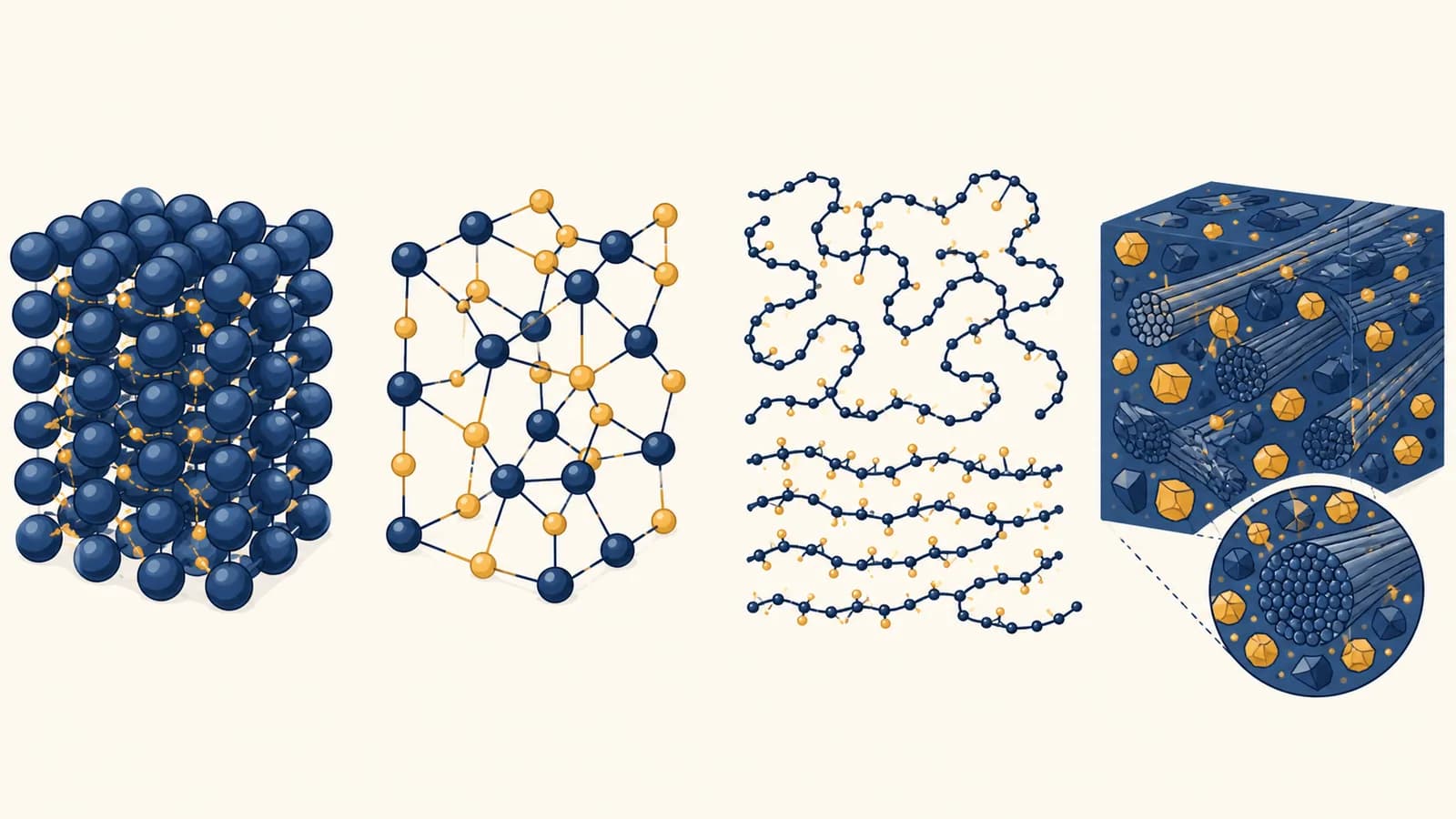
Materials science is an interdisciplinary field that connects a material's atomic structure and processing to its properties and performance, in the context of chemistry, physics, and engineering. Put simply, materials science explains why materials behave as they do and how people design better metals, ceramics, polymers, composites, semiconductors, and biomaterials. Its central idea is the structure-property relationship: atoms and molecules form structures, processing changes those structures, and structure controls properties. The field exists because choosing or making the wrong material can cause a phone screen to crack, an implant to corrode, or a bridge component to fail.
What a material actually is
A material is matter selected or made for a useful combination of properties, such as strength, electrical conductivity, transparency, flexibility, or resistance to heat. Its behavior depends on both its chemical composition and the arrangement of its atoms across several length scales.
A chemical substance is identified mainly by composition and bonding. A material is considered in terms of a job. Pure aluminium is a substance, but a heat-treated aluminium alloy shaped into an aircraft panel is a material with a controlled composition, microstructure, surface, and form. The same element can perform very differently after atoms are rearranged or other elements are added.
Scientists often group materials into broad families. Metals usually contain mobile electrons, which help them conduct electricity and allow metallic bonds to persist as atomic layers move. Ceramics commonly contain ionic or covalent bonds, so they can resist heat and wear but may fracture with little permanent bending. Polymers contain long molecular chains that can slide, stretch, crystallize, or become cross-linked. Composites combine distinct materials so that each supplies a useful feature.
- Metals are conductive and often formable.
- Ceramics resist heat and are often brittle.
- Polymers are light and chemically varied.
- Composites use different phases to share the load.
These groups are useful starting points, not rigid boxes. Glass is a ceramic without a regular crystal lattice. Conducting polymers carry electric charge even though most familiar plastics insulate. A carbon-fibre composite can be light along every direction yet much stronger along the fibres than across them. Classification helps predict behavior, but measured properties decide if a material suits a particular use.
How structure controls properties
Structure controls properties because forces and energy move through a material by way of its electrons, bonds, atoms, grains, pores, and larger features. Changing any level of that structure can alter how the material responds to stress, heat, light, chemicals, or an electric field.
Electrons and bonds set the basic possibilities
Electron arrangement determines which bonds atoms can form and how easily charge can move. The patterns explained by electron shells and atomic bonding help account for the contrast between copper, where electrons travel through the solid, and silica glass, where electrons are held in bonds and the material is normally an electrical insulator.
Bond strength also affects melting temperature, stiffness, and thermal expansion. Pulling bonded atoms slightly apart raises their potential energy. Strong, steep bond-energy curves resist that displacement, so the solid is stiff. Heating makes atoms vibrate with greater amplitude. Because a real bond-energy curve is asymmetric, the average separation often increases, which produces thermal expansion.
Crystal arrangement changes the available motion
Many solids are crystalline, meaning their atoms occupy a repeating three-dimensional pattern. Different patterns give atoms different neighbors and create different paths for slipping, diffusing, or conducting. Carbon demonstrates the effect sharply. Diamond has a three-dimensional covalent network and is extremely hard. Graphite has strongly bonded carbon sheets held together more weakly, so the sheets slide and graphite feels soft.
Microstructure turns one composition into many materials
Microstructure is the arrangement of grains, phases, precipitates, pores, and defects visible above the atomic scale, often with a microscope. Two steel parts can have nearly the same overall composition but different grain sizes or phases. One may be easy to shape, while another resists wear.
The arrows also point backward during design. An engineer begins with required performance, translates it into measurable properties, identifies structures that can provide those properties, then chooses compositions and processes likely to create those structures. Testing checks the chain.
How defects make materials useful
Defects are departures from a perfectly repeating atomic arrangement, and controlled defects often produce the desired material property. Vacancies permit diffusion, dislocations permit metal shaping, grain boundaries obstruct motion, and selected impurity atoms give semiconductors their useful electrical behavior.
A perfect crystal is a helpful model, but manufactured solids are never perfect. A vacancy is a missing atom at a lattice site. An interstitial is an extra atom squeezed into a gap. A substitutional atom replaces a host atom. A dislocation is a line defect around which atomic planes are misaligned. Boundaries between differently oriented crystals are two-dimensional defects.
To bend a metal permanently, dislocations must move. They let bonds break and reform along a narrow region instead of forcing an entire atomic plane to shift at once. Obstacles such as dissolved atoms, precipitates, and grain boundaries make this motion harder. The result is greater strength, although it commonly comes with less ductility.
A flawless crystal must always be the best material because defects are damage.
Selected defects control deformation, diffusion, colour, and electrical conductivity. The useful target is a controlled defect population, not automatic perfection.
Silicon provides a clean chemical example. Pure silicon has limited charge carriers at ordinary conditions. Adding a small, controlled amount of an element with one more or one fewer valence electron changes the carrier population. This process, called doping, produces the n-type and p-type regions used to direct current in diodes and transistors.
How processing changes a material
Processing changes a material by controlling atomic mobility, shape, phase formation, defects, and internal stress. Casting, rolling, heat treatment, sintering, polymer curing, coating, and additive manufacturing can therefore give the same starting chemistry very different structures and properties.
Choose elements, molecules, additives, or fibres that can form the required bonds and phases.
Melt, dissolve, press, deposit, stretch, or print the feedstock so its components can move and take form.
Use temperature, pressure, time, and cooling rate to govern crystal growth, chemical reaction, phase change, or cross-linking.
Cool, cure, machine, polish, or coat the part, then inspect whether its structure matches the design.
Cooling rate is a powerful control. During slow cooling, atoms have more time to diffuse toward lower-energy arrangements. Rapid cooling can trap a non-equilibrium structure. Glass forms when a melt becomes rigid without organizing into a long-range crystal lattice. In some steels, rapid cooling helps form a hard phase, but the product may need tempering to reduce brittleness and internal stress.
Polymers respond to a different but related set of controls. Cooling a melted polymer can leave chains tangled and disordered or allow sections to pack into crystalline regions. Stretching can align chains and increase strength in one direction. Chemical cross-links tie chains together, limiting their ability to flow past one another. A thermoset with a dense cross-linked network does not simply melt and reshape like a thermoplastic.
Processing is part of the material. A chemical formula alone cannot specify grain size, porosity, residual stress, molecular alignment, or surface condition, yet each can decide whether a component survives service.
Powder processing shows why the route matters. Ceramic powder can be pressed into a shape and heated below its melting point. Atoms diffuse across particle contacts, necks grow, and pores shrink. This process is sintering. Too little heating leaves weak contacts and high porosity. Too much can cause excessive grain growth or distortion.
Materials science versus chemistry
Chemistry explains substances through composition, bonding, reactions, and energy, while materials science asks how those chemical facts combine with structure and processing to deliver performance. The fields overlap strongly, but materials science follows matter all the way into a working object.
A chemist might identify why iron oxidizes in water containing dissolved oxygen. A materials scientist also asks how alloy composition, grain boundaries, mechanical stress, coating defects, and the service environment affect the corrosion rate of an actual pipe. The object has geometry and a manufacturing history, so its behavior cannot be read from a formula alone.
The relationship is easiest to see through the larger subject of chemical structure, reactions, and measurement. Thermodynamics tells whether a transformation is energetically favorable. Kinetics tells how quickly it can occur. Electrochemistry explains electron transfer at a corroding surface or inside a battery. Materials science uses those ideas while also tracking cracks, interfaces, texture, and scale.
One distinction prevents confusion: a material property belongs to a specified material in a specified condition. “Steel is strong” is incomplete. Which steel composition, heat treatment, temperature, loading direction, strain rate, and environment? A chemistry label narrows the possibilities, but it does not finish the description.
How material properties work
Material properties describe reproducible responses to forces, heat, charge, light, or chemicals under stated conditions. They arise from structure and are measured with controlled tests, so stiffness, toughness, conductivity, and corrosion resistance cannot be collapsed into one measure of quality.
Mechanical properties require separate measurements
Mechanical tests apply a known force or deformation to a sample and record its response. Stress, strain, stiffness, yield strength, toughness, hardness, and fatigue resistance describe different behaviors, so no single number means that a material is simply “strong.”
In a tensile test, a machine pulls a shaped specimen while measuring force and extension. Engineering stress divides force by original cross-sectional area. Engineering strain divides change in length by original length.
A 10,000 N force on an original area of 100 mm² gives a stress of 100 N/mm², equal to 100 MPa. A 50.0 mm sample stretched to 50.5 mm has strain 0.010, or 1%.
The initial straight portion of many stress-strain curves is elastic. Remove the load there, and the specimen returns close to its original shape. The slope is Young's modulus, a measure of stiffness. Past yield, permanent deformation remains. The highest engineering stress is the ultimate tensile strength, but fracture may occur later, after the sample necks.
Hardness measures resistance to localized indentation or scratching. Toughness is the energy a material absorbs before fracturing, represented by the area under an appropriate stress-strain curve. Fatigue resistance concerns failure under repeated loading, sometimes at stresses below the value that would break a sample in one pull. A hard material can still be brittle, and a stiff material need not be tough.
A bicycle frame must resist repeated pedalling loads and road impacts without becoming unnecessarily heavy. Its designer considers stiffness for handling, fatigue resistance at joints, toughness after a dent, corrosion resistance in rain, and whether tubes can be joined without damaging their microstructure.
Tests must match service conditions. A polymer can become softer when warm. A metal may fracture more readily at low temperature. A tiny surface notch can concentrate stress. Data from a smooth specimen pulled once cannot, by itself, guarantee the life of a scratched component under millions of load cycles.
How thermal, electrical, optical, and chemical properties work
Non-mechanical properties describe how a material exchanges energy or matter with its surroundings. Electrons, atomic vibrations, electronic energy levels, and surface reactions determine the flow of heat and charge, interaction with light, expansion during heating, and resistance to chemical attack.
Heat moves through carriers and vibrations
In metals, mobile electrons carry both charge and thermal energy. In electrically insulating solids, heat mainly travels through coordinated lattice vibrations. Defects, boundaries, and interfaces scatter these carriers, often reducing thermal conductivity. A foam insulates well partly because its gas-filled pores interrupt solid conduction and suppress large-scale fluid motion when the cells are small.
Heat capacity describes how much energy is required to raise temperature. Thermal conductivity describes how rapidly energy flows through a temperature gradient. They are not the same property. A material can store substantial heat yet conduct it slowly. The energy changes explored in heat flow and chemical systems help separate stored thermal energy from its transfer rate.
Charge moves only when carriers and paths exist
Electrical conductivity requires charge carriers that can respond to an electric field. Metals have accessible electronic states, so electrons move readily. In semiconductors, temperature, light, and dopants can change the number of electrons and mobile positive vacancies called holes. In ionic conductors, ions move through a solid or liquid structure instead.
Light reveals electronic and structural choices
A material appears coloured when some wavelengths are absorbed, transmitted, scattered, or reflected more than others. Electronic transitions can absorb selected photon energies. Particles and pores scatter light. A smooth metal reflects strongly because its mobile electrons respond to the light's electric field. A transparent solid needs low absorption and limited scattering across the visible range.
Corrosion is a coupled reaction and transport problem
Corrosion converts a material into more chemically stable products through reactions with its environment. In electrochemical corrosion, oxidation at one location releases electrons, reduction consumes them elsewhere, and ions move through an electrolyte. A protective oxide can slow further attack if it adheres and blocks transport. Cracks, salt, or mismatched metals can defeat that protection.
Property combinations create design conflicts. A window coating may need to transmit visible light while reflecting infrared radiation. A cookware handle should conduct little heat, while the pan base should spread heat. A battery electrode needs electronic and ionic transport, chemical stability over its operating range, and enough mechanical integrity to survive repeated changes in composition.
How materials show up in products, medicine, and infrastructure
Materials science appears wherever a product must perform under real forces, temperatures, electrical loads, chemicals, or biological contact. It guides material selection, manufacturing limits, inspection, repair, recycling, and failure analysis in objects ranging from food packaging to power cables.
A phone is a stack of engineered materials
A phone screen combines transparency, scratch resistance, impact tolerance, and touch sensitivity. Its glass can be chemically strengthened by exchanging smaller ions near the surface for larger ones, creating surface compression. A crack must first overcome that compressive region before opening. Thin transparent conducting layers register touch, while semiconductor regions switch current in the processor.
The battery adds another materials problem. Ions move through an electrolyte between electrodes as the cell charges and discharges, while electrons travel through the external circuit. Electrode particles can expand, contract, react at their surfaces, and lose electrical contact. Chemistry supplies the redox reactions; microstructure and interfaces decide how evenly and repeatedly they can occur.
An implant must coexist with the body
A hip implant experiences repeated loads in warm, salty fluid. Candidate materials are judged for fatigue, wear, corrosion, manufacturability, and biological response. Surface texture can influence how bone attaches. Wear particles can matter even when the bulk implant remains intact. Work in molecules and reactions in living systems helps explain why proteins, cells, and body fluids change what happens at an implant surface.
Concrete depends on reactions across time
Concrete is a composite of aggregate held in a cement-based binder. When water is added, cement compounds hydrate and form solid products that bind the mixture. Water serves as both a reactant and a processing medium; later evaporation is only part of its role. Pores, curing conditions, aggregate interfaces, and reinforcement all affect performance.
Visible damage may begin with invisible transport. Water, oxygen, chloride ions, or hydrogen can move through pores and defects before corrosion, swelling, embrittlement, or cracking becomes obvious at the surface.
Failure analysis works backward through evidence. Investigators locate where a crack began, inspect fracture surfaces, map composition, measure hardness, review loads, and reconstruct manufacturing history. The goal is not to blame a material family. It is to identify the interacting cause, such as an unsuitable alloy, a sharp geometry, a heat-treatment error, an aggressive environment, or an overload.
How materials are selected for a real design
Material selection translates a product's job into measurable requirements, screens out candidates that fail mandatory limits, and compares the survivors by performance, processing, cost, supply, safety, and environmental consequences. The best choice is conditional on the design, not universally best.
Consider a reusable hot-drink bottle. The wall must contain liquid, tolerate handling, resist corrosion, meet food-contact rules, and be manufacturable. Low thermal conductivity may be desirable, but a vacuum gap can provide insulation even if the structural walls are metal. The product is therefore a material system, not a contest for one substance with every ideal property.
State what the component must do, including load direction, life, environment, and acceptable failure.
Convert non-negotiable needs into limits, such as maximum temperature, minimum strength, or electrical insulation.
Decide what to minimize or maximize, such as mass, cost, heat loss, or maintenance.
Evaluate forming, joining, quality control, service, repair, reuse, separation, and end-of-life treatment.
A transparent drink bottle might use a polymer because it is light and easily moulded, but repeated heat exposure, gas permeability, scratching, and recycling route need examination. A metal bottle may tolerate impacts and form a durable barrier, but dents, joining, coating, and thermal conduction enter the decision. Requirements remove vague claims such as “eco-friendly” or “high quality” and replace them with testable comparisons.
Selection also includes variability. Real batches contain distributions of grain size, flaw size, thickness, and composition. A design limit must allow for that variation and for uncertainty in loads. Quality control samples the process, while nondestructive methods such as ultrasound or radiography can search for internal flaws without cutting open every part.
Four mistakes people make with materials
Common mistakes come from treating a broad property word as a complete specification. Strength is confused with stiffness, hard with tough, natural with harmless, and recyclable with actually recycled. Correct decisions require the relevant property, conditions, time scale, and full material system.
1. Strong means stiff
Strength concerns the stress associated with yielding or fracture. Stiffness concerns elastic deformation under load. A rubber band has low stiffness because it stretches easily, yet it can withstand large strain before breaking. A ceramic can be stiff but fracture after little deformation. The required property depends on whether too much bending or actual failure limits the design.
2. Hard means tough
Hardness is resistance to localized indentation or scratching. Toughness measures energy absorbed before fracture under specified conditions. Glass resists many scratches but can fail from an impact because a surface flaw concentrates stress. Protective designs may combine a hard outer surface with a tougher supporting layer.
3. Natural means safe and synthetic means harmful
Origin does not establish hazard. Asbestos minerals occur naturally yet inhaled fibres can cause severe disease. Many synthetic polymers are stable in ordinary use, although additives, heat, weathering, and disposal conditions can change exposure. Safety assessment asks what substance or particle is present, at what dose, by what route, and for how long.
4. Recyclable means it will become the same product again
Technical recyclability is only one part of a working loop. Collection, sorting, contamination, additives, mixed layers, degradation, economics, and demand for the recovered material all matter. Melting a mixed polymer stream can produce poor and variable properties. Design for recycling favors identifiable materials, separable parts, compatible additives, and processes that preserve useful value.
Choose the material with the highest number on a data sheet.
Choose a material and process whose measured properties satisfy the actual loads, environment, lifetime, geometry, and manufacturing limits.
Data sheets remain useful, but test method and sample condition matter. A quoted value may describe dry material at room temperature, loaded briefly in one direction. A finished part may be wet, warm, joined, aged, scratched, and repeatedly loaded. Good selection connects the number to the condition in which the product must work.
What smart materials actually do
Smart materials change a useful property in response to a stimulus such as temperature, stress, light, an electric field, or a magnetic field. The response comes from a reversible structural, electronic, or chemical change, not from the material thinking or making decisions.
A shape-memory alloy can be deformed in one structural state and recover a trained shape when temperature drives a phase transformation. A piezoelectric material develops electric polarization when mechanically stressed and can also deform under an applied electric field. Thermochromic materials change optical absorption or reflection with temperature.
The label “smart” does not remove ordinary engineering limits. Repeated transformations can cause fatigue. Response can depend on temperature history, loading direction, and speed. A useful device also needs electrodes, packaging, control electronics, and a way to transfer force or heat. The active material is one part of a system.
What nanomaterials actually change
Nanomaterials contain important structural features on the nanometre scale, where high surface area, short travel distances, quantum confinement, or size-dependent defects can alter behavior. Their chemistry may be familiar, but their dimensions can change reaction rate, strength, colour, magnetism, or conductivity.
As particles become smaller, a larger fraction of their atoms lie at or near a surface. Surface atoms have a different bonding environment and can interact readily with surrounding molecules. This can improve catalysis or speed reactions, but it can also promote unwanted oxidation, aggregation, or biological interactions.
Small size is not automatically an advantage. Nanoparticles may clump together, erasing the surface area a designer wanted. They can be difficult to disperse evenly or keep fixed inside a product. Exposure also depends on form: particles bound inside a stable solid present a different situation from loose airborne powder. Size, shape, coating, solubility, and route of contact all belong in an assessment.
How sustainable materials are judged
Sustainable material choices reduce harmful impacts across extraction, production, use, and end-of-life while still performing the required job. No single label proves this outcome, because a lighter product, a longer life, easy repair, low-toxicity processing, and effective recycling can pull decisions in different directions.
Life-cycle reasoning sets a boundary and counts inputs and outputs within it. A lightweight material may require more energy to produce per kilogram yet save energy during use if it reduces vehicle mass. A durable coating adds material and processing but can prevent replacement of a much larger component. The relevant comparison is the same delivered function over a stated lifetime.
When comparing two food containers, ask how many times each will actually be used, whether it protects food well enough to prevent waste, how it is washed, and what local collection system accepts it. Material name alone cannot answer those questions.
Circular design tries to keep products, components, and materials useful. Reuse can preserve more of a product's manufacturing work than breaking it into raw material. Repair requires access, spare parts, and compatible joining. Recycling works better when materials can be identified and separated. Some applications still need safe disposal because contamination or degraded properties make another cycle unsuitable.
The takeaway: Judge a material by the function it delivers, the structure and process that make that function possible, and the consequences across its whole life.
A practical habit is to inspect an object and name one property its job requires, one structural feature that may supply it, and one process that could create that feature. That chain turns material labels into explanations.
Materials science makes chemistry visible in objects
Materials science connects chemical composition and bonding to the performance of real objects through processing and structure. It shows that matter's useful behavior is designed across scales, tested under realistic conditions, and revised when evidence from manufacture or failure exposes a weak link.
Look at a chipped mug, a cloudy plastic container, a rust spot, or a bent paper clip. Each change records chemistry plus structure: a crack moved through a brittle network, polymer chains or additives changed, an electrochemical cell operated, or dislocations moved and multiplied. The visible event has a mechanism.
The next time a product claims to be stronger, safer, greener, or more advanced, ask for the missing noun and condition. Stronger under which load? Safer for which exposure? Lower impact over which life cycle? Then trace the answer backward through performance, properties, structure, processing, and composition. That is how materials science turns an object into a checkable explanation.