

What does chemistry study?
Chemistry is the study of matter and the changes that rearrange its atoms, in the context of substances, living systems, manufactured products, and the environment. It answers questions about what materials contain, why they have particular properties, how chemical reactions occur, how much product can form, and where energy goes during a change.
A chemist connects events at three scales. At the visible scale, iron rusts, fuel burns, tablets dissolve, and dyes change colour. At the particle scale, atoms exchange or share electrons, molecules collide, and ions move through water. At the symbolic scale, formulas and equations record those particles and let us calculate quantities. Chemical thinking becomes reliable when evidence at the visible scale agrees with a particle model and with the accounting in an equation.
Those scales explain why chemistry sits between physics and biology. Physics supplies rules for energy, charge, and motion. Chemistry asks how those rules play out in collections of nuclei and electrons. Biology then uses chemical structures and reactions to build cells, copy genetic information, and release energy from food. The same reasoning applies in a battery factory, a hospital laboratory, a water treatment plant, and a kitchen.
Matter is anything with mass that occupies space. A substance is matter with a definite composition and a characteristic set of properties. Elements contain one kind of atom; compounds contain atoms of different elements joined in fixed ratios. Mixtures contain substances together without forcing them into a single fixed ratio. This distinction tells a scientist what kind of separation, measurement, or reaction is possible.
How do atoms give substances their identities?
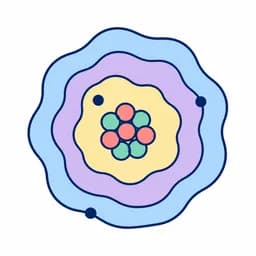
An atom's identity comes from its number of protons, while its chemical behaviour depends mainly on its electrons. Neutrons change mass and nuclear stability. The arrangement of electrons determines which atoms attract, repel, share charge, or transfer charge when substances form.
The nucleus contains positively charged protons and uncharged neutrons. Negatively charged electrons occupy regions called orbitals, described by probabilities rather than tiny planetary paths. A neutral atom has equal numbers of protons and electrons. An ion forms when that balance changes: losing electrons makes a positive ion, while gaining them makes a negative ion. The nuclear model and electron arrangement are developed in the page on how atoms are structured.
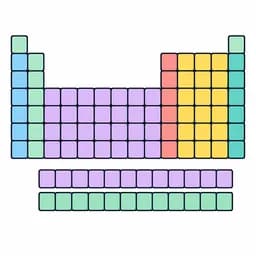
Elements are ordered by proton number in the periodic table. Repeating patterns appear because outer electron arrangements repeat. Elements in the same group often form similar ions and compounds; properties change across a period as nuclear charge increases and electrons fill the same main energy level. These trends make the table a prediction tool rather than a catalogue. The logic behind groups, periods, and trends appears in the structure of the periodic table.
Atoms become useful materials by bonding. In an ionic solid such as sodium chloride, attractions hold oppositely charged ions in a repeating lattice. In a covalent molecule such as water, atoms share electron pairs. In a metal, mobile electrons help bind positive metal ions and also carry electrical current. Bond polarity and molecular shape then influence boiling point, solubility, flexibility, and biological activity. A fuller account of these mechanisms is given in how chemical bonds control properties.
What makes a chemical reaction happen?
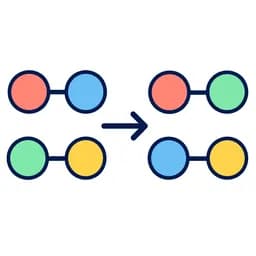
A chemical reaction occurs when atoms rearrange into a new set of substances. Reacting particles must meet with enough energy and a suitable orientation, but a possible collision is not automatically a fast one. Temperature, concentration, surface area, and catalysts change reaction rate.
Chemical equations track atoms through that rearrangement. In the reaction of hydrogen and oxygen, the balanced equation is . The coefficients show a ratio of particles or moles. They do not mean that the reaction follows one simple microscopic step. Real mechanisms can contain several collisions and short-lived intermediates.
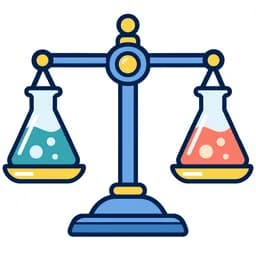
Conservation of mass requires the same number of each kind of atom on both sides of a closed system's equation. Charge must also balance in an ionic equation. Balancing changes coefficients, never the subscripts inside a chemical formula, because changing a subscript changes the substance itself. Patterns such as combustion, precipitation, acid reactions, and redox reactions are introduced through the evidence and equations for chemical reactions.
Use observations and formulas to decide which reactants are present and which products can form.
Represent each substance accurately before attempting to balance the equation.
Adjust whole number coefficients until the accounting agrees on both sides.
Compare the equation with measured mass, gas volume, colour, temperature, or another relevant observation.
Some reactions proceed in both directions. They reach dynamic equilibrium when the forward and reverse reaction rates become equal. The concentrations then remain constant, although particles continue reacting. Changing temperature, pressure, or concentration can shift the equilibrium position. A catalyst reaches equilibrium faster by lowering the activation barrier for both directions; it does not change the equilibrium composition.
How does chemistry turn equations into quantities?
Chemical equations become quantitative through the mole, which links countable formulas to measurable mass. Stoichiometry uses balanced coefficients as ratios, then combines them with molar mass, concentration, gas data, or energy data to predict reactants consumed and products formed.
The International System of Units defines one mole as exactly specified entities. Those entities may be atoms, molecules, ions, or formula units, so they must be named. Molar mass gives the mass of one mole and has units of grams per mole in ordinary laboratory work.
For 18.0 g of water with a molar mass of 18.0 g/mol, .
A calculation follows the balanced equation, not intuition about which pile looks larger. Convert the known measurement to moles, apply the coefficient ratio, and convert to the requested unit. If two reactants are supplied, one may run out first. That limiting reactant sets the maximum theoretical yield, while excess reactant remains. These connected methods are worked through in mole ratios and reaction quantities.
Units are part of the reasoning. A numerical answer without its unit cannot show whether mass, amount, volume, or concentration was calculated.
Real yields can be smaller than theoretical yields because reactions remain incomplete, side reactions consume material, or product is lost during transfer and purification. Percent yield compares measured product with the theoretical maximum. It diagnoses the whole process, but it does not by itself reveal which loss occurred. Scientists need observations and controls to find that cause.
How do solutions, acids, and bases behave?
A solution forms when solute particles disperse among solvent particles strongly enough to remain mixed. Concentration states how much solute occupies a given amount of solution. Acid and base behaviour depends on particle transfer and equilibrium, especially the transfer of protons in water.
Dissolving is a competition among attractions. Solvent particles must separate some solute particles and make space among themselves; new solute solvent attractions then form. Ionic solids dissolve in water when hydration and disorder make the overall process favourable. Some substances barely dissolve because the new attractions do not compensate for breaking the existing ones. Temperature, pressure for gases, and molecular polarity all matter. The page on why substances dissolve separates solubility, concentration, and rate of dissolving.
Molar concentration is amount of solute divided by solution volume. Dilution adds solvent while preserving the amount of dissolved solute, provided none reacts or escapes. This gives . It is an accounting relation, not a new chemical law.
A technician needs 250 mL of 0.100 mol/L solution from a 1.00 mol/L stock. The relation gives . The technician measures 25.0 mL of stock, then adds solvent until the total volume reaches 250 mL.
An acid donates a proton under the Brønsted-Lowry model; a base accepts one. In water, acidity is often expressed as . Because the scale is logarithmic, a change of one pH unit corresponds to a factor of ten in hydronium concentration. Strong and weak describe the extent of ionisation, while concentrated and dilute describe amount per volume. Those ideas are distinct. Buffers, neutralisation, indicators, and titration are connected in how acids and bases exchange protons.
Where does energy go during chemical change?
Chemical change redistributes energy between a reacting system and its surroundings. Breaking interactions requires energy, while forming interactions releases it. The measured energy change depends on both contributions, and reaction speed remains a separate question controlled by the pathway and activation barrier.
In an exothermic process, energy leaves the system and the surroundings warm if that energy appears as heat. In an endothermic process, energy enters the system. Enthalpy change is often used for reactions at constant pressure. A negative reaction enthalpy marks an exothermic change under the stated convention; a positive value marks an endothermic one.
Compares the starting and final states. It helps tell whether a process can be thermodynamically favourable under stated conditions.
Describes how quickly the change occurs. It depends on the reaction pathway, collisions, activation energy, and conditions.
A fuel can release energy overall yet remain stored for months because the first reaction step has a high activation barrier. A spark supplies enough energy to start combustion. A catalyst offers a different pathway with a lower barrier, speeding the process without being consumed overall. Calorimetry, bond energies, and energy cycles allow these changes to be measured or calculated; heat flow in chemical systems develops that accounting.
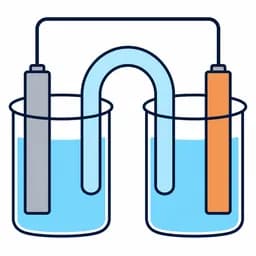
Redox chemistry tracks electron transfer. Oxidation is loss of electrons and reduction is gain. In a galvanic cell, a spontaneous redox reaction pushes electrons through an external circuit while ions move through the electrolyte to prevent charge buildup. Electrolysis reverses the energy conversion: an external power supply drives a reaction that would not proceed spontaneously under those conditions. Batteries, corrosion, electroplating, and electrolysis are linked through the chemistry of electrons and cells.
Why does carbon support so many different molecules?
Carbon forms stable bonds to itself and to many other elements, allowing chains, rings, branches, and multiple bonds. Functional groups create recurring patterns of reactivity. Molecular shape and electron distribution then decide how carbon compounds smell, dissolve, react, or interact with cells.
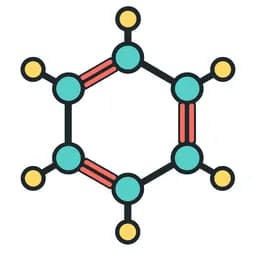
Two compounds can share a molecular formula while connecting their atoms differently. These structural isomers can have different boiling points and different reactions. Stereoisomers keep the same connections but differ in three-dimensional arrangement, which can matter when a molecule fits a biological receptor or enzyme. Names and structural formulas preserve distinctions that a molecular formula alone hides.
Hydrocarbons contain only carbon and hydrogen. Adding functional groups produces families such as alcohols, carboxylic acids, amines, esters, and polymers. Reactions often occur at these groups, so chemists use them to predict products and design synthetic routes. The relationship among structure, naming, and reactivity is mapped in the chemistry of carbon compounds.
Living organisms use carbon chemistry under controlled, watery conditions. Proteins fold into shapes determined by amino acid sequence and surrounding interactions. Enzymes speed selected reactions by binding particular substrates and stabilising a reaction pathway. Nucleic acids store information in their base sequence. Lipids form membranes because they contain regions with different affinities for water. Carbohydrates supply structure, recognition, and accessible chemical energy. Biochemistry studies how these mechanisms meet in living systems.
Biological does not mean free of chemistry, and synthetic does not mean harmful. A molecule's effects depend on its structure, amount, route of exposure, and interactions, not on whether a plant, microbe, or factory produced it.
How do chemists identify an unknown substance?
Chemists identify substances by combining selective measurements rather than trusting one dramatic test. Separation methods reduce mixture complexity, instruments measure interactions with matter, and calibration links signals to known quantities. Repeated samples, blanks, standards, and uncertainty checks reveal how much confidence a result deserves.
Qualitative analysis asks what is present. Quantitative analysis asks how much. Chromatography separates components because they divide differently between a moving phase and a stationary phase. Spectroscopy measures how matter absorbs, emits, or scatters radiation. Mass spectrometry separates ions by mass-to-charge ratio. Titration uses a reaction of known stoichiometry to determine an unknown concentration.
Name the target substance, sample type, expected range, and decision the result will support.
Collect a representative sample and remove substances that would distort the chosen measurement.
Compare instrument response with standards and include a blank that can expose contamination or background signal.
State the result with units, method limits, and enough context for another person to judge the evidence.
Accuracy describes closeness to an accepted value, while precision describes agreement among repeated measurements. Results can be precise but biased if every sample passes through a miscalibrated instrument. Detection also differs from identification: a signal above background may show that something is present without proving exactly what it is. The reasoning, tools, and quality controls behind such claims appear in how chemical analysis produces evidence.
A measurement is never just a number. Its unit, sampling method, calibration, uncertainty, and detection limit determine what conclusion the number can support.
How does chemistry become a material, a medicine, or a cleaner process?
Applied chemistry links molecular choices to product performance and human consequences. Chemists adjust composition, structure, processing, and reaction conditions, then test the result against requirements such as strength, purity, stability, cost, waste, exposure, and end of life.
A material's behaviour emerges across scales. Bonding affects stiffness and conductivity. Crystal structure and defects affect strength. Grain size and processing history change how a metal deforms. Polymer chain length and crosslinks alter flexibility. Composite materials combine phases so that each supplies a useful property. Materials science follows this chain from particles to product performance.
| Design level | Chemical question | Visible consequence |
|---|---|---|
| Atoms and bonds | How strongly do particles attract or share electrons? | Melting point, conductivity, stiffness |
| Microstructure | How are crystals, pores, phases, or chains arranged? | Strength, transparency, permeability |
| Processing | How did heating, cooling, mixing, or curing alter structure? | Durability, shape, surface finish |
| Use and disposal | What reactions occur during service and after release? | Lifetime, corrosion, recycling, environmental persistence |
Environmental chemistry follows substances through air, water, soil, and organisms. It asks about sources, transport, reactions, persistence, exposure, and removal. A compound can change form while moving, so tracking total mass is not enough. Acidity changes metal solubility; sunlight can break molecules apart; microbes can transform pollutants; particles can carry chemicals long distances. The mechanisms behind pollution and treatment are examined in how chemicals move through the environment.
Industrial process design must consider atom economy, energy demand, solvent choice, separation, recycling, and hazards. A reaction with a high laboratory yield may still make a poor manufacturing process if purification consumes large amounts of energy or creates a difficult waste stream. Medicines add another layer: a useful compound must reach the intended tissue at a suitable concentration, survive long enough to act, and avoid unacceptable effects elsewhere.
Where is chemistry commonly misunderstood?
Chemistry is commonly mistaken for memorising symbols, mixing liquids, or sorting substances into safe and dangerous boxes. In reality, it is a system for connecting measured evidence with particle models, calculating amounts, and judging how composition, dose, conditions, and exposure change an outcome.
Natural substances are safe, synthetic substances are harmful, and a long chemical name signals danger.
Hazard depends on the substance and its capacity to cause harm. Risk also depends on dose, route, duration, conditions, and the chance of exposure.
Water can damage lungs if inhaled, oxygen supports dangerous combustion, and many potent toxins are made by organisms. Conversely, carefully designed synthetic substances include medicines and stable materials. Labels such as natural and chemical do not replace a hazard assessment. Every material, including air and food, consists of chemicals.
Another misconception is that a balanced equation shows exactly what a person will observe. It shows stoichiometric relationships, but it may omit solvent, rate, equilibrium, competing reactions, and physical state. A predicted product might form too slowly to notice, remain dissolved, or react again. Laboratory evidence decides which model fits the conditions.
Laboratory safety is also more than goggles and warning symbols. Safe work begins by identifying hazards, choosing smaller quantities or safer substitutions, controlling vapour and contact, planning storage and waste, and preparing for spills or exposure. Personal protective equipment is one layer, not the entire system. Chemical safety organises these decisions into a system of controls.
Hazard and risk are different. Hazard is a substance's capacity to cause harm. Risk combines that hazard with the likelihood and extent of exposure under stated conditions.
Where does chemistry connect with other subjects?
Chemistry connects physics to biology and carries both into Earth science, medicine, engineering, law, and economics. Its particle models come from physical principles; its reactions sustain organisms; its measurements guide regulations, manufacturing choices, environmental decisions, and claims about evidence.
Physics explains electrostatic attraction, energy levels, thermodynamics, light, and electrical circuits. Chemistry uses those ideas to explain bonding, spectra, reaction energy, and electrochemical cells. Mathematics supplies ratios, logarithms, graphs, probability, and uncertainty. A pH calculation uses logarithms; a rate law uses changes in concentration over time; an instrument calibration uses a mathematical relationship between signal and amount.
Biology depends on molecular recognition and reaction networks. DNA base pairing, protein folding, membrane formation, respiration, and photosynthesis all involve structure, energy, and electron movement. Earth science adds open systems with rock, oceans, air, and living organisms interacting over time. Carbon cycling, ocean acidity, mineral weathering, and atmospheric reactions cannot be understood from one isolated reaction.
Engineering turns chemical knowledge into controlled processes. It must move heat, handle pressure, prevent corrosion, separate products, and keep a reaction stable at larger scale. Economics asks which inputs, energy sources, and recovery systems make a process viable. Law sets rules for testing, labelling, emissions, workplace exposure, medicines, and evidence. Chemical measurements may therefore affect a court case, a product recall, a drinking water decision, or a company's choice of materials.
A town considering a new water treatment step needs chemistry to identify contaminants and reaction products, biology to assess health effects, engineering to operate the process, mathematics to interpret sampling data, economics to compare costs, and law to determine which standards and reporting duties apply.
Daily decisions also sit at these boundaries. Cooking changes proteins, sugars, gases, and emulsions. Cleaning uses acidity, oxidation, surfactants, and solubility. Batteries turn redox reactions into current. Product labels communicate concentration and hazard. Chemistry does not make every choice automatically, but it reveals which mechanisms and measurements the choice should respect.
Chemistry makes invisible causes testable
Chemistry succeeds when a particle explanation produces a measurable prediction. A formula forecasts a ratio, a structural model predicts a property, and a proposed mechanism suggests an experiment. Results can then support the model, expose its limits, or force a better explanation.
The field holds together through a small set of habits. Identify the particles. Track atoms, charge, and energy. Separate amount from concentration, and hazard from risk. State conditions because temperature, pressure, solvent, and time can change the result. Match each conclusion to the quality of the measurement that supports it.
That habit of accounting reaches beyond school exercises. It helps a nurse prepare a solution, an analyst interpret a spectrum, an engineer select a corrosion-resistant alloy, and a regulator judge evidence of contamination. Each task uses different equipment, but each asks what matter is present, how its particles can change, how much is involved, and what evidence would show the answer.
Good chemistry also preserves uncertainty. Models simplify. Samples may not represent a whole site. Instruments have limits. A reaction that works in a small flask may behave differently when heat and material must move through a large vessel. Stating those limits is part of scientific accuracy, not a weakness in the result.
The takeaway: Chemistry explains materials and change by linking atoms, bonds, reactions, quantities, energy, and evidence. Once those links are visible, unfamiliar problems become questions that can be calculated, tested, and revised.