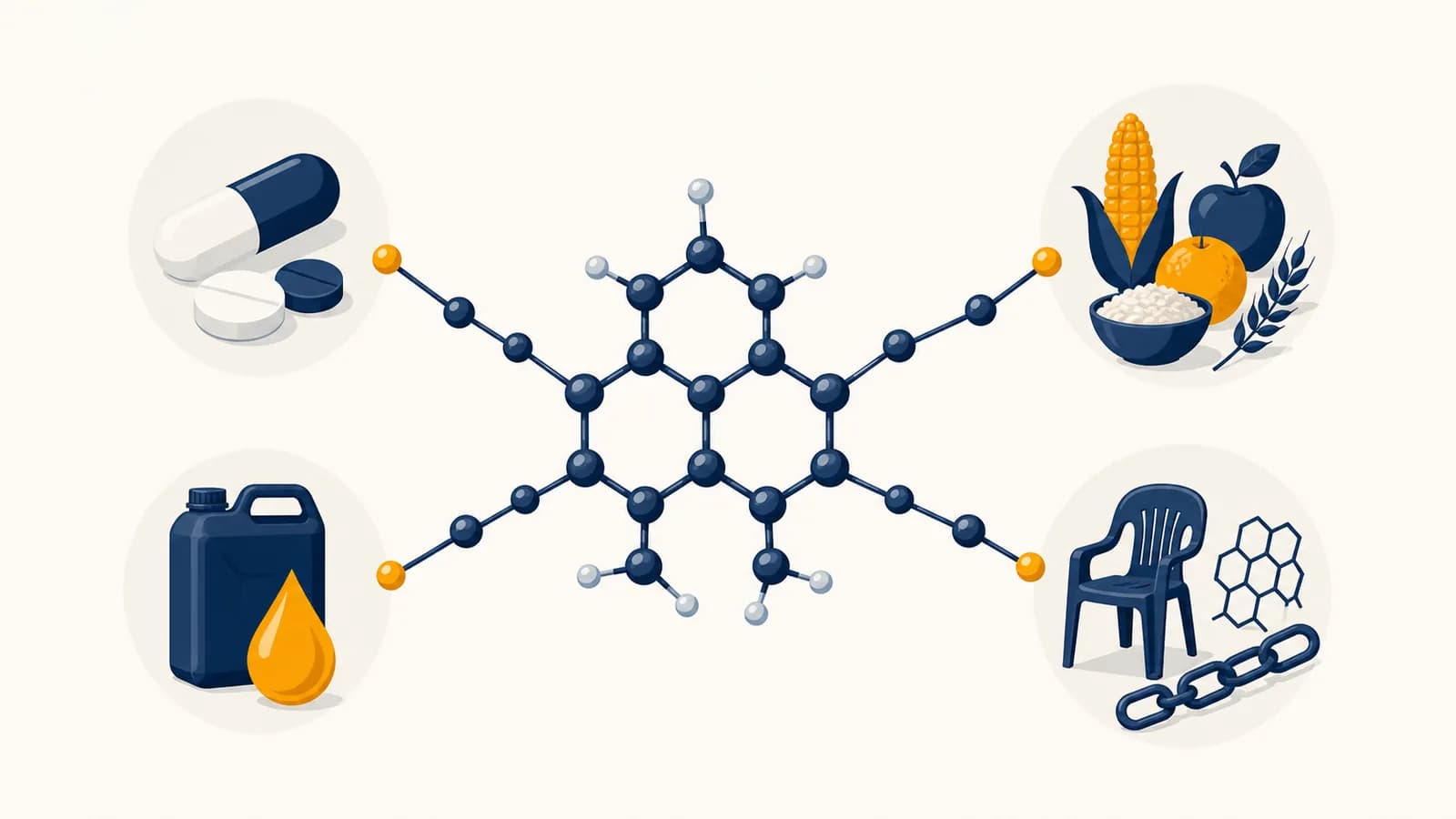
Organic chemistry is a branch of chemistry that explains the structures, properties, and reactions of carbon compounds, in the context of molecules used by living systems, industry, medicine, and daily life. It answers what organic chemistry is by connecting carbon bonding, functional groups, isomers, nomenclature, and organic reactions. The subject exists because carbon can build an exceptional range of stable molecular frameworks, and small changes to those frameworks can produce large changes in behavior.
Aspirin, cooking oil, nylon, caffeine, petrol, DNA, soap, and the scent of a lemon all contain organic compounds. They do not behave alike simply because they contain carbon. Their behavior comes from which atoms are connected, the shape those connections produce, and how electrons move when bonds form or break. Organic chemistry is the method for reading that structure and predicting what a molecule can do.
What organic chemistry actually is
Organic chemistry is the study of compounds built mainly from carbon, especially compounds containing carbon to hydrogen and carbon to carbon bonds. It classifies their structures, explains their physical properties, and tracks the electron movement that converts one molecular structure into another.
Carbon sits at the center of the subject because a neutral carbon atom commonly forms four covalent bonds. Those bonds can connect carbon to hydrogen, oxygen, nitrogen, sulfur, halogens, and other carbon atoms. Carbon atoms can join into straight chains, branched chains, and rings. They can also make single, double, or triple bonds. These options create molecular frameworks with sizes ranging from methane, , to polymers made from thousands of linked units.
The word organic does not mean natural, healthy, or grown without particular pesticides. In chemistry, it describes a broad structural family. Many organic compounds are manufactured, and many natural substances are inorganic. Carbon dioxide, carbon monoxide, carbonates, bicarbonates, cyanides, and elemental carbon are usually treated as inorganic compounds despite containing carbon. These conventions place closely related reactions together and keep the field usable; they are not a claim that the excluded compounds lack carbon.
Structure is the organizing idea. A molecular formula counts atoms, but a structural formula shows which atoms are connected. Organic chemistry needs both because equal atom counts can hide different substances.
This branch fits inside Chemistry, the wider study of matter and its changes. It overlaps with biochemistry, materials science, pharmacology, and environmental science whenever carbon based molecules determine what a system does.
How carbon structure works
Carbon structure works by arranging four valence bonds around each carbon atom while satisfying electron sharing rules. Bond order sets local geometry, connected atoms create a carbon skeleton, and the skeleton folds into a three dimensional shape that controls collisions and intermolecular attractions.
A single carbon to carbon bond contains one sigma bond. Rotation around many sigma bonds lets a chain adopt different conformations without breaking a bond. A double bond contains one sigma bond and one pi bond. The pi bond prevents free rotation, so groups attached to the double bonded carbons can be locked on the same side or on opposite sides. A triple bond contains one sigma bond and two pi bonds, producing a nearly linear arrangement around the bonded carbons.
The electron model behind these structures follows the same principles developed in how atoms share electrons in chemical bonds. In a simple line drawing, each line represents a shared electron pair. Carbon and hydrogen labels are often omitted in a line angle formula: every unlabelled corner and line end is a carbon, and enough hydrogens are implied to give that carbon four bonds.
reports two carbon atoms, six hydrogen atoms, and one oxygen atom. It does not show their connections.
shows ethanol, while shows dimethyl ether. The same atom count produces different connectivity and different properties.
Ethanol has an oxygen to hydrogen bond and can donate a hydrogen bond. Dimethyl ether has no oxygen to hydrogen bond and cannot donate one. At standard atmospheric pressure, ethanol boils at about 78 degrees Celsius, while dimethyl ether is a gas at ordinary room temperature. That difference follows from intermolecular attraction, not from a different molecular mass, because the formulas and molar masses are the same.
Shape also explains why some molecules fit a protein and others do not. A receptor has a three dimensional arrangement of charged, polar, and nonpolar regions. A molecule binds strongly only if its own shape and attractions complement that site. Chemists therefore care about connectivity, bond angles, rotation, and spatial orientation rather than treating a formula as a flat string.
How functional groups control behavior
Functional groups control behavior because a recurring group of atoms creates a predictable pattern of charge, polarity, acidity, and reactivity. The surrounding carbon skeleton modifies that pattern, but recognizing the group gives a practical first prediction about how the whole molecule behaves.
A hydrocarbon contains only carbon and hydrogen. Alkanes have carbon to carbon single bonds and are relatively nonpolar. Alkenes contain a carbon to carbon double bond whose pi electrons are accessible to attacking reagents. Aromatic rings, such as the benzene ring, contain a stabilized cyclic electron system and undergo a characteristic set of substitution reactions.
| Functional group | General structural feature | Typical consequence | Familiar example |
|---|---|---|---|
| Alcohol | Carbon bonded to | Hydrogen bonding often raises water solubility and boiling point | Ethanol |
| Amine | Carbon bonded to nitrogen | The nitrogen lone pair often accepts a proton | Methylamine |
| Carboxylic acid | Can donate a proton and form strong intermolecular attractions | Acetic acid | |
| Ester | Often has a noticeable odor and can be hydrolyzed | Ethyl acetate | |
| Amide | or a related form | Resonance stabilizes the carbon to nitrogen connection | Peptide bond in a protein |
| Ketone | Carbonyl carbon bonded to two carbons | The polar carbonyl carbon can be attacked by a nucleophile | Acetone |
Polarity does not divide molecules into simply polar or nonpolar categories. A molecule can contain a polar group and a large nonpolar region. A short alcohol such as ethanol mixes with water because its hydroxyl group can hydrogen bond and its carbon portion is small. A long chain alcohol has a much larger nonpolar surface, so its water solubility falls. The functional group and the size of the skeleton must be considered together.
A cook adds oil to water and sees separate layers. Triacylglycerol molecules in the oil have long hydrocarbon chains, so water cannot replace its own hydrogen bonding network with equally favorable attractions to the oil. Soap works because each soap ion has a charged end that interacts with water and a hydrocarbon tail that associates with grease.
Functional groups also create reaction sites. In a carbonyl group, oxygen pulls electron density toward itself. The oxygen becomes partially negative and the carbon becomes partially positive. An electron rich nucleophile can attack that carbon. This local charge pattern appears in aldehydes, ketones, esters, carboxylic acids, and amides, though the atoms attached to the carbonyl change how readily each group reacts.
How organic reactions work
Organic reactions work through electron movement that breaks selected bonds and forms new ones. A mechanism records each elementary step, identifies electron rich and electron poor sites, and explains why one product forms faster or in greater amount than plausible alternatives.
Curved arrows are the accounting system. The tail begins at an electron pair, usually a bond or a lone pair. The arrowhead points to the atom or bond receiving that pair. An arrow never begins at a positive charge because a positive charge is an absence of electron density. After every step, atoms, charge, and electrons must still balance.
Find lone pairs, negative charges, and pi bonds. These are common sources of an electron pair and often act as nucleophiles.
Find a positive charge or a polarized atom such as the carbon of a carbonyl group. This site acts as an electrophile.
Draw a curved arrow from the source to the destination. If the destination atom would exceed its normal valence, another bond must break in the same step.
Count bonds and formal charges, then repeat until a stable product and any leaving group have formed.
Consider an alkene reacting with hydrogen bromide. The alkene pi bond supplies an electron pair to a hydrogen atom. The hydrogen to bromine bond breaks, giving bromide and a positively charged carbon intermediate called a carbocation. Bromide then donates a lone pair to that carbocation, forming a carbon to bromine bond. The net result is addition of hydrogen and bromine across the original double bond.
A reaction mechanism is not a film of atoms following drawn arrows. It is a model supported by rate measurements, product patterns, isotope tracing, and other experiments. A transition state is the brief, high energy arrangement at the top of an activation barrier. An intermediate occupies a local energy minimum and has a finite lifetime, even if that lifetime is very short.
Temperature, concentration, solvent, and catalysts can alter reaction rate. Equilibrium determines the favored proportions after forward and reverse reactions balance; rate determines how quickly the system approaches that condition. Heat flow and reaction energetics tell whether products lie lower or higher in energy, but a favorable energy change alone does not guarantee a fast reaction.
Isomers versus identical molecules
Isomers have the same molecular formula but differ in connectivity or spatial arrangement, while identical molecules can be rotated or redrawn until every atom occupies the same relationship. Distinguishing them requires comparing bonds first, then testing three dimensional orientation and symmetry.
Constitutional isomers differ in which atoms are bonded. Ethanol and dimethyl ether are constitutional isomers because their shared formula, , hides different connections. Stereoisomers have the same connections but different arrangements in space. Cis and trans forms around a double bond are stereoisomers because restricted rotation preserves their different geometry.
Enantiomers are nonsuperimposable mirror images. A common source is a tetrahedral carbon bonded to four different groups, called a stereocenter. The two arrangements have many identical bulk properties in an achiral environment, but they can interact differently with enzymes, receptors, and other chiral molecules. A biological binding site is itself three dimensional and chiral, so one mirror image may fit more strongly than the other.
Rotating a molecule on paper or turning it in space does not make a new compound. Bond connections and spatial relationships remain unchanged.
Changing which atoms connect, reversing one stereocenter while holding others fixed, or changing locked double bond geometry can create a distinct compound.
Conformations need separate treatment. Rotation around a single bond can turn one conformation into another without breaking a bond. Staggered and eclipsed ethane are conformations of the same molecule. They have different energies because electron clouds and bonds interact differently at different angles, but ordinary rotation rapidly interconverts them. A configuration usually cannot change without breaking and reforming a bond.
How organic chemistry shows up in medicines
Organic chemistry shows up in medicines through molecular shape, functional groups, dose, metabolism, and formulation. A drug must reach a biological target, make favorable interactions there, avoid unacceptable interference elsewhere, and remain in the body long enough to produce a useful effect.
A medicine molecule may bind through hydrogen bonds, attractions between opposite charges, dispersion forces, and the tendency of nonpolar surfaces to cluster away from water. Medicinal chemists can change one functional group and then measure how the change affects potency, solubility, stability, and side effects. Adding a polar group may improve water solubility, yet it may also make passage through a lipid membrane harder. Design is a set of measured tradeoffs.
Aspirin provides a clear reaction example. It contains an ester that can be hydrolyzed, and it irreversibly transfers an acetyl group to a serine residue in cyclooxygenase enzymes. This covalent modification reduces production of prostaglandins involved in pain, fever, and inflammation. The same chemistry also affects platelet function, which is why dose and clinical context matter.
Hazard cannot be read from the word organic. Natural and synthetic organic compounds can be medicines, fuels, irritants, nutrients, or poisons. Toxicity depends on structure, dose, route, timing, and metabolism.
The liver often changes drug molecules through oxidation, reduction, hydrolysis, and conjugation reactions. These changes commonly make a compound easier to excrete, although metabolism can also activate a prodrug or create a reactive product. A pharmacist uses these principles when checking interactions. If two drugs depend on the same metabolic enzyme, one may alter the concentration or lifetime of the other.
Formulation is chemistry too. A weakly acidic or basic drug can exist in neutral and charged forms. The charged form is usually more comfortable in water, while the neutral form often crosses nonpolar membranes more readily. Salt formation, particle size, coatings, and choice of solvent can determine whether an active molecule reaches the place where it is needed.
How organic chemistry shows up in food, fuels, and materials
Organic chemistry shapes food, fuels, and materials by linking molecular structure to energy release, flavor, texture, flexibility, and durability. Cooking rearranges food molecules, combustion oxidizes fuels, and polymerization joins small monomers into materials whose chain structure sets their properties.
In food, heat can accelerate reactions between amino compounds and reducing sugars, producing many of the molecules associated with browning and roasted flavor. Fats can oxidize when exposed to oxygen, light, or heat, producing smaller molecules responsible for rancid odors. Fermentation uses enzyme controlled organic reactions to convert sugars into products such as ethanol, carbon dioxide, or lactic acid.
Complete combustion of a hydrocarbon converts its carbon to carbon dioxide and its hydrogen to water. For methane, the balanced equation is:
One methane molecule requires two oxygen molecules, producing one carbon dioxide molecule and two water molecules.
The coefficients conserve atoms: one carbon appears on each side, four hydrogens become two water molecules, and four oxygen atoms enter and leave. Limited oxygen can produce carbon monoxide or soot instead of fully oxidizing every carbon atom. That incomplete combustion wastes potential energy and creates harmful products.
Polymers show how repeated molecular decisions become visible material properties. Ethene molecules can add together to make polyethylene, a chain with a carbon backbone. Branching can prevent chains from packing closely, which changes density and flexibility. Crosslinks connect separate chains and restrict their movement, making a material hold its shape more firmly. Plasticizers can sit between chains and increase mobility without becoming part of the main backbone.
A recycling symbol identifies a broad resin family, not a promise that every object bearing it can enter a local recycling stream. Pigments, fillers, multilayer construction, contamination, and the economics of sorting affect what a facility can process. Polymer identity is necessary information, but it is not the whole decision.
Solvents provide another daily encounter. Nail polish remover, paint products, cleaning fluids, and fragrances rely on evaporation and selective dissolving. The molecular explanation belongs with how structure controls dissolving and solubility: substances tend to mix when the new attractions between unlike molecules can compete with the attractions that must be disrupted.
How laboratories identify an organic compound
Laboratories identify an organic compound by combining separation methods with measurements that reveal mass, functional groups, connectivity, and purity. No single instrument usually proves a complex structure; chemists assemble mutually consistent evidence and compare the result with authentic data or standards.
Chromatography separates mixture components because each component distributes differently between a moving phase and a stationary phase. A compound that interacts strongly with the stationary phase usually travels more slowly. Gas chromatography suits volatile compounds that survive heating. Liquid chromatography works for many less volatile or heat sensitive molecules.
Infrared spectroscopy measures which frequencies of infrared light a sample absorbs. Molecular bonds vibrate, and particular bond types absorb in characteristic regions. A broad oxygen to hydrogen signal can support the presence of an alcohol, while a strong carbonyl absorption can indicate a group containing . An infrared spectrum is evidence for functional groups, not usually a complete map of the molecule.
Nuclear magnetic resonance spectroscopy places certain nuclei in a magnetic field and detects how their local electron environments affect resonance. A proton spectrum can show sets of nonequivalent hydrogens, their relative amounts, and interactions with nearby hydrogens. Chemists use these patterns to infer which fragments connect.
Mass spectrometry ionizes molecules and sorts resulting ions by mass to charge ratio. The molecular ion or a related ion can indicate molecular mass, while fragmentation patterns reveal bonds that break in recognizable ways. High resolution measurements can distinguish formulas whose nominal masses happen to match.
Suppose a colorless liquid has molecular formula . An infrared oxygen to hydrogen absorption would support ethanol over dimethyl ether. A proton NMR pattern consistent with a three hydrogen group next to a two hydrogen group would add evidence for ethanol. A boiling point and comparison with an authentic sample could strengthen the identification. Agreement among independent measurements is more persuasive than one matching feature.
Five mistakes people make with organic chemistry
Most persistent organic chemistry mistakes come from treating drawings as pictures instead of electron and bond records. Correct work begins by counting bonds, preserving atoms and charge, distinguishing reaction rate from equilibrium, and using names only after the actual structure is clear.
1. Assuming every carbon containing substance is organic
Organic chemistry covers most carbon compounds, but conventional exceptions include carbon dioxide, carbonates, and several other simple carbon substances. Classification follows useful chemical relationships. When the category seems uncertain, inspect how the substance reacts and check the convention used in that course or field.
2. Treating a molecular formula as a complete identity
A molecular formula cannot distinguish constitutional isomers or stereoisomers. , for example, can describe propanal or propanone, among other structures. Draw connections, identify functional groups, and consider stereochemistry before assigning behavior to a formula.
3. Moving atoms with a curved arrow
A standard double barbed curved arrow tracks an electron pair. Its tail must begin at electrons, and its head must show their destination. Atoms change position only as their bonds change. If a proposed arrow produces carbon with five ordinary covalent bonds, the electron bookkeeping is incomplete.
4. Believing a catalyst changes the equilibrium position
A catalyst supplies a pathway with lower activation barriers for both forward and reverse reactions. It can help a system reach equilibrium faster, but it does not change the equilibrium constant. Changing temperature can change that constant because it changes the thermodynamic balance.
5. Reading hazard directly from a familiar name
Words such as natural, alcohol, acid, and solvent do not specify safe exposure. Ethanol and methanol are both alcohols, yet the body processes them differently and methanol exposure can cause severe poisoning. A sound decision uses the exact compound, concentration, amount, route, and safety instructions.
How organic compounds get their names
Organic compounds get systematic names by selecting a parent structure, identifying the highest priority functional group, numbering the parent, and naming attached substituents. The result encodes enough connectivity for a trained reader to reconstruct one intended structure rather than guess from a nickname.
For a simple alkane, find the longest appropriate carbon chain and use a parent such as methane, ethane, propane, or butane. Number the chain to give substituents the lowest allowed locants. Name and alphabetize the substituents, using prefixes such as di or tri for repeated groups. Functional groups can replace the final letters of the parent name, as in ethanol or propanoic acid.
Consider . The longest chain containing the alcohol carbon has three carbons, so the parent is propanol. Numbering from the alcohol end puts the hydroxyl group at carbon 1 and the methyl substituent at carbon 2. The name is 2 methylpropan 1 ol, conventionally written with punctuation as 2-methylpropan-1-ol.
Common names remain widespread because laboratory and commercial practice predates modern systematic rules. Acetone is the familiar name for propanone, and acetic acid is the familiar name for ethanoic acid. A label, safety sheet, or medical record may use either system, so recognizing both can matter even when only one name is required in an exam.
How acidity works in organic molecules
Organic acidity works through proton transfer, and acid strength depends on the stability of the conjugate base left behind. Charge location, electronegativity, resonance, inductive effects, orbital character, and solvent all influence how favorable that deprotonation becomes.
A carboxylic acid loses the proton attached to oxygen and forms a carboxylate ion. The negative charge is delocalized across two oxygens by resonance, which stabilizes the conjugate base. An ordinary alcohol produces an alkoxide ion whose negative charge is more localized. This difference helps explain why carboxylic acids are generally much more acidic than comparable alcohols.
The relation between acid dissociation and is logarithmic:
If one acid has and another has , their values are 5 and 4; the second has the larger dissociation constant.
Lower means the acid donates a proton more readily under the stated conditions. Tables usually refer to a particular solvent and temperature, since proton transfer depends on the surrounding medium. The broader framework of proton transfer, pH, and conjugate pairs supplies the equilibrium language used to compare these molecules.
Predicting the direction of an acid base reaction can be practical. Identify the acid on each side and compare their values in the same solvent. Equilibrium generally favors the side with the weaker acid, which has the higher . This prediction helps chemists choose a base that will generate a desired nucleophile before another reaction step.
Organic chemistry connects structure to consequence
Organic chemistry turns a carbon skeleton into testable predictions about shape, attraction, reaction, and use. It connects microscopic electron movement to visible outcomes such as a drug dissolving, food browning, fuel burning, an odor spreading, or a polymer bending.
The most useful habit is to pause at any organic molecule and ask a fixed set of concrete questions. Which atoms are connected? Where are the lone pairs and pi bonds? Which bonds are polarized? What functional groups are present? Can the structure rotate, or is its geometry locked? Which part interacts with water, and which part avoids it? Those answers often predict the next observation before a reagent is added.
The takeaway: Do not memorize an organic reaction as a before and after picture. Track the electron pair, check every atom and charge, then connect the product's structure to the property or task that made the reaction useful.
That practice also reveals the unity of the subject. Bonding explains geometry, geometry helps set intermolecular attraction, attraction affects solubility and boiling, and electron distribution determines reaction sites. Pick one ingredient label, medicine packet, fuel, fragrance, or plastic object today. Identify one organic compound on it, find its functional groups, and use its structure to predict one property you could check.