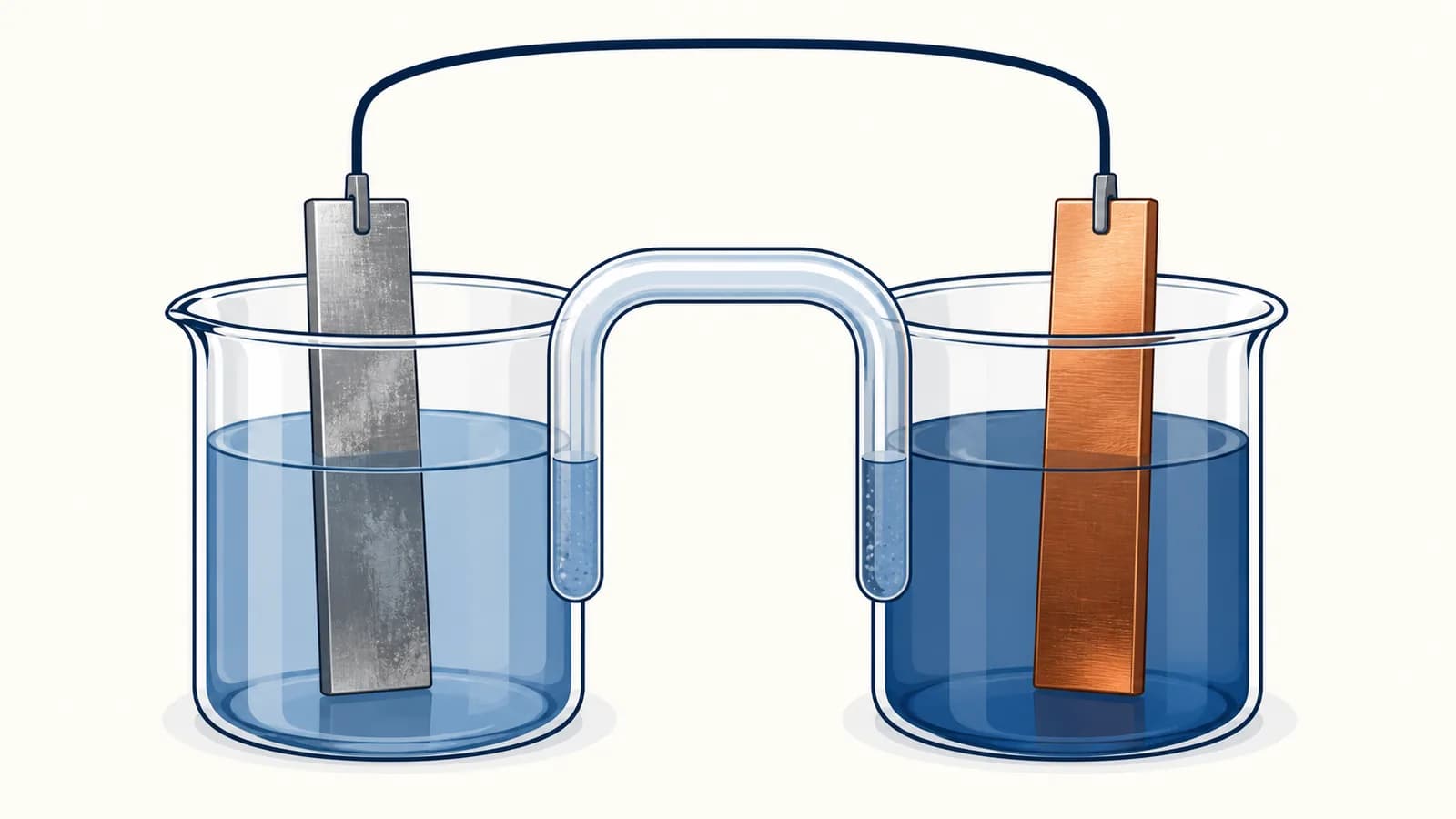
Electrochemistry is a branch of chemistry that connects electron transfer with electrical energy, in the context of redox reactions at electrodes. It explains how electrochemical cells, batteries, electrolysis, corrosion and fuel cells work. Oxidation releases electrons, reduction accepts them, and a voltage can push those electrons through a circuit. The idea exists because chemical change and electric current are two ways of tracking the same moving charge. A battery turns a spontaneous chemical reaction into useful electrical work; an electrolytic cell reverses the bargain by using electrical energy to force a reaction that would not proceed on its own.
What electrochemistry actually is
Electrochemistry studies reactions in which electrons move between chemical species and, under controlled conditions, through an external circuit. It links the molecular bookkeeping of oxidation and reduction to measurable quantities such as current, charge, voltage and the amount of material transformed.
A redox reaction can happen in one container, as when zinc metal is placed directly into a copper sulfate solution. Zinc atoms give electrons to copper ions at the metal surface. Copper metal forms and zinc enters the solution:
One zinc atom loses two electrons for every copper ion that gains two electrons.
An electrochemical cell separates the electron donor from the electron acceptor. The electrons then have a useful route through a wire. Their motion can light a lamp, run a motor or produce a reading on a meter. Ions move through the liquid inside the cell, so charge does not accumulate and stop the reaction.
This is one place where the wider subject of Chemistry becomes visibly connected: atomic structure explains electrons, bonding explains stable products, energetics explains direction, and reaction quantities explain how much material changes.
What oxidation and reduction actually are
Oxidation is the loss of electrons, while reduction is the gain of electrons. They always occur together because electrons released by one species must be accepted by another. Oxidation numbers provide a systematic way to identify which atoms lost or gained electron ownership.
The two parts of a redox reaction are written as half equations. For the zinc and copper cell, they are:
Zinc loses electrons, so its oxidation number rises from 0 to +2.
Copper ions gain electrons, so copper's oxidation number falls from +2 to 0.
The electrons cancel when the half equations are added. That cancellation is not a mathematical convenience alone. It expresses conservation of charge. If one half equation releases six electrons, the other must consume six electrons after both equations have been multiplied by suitable whole numbers.
The species oxidized is called the reducing agent because it supplies electrons that reduce something else. The species reduced is the oxidizing agent because it accepts electrons and causes something else to be oxidized. The names describe what each agent does to its reaction partner.
Use electron movement, not oxygen alone. Some oxidations add oxygen and some reductions remove it, but loss and gain of electrons is the definition that works for every redox reaction.
For complicated reactions, balance atoms and charge one half equation at a time. In acidic solution, water can balance oxygen atoms, hydrogen ions can balance hydrogen atoms, and electrons can balance charge. In basic solution, hydroxide ions are then used to remove any hydrogen ions. This method is chemical accounting: the final equation must conserve every element and total electric charge. The quantitative side connects directly to mole ratios and reaction calculations.
How a galvanic cell works
A galvanic cell converts the energy of a spontaneous redox reaction into electrical energy. Oxidation occurs at the anode, reduction occurs at the cathode, electrons travel through the outer circuit, and ions travel through the electrolyte and separator to preserve electrical neutrality.
Consider a zinc electrode in zinc ion solution and a copper electrode in copper ion solution. A wire joins the metals, and a salt bridge joins the solutions. The zinc and copper arrangement is often called a Daniell cell.
At the anode, zinc atoms leave the metal as zinc ions. Each atom sends two electrons into the electrode.
The difference in electrode potential drives electrons through the wire from zinc toward copper. Conventional current is defined in the opposite direction.
At the cathode, copper ions accept electrons and join the copper metal. The cathode gains copper atoms as the cell operates.
Anions migrate toward the anode side, where positive zinc ions are being produced. Cations migrate toward the cathode side, where positive copper ions are being removed.
The electron path and the ion path are both necessary. Disconnect the wire and electrons cannot reach the cathode. Remove the salt bridge and charge imbalance develops in the solutions. Either interruption stops sustained current even though the reactants still exist.
Electrode names are tied to reactions, not signs: anode means oxidation, and cathode means reduction. In a working galvanic cell the anode is negative because it supplies electrons, while the cathode is positive because it receives them.
How cell voltage works
Cell voltage is the electric potential difference between two electrodes, meaning the energy transferred per unit charge. It depends on the identities and conditions of both half cells, and it predicts reaction direction but does not by itself predict reaction speed.
A volt is a joule per coulomb. If a cell maintains a potential difference of 1.10 volts, each coulomb of charge can transfer 1.10 joules of electrical energy under ideal conditions. Voltage resembles pressure difference in a pipe only as an analogy. What actually differs is electric potential energy per charge.
Tables list standard reduction potentials. Each value belongs to a reduction half equation measured relative to the standard hydrogen electrode, which is assigned exactly 0 volts by convention. Standard conditions for common school tables use dissolved species at unit activity, gases at a standard reference pressure, pure solids or liquids, and usually a stated temperature of 25 degrees Celsius. Introductory calculations often approximate unit activity with a concentration of 1 mole per litre.
Using textbook standard reduction potentials, copper is +0.34 V and zinc is -0.76 V, so .
A positive calculated cell potential means the reaction is spontaneous in the written direction under the stated conditions. A negative result means the reverse direction is spontaneous. Multiplying a half equation to balance electrons does not multiply its electrode potential. Potential is energy per charge, an intensive quantity, so doubling both reaction amount and charge leaves the ratio unchanged.
Voltage links electrochemistry with energy through free energy:
For two moles of electrons at 1.10 V, for the reaction as written.
Here, is the number of moles of electrons transferred per mole of reaction, and is the Faraday constant, about 96,485 coulombs per mole of electrons. A positive gives a negative , matching a spontaneous process. The larger energy framework belongs to chemical energy and enthalpy changes, though cell voltage is governed specifically by Gibbs free energy rather than enthalpy alone.
How concentration changes electrode potential
Electrode potential changes when reactant or product activity changes because chemical driving force depends on composition. The Nernst equation corrects a standard cell potential for actual conditions, so a cell can lose voltage as products accumulate even before its reactants are exhausted.
For a complete cell reaction, the relation is:
is the reaction quotient. Pure solids are omitted from it, while dissolved species and gases contribute through their activities.
For the zinc and copper reaction, the classroom concentration approximation gives . If zinc ion concentration rises or copper ion concentration falls, becomes larger. The logarithmic correction then lowers the cell voltage. The reaction has less chemical incentive to keep moving in the forward direction.
Concentration cells make this effect especially clear. Two electrodes can be made from the same material and placed in solutions containing the same ion at different activities. Their standard potentials are identical, but their actual potentials differ. The cell produces voltage while the composition difference relaxes. No new type of electrode chemistry is needed; unequal chemical potential supplies the driving force.
Galvanic cells versus electrolytic cells
A galvanic cell uses a spontaneous reaction to provide electrical energy, while an electrolytic cell consumes electrical energy to force a nonspontaneous reaction. Both have oxidation at the anode and reduction at the cathode, but the electrode signs and energy direction differ.
| Feature | Galvanic cell | Electrolytic cell |
|---|---|---|
| Energy conversion | Chemical to electrical | Electrical to chemical |
| Reaction without an external supply | Spontaneous | Nonspontaneous |
| Anode sign | Negative | Positive |
| Cathode sign | Positive | Negative |
| Anode process | Oxidation | Oxidation |
| Cathode process | Reduction | Reduction |
An external power supply pulls electrons away from the electrolytic anode and pushes them toward the electrolytic cathode. That makes the anode positive and the cathode negative. The reaction definitions remain fixed even though the signs switch.
A workshop plates a steel part with nickel. The part is connected as the cathode, where nickel ions gain electrons and become nickel metal. A nickel anode can dissolve to replenish nickel ions. The power supply pays the energy cost and controls the electron flow.
Electrolysis can produce metals, refine copper, coat objects, split molten salts, and manufacture chemicals. Product prediction requires more than naming the ions. In water, water itself may be oxidized or reduced instead of an ion. Electrode material, concentration and kinetic barriers can change which reaction dominates.
How charge controls the amount made by electrolysis
The amount of substance produced in electrolysis is fixed by the total charge passed and the electrons required per particle. Current measures charge per second, so time and current determine moles of electrons, while the balanced half equation converts electrons into product.
The calculation begins with the definition of current, , rearranged to . Charge is divided by the Faraday constant to obtain moles of electrons. The half equation then supplies the mole ratio between electrons and the deposited or released substance.
A current of 2.00 amperes running for 30.0 minutes passes .
of electrons, rounded to three significant figures.
For , two moles of electrons deposit one mole of copper, giving .
Using copper's molar mass of 63.546 grams per mole, the ideal deposited mass is .
The example assumes every electron contributes to copper deposition. Real cells can have competing reactions, such as hydrogen formation, so the measured mass may be lower. Current efficiency compares the actual amount with the theoretical amount. Surface shape and coating quality also depend on current density, mixing, temperature and the chemistry of the bath, not only on total charge.
Current is not voltage. Current tells how quickly charge passes. Voltage tells how much energy is transferred per unit charge. Raising either one can change a process, but they describe different quantities.
How electrochemistry shows up in batteries and fuel cells
Batteries package one or more electrochemical cells so separated redox reactions can power a device. Fuel cells follow the same principle but receive fuel and oxidant continuously, while rechargeable batteries use an outside current to drive their cell reactions approximately backward during charging.
A cell contains an anode material, a cathode material, ion conducting electrolyte, an electron blocking separator, and current collectors. During discharge, electrons move through the device's outer circuit while ions move inside the cell. The separator must permit ionic conduction but resist direct electronic contact, which would short circuit the cell.
In a lithium ion cell, lithium ions move through the electrolyte between host materials while electrons take the outer path. The phrase lithium ion names a family, not one single chemistry. Different cathode materials change voltage, energy storage, cost, heat response and service life. Atomic arrangement and electrolyte stability therefore help determine how a cell behaves.
Charging is not a perfect rewind. Side reactions slowly consume mobile material or electrolyte, interfaces change, and internal resistance can rise. Fast charging can create steep concentration gradients and extra heating. Battery management electronics therefore monitor voltage, current and temperature, and they restrict operation outside chosen limits.
A hydrogen fuel cell oxidizes hydrogen at one electrode and reduces oxygen at the other. Its overall reaction forms water, but the device still requires fuel production, storage, delivery and suitable catalysts. Evaluating its environmental impact requires examining how the hydrogen was made and how the equipment was produced, not only the substance leaving the cell.
How electrochemistry shows up in corrosion, coatings and sensors
Corrosion is an unwanted electrochemical cell spread across a material's surface, while coatings and sensors deliberately control related electrode reactions. These processes appear in bridges, pipelines, dental work, water testing, factories and handheld meters because metals and ions exchange electrons wherever suitable paths exist.
Corrosion creates local anodes and cathodes
Iron corrosion in moist, oxygenated conditions involves iron oxidation at anodic regions and oxygen reduction at cathodic regions. Electrons move through the metal, while ions move through the thin water layer. Later reactions produce hydrated iron oxides commonly called rust. Salt water often speeds corrosion by making the water layer conduct ions more effectively.
A scratch, a difference in oxygen supply, a stressed region or contact between dissimilar metals can help establish local electrode regions. This is why corrosion is not simply a uniform reaction between an entire metal object and oxygen. Its geometry matters.
Protection interrupts the corrosion cell
Paint and polymer coatings separate metal from water and oxygen, but damage can expose a small active area. Galvanizing covers steel with zinc. Zinc is more readily oxidized than iron under many service conditions, so it can provide sacrificial protection even at a small scratch. Cathodic protection connects a structure to a more easily oxidized sacrificial anode or to an impressed current system.
A coating tries to keep reactants and electrolyte away from the metal. Its performance depends strongly on continuous coverage and adhesion.
A sacrificial anode or external current keeps the protected structure cathodic, reducing its tendency to lose electrons.
Choosing compatible metals is also important. If two dissimilar metals touch in an electrolyte, their potential difference can drive galvanic corrosion. The size ratio matters: a small anodic area connected to a large cathodic area can experience concentrated attack.
Electrochemical sensors turn chemistry into a signal
A pH electrode develops a potential related to hydrogen ion activity across a selective glass membrane, measured against a reference electrode. An amperometric sensor instead measures current from an electrode reaction under controlled potential. Glucose test systems, oxygen probes and some toxic gas detectors use variations on these principles.
Calibration matters because the electrical reading is not automatically a trustworthy concentration. Temperature, interfering species, electrode fouling and reference electrode condition can shift the response. Converting a signal into a result belongs to measurement, calibration and chemical analysis.
4 mistakes people make with electrochemical cells
Most electrochemistry errors come from mixing reaction names with electrode signs, treating electrons as if they cross the electrolyte, or confusing thermodynamic direction with reaction rate. Fixing those distinctions makes cell diagrams, voltage calculations and electrolysis predictions much more reliable.
1. Assigning anode and cathode by sign
The anode is always the site of oxidation, and the cathode is always the site of reduction. Their signs depend on cell type. A galvanic anode is negative, but an electrolytic anode is positive. Start by identifying each half reaction, then assign the names, then determine the signs.
2. Sending electrons through the salt bridge
Electrons move through metals and the outer circuit. Ions carry charge through the electrolyte and salt bridge. If electrons moved freely through the bridge, they could transfer directly between half cells and bypass the useful outer circuit.
3. Multiplying electrode potentials
Half equations may need multiplication so their electrons cancel, but standard potentials are not multiplied. If three copies of a half reaction occur, both its energy change and transferred charge triple. Energy per charge, which is voltage, stays the same.
4. Assuming a positive voltage means a fast reaction
A positive cell potential indicates thermodynamic favorability under specified conditions. It says nothing definite about reaction rate. Activation barriers, surface condition, ion transport and catalysts control how quickly charge can move. A favorable reaction can be extremely slow, while an applied voltage can drive a fast nonspontaneous one.
What does a salt bridge actually do?
A salt bridge completes the internal ionic circuit and limits bulk mixing between half cells. Its ions migrate to counter the charge created by electrode reactions, allowing sustained electron flow through the wire without requiring electrons themselves to cross through the solution.
The bridge contains an electrolyte chosen not to react strongly with the cell contents. As oxidation produces cations at an anode, anions from the bridge migrate toward that solution. As reduction removes cations at a cathode, bridge cations migrate toward that side. A porous separator can perform a similar function in practical cells.
Why does a battery stop producing useful voltage?
A battery stops providing useful power when reactant depletion, product buildup, resistance or side reactions pull its terminal voltage below the device's requirement. A reading with no load can remain noticeable even when voltage collapses once the device draws current.
Cell chemistry sets an equilibrium voltage, but real current produces losses. Slow ion transport creates concentration differences, electrode reactions require extra driving force, and internal resistance causes a voltage drop. Resting can partly relax concentration gradients, which explains why a weak battery may appear to recover briefly without gaining new chemical energy.
Can electrolysis split water directly?
Electrolysis can split water into hydrogen and oxygen when a sufficient applied voltage drives reduction and oxidation at suitable electrodes. In practice, the required voltage exceeds the reversible thermodynamic value because electrode kinetics, electrical resistance and gas bubble formation create additional losses.
Pure water conducts poorly because it contains few mobile ions, so an electrolyte is normally added. Its identity matters because the added ions might react. Electrode catalysts can lower kinetic barriers, but a catalyst does not change the overall energy difference or make an unfavorable reaction spontaneous without an energy supply.
Gas identity must be tested, not guessed. Aqueous electrolysis can involve dissolved ions, water and the electrode material. The products depend on which available half reactions actually occur.
Electrochemistry makes invisible electron transfer measurable
Electrochemistry turns redox chemistry into voltage, current, mass change and concentration readings. It joins atomic electron transfer to devices and industrial processes, giving the subject a direct way to measure chemical driving force and control matter with electricity.
The same checklist works for a coin cell, a corroding bolt, a plated tap and a laboratory sensor. Identify what is oxidized and reduced. Locate the anode and cathode. Trace electrons through the external conductor and ions through the electrolyte. Then separate the questions of direction, speed and quantity: potential predicts energetic direction, kinetics governs rate, and charge counts how much reacts.
The takeaway: Look for two linked paths whenever chemistry and electricity meet. Electrons need an electronic path, ions need an ionic path, and the paired electrode reactions explain the voltage or chemical change you observe.
The next time a battery powers a device, a metal surface tarnishes or a sensor reports a number, sketch the two half reactions. That simple act exposes the mechanism: matter changes at electrode surfaces, charge crosses two different routes, and conservation connects every electron to a chemical event.