Why can a rational choice produce a bad deal?
Game theory explains how rational people can make irrational deals because the best move for one person depends on what everyone else is expected to do. By the end, you can identify incentives, predict strategic responses, and redesign everyday bargains so cooperation becomes easier.
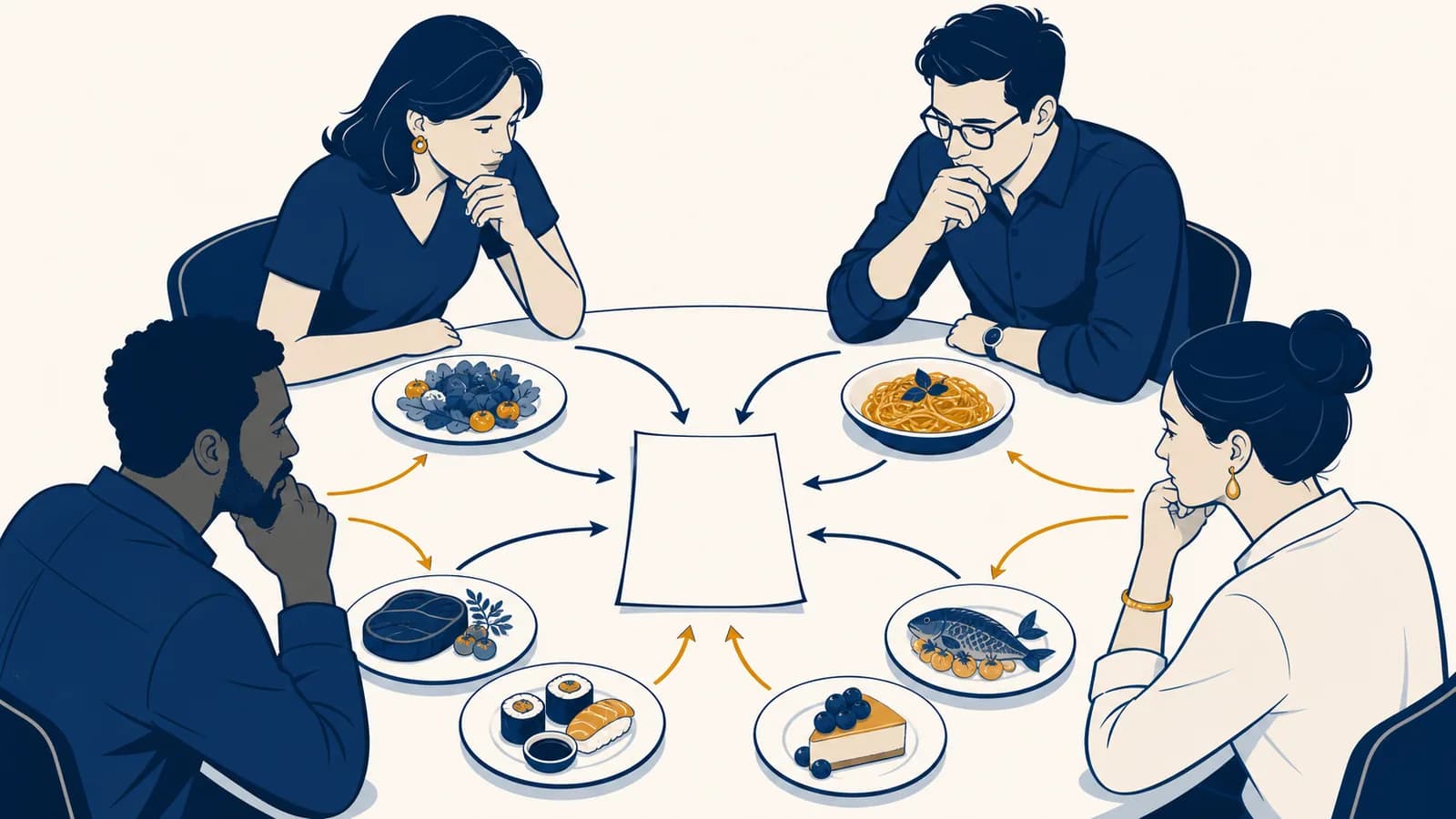
A choice can be individually sensible and collectively poor. Suppose four people share dinner, and the bill will be divided equally. Each person can order a modest meal for 12 credits or a deluxe meal for 24. If one person upgrades, that person gets 12 credits of extra food but pays only one quarter of the added cost, which is 3 credits. Upgrading looks rational. If everyone follows the same logic, each pays 24, even though all four may have preferred the modest meal and a bill of 12 each.
Four diners split the bill equally. One upgrade adds 12 credits to the total bill, so the person ordering it pays 3 of that increase while the group pays the other 9.
The arithmetic is simple, but the decision is strategic. Your cost depends on the choices of the other diners. This interdependence is what makes the situation a game in the technical sense. A game does not require a board, dice, or a winner. It requires decision-makers, available actions, consequences, and some dependence between one person's result and another person's choice.
Calling the final deal irrational needs care. The people may reason accurately about the incentives they face. The outcome is irrational only when judged against a result that all of them prefer. Bad systems can turn good individual reasoning into waste.
What exactly is a game at the dinner table?
A game is a model with players, strategies, payoffs, and rules connecting choices to results. At dinner, the players are the diners, strategies include what to order or contribute, and payoffs include food, money, fairness, approval, and future trust.
A payoff is not necessarily cash. It is a compact way to represent everything a player values in that choice. Someone may accept a smaller slice to avoid an argument, or pay more because generosity improves a friendship. Those motives do not make the person irrational. They show that the payoff includes more than the receipt.
Game theorists often assign numbers to payoffs. The numbers rank outcomes, but they do not need to measure happiness in physical units. If Ana assigns a payoff of 4 to sharing fairly, 2 to taking the last dumpling, and 0 to starting a fight, the useful claim is that she prefers the first result to the second and the second to the third.
Rational does not mean selfish. It means choosing an action that best serves the preferences a person actually has, given their information and beliefs.
Models leave details out on purpose. A useful dinner model might ignore the color of the plates but include who pays. The test is not perfect realism. The test is whether the model keeps the incentives that drive the choice. That habit of translating a messy event into quantities also rests on basic arithmetic for comparing costs and shares.
How does the shared bill change everyone's incentive?
A shared bill separates the cost a person creates from the cost that person pays. Each diner receives the full benefit of an upgrade but bears only a fraction of its price, so expensive choices become privately attractive even when they make the group poorer.
Let diners split the total equally. If one person adds an item costing , that person pays only of the extra bill. The remaining cost, , is spread across everyone else. Economists call a cost imposed on other people an external cost.
If an extra dish costs 20 credits and five diners split the bill, the person ordering it pays 4 credits of the increase.
Suppose the extra dish gives its buyer 9 credits of value. Bought alone, it is a bad purchase because 9 is less than 20. Under a five-way split, the buyer gains value of 9 and personally pays 4, so ordering it improves that buyer's payoff by 5. The other diners together absorb the missing 16. No one has made a calculation error. The rule has changed the calculation.
| Choice by one diner | Value to that diner | Extra personal cost | Private net result |
|---|---|---|---|
| Skip the extra dish | 0 credits | 0 credits | 0 credits |
| Buy it alone | 9 credits | 20 credits | Loss of 11 credits |
| Add it to a five-way bill | 9 credits | 4 credits | Gain of 5 credits |
This structure appears well beyond restaurants. A team may overuse a shared budget, roommates may leave chores for one another, and drivers may enter a crowded road because each driver receives the trip's benefit while spreading the added delay across many people. The surface details change. The gap between private cost and total cost remains.
Why does the prisoner's dilemma trap sensible people?
The prisoner's dilemma traps players because each has a safer individual move that leads to a worse shared result. Cooperation would help both, yet each fears being the only cooperator, so self-protection pushes both toward mutual defection.
Imagine two siblings dividing cleanup after dinner. Each can clean or avoid the work. If both clean, the job ends quickly and resentment stays low. If one cleans while the other avoids it, the cleaner does extra work and the avoider relaxes. If both avoid it, the kitchen remains dirty and both face consequences later.
The exact payoff numbers below are invented model values, not survey results. They preserve the preference order that defines the dilemma: exploiting a cooperator is best, mutual cooperation comes next, mutual avoidance is worse, and cooperating alone is worst.
| Your choice | Other person cleans | Other person avoids |
|---|---|---|
| You clean | 3, 3 | 0, 4 |
| You avoid | 4, 0 | 1, 1 |
Read each pair as your payoff first and the other person's payoff second. If the other person cleans, avoiding gives you 4 instead of 3. If the other person avoids, avoiding gives you 1 instead of 0. Avoiding is therefore your better choice in either case. The same reasoning applies to the other person, so both avoid and receive 1 each. Yet both would prefer the cooperative result of 3 each.
Given either action by the other person, avoiding cleanup gives you the higher modeled payoff.
When both follow that reasoning, each receives less than if both had cleaned.
A strategy that performs better regardless of the other player's move is called a dominant strategy. Not every game has one. The prisoner's dilemma is memorable because both players have a dominant strategy, but following both dominant strategies produces an outcome that both rank below mutual cooperation.
What does Nash equilibrium predict, and what does it not?
A Nash equilibrium is a set of strategies in which no player can improve their own payoff by changing alone. It predicts a stable response pattern under stated assumptions, but it does not guarantee fairness, happiness, efficiency, or a unique outcome.
In the cleanup game, mutual avoidance is a Nash equilibrium. If one sibling starts cleaning while the other still avoids, the cleaner falls from a payoff of 1 to 0. A move by one person cannot repair the outcome. Improvement requires both to change, or requires a change to the rules.
Equilibrium means resistant to unilateral change. A traffic jam can be an equilibrium if no driver can choose a faster route alone. A tense seating arrangement can be an equilibrium if every available solo move creates a worse conflict. Stability describes the incentives around a result, not its moral quality.
Some games have several equilibria. Two friends choosing where to eat may both prefer dining together but disagree about the restaurant. Meeting at either restaurant can be stable once each expects the other to go there. Their problem is coordination, not temptation. A message, convention, or familiar meeting point can select one outcome.
The method resembles debugging: hold the other person's action fixed, then test what changes when one choice changes. In computing, version control makes controlled comparisons possible by recording which change produced which result. Strategic analysis uses the same discipline of changing one input at a time.
Why do fairness and trust belong in a rational model?
Fairness and trust belong in a rational model whenever people value them or expect them to affect later choices. A person may reject profitable treatment that feels insulting, reward generosity, or sacrifice now to protect a relationship that will matter again.
A narrow model counts only tonight's money and food. A better model may include embarrassment, gratitude, anger, reputation, and expected future help. These factors are harder to measure, but ignoring them does not make the model more scientific. It can make its predictions wrong.
Consider a host who offers a guest the smaller half of a dessert. The guest could accept and receive more dessert than none, yet refusal may discourage future unfair offers. If the host values the relationship, the refusal also communicates a boundary. The immediate food payoff is only one part of the strategic result.
Trust changes expectations. If you believe a friend will repay a favor, helping has a likely future return. If you expect betrayal, withholding help becomes safer. The same action can therefore be rational under one belief and irrational under another. Good analysis states the beliefs instead of pretending they do not exist.
Do not diagnose motives from one choice. The observed action may fit several payoff systems, including generosity, fear of conflict, concern for reputation, or a simple preference you did not know about.
This is also why evidence matters. Watch what people choose under different rules, ask what they knew, and separate stated preferences from observed tradeoffs. Prediction improves when the model reflects real incentives rather than a cartoon of selfishness.
How does repetition turn conflict into cooperation?
Repeated interaction can support cooperation because today's choice changes tomorrow's treatment. A short-term gain from cheating may be outweighed by lost trust, retaliation, exclusion, or the end of a valuable relationship.
Return to the cleanup problem. In a one-time encounter, avoiding the work dominates. If the siblings share hundreds of dinners, each choice becomes information. One sibling can respond to avoidance by refusing the next favor. Cooperation now carries an expected future benefit, while defection carries an expected future cost.
If each cooperative round gives 3 payoff units and future payoffs are weighted by , the continuing value is .
The discount factor represents how much a player values a later payoff compared with an immediate one. It lies between 0 and 1 in this simple model. A value near 0 means the future counts little. A value near 1 means later rounds remain important. The geometric pattern behind this formula connects strategic reasoning to wider mathematical tools for modelling repeated change.
Repetition does not automatically create kindness. Retaliation can produce long feuds, and a known final round can weaken cooperation because there is no later punishment. Cooperation becomes more plausible when players expect to meet again, can recognize past behavior, can detect cheating reasonably well, and can respond at a cost that is not ruinous.
Others receive evidence that promises may be reliable.
People may share dishes or alternate paying with less fear.
Reliable behavior can make future cooperation easier and cheaper.
Forgiveness matters as much as punishment when mistakes are possible. A strategy that retaliates forever after one misunderstood action can destroy a useful relationship. Conditional cooperation works best when responses are clear, proportionate, and able to reset after repair.
How can you diagnose a bad bargain before accepting it?
Diagnose a bargain by listing the players, available actions, payoffs, information, timing, and repeat interactions. Then test how each person would respond to every rule, including responses that appear inconvenient or unfair.
Include anyone who can change the result, not only the people speaking at the table.
Count money, time, effort, risk, status, fairness, and future effects that the players plausibly value.
Hold other choices fixed and ask which available move gives that player the preferred result.
Look for results where no player benefits by switching alone, then compare them with outcomes the group prefers.
Test separate bills, rotation, deposits, deadlines, visible records, or another rule that changes the incentives.
Information deserves special attention. Does everyone know the prices? Are promises observable? Can a player hide an action? Do people move simultaneously, or can one wait and react? A bargain that works with transparent choices may fail when actions are private.
Commitment also changes a game. A credible commitment removes a tempting future action or makes it costly. Paying a deposit, setting a spending cap before ordering, or assigning cleanup in advance can make a promise believable. Empty words do not alter payoffs. A commitment does.
Use skepticism on your own model. Check the assumed payoff order, search for a choice you omitted, and test how the result changes under different beliefs. This is close to reviewing generated work for hidden assumptions and errors: a neat answer is not enough if the inputs are wrong.
Better rules make better deals possible
A bad outcome often calls for a better rule, not a lecture about character. Aligning private costs with shared costs, making actions visible, supporting credible commitments, and preserving future consequences can turn cooperation into each person's sensible choice.
At the restaurant, separate bills make each diner face the cost of their own order. A fixed shared menu removes the upgrade decision. A spending cap limits exposure. Taking turns paying can work among trusted friends who expect the meals to balance over time. Each solution changes a different part of the game.
Ask everyone to resist an incentive that still rewards the costly behavior.
Make the cooperative action cheaper, safer, easier to verify, or more rewarding.
Rule changes can create new problems. Separate checks may discourage shared dishes. Public records may improve accountability but reduce privacy. Strict punishment may deter cheating but also punish mistakes. Every mechanism should be tested against the behavior it encourages, including attempts to exploit it.
The most useful question is not, “Why are these people irrational?” Ask, “What becomes rational under these rules?” That shift directs attention toward the mechanism producing the result. It also makes disagreement easier to analyze because it separates preferences, beliefs, and incentives.
The takeaway: Rational choices can combine into an outcome nobody wants. Map the payoffs, find the best responses, and change the rules so a good shared result is also a good individual move.
Game theory does not promise perfect predictions. People misunderstand situations, care about unexpected things, and sometimes act impulsively. It provides a disciplined way to ask what each person can do, what each expects, and what each stands to gain. At a dinner table, in a workplace, or inside a public policy, those questions expose why a bad bargain persists and where a better one can begin.