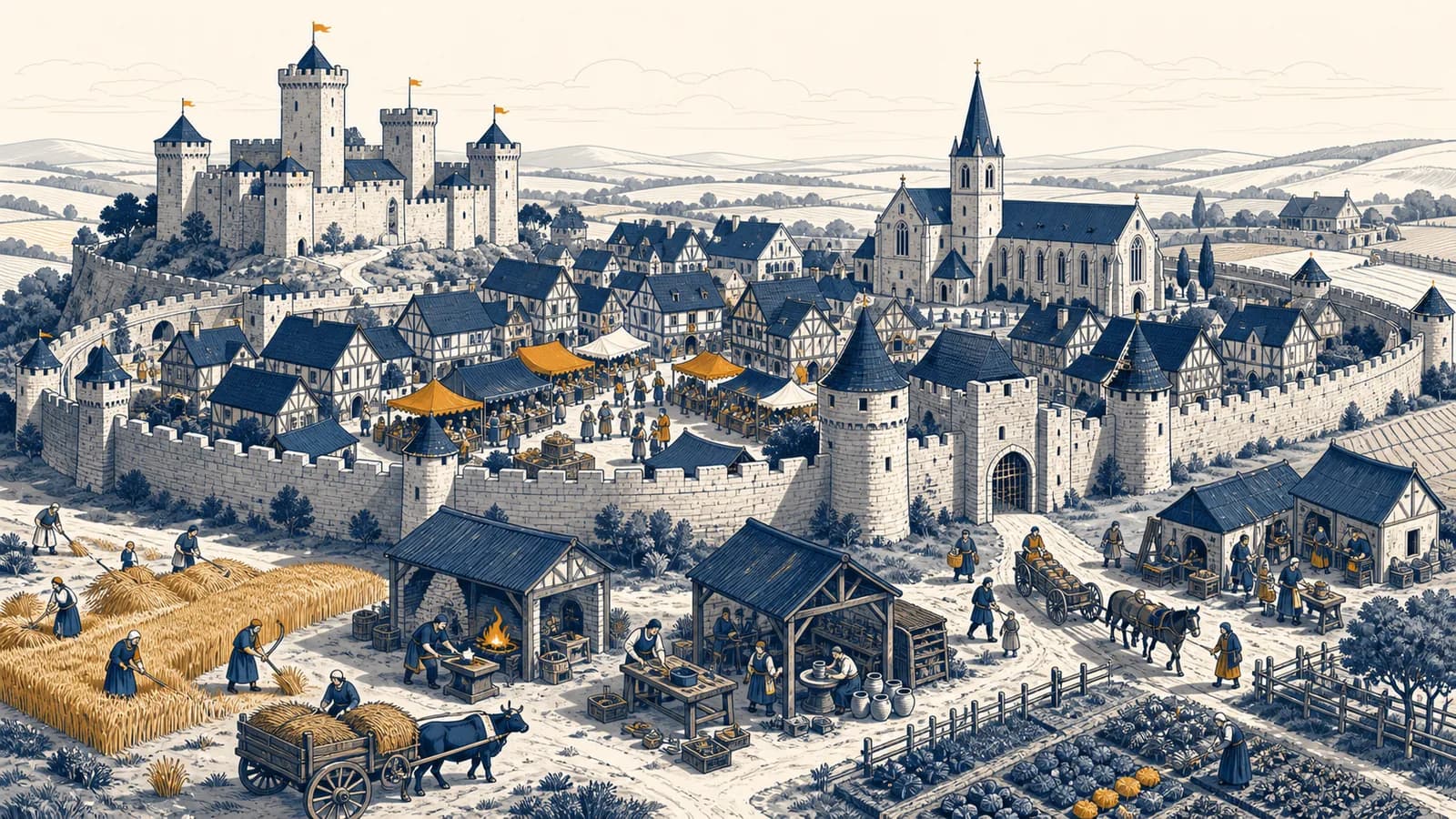
The Middle Ages is a historical period that connects the end of Roman rule in western Europe to the beginning of early modern Europe, in the context of European history. Also called the medieval period, it lasted roughly from the fifth century to the late fifteenth century, although its dates vary by place. Historians use the term because institutions, economies, beliefs, and political systems changed across these centuries in related ways. Medieval Europe included feudalism and manorialism, the Crusades, growing towns, powerful churches, and the Black Death. It was neither a single civilization nor a thousand years of unbroken decline.
A person living in 900 did not know that they were in the Middle Ages. The label was created later by scholars who placed a middle period between classical antiquity and their own age. That hindsight can be useful, but it can also hide regional differences and make gradual change look like a clean break.
What the Middle Ages actually is
The Middle Ages is the conventional name for the period of European history after Roman political authority fragmented in the West and before early modern states, Atlantic expansion, and Renaissance culture became established. Its boundaries are analytical tools, not events experienced everywhere at once.
A common school date range is about 500 to 1500. It is convenient because the western Roman imperial office ended in 476, while changes around 1500 included the printing press, stronger monarchies, voyages across the Atlantic, and religious conflict. None of those developments switched Europe from medieval to modern on one day.
The Germanic commander Odoacer deposed Romulus Augustulus. Roman government, law, and culture continued in altered forms.
Pope Leo III crowned the Frankish king in Rome, joining royal power to a revived western imperial title.
Pope Urban II urged armed Christians to aid eastern Christians and capture Jerusalem.
A vast plague epidemic killed people across Europe and reshaped labor, wealth, and religious life.
Ottoman forces captured the capital of the Byzantine Empire, ending a political continuation of the Roman Empire.
Historians often divide the period into early, high, and late phases. The early Middle Ages saw post-Roman kingdoms form and Christianity spread across more of Europe. The High Middle Ages brought population growth, expanding agriculture, towns, universities, and stronger monarchies. The Late Middle Ages included plague, war, revolt, and institutional change.
These divisions fit western and central Europe better than they fit every neighboring society. The Byzantine Empire, Islamic caliphates, Mongol states, and African kingdoms followed their own chronologies. They still belong in medieval history because trade, migration, diplomacy, scholarship, and warfare connected them to Europe.
How medieval society worked
Medieval society worked through overlapping relationships rather than one uniform system. Households produced food, landlords claimed rent and labor, rulers demanded loyalty, churches organized worship and property, and towns protected commercial privileges. A person could answer to several authorities at the same time.
Most people lived in rural communities and worked the land. Their legal status mattered. An enslaved person was treated as property under local law. A serf was not normally owned as an object, but was bound by inherited obligations to a lord or estate. A free peasant had more control over movement and property, although taxes, rent, and custom still limited choices.
The flow was not simply upward. A lord was expected to protect an estate, settle disputes, and maintain resources such as mills or ovens. A parish priest conducted services and recorded parts of community life. Villagers shared grazing land, enforced field customs, and sometimes challenged demands in court. Obligations could be unequal without being unlimited.
Status shaped duties and opportunities
Social rank was a legal and economic position, not only a measure of wealth. Nobles often possessed rights to land, jurisdiction, or military command. Clergy had church offices and were governed in some matters by canon law. Town residents could gain liberties through a borough charter. People crossed categories through marriage, migration, ordination, purchase, service, or royal favor, but birth remained powerful.
Gender shaped work and authority
Medieval law and custom usually gave men greater formal authority in marriage, inheritance, and public office. Women still farmed, brewed ale, sold goods, managed households, practiced trades, entered religious houses, and ruled estates or kingdoms. Their choices depended on rank, marital status, local law, and life stage. A wealthy widow could possess more legal independence than a married woman, while a poor widow might face greater insecurity.
There was no single medieval social pyramid. The familiar diagram of clergy, nobles, and peasants describes an ideal promoted by some writers. It leaves out merchants, artisans, servants, enslaved people, officials, students, and the differences within every group.
How land, lordship, and farming worked
Land supported medieval power because harvests fed households and the rights attached to land produced rent, labor, and jurisdiction. Lords did not simply own every field outright. Tenants held plots under local customs, while villages coordinated planting, grazing, and shared resources.
An estate, often called a manor in parts of western Europe, could contain the lord's own land and tenant holdings. Some tenants paid with crops or money. Others owed labor on the lord's fields for a set number of days. A household might owe several kinds of payment because rent, court fees, church tithes, and royal taxes served different institutions.
Custom defines what the family may cultivate, inherit, sell, or surrender. The answer varies by estate and region.
Open fields may require shared planting dates. Common pasture and woodland provide grazing, fuel, and building material under agreed rules.
The household keeps food and seed, then meets rent and other dues in labor, produce, or money.
A manorial court records transfers, fines offenses, hears disputes, and preserves evidence of what tenants and lords claimed they could do.
Farming changed over the period. In suitable regions, heavier plows helped work dense soils, horse equipment made animal power more useful, and crop rotations distributed planting across fields. These methods were not invented or adopted everywhere at the same time. Their effect depended on soil, climate, animals, labor, and access to markets.
A tenant household harvests grain from several strips. It must reserve seed before the next planting, keep enough food for the household, and meet a grain rent. If rain reduces the crop, those claims do not automatically shrink. The family may sell an animal, borrow, negotiate, break a rule, or go hungry. One poor harvest becomes a social problem because production and obligation are linked.
Feudalism versus manorialism
Feudalism usually describes political and military relationships among elites, while manorialism describes the organization of land, labor, and dues on an estate. The two could overlap, but neither term names a complete system shared by all of medieval Europe.
A lord grants a fief, office, income, or protection to a vassal who promises loyalty and service. Historians debate how consistently this model fits the surviving evidence.
A landlord receives rent or labor from tenants on an estate. Local courts and customs regulate holdings, inheritance, shared land, and agricultural duties.
A knight might hold land from a count in return for military service, while peasants working that land owed rents under a different set of customs. The count might also owe loyalty to a king, serve another lord for a separate property, and exercise court rights claimed from inheritance. The result was a network, not a tidy chain.
Modern historians use feudalism cautiously because later scholars bundled many local practices into one model. Medieval documents usually name specific acts, such as homage, a fief, wardship, rent, or military service. Ask which right changed hands, who owed what, and which court could enforce it. Those questions explain more than the broad label alone.
How towns and trade changed medieval life
Towns and trade changed medieval life by turning surplus crops, skilled work, credit, and transport into sources of power beyond the estate. Markets connected villages to regional networks, while charters and guilds gave many urban residents rules different from rural custom.
A town needed food from the countryside and routes along which goods could move. A miller, weaver, smith, or mason could exchange specialized work for money rather than producing every necessity at home. Merchants linked local markets to ports and fairs. Mediterranean shipping connected European buyers and sellers with Byzantine, Islamic, African, and Asian trade networks. Northern sea routes joined the Baltic and North Sea regions.
| Institution | What it controlled | How it affected daily life |
|---|---|---|
| Market charter | The right to hold a market and collect specified fees | It created a regular place and time for exchange. |
| Craft guild | Training, standards, and access to a trade in some towns | It shaped apprenticeships and who could open a workshop. |
| Merchant association | Commercial privileges and mutual protection | It reduced some risks of travel and bargaining. |
| Town court | Local disputes, debts, property, and ordinances | It made urban rights enforceable through records. |
Money did not replace barter everywhere, and villages were not isolated from exchange. A peasant might sell eggs at a nearby market, owe part of a rent in coins, and still exchange labor with neighbors. Commercial growth altered lordship because landlords increasingly accepted cash payments, while rulers taxed trade and borrowed from financiers.
Guilds regulated work but did not include everyone
A guild could train apprentices, inspect products, support members, and take part in town politics. Membership also excluded competitors. Women participated in production and sometimes held guild rights through family or widowhood, but many guild structures favored male masters. Unregulated workers and migrant laborers remained part of the urban economy.
Trade carried ideas and disease as well as goods
Ships, roads, and caravan routes moved books, techniques, beliefs, and pathogens. Commercial contact helped transmit mathematical learning and translated texts. The same connected routes also helped plague spread across long distances in the fourteenth century. Connection created opportunity and exposure through the same mechanism: repeated movement between populated places.
How religion, learning, and political power worked together
Religion, learning, and political power worked together because churches held land, taught doctrine, preserved records, judged some disputes, and legitimized rulers. Yet secular and religious authorities also competed over appointments, taxes, law, and obedience, so neither side simply controlled the other.
Latin Christianity linked much of western Europe through worship, institutions, and a learned language. Orthodox Christianity shaped the Byzantine Empire and eastern Europe. Jewish communities maintained religious and commercial networks despite recurring legal restrictions, expulsions, and violence. Islamic states governed much of the Iberian Peninsula at different times and supported centers of learning whose texts and scholarship entered Latin Europe through contact and translation.
Monasteries and cathedral schools trained clergy and copied manuscripts. Universities later formed as legally recognized communities of teachers and students in cities such as Bologna, Paris, and Oxford. Their scholars argued through structured questions, authorities, and objections. This intellectual culture helped develop theology, law, medicine, and natural philosophy.
Medieval books were designed for use. A legal manuscript could guide a court, a psalter could organize prayer, and a merchant's account book could track debts. Marginal notes, repairs, stains, and handwriting reveal what readers actually did with a text.
Rulers governed through people and documents. A king depended on nobles, household officials, sheriffs or comparable local agents, clergy, town leaders, and assemblies. Written charters turned commands or grants into evidence that could be stored and cited. Seals authenticated documents for people who might never see the ruler.
The Crusades joined belief to organized violence
A crusade was a church-authorized armed expedition whose participants took vows and received spiritual privileges. The First Crusade captured Jerusalem in 1099 and established Latin Christian states in the eastern Mediterranean. Later crusades targeted other places and groups, including Muslim powers, pagans, heretics, and political enemies within Europe.
Crusading depended on preaching, finance, transport, family strategy, and military organization. Motives varied. Religious devotion could exist beside hopes for status or security. The campaigns produced conquest and massacre, while also intensifying contact among Christian, Muslim, and Jewish communities. Explaining the institution requires both its stated religious rules and the actions of participants.
How crisis transformed the Late Middle Ages
Crisis transformed the Late Middle Ages by reducing populations, disrupting labor, increasing military costs, and forcing institutions to renegotiate power. Plague and war did not cause uniform collapse. Their effects depended on local property rules, markets, government capacity, and the choices survivors made.
The Black Death reached Mediterranean ports in 1347 and spread through Europe. It was part of the second plague pandemic, and the main disease involved the bacterium Yersinia pestis. Fleas and rodents played important roles in transmission, while plague can also pass between people in pneumonic form. Medieval observers lacked germ theory, but they tracked symptoms, movement, and mortality using the explanations available to them.
Plague killed people, labor became scarce, and every surviving worker gained freedom and higher pay.
Labor scarcity strengthened bargaining in many places, but landowners and governments resisted through wage rules and service demands. Outcomes differed with access to land, urban jobs, courts, and collective action.
Population loss could leave farms vacant and make workers harder to replace. Some survivors demanded wages or better leases. Some landlords shifted from labor dues toward money rents or livestock. Authorities sometimes tried to limit pay or movement. Conflict followed because catastrophe changed bargaining conditions faster than social rules changed.
Long wars also pushed rulers to gather taxes, borrow money, contract troops, and improve administration. The Hundred Years' War was a sequence of conflicts between the English and French crowns from 1337 to 1453, interrupted by truces and shifting alliances. Its armies damaged farms and towns, but the war also encouraged fiscal and military changes that outlasted particular campaigns.
Late medieval revolt makes this process visible. Rural and urban groups protested taxes, labor controls, officials, landlords, or political exclusion. Revolts often failed in their immediate demands, yet their records reveal what ordinary participants thought was fair. Crisis was therefore both destruction and negotiation, with unequal results.
How medieval evidence shows up in real work
Medieval evidence shows up in real work when archivists preserve charters, archaeologists compare objects with soil layers, conservators stabilize buildings and manuscripts, lawyers trace institutions, and researchers test claims against records created for purposes very different from historical study.
A tax list was written to collect money, not to give a balanced portrait of society. It may omit people who owed nothing, group households under one name, or use categories that changed by district. A historian first asks who created it and what action it supported. Only then can the list be used to study population, wealth, naming, or work.
Record its material, language, date range, place, and physical alterations without assuming the story it tells.
Ask who made it, for whom, under which rules, and what result the maker wanted.
Test a chronicle against accounts, letters, court rolls, buildings, burials, coins, or environmental data.
Separate what the evidence demonstrates from what it suggests and what it cannot answer.
This method matters in museums and heritage planning. A curator must decide which object supports a claim and how much context a label needs. A building conservator distinguishes medieval fabric from later repair before changing anything. An archaeologist maps where an object was found because location can matter more than appearance.
A town plans work near an old church. Archaeological survey finds burials whose orientation and position suggest a cemetery boundary different from the present wall. The discovery affects construction plans, legal treatment of human remains, and interpretation of the site. Medieval history becomes a current decision about land, evidence, cost, and respect.
Medieval institutions also leave traces in present law and government. Parliament, universities, municipal charters, church courts, and common law all have medieval histories, although none survived unchanged. Looking backward helps lawyers and policy historians distinguish an old name from an old function. It also prevents the false argument that a practice is justified simply because it is traditional.
Were the Middle Ages really dark?
The Middle Ages were not a uniform Dark Age, although war, disease, coercion, and loss were real. The label becomes misleading when it treats limited written evidence or the decline of some Roman institutions as proof that every field and region stopped developing.
After Roman authority fragmented in western Europe, some cities shrank, long-distance tax systems weakened, and fewer texts were produced in certain places. In other regions, the eastern Roman Empire preserved urban government and scholarship. Islamic societies expanded scientific, medical, philosophical, and commercial work. Medieval European builders, farmers, jurists, artists, and scholars also created new institutions and techniques.
A period with sparse surviving evidence for a particular place, or a historian's limited ability to answer a narrow question.
That an entire continent lacked learning, invention, trade, government, or cultural change for a thousand years.
The useful correction is not to call medieval life pleasant. Violence, hierarchy, hunger, persecution, and high vulnerability to disease mattered. So did legal argument, technical skill, commercial growth, literature, and community action. A historical judgment becomes stronger when it specifies the place, date, group, and evidence.
When did the Middle Ages end?
The Middle Ages ended at different times depending on the region and the feature being measured. Historians often use dates near 1500 for convenience, but political, religious, economic, and cultural changes crossed that boundary at different speeds.
The fall of Constantinople in 1453 ended the Byzantine Empire. Movable type printing spread through western Europe after Johannes Gutenberg's work in the mid-fifteenth century. Columbus reached the Caribbean in 1492 under the sponsorship of the Spanish monarchs. Martin Luther's challenge to church authority began in 1517. Each date answers a different question, so none is a universal finish line.
The changes associated with Renaissance art, scholarship, and political thought grew within medieval cities, courts, schools, and trade networks. Calling them a sudden rebirth hides those foundations. Periods overlap because people reuse existing institutions while changing their purposes.
European Atlantic expansion is another marker, but it makes sense only by following its later consequences. The processes explained through oceanic exploration and colonial rule drew on medieval navigation, commerce, warfare, and religious claims, then created new systems of conquest and exchange.
Did people in the Middle Ages live like films suggest?
Films compress medieval life into castles, mud, battles, and rigid ranks because those images communicate quickly. Real lives also involved contracts, jokes, worship, skilled work, family disputes, migration, market choices, and local politics that leave less obvious visual shorthand.
Castles were fortified residences and political centers, not the normal home of most people. Armor changed with period and purpose. A twelfth-century mail coat and a fifteenth-century plate harness belong to different military settings. Cleanliness also varied with water access, labor, custom, and wealth. Town governments regulated waste because crowded streets created obvious problems, not because people were unaware of dirt.
Speech in English-language films presents another distortion. Medieval Europe contained many spoken languages, while Latin served much western scholarship and church administration. Most people learned through speech, demonstration, ritual, and memory rather than private reading. That did not make them unintelligent. It meant knowledge moved through different media.
Was medieval Europe cut off from the wider world?
Medieval Europe was connected to a wider world through trade, pilgrimage, warfare, diplomacy, migration, and scholarship. The intensity and reach of those links changed over time, but European societies never developed in complete isolation from Africa and Asia.
Silver, textiles, spices, ceramics, enslaved people, and other goods moved through linked markets. Translators working with Arabic, Greek, Hebrew, and Latin texts transmitted learning across linguistic borders. Mongol expansion in the thirteenth century created enormous destruction, while also placing distant regions within connected political and commercial routes.
Contact did not mean equal knowledge or peaceful exchange. Travelers misunderstood unfamiliar societies, rulers restricted merchants, and religious categories shaped suspicion. War and enslavement were forms of connection too. A map of movement shows relationships, but the sources are needed to explain who controlled them and who paid the cost.
Do not use “medieval” as a synonym for backward. The habit turns a specific historical period into an insult and encourages false comparisons with present societies. Name the actual practice being criticized, such as arbitrary detention, forced labor, or poor sanitation.
The Middle Ages make cause and continuity visible
The Middle Ages show that history is made through linked changes in work, authority, belief, environment, and exchange. Studying those links explains why institutions survive, why crises produce uneven outcomes, and why neat period boundaries are useful only when treated as questions.
Take any medieval object or event and build a chain of causes. A castle required revenue, labor, materials, engineering knowledge, and a political reason for fortification. It then changed local movement, defense, taxation, and status. The building is evidence of a system, not a detached monument.
The same habit works beyond the medieval period. Later nationalism reused legends and symbols from the medieval past, a pattern examined through the growth of nationalism and imperial power. Political movements selected old stories because claims about ancestry and territory could support present goals.
The takeaway: Treat the Middle Ages as a set of connected historical problems, not a costume or stereotype. Choose one claim, fix its time and place, identify the mechanism, and ask what evidence could prove it wrong.
That practice connects this topic to the wider study of evidence, change, and historical explanation. The next time a church, street name, court custom, university ceremony, or film invokes the medieval past, notice which part survives, which part was reinvented, and whose version of the past is being used.