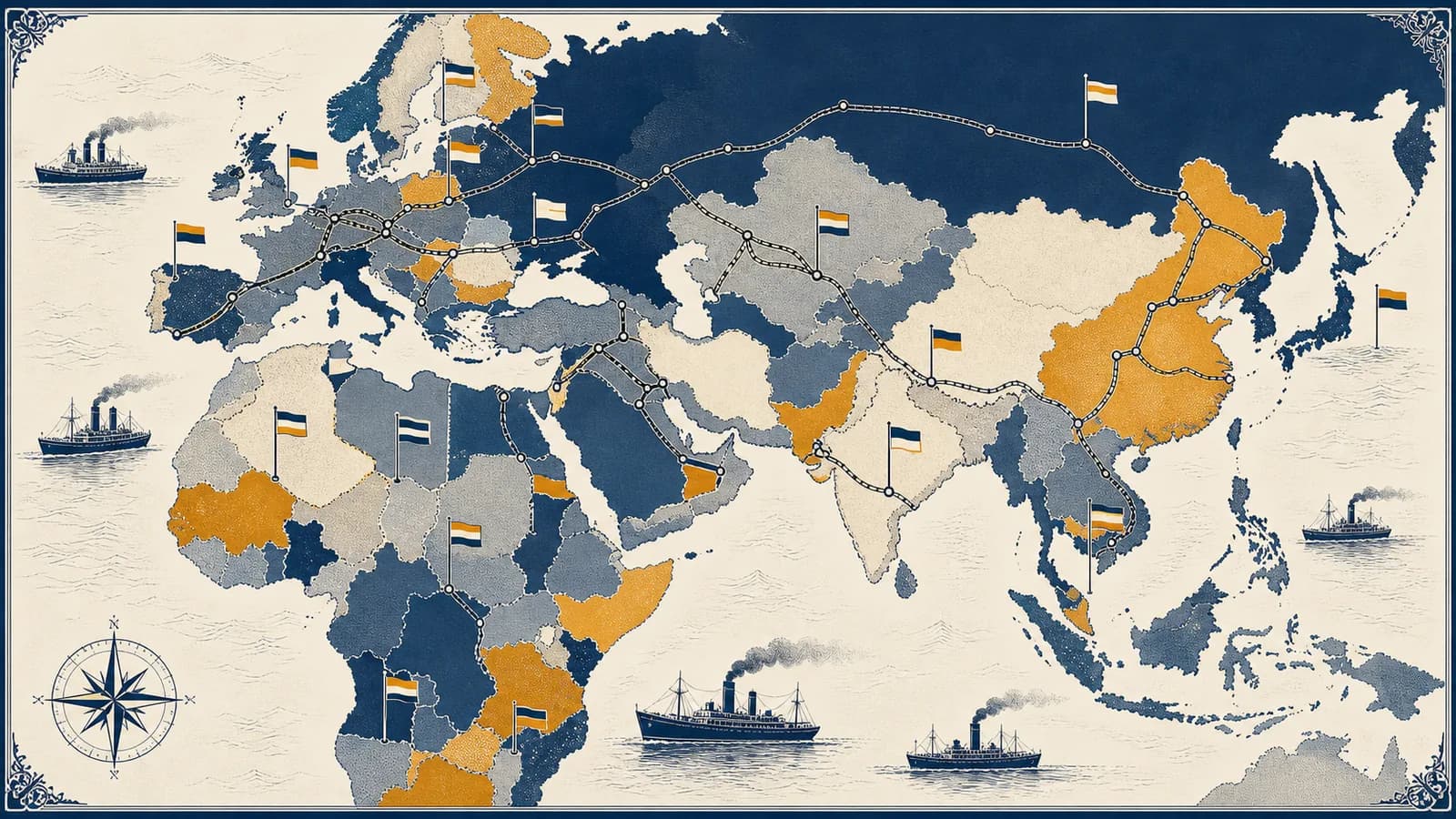
19th Century Nationalism and Imperialism is a set of political forces that built nation-states and extended state power over foreign peoples, in the context of industrializing Europe and its global empires. Nationalism claimed that a people sharing a nation should govern itself, while imperialism placed other societies under outside control. Together, they explain the unification of Italy and Germany, the weakening of multinational empires, and the European partition of much of Africa and Asia. These ideas existed because governments and political movements needed ways to organize loyalty, territory, labor, markets, and military power in a century of rapid change.
That distinction matters. People could share a language or memory without having their own state, and a state could rule many peoples who did not see themselves as one nation. Leaders turned selected customs, symbols, and histories into public institutions. The same governments that praised national self-rule in Europe often denied it to colonized people abroad.
What nationalism actually is
Nationalism is the belief that a population understood as a nation should form a political community, usually with its own state, government, or public institutions. It turns shared identity into a claim about who should rule, where borders belong, and whom citizens owe loyalty.
A nation is a group imagined to share features such as language, history, religion, ancestry, territory, or political values. A state is an organization that makes and enforces laws over a territory. A nation-state is the ideal that the borders of the nation and the borders of the state should match. They rarely match perfectly.
A claimed community of people. It depends on belonging, memory, culture, and political identification.
A governing structure with territory, laws, officials, taxation, police, and armed forces.
National identity does not appear automatically when people speak alike. Nineteenth-century Italy contained many regional dialects and loyalties. German speakers lived in numerous states and in territories ruled by larger empires. Political organizers had to persuade people that a broader Italian or German identity deserved sacrifice and obedience.
Nationalism also took different political forms. Liberal nationalism linked the nation to constitutions, citizenship, and representative government. Conservative nationalism used national unity to strengthen monarchies, armies, and established authority. Ethnic nationalism treated ancestry and inherited culture as the basis of membership. Civic nationalism stressed common laws and political participation. Actual movements often mixed these forms.
How nationalism works
Nationalism works by defining a people, spreading a shared story, attaching that identity to institutions, and converting belonging into political action. Schools, newspapers, armies, ceremonies, maps, and elections make the nation visible, while governments reward loyalty and marginalize rival identities.
Writers and organizers select markers such as language, descent, religion, remembered victories, or remembered injuries. Those markers identify insiders and can also identify outsiders.
Grammars, schoolbooks, museums, songs, flags, and public holidays turn varied local memories into a national account of the past.
Political clubs, parties, churches, newspapers, and secret societies connect people who might never meet. Railways and cheaper printing help their messages travel.
The movement demands unification, independence, autonomy, equal citizenship, or control of disputed territory.
A successful state teaches an official language, administers common laws, collects taxes, and requires military service. Institutions then make national identity part of ordinary life.
The process is selective. A textbook may turn one medieval kingdom into the ancestor of a later nation and ignore populations that do not fit the story. A map may show a claimed homeland as a solid block even where languages and religions overlap. A census can force fluid identities into official boxes. These tools do not simply record nations. They help produce them.
Participation can deepen the identity that the state claims to represent. A young man conscripted into an army meets recruits from other regions, receives commands in a standard language, and serves under a national flag. A child learns the same national history as millions of classmates. A voter encounters parties that speak in the name of the nation. Repetition makes an invented system feel ordinary, even when the attachment becomes sincere.
What imperialism actually is
Imperialism is a policy or system in which a powerful state controls other territories and peoples through conquest, political pressure, economic dependence, or cultural authority. Colonial rule is one form of imperialism, but imperial power can operate without formal annexation.
An empire contains a dominant center and subordinate territories or peoples. A colony is a territory ruled by an outside power. A protectorate keeps a local ruler or government but places major decisions, often diplomacy and defense, under foreign control. A sphere of influence gives an outside power privileged access without always replacing the local government.
| Form of control | Who appears to govern? | Where power actually sits |
|---|---|---|
| Settler colony | Colonial officials and settler institutions | The imperial state and a privileged settler population |
| Direct colony | Foreign governors and administrators | The imperial government |
| Protectorate | A local ruler alongside foreign advisers | Split authority, with the foreign power controlling key decisions |
| Sphere of influence | A formally independent state | Local government constrained by foreign commercial or strategic pressure |
These categories could blur in practice. British power in India passed through the East India Company before the British Crown assumed direct rule in 1858. In China, European states and Japan won treaty privileges, ports, and commercial advantages while the Qing state formally continued. The useful question is not only who owned a territory on a map. It is also who could set tariffs, command troops, extract resources, judge legal disputes, or remove officials.
Nineteenth-century imperial expansion continued older patterns described in the history of overseas exploration and colonial rule, but industrial machinery, steam transport, modern firearms, telegraphy, and new financial networks changed its speed and reach.
How industrial imperialism works
Industrial imperialism works through a reinforcing chain: military advantage opens territory, treaties and administrations secure control, infrastructure moves soldiers and goods, and racial or civilizing claims justify unequal rule. Local intermediaries reduce costs, while taxation pushes households into colonial labor and markets.
No single motive explains every conquest. Governments sought naval bases, border security, prestige, and strategic routes. Businesses sought raw materials, buyers, land, and investment opportunities. Missionaries sought converts. Migrants sought farms or wages. Officials sometimes occupied territory to block a rival power, even when immediate profits were uncertain.
A colonial government imposes a cash tax on households that previously met many needs through farming and local exchange. Families now need currency. Some members take wage work on plantations, in mines, or on road crews. The state then uses the tax and labor system to support the administration that imposed it.
Transport projects show the double purpose of colonial development. A railway might lower travel time and connect inland farmers to ports. Its route could also be designed to carry troops quickly and move export crops or minerals outward, rather than connect local communities to one another. The same track could provide a useful service and organize an economy around imperial needs.
Rule depended heavily on colonized people. European officials were too few to administer vast territories alone. They recruited soldiers, clerks, translators, chiefs, tax collectors, and merchants. Some collaborators gained security or status; others chose among dangerous options. Their involvement did not make the structure equal. Final authority and the largest gains remained concentrated at the imperial center and among favored groups.
Technology did not make conquest automatic. African and Asian states negotiated, adapted, fought back, and sometimes defeated invading forces. Ethiopia's army defeated Italy at the Battle of Adwa in 1896, preserving Ethiopian independence against that invasion.
Disease environments, supply lines, rivalries, local alliances, and political choices all affected outcomes. Industrial capacity created a large imbalance, especially late in the century, but people still made decisions within that imbalance.
Nationalism versus imperialism
Nationalism seeks political authority for a claimed nation, while imperialism extends one state's authority over other peoples. They can conflict when a subject nation demands independence, yet they can cooperate when national pride, competition, and claims of superiority encourage overseas expansion.
A movement argues that Italians, Poles, or another people should govern themselves because they form a nation.
A powerful state claims the right to govern people elsewhere, even when those people do not consent or share its national identity.
The apparent contradiction was often managed through hierarchy. European political thinkers could defend popular sovereignty at home while describing colonized societies as unready for it. Racial theories presented domination as natural. A so-called civilizing mission recast conquest as education or improvement. Such language hid the basic asymmetry: the imperial power decided what counted as readiness and when, if ever, control would end.
Nationalism could also break empires apart. Greeks won independence from Ottoman rule earlier in the century. Poles repeatedly challenged the states that had partitioned Poland. Hungarians sought greater control within the Habsburg Empire. Later, educated elites in colonized societies used the language of nationhood and self-determination against European rulers. An argument first used to unite or strengthen European states became a weapon against empire.
The central tension: if nations deserve self-government, imperial rulers must explain why the principle stops at the colony's border.
National feeling did not always aim at independence. Some movements sought federalism, language rights, or autonomy within a larger state. Likewise, imperialism was not always celebrated by everyone in the imperial country. Workers, liberals, religious groups, and anti-imperial activists disputed its expense, violence, and moral claims.
How nationalism and imperialism reshaped Italy, Germany, Africa, and Asia
Nationalism consolidated states in Italy and Germany, while imperial competition extended foreign control across Africa and Asia. In both processes, broad ideas gained force through armies, diplomacy, administration, and local action. The results followed conflict and choice, not an automatic historical path.
How nationalism reshaped Italy and Germany
Italian and German unification joined smaller states into larger kingdoms through political organizing, diplomacy, and war. National ideas supplied legitimacy, but state leaders, armies, and international rivalries determined which institutions controlled the new countries and where their borders were drawn.
National and liberal uprisings spread across Europe, but many were defeated or divided over borders, class, and political authority.
Piedmont-Sardinia, assisted by diplomacy, war, and popular campaigns, becomes the center of a new Italian kingdom. Venetia and Rome are added later.
Prussia leads German states into a new empire after wars against Denmark, Austria, and France. Austria is excluded from the new state.
Italy illustrates how different actors could share a goal but disagree about the result. Giuseppe Mazzini promoted a republican nation created by popular action. Count Camillo di Cavour, prime minister of Piedmont-Sardinia, used monarchy, diplomacy, and limited wars. Giuseppe Garibaldi led volunteers who conquered the Kingdom of the Two Sicilies, then handed their gains to King Victor Emmanuel II. The nation that emerged was a monarchy, not Mazzini's republic.
Germany shows that national unification could strengthen conservative power. Otto von Bismarck, minister-president of Prussia, did not simply awaken a waiting nation. He used Prussia's army, bureaucracy, monarchy, and position among the German states. The settlement excluded German-speaking Austria and placed the Prussian king at the head of the German Empire. This was one possible German nation, built through victory and political choice.
Unification did not erase internal difference. New governments had to integrate legal systems, currencies, armies, schools, and transport networks. Regional loyalties remained. Catholics, socialists, linguistic minorities, and residents of borderlands could disagree with the official national program. A date of unification marks a constitutional change, not the instant creation of a uniform people.
How imperialism divided Africa and pressured Asia
Late nineteenth-century imperialism placed most of Africa under European rule and subjected much of Asia to colonies, protectorates, and unequal treaties. Conquest followed local conditions, but rival powers repeatedly converted commercial or strategic footholds into political control backed by armed force.
The Berlin Conference of 1884 and 1885 established rules among European powers for recognizing claims in Africa, including the expectation of effective occupation. No African state, ruler, or people was represented at the conference. The Sultan of Zanzibar's request to send a representative was refused. The conference did not draw every later border in one meeting, but it helped regulate and accelerate European competition.
Africa was never an empty surface on which Europe drew. It contained kingdoms, city-states, trading networks, farming communities, pastoral societies, and changing political alliances. Some rulers signed treaties to gain support against local rivals and later discovered that European officials interpreted the agreements as surrendering sovereignty. Others resisted by force, adjusted their armies, moved communities, or used diplomacy to play foreign powers against each other.
Asia faced several patterns. Britain ruled India directly after 1858 and expanded influence around it. France built an empire in Indochina. The Dutch tightened control in the Indonesian archipelago. European states forced commercial concessions from Qing China after wars and diplomatic pressure. Japan, after the Meiji Restoration of 1868, built industrial and military capacity, avoided colonization, and developed an empire of its own.
Older empires supply useful comparisons through accounts of ancient states and imperial systems. Nineteenth-century empires were not the first to tax distant peoples or move armies across continents. What distinguished the period was the combination of industrial production, mass nationalism, global finance, steam transport, modern communications, and racial classification.
Colonized people changed imperial systems
Colonized people were political actors who resisted, negotiated with, and altered imperial rule. Their strikes, rebellions, petitions, lawsuits, religious movements, military service, journalism, and everyday refusal forced colonial governments to revise taxes, labor demands, land policy, or policing.
Resistance was not limited to battlefield victories. A farmer who planted food instead of an ordered export crop, a clerk who circulated a petition, or a newspaper editor who exposed unequal law could obstruct imperial objectives. These actions were often local and did not always seek a modern nation-state, but they shaped what rulers could enforce.
How these forces show up in borders and citizenship
Nationalism and imperialism show up in modern borders, official languages, citizenship rules, property systems, and disputes over historical memory. A present-day map often records earlier conquest or state-building, while passports and censuses preserve decisions about who belongs and who remains outside.
A straight border is not automatically an imperial border, and an irregular one is not automatically natural. The more useful test asks how a line was negotiated, who participated, which communities it divided, and which government could enforce it. Colonial borders sometimes joined rivals under one administration or separated connected communities. After independence, many new governments retained inherited boundaries because changing them risked wider war.
You notice that one language community lives on both sides of a national border. Check the history of the line before assuming migration caused the split. A treaty, imperial partition, or war may have moved the border across a population that was already there.
Citizenship law carries similar history. A state may define membership by birthplace, parentage, naturalization, former colonial ties, or some mixture. Language requirements and national school systems can create common civic tools, but they can also pressure minorities to abandon public use of their languages. Debates about monuments, museum objects, and official apologies ask who has authority to describe the past and who receives recognition or repair.
Historical figures can clarify choices without turning history into biography. The profiles and contexts in studies of influential people and their decisions help separate what one leader intended from the larger institutions, movements, and constraints around that person.
How these forces show up in news, law, and money
Nationalism and imperialism appear in news about separatism, annexation, language policy, migration, resource ownership, and the return of cultural objects. They appear in law through sovereignty and citizenship, and in money through trade routes, land titles, debt, and unequal economic structures.
News reports use national claims as arguments
A nationalist claim in the news usually links four elements: a named people, a historical story, a territory, and a demand for authority. Check each separately. Do all residents identify with the named nation? Which period supplies the border? Is the demand autonomy, independence, annexation, or cultural protection? Who would become a minority if it succeeded?
Law turns control into categories
Law distinguishes a sovereign state from a dependent territory, but legal wording and actual power can diverge. Colonial administrations often applied different rules to settlers and subject populations. Current disputes over indigenous land, treaty obligations, or citizenship may rest on documents created under those unequal systems. Courts must decide whether old grants were valid, what later governments inherited, and which rights survive.
Money reveals who a system was built to serve
Follow the direction of value. Ask who owned the mine or plantation, who controlled credit and shipping, who paid taxes, who built infrastructure, and where profits went. Avoid assuming that any railway or port proves either pure exploitation or generous development. Its financing, route, labor system, freight, access, and ownership provide better evidence.
Economic effects could continue after formal independence because roads, export industries, ownership patterns, and administrative capitals could not be redesigned overnight. Continuity does not mean nothing changed. Independent governments gained legal authority and made new choices, but they often began with institutions shaped for colonial extraction and control.
Four mistakes people make with nationalism and imperialism
The most common errors treat nations as timeless, reduce imperialism to colonies on a map, assume industrial power erased local agency, or sort every consequence into simple benefit and harm. Better analysis identifies the actors, mechanism, evidence, and scale in each case.
1. Treating nations as ancient and unchanged
National movements often use old symbols, but their political programs respond to recent conditions. Standardized schools, print markets, voting systems, censuses, and armies joined people in new ways. An old language does not prove that everyone who spoke it had always wanted the same state.
2. Equating imperialism only with formal colonies
A map shaded by legal possession misses financial pressure, treaty ports, military occupation, and spheres of influence. Ask which state could compel decisions. Formal independence can coexist with severe outside constraint, while a colony may still contain local institutions with limited authority.
3. Describing colonized societies as passive
Imperial sources often center governors, generals, and explorers because their institutions preserved records. That archive can make conquest look one-sided. Reading petitions, oral histories, local newspapers, court cases, tax records, and material evidence reveals resistance, bargaining, flight, adaptation, and conflicts within colonized societies.
4. Using a simple good or bad ledger
A single institution can have mixed effects distributed unequally. A school may teach literacy while suppressing a local language. A railway may help traders while taking land and directing production toward exports. Naming a later benefit does not justify coercion; naming coercion does not explain every later use. Identify who gained, who paid, who decided, and over what period.
A stronger historical sentence: “The railway reduced transport costs for merchants, but colonial authorities chose its route to serve an export port and obtained labor under unequal rules.” The sentence names an effect, a decision-maker, a purpose, and a cost.
What caused the scramble for colonies?
The late nineteenth-century scramble for colonies came from several interacting pressures: strategic rivalry among states, industrial demand and investment, missionary activity, racial ideology, and opportunities created by local conflicts. No universal ranking of causes fits every territory or every decision.
Evidence should be tied to the particular case. A naval base may dominate one decision, fear of a rival may dominate another, and settler pressure may drive a third. Business lobbies sometimes demanded annexation, but governments could also occupy places that private firms considered unprofitable. Ideology mattered because it made violence and unequal rule easier to present as legitimate.
Cause also changes by scale. Industrialization helps explain why European states possessed greater transport and firepower. It does not by itself explain why one cabinet chose one territory in one year. For that, historians examine diplomatic correspondence, commercial disputes, local alliances, public pressure, and events on the ground.
Did nationalism create both unity and conflict?
Nationalism created unity by linking strangers to shared institutions and political goals, but it also created conflict when movements claimed the same territory or excluded minorities. The outcome depended on how leaders defined membership, borders, citizenship, and the rights of dissenting groups.
Italian and German movements overcame political fragmentation, but their successes generated new minorities and new border disputes. In multinational empires, one group's national program could threaten another group's security. A proposed state might liberate people from imperial government while placing a different population under a national majority it did not choose.
This double effect explains why national self-determination is powerful but incomplete as a rule. Populations overlap. People hold several identities. Economies and cities connect communities across proposed borders. Any settlement needs rules for minority rights, citizenship, language, property, and political participation, not only a flag and boundary.
How did imperial rule end, and what remained?
Imperial rule ended through wars, mass politics, labor action, negotiation, international pressure, and declining imperial capacity, especially during the twentieth century. Independence transferred sovereignty, but inherited borders, export economies, legal systems, languages, and social divisions often remained and were repeatedly changed afterward.
The nineteenth century supplied many conditions for later decolonization. Colonial schools and cities connected activists. Veterans carried political experience home. Newspapers created wider publics. Intellectuals turned European claims about liberty and nationhood against imperial governments. Rural communities defended land and local authority for reasons that did not always match elite nationalist programs.
Independence should not be treated as the delayed gift of an imperial power. It emerged from organized demands and changes in the balance of power. Nor should every later problem be assigned mechanically to colonialism. A sound explanation traces the specific institution or border forward, then includes decisions made by postcolonial governments, foreign states, companies, and local groups.
Nationalism and imperialism teach a method for reading power
Nationalism and imperialism make sense when history is read as a struggle over membership, territory, institutions, and authority. Trace who defined the group, who enforced the border, who gained from the system, and whose evidence survives. Those questions connect past events to present claims.
When a politician calls a border natural, look for the treaty, war, census, or settlement that made it. When a museum labels an object as acquired, ask under what law and balance of power it changed hands. When a map names an empire but leaves subject peoples invisible, look beneath the color for the taxes, schools, armies, firms, families, and resistance that made rule possible.
The takeaway: Nationalism converts a claimed shared identity into a demand for political authority. Imperialism extends authority over other peoples. Their interaction built states, empires, borders, and inequalities, while resistance changed every stage of the process.
The broader methods in the subject's guides to evidence, causation, and change apply here: compare claims with institutions, connect ideals to enforcement, and test a large explanation against a specific case. The next time you meet a national symbol, a disputed border, or an imperial monument, identify who made it, what action it supported, and which voices its story leaves out.