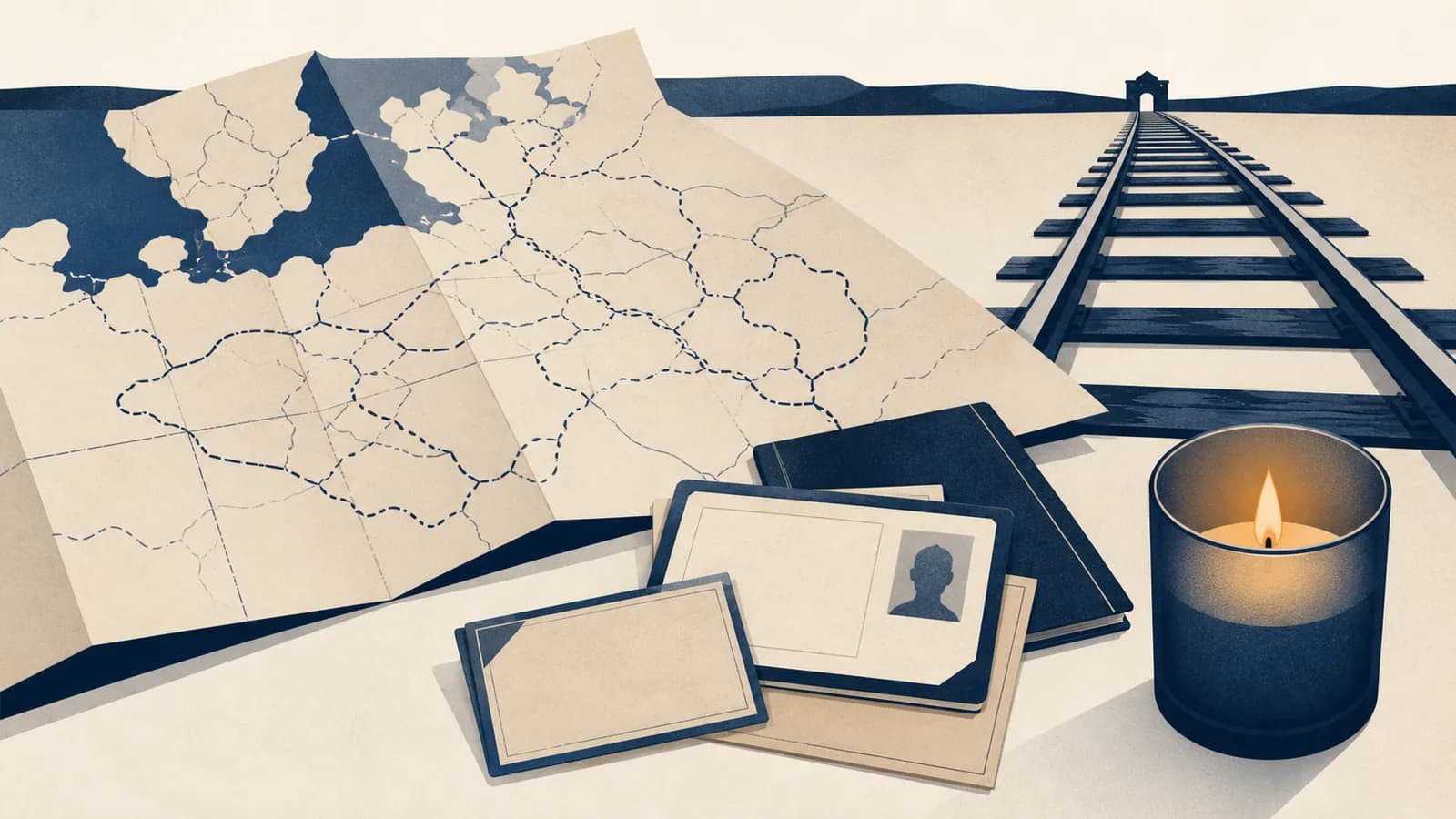
World War II and the Holocaust is a historical topic that explains how global war and state-organized genocide reshaped power, borders, law, and human life, in the context of the Nazi era and the 1939 to 1945 conflict. The causes of World War II included expansionist dictatorships, racial ideology, imperial ambition, and failure to enforce the post-World War I settlement. The Holocaust was Nazi Germany's systematic persecution and murder of European Jews, alongside mass killing of other targeted groups. We study both to see how governments, institutions, soldiers, and ordinary people can produce, resist, document, or survive organized violence.
What World War II and the Holocaust actually are
World War II was a global conflict among coalitions led by Germany, Italy, and Japan on one side and Britain, the Soviet Union, the United States, China, and other Allies on the other. The Holocaust was a genocide carried out within that wider war.
The war began in Europe when Germany invaded Poland on 1 September 1939 and Britain and France declared war on Germany two days later. Fighting already underway between Japan and China became part of the larger conflict. By the time Japan attacked the United States at Pearl Harbor on 7 December 1941, major campaigns connected Europe, North Africa, the Atlantic, East Asia, and the Pacific.
The Holocaust began with exclusion and persecution before it became a continent-wide program of mass murder. Adolf Hitler and the Nazi Party defined Jews as a supposed racial enemy, removed their rights, seized their property, forced many into ghettos, deported them, and killed them through shootings, deliberate deprivation, forced labor, and extermination camps. The United States Holocaust Memorial Museum gives the established estimate that Nazi Germany and its allies and collaborators murdered six million European Jews.
Keep the relationship precise. World War II created conditions that let Nazi Germany extend persecution across occupied Europe, but the Holocaust was a specific genocidal project with its own ideology, policies, perpetrators, victims, and sequence.
The two histories overlap without becoming interchangeable. A military map explains which army controlled Poland in 1942. It does not by itself explain why German authorities deported Jewish families from occupied cities. A history of Nazi antisemitism explains the selection of victims. It does not by itself explain the naval war in the Pacific. Good historical reasoning keeps both scales visible.
How the road to war worked
The road to war worked through accumulated choices rather than one automatic chain. The post-1918 settlement left grievances, economic crisis weakened democracies, dictators promised national revival, aggressor states tested resistance, and repeated concessions showed them that expansion might carry limited immediate cost.
The background starts with the causes and unsettled aftermath of the First World War. The Treaty of Versailles restricted Germany's military, changed borders, and required reparations. Hitler used anger about the settlement, fear of communism, and existing antisemitism to gain support. These conditions helped him, but they did not make his dictatorship inevitable. Political leaders, voters, business interests, conservative elites, and state officials made choices that dismantled the Weimar Republic.
The Nazi government rapidly destroys political opposition, builds a one-party dictatorship, and begins excluding Jews from public life.
Nazi law strips German Jews of citizenship and prohibits marriages classified by the state as mixed.
Germany annexes Austria, gains the Sudetenland after the Munich Agreement, and Nazi-directed violence during Kristallnacht destroys synagogues and businesses while thousands of Jewish men are arrested.
Their nonaggression pact contains a secret protocol assigning spheres of influence. Germany attacks from the west, and the Soviet Union invades from the east.
Appeasement meant granting some German demands in hopes of avoiding a larger war. It had understandable motives. Britain and France carried memories of the First World War, needed time to rearm, and faced uncertain public support for another conflict. Yet the policy also taught Hitler that treaty violations might succeed. After Germany occupied the rest of the Czech lands in March 1939, the claim that expansion only united German-speaking people became impossible to sustain.
Japan and Italy followed their own imperial projects. Japan seized Manchuria in 1931 and expanded its war in China in 1937. Fascist Italy invaded Ethiopia in 1935. The League of Nations could condemn aggression but lacked an army and depended on member states to enforce decisions. Economic sanctions and diplomatic protest did not stop states willing to use force.
How the global war worked
The global war worked by combining industrial production, mass armies, air power, sea transport, intelligence, and control of resources. Each coalition had to move fuel, food, weapons, and people across long distances while destroying the enemy's capacity and political will to do the same.
This pipeline explains why logistics could decide battles before soldiers met. A tank without fuel could not maneuver. An army without ammunition could not hold ground. German submarines attacked Atlantic shipping because Britain depended on imported supplies. The Allies used convoys, escorts, aircraft, radar, and codebreaking to protect the route. The fight was about cargo space and replacement rates as much as dramatic naval encounters.
Germany used rapid combined operations, then met wars it could not finish
German victories in Poland and western Europe joined aircraft, armor, infantry, radio communication, and surprise into fast operations often called blitzkrieg. This was not a single official formula. It was a practical way to break through, disrupt command, surround forces, and prevent an enemy from organizing a stable defense.
The method worked best against opponents caught in the wrong position. It did not remove the need for supply or solve a long war. Britain remained in the conflict after France fell in 1940. Germany then invaded the Soviet Union in June 1941, opening an enormous front where distance, resistance, Soviet production, and German losses wore down the attacking force.
Japan sought an empire protected by a defensive perimeter
Japanese leaders wanted access to oil and other resources and sought to exclude Western powers from East Asia and the Pacific. The attack on Pearl Harbor aimed to disable the United States Pacific Fleet while Japan seized territory. It produced tactical damage but failed to remove American carriers and brought a far larger industrial power into the war.
American forces could lose ships and replace them at a rate Japan could not match. Island bases then became airfields, ports, and stepping stones toward Japan. Submarines cut Japanese shipping, while bombing damaged cities and industry. Geography shaped the campaign: control of ocean routes mattered because soldiers and aircraft needed supplies brought by sea.
Civilians became part of the target and the production system
Governments mobilized civilian labor, rationed food and fuel, controlled information, and directed factories toward military needs. Strategic bombing aimed at industry, transport, and cities, with immense civilian loss. Occupying powers requisitioned food and labor. Resistance groups gathered intelligence, printed illegal newspapers, hid fugitives, and attacked infrastructure, while collaboration ranged from coerced administrative work to willing participation in persecution.
How the Holocaust worked
The Holocaust worked through a sequence of identification, exclusion, dispossession, concentration, deportation, and killing. Nazi ideology supplied the target; laws and records located people; police and administrators organized removal; transport systems moved prisoners; camps and shooting units carried out mass murder.
Nazi authorities used ancestry rules, censuses, identity papers, community records, and denunciations to classify people as Jewish under racial law.
Laws removed jobs, schooling, citizenship, and property. Forced sales and confiscation transferred businesses, homes, and valuables to the state or non-Jewish owners.
In occupied eastern Europe, German authorities forced many Jews into sealed ghettos where overcrowding, hunger, disease, forced labor, and violence killed people even before deportation.
Police units, railway personnel, local collaborators, soldiers, and camp staff moved victims to killing sites or murdered them near their homes.
Perpetrators used coded language, destroyed evidence, seized victims' belongings, and forced prisoners to handle bodies and property under threat of death.
The mechanism changed over time and place. After Germany invaded the Soviet Union, mobile killing units called Einsatzgruppen, supported by police battalions, military units, and local auxiliaries, conducted mass shootings. Victims were taken to ravines, forests, or prepared pits. Babi Yar near Kyiv is one documented killing site. This was face-to-face mass murder organized through orders, transport, guards, ammunition, recordkeeping, and local knowledge.
Extermination camps made murder more centralized. At Operation Reinhard camps such as Treblinka, Sobibor, and Belzec, most deportees were killed soon after arrival. Auschwitz-Birkenau combined concentration, forced labor, selection, and mass killing. Gas chambers did not make the crime impersonal or automatic. People designed the sites, approved budgets, scheduled trains, guarded prisoners, stole property, and operated the machinery.
A small circle of fanatics acted alone while the rest of society knew nothing and had no connection to the crime.
The killing depended on many institutions and degrees of participation. Knowledge varied, secrecy existed, and refusal carried different risks, but bureaucracy and cooperation made the scale possible.
Jewish people resisted in many ways. Armed uprisings occurred in ghettos and camps, including the Warsaw Ghetto uprising of 1943 and the Sobibor revolt that year. Resistance also meant smuggling food, teaching children, recording events, maintaining religious practice, producing art, forging papers, and helping someone hide. Judging resistance only by military success mistakes survival and testimony for passivity.
The Nazis also persecuted and killed Roma, disabled people, Polish civilians, Soviet prisoners of war, gay men, political opponents, and others. Their treatment followed different policies and chronologies. Naming these victims makes the history more accurate. It should not erase the distinct Nazi plan to annihilate every Jewish community the regime could reach.
World War II versus the Holocaust
World War II and the Holocaust are related but different categories: one is an international armed conflict, while the other is a genocide pursued by Nazi Germany and its partners within territory shaped by conquest, occupation, alliance, and collaboration.
| Question | World War II | The Holocaust |
|---|---|---|
| What kind of event was it? | A war among states, empires, coalitions, and armed movements | A state-organized genocide centered on the murder of European Jews |
| What drove it? | Expansion, security, empire, resources, ideology, and alliance commitments | Antisemitic racial ideology, dictatorship, dispossession, and a policy of annihilation |
| Who carried it out? | Military forces, governments, resistance movements, and mobilized economies | Nazi leaders, SS and police bodies, civil agencies, military units, camp staffs, allies, and collaborators |
| How did it end? | Axis states surrendered after military defeat in 1945 | Allied advance stopped the killing apparatus, though survivors still faced displacement, loss, illness, and antisemitism |
The distinction helps explain apparent contradictions. Germany could exploit a Jewish prisoner for forced labor while still treating that person as marked for death. A government could fight Nazi Germany without making rescue of Jews its main military objective. An occupied population could suffer harshly under German rule while some of its members also helped identify or capture Jewish neighbors.
Genocide is also not simply a synonym for any large wartime death toll. The 1948 United Nations Genocide Convention defines the crime through specified acts committed with intent to destroy, in whole or in part, a national, ethnic, racial, or religious group. The required element is destructive group intent, not a numerical threshold.
How the Allies turned military resources into victory
The Allies won by keeping major powers in the coalition, outproducing the Axis, protecting supply networks, learning from defeats, decoding some enemy communications, and forcing Germany and Japan to fight across multiple fronts they could not supply or replace indefinitely.
No single turning point explains victory everywhere. Midway reduced Japan's carrier strength, but years of fighting followed. Stalingrad ended with the destruction of a German field army, yet the Soviet Union still had to push across eastern Europe. The Normandy landings opened a major western front, while Soviet forces were already inflicting the largest share of German military losses in Europe.
Production mattered because loss was constant. Armies consumed vehicles, aircraft, shells, fuel, uniforms, food, and medical supplies every day. The United States supplied its own forces and sent equipment and food to allies through Lend-Lease. The Soviet Union moved much industry eastward beyond immediate German reach. Britain maintained global shipping and served as a base for air operations and the invasion of western Europe.
Allied victory does not turn every Allied policy into a moral or strategic success. The Soviet government committed repression and mass deportations. Allied bombing killed large numbers of civilians. The United States incarcerated people of Japanese ancestry without individual findings of disloyalty. Studying a coalition's victory and examining its abuses are compatible historical tasks.
How historians test claims about the war and genocide
Historians test claims by comparing sources created for different purposes, locating each source in time and place, asking what its creator could know, and checking whether documents, objects, photographs, testimony, demographic records, and physical sites support the same explanation.
Nazi records are extensive but incomplete. Some describe deportation, confiscation, forced labor, and killing through euphemisms. Some were destroyed. Historians therefore connect train schedules to arrival records, orders to unit reports, aerial images to ruins, and perpetrator documents to survivor testimony. Agreement among independent kinds of evidence is stronger than repetition within one source family.
A post says that a photograph shows a camp liberation in 1945. Check the archive holding the image, its catalog date, photographer, original caption, and location. Then compare uniforms, buildings, weather, and known unit movements. A vivid image is evidence only after its identity and context are established.
Testimony answers questions that administrative documents often hide: what hunger felt like, how rumors traveled, why a family chose one hiding place, or how a guard behaved. Memory can contain errors in exact dates or sequence, especially after trauma and long intervals. That does not make testimony useless. Historians compare accounts, distinguish lived experience from later interpretation, and avoid demanding that a survivor remember every detail like a machine.
Denial usually relies on predictable tactics. It demands an impossible single document for a policy carried out across agencies, isolates a translation from its context, treats small inconsistencies as proof that all evidence is false, or misuses uncertainty about one figure to reject the crime itself. Serious revision can change an estimate or interpretation when new evidence appears. Denial begins with the desired conclusion and tries to remove contrary evidence.
How World War II shows up in law, news, and public decisions
World War II appears outside school whenever courts define international crimes, governments debate alliances and refugees, journalists compare modern leaders with fascists, museums present contested memory, or families interpret military service, migration, stolen property, and inherited trauma.
The Nuremberg trials prosecuted leading Nazi officials for crimes including crimes against humanity and war crimes. Later legal developments did not spring from one courtroom, but the trials made individual responsibility visible: a government office or military rank could not automatically excuse participation in an international crime. The Genocide Convention and the Universal Declaration of Human Rights followed in 1948.
News comparisons require discipline. Calling every aggressive leader Hitler or every detention policy a Holocaust can replace analysis with shock. A useful comparison names the mechanism being compared, such as one-party control, racial law, territorial annexation, dehumanizing propaganda, or forced population transfer. It also names the differences in scale, intent, institutions, and historical setting.
Museums, memorials, school curricula, and national ceremonies reveal what a society chooses to remember. Disputes often concern responsibility. Was the nation mainly a victim, a collaborator, a liberator, or some mixture that changed by region and year? The next period, including decolonization and the Cold War, belongs to the guide to political change after 1945.
How did civilians experience occupation, resistance, and liberation?
Civilians experienced occupation through rules imposed on food, movement, speech, labor, and identity. Their choices ranged across survival, accommodation, collaboration, rescue, and resistance, but the available options depended on local policy, social position, resources, timing, and the penalties imposed.
Occupation was not uniform. German rule in western Europe differed from the racial war and mass starvation policies pursued in the east. Japan's occupation systems likewise varied across China, Korea, Southeast Asia, and Pacific islands. A person with money, rural relatives, forged documents, or a trusted network had options another person lacked.
Liberation ended German control but did not instantly restore ordinary life. Camps contained people who were severely ill and malnourished. Survivors searched for relatives and often discovered that homes had new occupants or communities had been destroyed. Millions of former forced laborers, prisoners of war, refugees, and expelled civilians became displaced persons. Military victory was a date; recovery was a long social process.
What ended the war in Europe and Asia?
The war ended through separate Axis defeats. Germany surrendered after Allied armies occupied the country and Hitler died. Japan surrendered after blockade, conventional bombing, two American atomic bombings, and the Soviet Union's entry into the war against Japan combined into an impossible strategic position.
Germany's unconditional surrender took effect on 8 May 1945 in Europe. Japan announced acceptance of surrender terms on 15 August, and representatives signed the formal instrument on 2 September. These dates explain why commemorations differ. They also prevent the vague claim that one event ended the whole global war at once.
The United States dropped atomic bombs on Hiroshima on 6 August and Nagasaki on 9 August. The Soviet Union declared war on Japan and invaded Japanese-held territory in northeast Asia between those attacks. Historians debate the weight Japanese leaders gave each shock, the expected cost of invasion, the role of preserving the emperor, and whether alternatives could have ended the war. A responsible answer presents the combined pressure and the dispute instead of pretending the evidence permits one simple cause.
What changed after 1945?
After 1945, defeated regimes fell, borders shifted, occupation authorities rebuilt governments, the United Nations began work, European empires weakened, and rivalry between the United States and Soviet Union hardened. Survivors and displaced people faced the immediate tasks of health, housing, family search, and migration.
Germany and Austria were occupied by Allied powers. Germany later divided into western and eastern states until reunification in 1990. Japan came under American-led occupation, adopted a new constitution, and lost its empire. In Europe, Soviet influence extended across states occupied by the Red Army, while the United States supported western European reconstruction. The wartime alliance gave way to Cold War competition.
The creation of Israel in 1948 had a longer history in Zionism, British rule in Palestine, Arab opposition, migration, and conflict. The Holocaust shaped international support and the choices of many Jewish survivors, but saying it single-handedly created Israel erases decades of earlier politics and the experiences of Palestinians displaced in the 1948 war.
Decolonization also accelerated. Colonial subjects had fought and worked for empires that spoke of freedom while denying them self-rule. War weakened European states and strengthened independence movements. To see why factories, imperial trade, and mass production had already changed the balance of power, examine how industrialization transformed states and warfare.
3 mistakes people make with World War II and the Holocaust
Three common mistakes distort the topic: treating the war as inevitable, reducing the Holocaust to camps alone, and explaining Allied victory with one battle or invention. Each mistake removes human decisions and hides the institutions that connected policy to consequences.
1. Treating hindsight as inevitability
Once the dates are memorized, the sequence can look fixed. It was not. French and British leaders could not know in 1938 exactly what Hitler would do in 1939. German generals could not know in 1941 how the Soviet campaign would end. Historical explanation should identify pressures and probabilities while preserving uncertainty at the moment of decision.
2. Reducing the Holocaust to gas chambers
This mistake hides years of law, theft, segregation, hunger, forced labor, shootings, and deportation. It also hides the large number of people and offices involved before victims reached a camp. Follow the process backward from a killing site: the train required a schedule, the deportation required a list, and the list required a definition backed by state power.
3. Searching for one reason the Allies won
Claims about the decisive tank, general, battle, or code usually confuse a major contribution with a complete cause. Ask a counterfactual question: if that factor disappeared, could production, coalition strategy, geography, or another front compensate? The answer often reveals a system of connected advantages rather than one master switch.
The takeaway: Explain the war and the Holocaust by tracing decisions through institutions. Ideology shaped goals, governments turned goals into orders, organizations supplied people and materials, and individuals chose to comply, profit, resist, rescue, record, or look away.
World War II makes history a study of choices under pressure
World War II and the Holocaust show that history connects large structures with individual action. Economies and ideologies set conditions, but laws still need drafters, trains need schedules, armies need supplies, and persecution advances through identifiable choices that leave evidence behind.
The most useful habit is to test every broad claim against a mechanism. If someone says appeasement caused the war, ask how each concession changed later calculations. If someone says nobody knew, ask who knew what, at which date, and from which evidence. If someone says technology won, trace how it was produced, supplied, operated, and countered.
This habit applies across the wider set of history explanations and methods. Dates locate change, but relationships explain it. Notice the next time a speech turns a group into a threat, an office turns a category into a list, or a news comparison borrows the 1930s. Then ask what institution can convert those words into action, what evidence would show the conversion, and where a person could interrupt it.