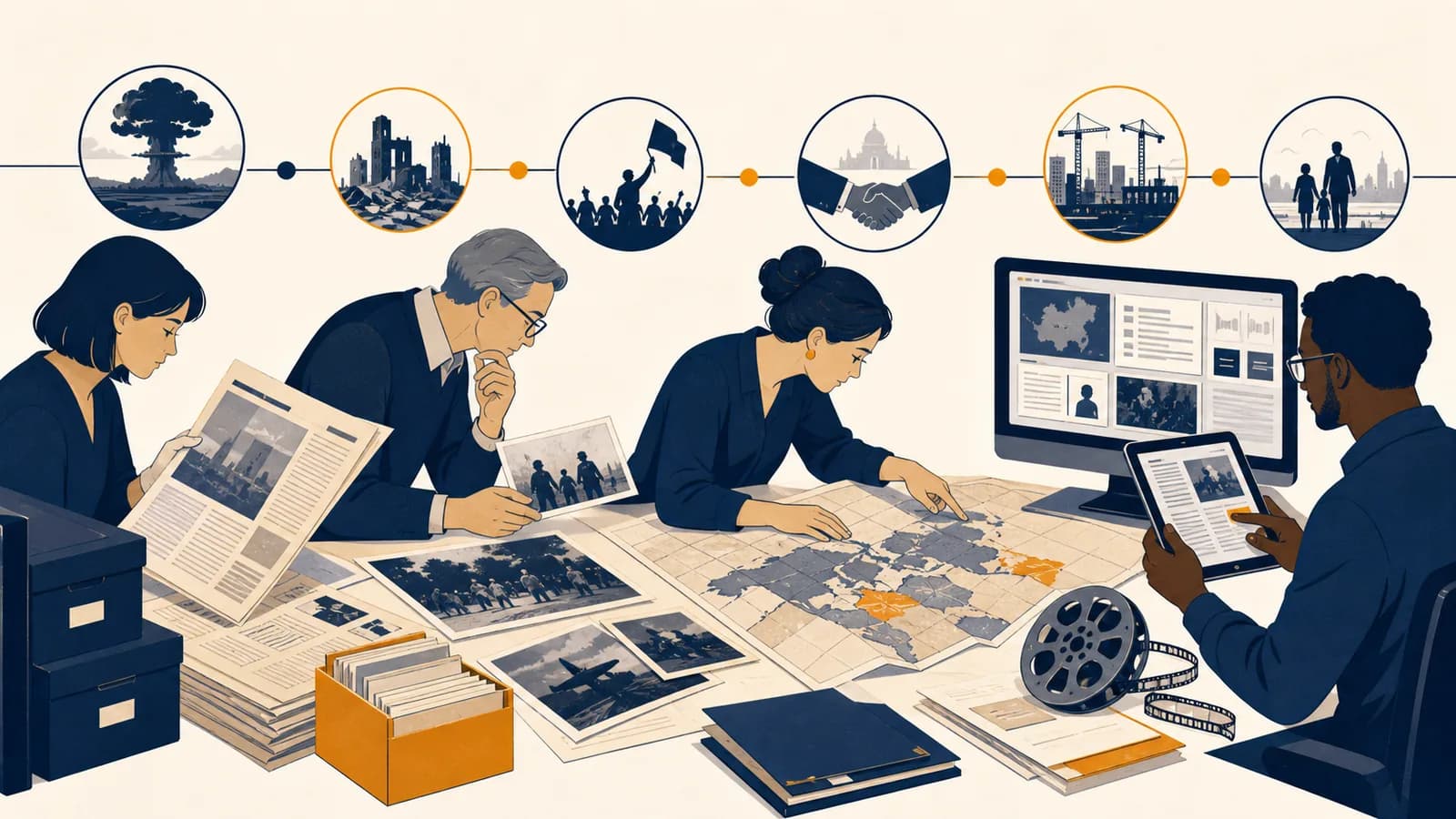
Contemporary history is a branch of historical study that explains the recent past and its continuing effects, in the context of societies still shaped by living memory and surviving institutions. A common contemporary history definition begins in 1945, after World War II, although historians move the starting date to fit the country or question. The field exists because current borders, laws, conflicts, technologies, and public arguments have histories that can still be reconstructed from records and testimony. It asks what changed, what persisted, who had power, and how evidence supports each answer.
What contemporary history actually is
Contemporary history is the evidence-based study of a recent period whose consequences remain active and whose participants may still be alive. It joins chronology to explanation, using records, objects, statistics, images, and testimony to test claims about change over time.
The word contemporary does not mean that every event happened yesterday. It means that the period connects directly to the institutions and disputes of the present. The United Nations, nuclear deterrence, European integration, decolonized states, mass television, digital networks, and international human rights law all took recognizable modern forms after 1945. A historian can therefore begin with a current institution and trace the decisions that produced it.
There is no universal first year. A course may begin in 1945, 1989, or another turning point. The boundary is a research choice, not a natural wall in time.
The field overlaps with political history, social history, economic history, cultural history, environmental history, and the history of science. Its subject can be a treaty negotiation, a strike, a family migration, a disease-control campaign, or the spread of a music format. Scale matters. A cabinet minute may explain what officials intended, while a household diary shows what their policy did to daily life.
Earlier periods remain part of the explanation. The factories, empires, and labor systems examined in the history of industrialization and its social effects shaped the economies inherited by the postwar world. Contemporary history asks how people changed that inheritance rather than treating 1945 as a clean reset.
How historians choose the period
Historians choose a period by identifying a defensible turning point, then testing how far its effects extend. The opening date should clarify the question, while the closing date usually reflects available evidence rather than an assumption that historical change has stopped.
Periodization is the act of dividing continuous time into useful sections. The divisions help people compare conditions before and after a change, but every division highlights some developments and hides others. Starting European contemporary history in 1945 emphasizes defeat, reconstruction, and the emerging Cold War. Starting in 1989 emphasizes the collapse of communist governments in Eastern Europe and the end of the division symbolized by the Berlin Wall.
Germany surrendered in May and Japan surrendered in September. The United Nations Charter also entered into force that October.
Independence created India and Pakistan amid mass displacement and communal violence.
The Berlin Wall opened in November, becoming a visible marker of a larger political transformation.
Fifteen union republics became independent states, changing borders and international relations.
A different region produces a different timeline. For historians of India, 1947 is a major break. For historians of South Africa, the first democratic election with universal adult suffrage in 1994 may organize the period. For internet history, the public release of the World Wide Web software by CERN in 1991 may be more useful than a diplomatic event.
A good boundary is explicit and revisable. If a paper claims that a policy began in 1980, evidence of a similar program in 1975 should force a change in the argument. Dates organize evidence; evidence must not be forced to obey the dates.
How contemporary historical research works
Contemporary historical research works by turning a broad topic into a testable question, locating independent sources, establishing their origins, comparing their claims, and building an explanation that accounts for both supporting and conflicting evidence. Each conclusion remains open to revision when records change.
Replace “What caused migration?” with “How did a named law affect migration through one border during a defined period?” The narrower wording identifies relevant evidence.
List the institutions and people who created records: ministries, courts, newspapers, companies, unions, aid groups, families, and witnesses.
Record who made each source, when, for which audience, and under what constraints. A private memo and a campaign speech serve different purposes.
Compare sources that did not simply copy one another. Agreement among independent records carries more weight than repetition of one press release.
State the mechanism connecting events, consider rival explanations, and identify people or places to which the conclusion may not apply.
Consider a local factory closure. The company announcement gives the official reason. Accounts reveal costs and sales. Union minutes record negotiations. Employment data show the scale of job loss. Oral histories describe how workers responded. Land records reveal what later occupied the site. No single item answers the whole question, but together they can show a sequence of decisions and consequences.
Revision is normal historical work. Governments declassify files, families donate papers, courts release judgments, and digital searches expose connections that earlier researchers missed. A revised interpretation does not show that evidence is useless. It shows that claims have to match the best accessible record.
What counts as evidence in the recent past
Evidence in contemporary history is any surviving trace that can answer a defined question, provided its origin, context, and limitations can be examined. Official files matter, but so do photographs, broadcasts, databases, buildings, personal messages, objects, and recorded memories.
A source is not reliable or unreliable in every possible use. An election poster may be poor evidence of what a government actually achieved, yet excellent evidence of what a party wanted voters to believe. A classified assessment may contain frank analysis, but it may also repeat a faulty intelligence report. The useful question is specific: reliable for which claim?
| Source | What it can show | What must be checked |
|---|---|---|
| Cabinet minutes | Options discussed and decisions recorded | Missing informal talks, redactions, and later editing |
| Newspaper report | Publicly available claims and editorial priorities | Ownership, access, censorship, and copied reports |
| Photograph | Visible conditions inside the frame at one moment | Caption, crop, staging, location, and original file |
| Oral testimony | Experience, memory, language, and personal meaning | Elapsed time, interviewer influence, and later knowledge |
| Statistical series | Measured patterns across time or populations | Definitions, collection methods, exclusions, and revisions |
| Digital post | A claim circulated by an account at a recorded time | Account identity, deletion, manipulation, and platform context |
Provenance means the history of a source itself. For a photograph, provenance includes the photographer, original date, first publication, caption changes, and the route by which the file reached an archive. A copied image without that chain may still offer a clue, but it cannot safely carry a precise claim.
Silence can also be evidence, but it needs care. If a police archive records officials but never the names of detained people, the omission may reveal an administrative habit. It does not reveal the detainees' experiences. Historians must seek records made outside the institution and state plainly what cannot be recovered.
Contemporary history versus current affairs
Current affairs reports what has recently happened, while contemporary history reconstructs how present conditions developed through time. The two use some of the same material, but historical work adds longer chronology, source criticism, comparison, and explicit testing of causal explanations.
A report identifies a new law, quotes participants, and explains the immediate dispute. Speed and verified description are central.
A study traces earlier laws, institutions, campaigns, and court decisions, then explains which conditions made the new law possible.
Suppose a government closes a border crossing after violence. A news report needs to establish what closed, when, under whose authority, and with what immediate effects. A historian might ask why that crossing existed, how the border was drawn, which earlier security policies created the available choices, and how residents remember previous closures.
Distance can improve judgment, because consequences become clearer and more records become available. Distance does not automatically create neutrality. Historians of ancient societies also disagree, while researchers of recent events can make careful, limited claims. The relevant standard is transparent reasoning supported by evidence, not a fixed number of years since the event.
The confrontation between the United States and Soviet Union offers a clear example. A daily report in October 1962 described ships and speeches during the Cuban Missile Crisis. Later scholarship could compare American, Soviet, and Cuban records and place those thirteen days within the wider Cold War system of rivalry and deterrence.
How cause and consequence work in contemporary history
Historical causation links conditions, decisions, and triggers through a stated mechanism. A strong explanation separates long-term pressures from immediate events, identifies the choices available to people at the time, and shows why one outcome occurred instead of plausible alternatives.
Listing events in order is necessary, but sequence alone does not prove cause. If unemployment rises before a government loses an election, the timing suggests a question. To argue causation, a historian needs a mechanism, such as household hardship changing votes, and evidence that connects economic experience to political behavior. Other explanations, including scandal or war, must be considered.
A protest begins after a fare increase. The increase is the trigger, but it may not explain the scale of the response. Earlier wage stagnation, mistrust of police, organized neighborhood groups, and a recent corruption case could have made rapid mobilization possible. Interviews show motives, organization records show capacity, and dated messages show the sequence.
Causes also operate at different levels. An individual leader may sign an order, an institution may shape which orders are possible, and an international market may constrain the budget behind the decision. Giving all weight to one level produces weak history. Individual choices matter most when the account shows the alternatives and constraints those people faced.
Counterfactual reasoning can test a claim. If an explanation says a broadcast caused a protest, ask what evidence would be expected if the broadcast had not occurred. Existing organization and earlier demonstrations might suggest the protest would still have happened, perhaps later or on a different scale. This is a controlled comparison, not an invitation to invent an alternative world.
Consequences require the same discipline. A treaty can change a legal border immediately, but movement, trade, identity, and conflict may respond at different speeds. Historians trace those separate pathways rather than declaring one total result.
How contemporary history shows up in news and public debate
Contemporary history appears in news whenever a report depends on inherited borders, old laws, institutional memory, or competing accounts of the past. Knowing the history helps a reader check analogies, recognize omitted causes, and distinguish a documented precedent from a political slogan.
Public figures often use historical analogy: a current recession becomes another Great Depression, a diplomatic compromise becomes appeasement, or a rivalry becomes a new Cold War. An analogy can isolate a useful similarity, but it never proves that outcomes will repeat. The reader should compare actors, institutions, technology, economic ties, and the range of choices before accepting the comparison.
Check the comparison, not just the date. Two events can share a dramatic image while differing in the conditions that produced them. Similar appearance is not the same as a shared mechanism.
Maps in the news also carry history. A border line may reflect an imperial agreement, a war settlement, an armistice, or later international recognition. Different maps can encode rival legal claims. Before treating a map as neutral, check its publisher, legend, date, projection, and treatment of disputed territory.
Anniversaries shape coverage because round dates create an occasion to remember. The resulting speeches and exhibitions reveal as much about the commemorating society as about the original event. Ask who organized the ceremony, which victims or victories it names, which it omits, and what present policy the memory supports.
Propaganda is another meeting point. It does not have to be completely false. Effective propaganda can select accurate facts, remove context, repeat emotional symbols, and conceal the source directing the message. A historian investigates the production and distribution system as well as the words on the poster or screen.
How contemporary history shows up in law, work, and daily decisions
Contemporary history shapes ordinary decisions through precedents, ownership records, workplace rules, citizenship documents, product standards, and public policy. People meet it when a court interprets an older statute, a company investigates responsibility, or a family reconstructs an official record.
Lawyers use legislative history and earlier judgments to establish how legal language developed. Judges do not treat every historical source in the same way, and legal systems differ in how much weight they allow such material. Still, a dated chain of statutes, amendments, regulations, and cases can explain why a present rule has its exact wording.
Journalists build chronologies to test what an official knew and when. Policy analysts compare earlier programs before predicting the effect of a new one. Museum curators document an object's ownership to establish authenticity and detect possible looting. Urban planners examine past land use because buried fuel tanks, demolished factories, and earlier zoning can affect a site long after the original business closes.
These dates are not trivia. Each identifies a documented institutional change whose consequences can be traced in present work. A human rights lawyer may cite principles articulated in 1948. A web archivist must understand the early internet to explain why many born-digital records are fragmented or missing.
A family receives a message claiming that an old photograph proves a relative took part in a famous demonstration. Before reposting it, they compare the street signs, locate the earliest copy, ask who wrote the caption, and seek an independent image from the same place. That is source criticism in ordinary life.
Historical thinking also helps at work when an organization says, “We have always done it this way.” Minutes, policy manuals, archived web pages, and staff testimony may show that the supposed tradition began recently or served a condition that no longer exists. The finding does not dictate a new policy, but it removes a false constraint from the decision.
4 mistakes people make with contemporary history
Four common mistakes weaken accounts of the recent past: treating memory as a recording, reading outcomes backward into earlier decisions, accepting national experience as universal, and confusing abundant information with representative evidence. Each error can be reduced by asking a more precise source question.
1. Treating eyewitness memory as a recording
Eyewitness testimony records remembered experience, not an untouched replay of perception. Memory can preserve emotion, sequence, and personal meaning while changing under later conversations, public stories, trauma, or repeated retelling.
The answer is not to discard testimony. Interviewers ask open questions, record the circumstances of the interview, separate what a witness saw from what they later learned, and compare the account with other evidence. A disagreement between testimony and an official file may expose an error in either source, or reveal that each describes a different part of the event.
2. Reading the outcome backward
Hindsight bias makes an outcome appear inevitable after it has happened. People living through the event did not know the ending, so their decisions must be reconstructed using the information and choices they actually had.
The dissolution of the Soviet Union in 1991 can make every earlier problem look like a step toward collapse. Yet officials and citizens faced several possible futures at different moments. Contemporary documents show expectations that later proved wrong. Those failed predictions are valuable because they recover uncertainty.
3. Turning one country's history into everyone's history
A national timeline becomes misleading when it is presented as a global sequence. Decolonization, dictatorship, welfare policy, civil rights, economic reform, and digital access occurred through different institutions and at different times across societies.
Comparison should name both the shared feature and the relevant difference. Two colonies may gain independence in the same decade but inherit different borders, administrative systems, land ownership patterns, and relations with former imperial powers. The broader background of World War I and the settlements that followed it can explain boundaries that later postwar governments had to manage.
4. Mistaking more sources for a complete record
The recent past produces enormous quantities of data, but survival is selective. Powerful institutions can preserve files systematically, while displaced people, informal workers, and private families may leave scattered or inaccessible records.
Digital abundance adds another distortion. A million public posts may represent only people with platform access who chose to post and whose material survived collection. Deleted accounts, private groups, recommendation systems, and automated bots alter the visible record. Counting searchable items does not prove that the collection represents a population.
What makes oral history different
Oral history is a planned, recorded interview created to preserve a person's account of the past. It differs from casual conversation because the interviewer documents consent, questions, recording conditions, access rules, and the relationship between memory and later interpretation.
An oral history source is produced by two people. The interviewer chooses prompts and follow-up questions; the narrator chooses language, emphasis, and silence. Tone, hesitation, and emotion may carry meaning that a transcript cannot fully preserve. Researchers should therefore consult the recording when permitted, not only the typed words.
Ethics are part of the evidence. A narrator may face danger, stigma, or family conflict if named. Consent must cover storage and future access, not simply the moment of recording. An archive may close sensitive material for a period or remove identifying details. These limits can reduce what a researcher may quote, but they protect the person who supplied the account.
How a person remembers an event, understood its meaning, describes a workplace, or experienced a policy.
An exact crowd total, the private motive of another person, or a precise date recalled many years later.
Silence should not be filled with guesswork. A pause may signal emotion, uncertainty, caution, or interruption. The historian can describe the pause and seek context, but cannot assign one meaning without support.
How archives handle records that are still sensitive
Archives handle recent sensitive records through access rules, privacy review, closure periods, redaction, and documented exceptions. The goal is to preserve evidence while obeying law and protecting people from harms that unrestricted disclosure could cause.
A record can exist without being open. Medical files, personnel records, intelligence documents, adoption records, and testimony naming vulnerable people may be restricted. Rules vary by jurisdiction and archive. A catalogue entry should indicate enough about a closed collection for researchers to know that it exists, even when the contents cannot yet be read.
Redaction removes protected passages while releasing the rest. A blacked-out name can frustrate research, but it is more informative than pretending that no record exists. Researchers should record the version and access date because later review may release additional material.
Private archives create another limit. A business or family can hold records outside public access, and survival may depend on storage decisions no researcher controlled. Historians make this unevenness visible by describing the collections consulted, the denied requests, and the gaps that remain.
When does an event become history
An event becomes a subject of history as soon as people can ask evidence-based questions about its place in change over time. It does not need to reach a set age, although responsible interpretation may remain limited by missing records and unfinished consequences.
Time passing changes the available evidence. Immediate accounts preserve fresh detail but contain uncertainty. Later testimony may know the outcome but reshape earlier memories. Official files may open after restrictions expire. Long-term effects, such as a law's influence on a generation, may only become visible after many years.
This creates a tradeoff, not a ban. A historian studying a very recent disaster can establish chronology, institutional responsibility, and public response while avoiding claims about consequences that have not yet unfolded. Precise limits make early history stronger.
Living participants can challenge a researcher's interpretation, correct names, or provide missing records. They can also have interests in how events are presented. The same is true of institutions. Close contact with participants raises ethical and evidential questions, but it also offers kinds of access unavailable for distant centuries.
Contemporary history makes the present inspectable
Contemporary history makes present institutions inspectable by showing that they were built through dated choices rather than appearing naturally. Its method connects the whole subject of history to practical judgment: define the claim, trace its sequence, inspect its sources, and test alternatives.
The field does not supply automatic lessons. “History repeats itself” is too blunt because people act with knowledge of earlier events, technologies change, and institutions differ. History offers comparisons with conditions attached. A useful lesson states what was similar, what was different, and which mechanism might still operate.
It also restores agency without pretending everyone had equal power. Laws, markets, armies, and bureaucracies constrain action, yet people organize, comply, resist, migrate, vote, write, and remember. The work of historians is to show how those choices interacted and whose records survived.
The takeaway: When a public claim uses the recent past, identify its date range, ask who created the evidence, look for an independent source, and demand a mechanism connecting cause to consequence. Those four checks turn a familiar story into a historical argument you can assess.
Pick one institution you used this week, such as a school rule, transit route, payment system, or public service. Find its earliest official record and one account from a person affected by it. Compare their purposes and omissions. For more ways to connect evidence, chronology, and explanation, see how historical study works across periods.