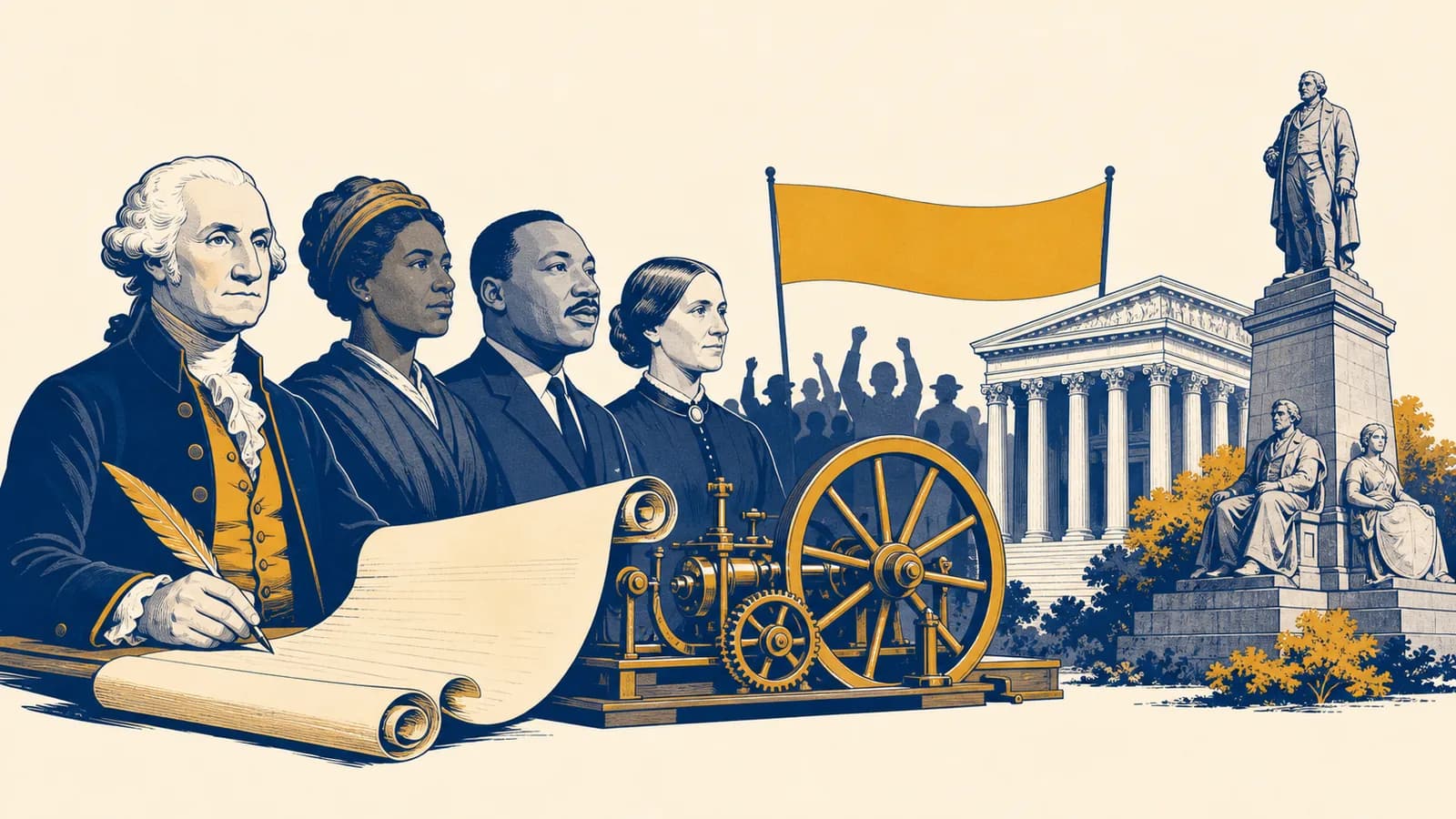
Key historical figures are people whose choices, positions, ideas, or public images help explain major change in the human past, in the context of history. Studying famous historical figures and their achievements shows how individual action meets institutions, conflict, technology, and chance. The category exists because people make decisions, leave evidence, and become symbols through which later generations interpret events. A king can sign a law, an organizer can build a movement, and a scientist can name a pattern, but none acts alone. The useful question is not simply, “Who was important?” It is, “What changed, what part did this person play, and what evidence supports that claim?”
Consider Rosa Parks. Her refusal to surrender a bus seat in Montgomery on 1 December 1955 mattered, but the familiar story becomes misleading if it presents her as a tired passenger who accidentally started a movement. Parks was an experienced activist and secretary of the local NAACP. Community networks organized the bus boycott, Black residents sustained it, lawyers challenged segregation, and a federal court case helped end the bus rules. One person gives the event a human face. The mechanism of change includes thousands of other people and several institutions.
A name is an entry point, not a complete explanation. A strong historical account connects the person to conditions, collaborators, opponents, evidence, and consequences.
What a key historical figure actually is
A key historical figure is a person whose actions or recorded influence provide strong explanatory value for a significant event, system, or change. “Key” does not mean admirable, famous everywhere, or solely responsible. It means the person helps historians answer a defined question.
The definition depends on scale. Qin Shi Huang is key to an account of imperial unification in China because his rule joined conquest to centralized administration and standardization. He may be less useful in a study of everyday farming in the same period. Florence Nightingale is central to the history of nursing reform and hospital statistics, yet a history of nineteenth-century public health also needs sanitation engineers, local officials, patients, and germ theory.
Historical significance usually comes from one or more kinds of influence:
- Decision power: a ruler, judge, minister, or commander can direct institutions and resources.
- Idea production: a writer, scientist, religious teacher, or economist can supply concepts that other people use.
- Organization: an activist, union leader, or revolutionary can turn scattered demands into coordinated action.
- Representation: a witness, victim, dissenter, or public symbol can make a larger experience visible.
- Long consequences: a decision, text, invention, or institution can keep shaping conduct after its author dies.
Significance is therefore relational. A person is key to something. Mansa Musa is central to questions about Mali’s wealth, Islamic scholarship, diplomacy, and trans-Saharan connections. Calling him merely a “rich king” removes the trade routes, tax base, court, and scholarly centers that made royal wealth possible.
How historians decide who counts
Historians decide who counts by stating a question, measuring a person’s connection to it, testing the available evidence, and comparing that influence with other causes. The result is an argued judgment, not a permanent ranking of the most famous people who ever lived.
Name the outcome precisely: a state formed, a law changed, an idea spread, or a movement gained power.
Find decisions, relationships, texts, offices, money, or organized actions that link the person to that outcome.
Ask what institutions, economic pressures, collective movements, technologies, and accidents could also explain the result.
Separate immediate effects from later effects, local importance from wider importance, and intended results from unintended ones.
A counterfactual can sharpen the test: if this person had been absent, what probably changes? The method does not require fantasy. It compares real constraints and available alternatives. If several officials were already pursuing the same policy, one minister may have been replaceable. If a leader held unique constitutional authority at a narrow moment, that person’s decision may have had greater independent weight.
Alexander Fleming’s 1928 observation of antibacterial mold is a useful example. His observation mattered, but penicillin did not become a mass-produced medicine through observation alone. Researchers including Howard Florey, Ernst Chain, and Norman Heatley developed purification and production methods, while laboratories, governments, and manufacturers supported large-scale use during the Second World War. The accurate claim is a chain of contribution, not a lone flash of genius.
This method also explains why lists differ across countries and courses. A curriculum about Atlantic slavery will foreground figures different from one about Mughal government or Andean state formation. The difference is not automatically bias. Bias appears when a selection ignores evidence, hides its question, or treats one region’s concerns as the whole human past.
How evidence turns a life into history
Evidence turns a life into history when historians use surviving traces to reconstruct actions, motives, limits, and effects. No source gives direct access to a person’s mind. Each source was created for a purpose, preserved unevenly, and interpreted alongside other evidence.
A speech can show what a leader wanted an audience to hear, but it cannot by itself prove private belief or public response. A law proves that a rule was issued, not that people obeyed it. A diary brings the historian close to one voice, yet that writer may misunderstand events or edit their own image. An opponent’s account can reveal conflict while also exaggerating faults.
Historians ask the same practical questions of every source: Who made it? When? For whom? What could its creator know? What did the creator want to happen? What has been omitted? Then they corroborate. A royal decree may be checked against tax records, court cases, building remains, letters, and reports from other communities.
A museum label says that an emperor “brought peace.” Look for the dates and territory covered, then compare court propaganda with records of rebellion, military campaigns, taxation, and displaced communities. The claim may describe peace for the capital and coercion at the frontier.
The archive itself is unequal. Rulers employed scribes, commissioned monuments, and stored correspondence. Enslaved people, domestic workers, rural laborers, and colonized communities often appear only in records created by authorities. Archaeology, oral history, material objects, court testimony, songs, and family records can recover some of those lives, but survival remains selective.
This is especially important online, where a polished sentence can circulate with a famous name attached and no source. A searchable quotation is not necessarily a genuine one. A reliable biography usually identifies a letter, speech transcript, interview, publication, or archive that another researcher can inspect.
Key figures versus the “great man” theory
Studying key figures examines people as causes within a larger system, while the “great man” theory treats exceptional individuals as the main engines of history. The first approach can test personal agency. The second tends to shrink collective action and structural pressure into background scenery.
James Watt invents an improved steam engine, so his genius causes industrialization.
Watt improves and commercializes steam technology through partnership with Matthew Boulton, within a system of mining demand, skilled metalwork, investment, patents, fuel, factories, and earlier engine designs.
The second account does not erase Watt. It identifies his work more accurately. His separate condenser greatly improved steam-engine efficiency, and his business partnership helped sell the design. Yet even a superior machine has little effect without customers, capital, materials, workers, and legal arrangements. The broader setting is developed further in how industrial production reorganized work and power.
Agency and structure answer different questions. Agency is the capacity of people to choose and act. Structure is the set of institutions, resources, social relations, and inherited rules that make some choices easier than others. A monarch has agency, but succession law gives that agency a shape. A striker chooses to stop work, but wages, union organization, and policing affect what that choice can achieve.
Chance matters too. Weather changes battles. Illness changes successions. A messenger arrives late. These factors do not make explanation impossible; they warn against treating outcomes as inevitable. A sound account can say that Napoleon’s command decisions mattered at Waterloo in 1815 while also examining allied coordination, troop condition, terrain, timing, and the arrival of Prussian forces.
That sentence is a summary, not a quotation attributed to a historical person. It captures the balance to seek: individuals act, other people respond, and inherited systems channel the result.
How key figures show up in government and war
Key figures show up in government and war because offices concentrate lawful authority, military command, information, and resources in particular hands. A ruler or commander can redirect policy quickly, but success still depends on administrators, soldiers, taxpayers, allies, and public compliance.
Augustus offers a clear case. After decades of Roman civil war, he accumulated powers while preserving many republican titles and institutions in form. His importance lies not simply in becoming Rome’s first emperor in 27 BCE. It lies in how personal dominance became a durable political system, supported by military command, patronage, provincial administration, and carefully managed public images.
Political figures also expose the difference between intention and consequence. Otto von Bismarck used diplomacy and war while Prussia led German unification in the nineteenth century. A biography can reconstruct his goals and tactics. It must also examine industrial capacity, Prussian institutions, nationalism, military organization, and the decisions of rival states. Later events in Germany cannot be treated as results he personally designed.
War magnifies individual decisions because command hierarchies can place thousands of lives under a few orders. It also makes myths grow quickly. Victors write memoirs, states build statues, and later politicians borrow heroic images. Battle maps and command orders need to be read beside soldiers’ letters, logistics records, civilian testimony, and the material remains of destruction.
Julius Caesar’s armed return to Italy breaks a political boundary and helps begin civil war.
Senators kill him, but the act does not restore stable republican government.
Victory over Antony and Cleopatra removes his strongest rivals.
The Senate grants Octavian the name Augustus, a conventional date for the start of the Roman Empire.
The sequence shows why “Caesar ended the Republic” is too neat. His actions accelerated institutional breakdown, his assassins made consequential choices, civil wars continued, and Augustus built the new settlement. Several figures matter because the transformation was a process, not a single scene.
How key figures show up in science and ideas
Key figures show up in science and intellectual history by proposing explanations, creating methods, publishing texts, and building communities that let ideas travel. Discovery is rarely a solitary instant. Instruments, correspondence, criticism, teaching, translation, and institutions make knowledge durable.
Isaac Newton’s Principia, published in 1687, joined mathematical laws of motion with universal gravitation. His achievement depended on earlier work by figures such as Galileo, Kepler, and Descartes, as well as astronomical observations and networks that circulated problems. Robert Hooke disputed Newton’s account of intellectual priority concerning orbital ideas. The dispute itself shows that knowledge develops through contested contributions.
Mary Wollstonecraft’s A Vindication of the Rights of Woman, published in 1792, argued that women appeared inferior because they were denied serious education, not because nature fixed their capacities. Her text matters within debates about reason, rights, education, and revolution. Those wider debates appear in the age of reason, rights, and political criticism.
Ideas have a transmission mechanism. An author frames a claim. Printers or digital platforms reproduce it. Teachers, clergy, journalists, officials, translators, and activists adapt it. Readers accept, resist, or alter it. A text can influence institutions long after its original dispute has changed.
Credit can therefore be political. Rosalind Franklin’s X-ray diffraction work supplied important evidence for the structure of DNA. James Watson and Francis Crick built a successful model, drawing on data that included Franklin’s work, and Maurice Wilkins also contributed. The familiar desire for one discoverer compresses a competitive research network into a cleaner story than the evidence supports.
The same caution applies outside Europe. Ibn al-Haytham’s work on optics connected experiment, geometry, and theories of vision in the eleventh century. His later influence depended on copying, translation, commentary, and use by other scholars. Treating knowledge as a relay between isolated geniuses misses the translators and institutions that carried ideas across language and time.
How key figures show up in resistance and rights
Key figures show up in resistance and rights movements by articulating demands, coordinating people, taking visible risks, or negotiating with power. Their influence comes from relationships with participants. A movement leader without organized followers, shared grievances, and channels of action has little practical force.
Toussaint Louverture became a leading general and political figure during the Haitian Revolution, which began with an enslaved uprising in 1791. His shifting alliances and military skill shaped the conflict, but he did not single-handedly free Haiti. Enslaved rebels, other commanders, free people of color, European wars, disease, French policy, and the later leadership of Jean-Jacques Dessalines all changed the outcome. Haiti declared independence in 1804, after Toussaint had died in French captivity.
Mahatma Gandhi made nonviolent resistance internationally visible, but Indian independence cannot be reduced to his biography. The Indian National Congress, local organizers, workers, peasants, revolutionaries, soldiers, journalists, women’s groups, rival political organizations, British decisions, and the strain of the Second World War all belong in the explanation. Gandhi’s choices influenced strategy and symbolism. They did not control every participant or consequence, including partition.
A city considers removing a monument to a colonial official. The historical task is not to vote on whether the person was simply “good” or “bad.” It is to identify what the official did, whom the monument honored, when it was erected, whose experiences it excluded, and what public message the site sends now.
Public symbols often concentrate complicated movements into one face. Nelson Mandela can stand for resistance to apartheid and democratic transition in South Africa. That symbolic role is real, but it can hide the African National Congress, other political traditions, mass protest, labor action, international pressure, state violence, negotiations, and disagreements within the anti-apartheid struggle.
People outside formal leadership can also be key figures. Testimony from survivors may reshape law or public memory. A photographer can alter what distant audiences see. A plaintiff can give a constitutional dispute a name. Their importance comes from the connection between a particular life and a larger process, not from holding office.
How reputations change after a person dies
Reputations change because later generations select new evidence, ask different questions, and use the past for present purposes. A historical person stays dead, but biographies, schoolbooks, films, anniversaries, monuments, archives, and political speeches continually rebuild that person’s public image.
Christopher Columbus provides a sharp example. Some commemorations cast him as a heroic discoverer who connected worlds. That account ignores that Indigenous peoples already inhabited the Americas, that Norse voyagers had reached North America earlier, and that Columbus’s voyages opened sustained Spanish colonization marked by forced labor, violence, disease, and dispossession. A change in reputation can follow from widening the evidence and changing whose experience anchors the story.
Selects features of a person to express public values, identity, grief, pride, or authority.
Tests claims against evidence, includes conflicting experiences, and allows a conclusion to remain mixed or uncertain.
Commemoration is evidence too. A statue tells us about the period that erected it as well as the person it depicts. Ask who paid, who approved the site, what inscription was chosen, and what political need the monument served. A medieval ruler commemorated by a nineteenth-century nationalist may reveal more about nineteenth-century state building than medieval politics.
New sources can force real revision. Governments open archives. Families release letters. Archaeologists uncover graves or buildings. Oral historians record witnesses. Digital collections make scattered records comparable. Recent events also change the questions historians ask, especially about race, gender, disability, labor, environment, and empire. Work on living memory and the recent past makes this process unusually visible because witnesses and historians can challenge one another directly.
Revision is not the same as inventing a fashionable opinion. A revision deserves acceptance when it explains the evidence better, identifies earlier omissions, and survives criticism. Historians may still disagree because sources are incomplete or because they weigh consequences differently.
Four mistakes people make with key figures
Four common mistakes weaken explanations of key figures: turning biography into worship, judging the past without context, treating correlation as personal causation, and using one life to represent everyone. Each mistake can be corrected by making the claim narrower and adding the missing evidence.
1. Turning a person into a hero or villain
Moral judgment can be necessary, especially when evidence documents enslavement, persecution, aggressive war, or mass killing. The mistake is assuming that praise or condemnation completes the explanation. Calling a ruler cruel does not show how orders traveled, who enforced them, who benefited, or why resistance failed or succeeded.
2. Removing a person from the standards of their time
Context explains the options and language available to a person. It does not excuse harm. Historians can ask what contemporaries believed, including dissenters who prove that alternatives existed. If critics at the time challenged slavery, conquest, or censorship, their arguments are evidence against the claim that “everyone thought that way.”
3. Assuming that sequence proves personal causation
If a reform follows a leader’s speech, the speech did not necessarily cause the reform. Look for a mechanism: changed votes, new organization, funding, orders, press coverage, or a documented shift in public conduct. Timing begins a causal inquiry. It does not finish one.
4. Treating one life as a typical life
A famous person is often unusual by definition. A queen cannot stand in for all women, and an industrialist cannot stand in for all people living through industrialization. Compare the biography with wages, court records, household objects, demographic records, and testimony from people in different positions.
Beware the neat nickname. Labels such as “the Great,” “the Liberator,” or “the Father of the Nation” are historical claims made by particular communities. They should be investigated, not silently accepted.
A good correction does not make the person disappear. It turns an oversized claim into a testable one. Replace “Lincoln freed the slaves” with an account of Abraham Lincoln’s wartime decisions, the Emancipation Proclamation, congressional action, military outcomes, self-emancipation by enslaved people, Black military service, abolitionist pressure, and the Thirteenth Amendment.
Can one person represent a whole period?
One person can illuminate a period but cannot represent all of it. A carefully chosen life reveals institutions, beliefs, opportunities, and conflicts, while comparison shows which features were unusual. Biography works best as a window into a period, not as a substitute for it.
Queen Elizabeth I can illuminate monarchy, religion, court politics, war, gender, and overseas expansion in late sixteenth-century England. Her life cannot stand for an Irish community facing English conquest, an African person caught in early English slave trading, a London craft worker, or a rural Catholic family. Each occupied a different relationship to the crown.
A useful method is to place a famous biography beside a less powerful life from the same setting. Compare an emperor’s edict with a petition from a subject. Compare a factory owner’s accounts with a worker’s testimony. Compare a general’s map with a civilian’s damaged home. Agreement confirms some claims; disagreement exposes differences in position.
This approach is called microhistory when a tightly studied person, incident, or community is used to investigate larger questions. Its strength is detail. Its limit is representativeness. The historian must explain why the case can support a broader claim and where it cannot.
Who gets left out of lists of historical figures?
Lists often leave out people who lacked formal power, written records, elite education, or later institutions willing to preserve their memory. The omission reflects both past inequality and present selection. Recovering excluded lives requires different sources and more precise questions.
Women may appear in an archive under a husband’s name or through court disputes rather than public office. Enslaved people may be recorded as property while their testimony is absent. Indigenous leaders may be described through a colonizer’s spelling and political categories. Translators, assistants, and technicians can disappear behind the name of a famous employer.
Historians respond by reading records against their creators’ purposes. A runaway advertisement intended to recover an enslaved person may still preserve that person’s skills, clothing, family connections, language, and act of resistance. A missionary report may contain an Indigenous speaker’s argument even when the report tries to refute it. Such use demands caution because the powerful recorder selected the words that survived.
Inclusion does not require pretending that every person had equal influence on every event. It requires asking whose actions explain the question, whose experience measures the consequences, and whose absence from the archive could distort the answer. A fuller cast produces better causation, not just a longer roll call.
The takeaway: Judge a figure by a stated historical question, trace the mechanism between action and outcome, test other causes, and inspect who created the surviving evidence.
Key historical figures make history arguable
Key historical figures make history arguable because their lives connect human choices to larger systems without settling the balance automatically. Studying them well means building claims from evidence, comparing personal agency with structural causes, and remaining alert to missing voices and later mythmaking.
The next time a politician cites Churchill, a company invokes Edison, a protest displays Gandhi, or a museum centers an emperor, notice what work the name performs. Is it supplying authority, simplifying causation, defining a group, selling an invention, or hiding collaborators? Then ask what evidence would confirm the implied story.
That habit links biography to chronology, source analysis, political history, social history, economic change, and historical memory. It also shows how evidence and causation connect across the study of history. Names matter because people choose and act. History begins to work when those actions are placed among the conditions, relationships, and consequences that gave them force.