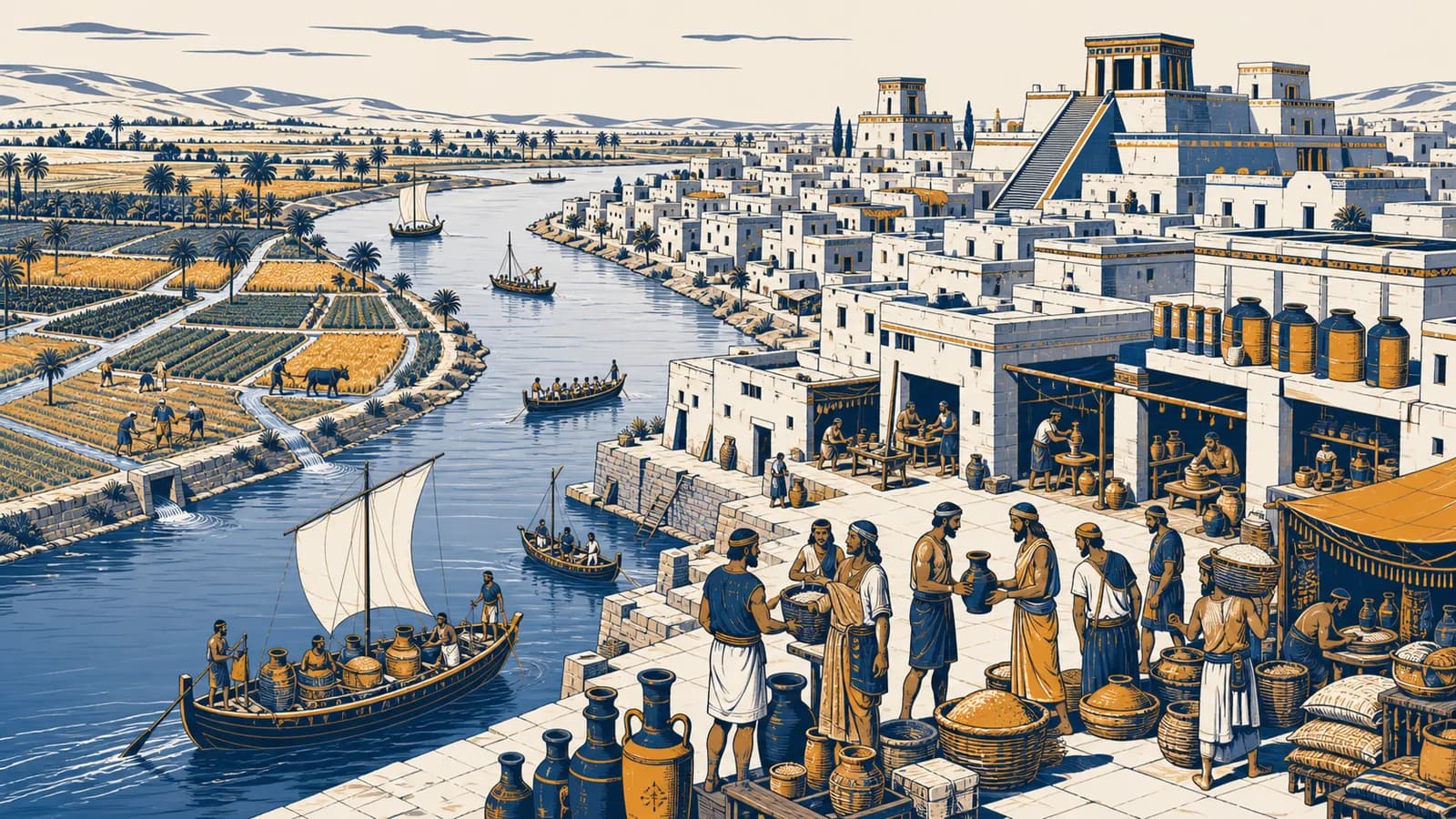
Ancient civilizations are complex human societies that organize cities, government, work, belief, and record-keeping, in the context of the earliest large-scale communities studied by history and archaeology. The term covers societies such as Mesopotamia, ancient Egypt, the Indus civilization, early China, Mesoamerica, and the Andes. Studying ancient civilizations explains how people created institutions to solve shared problems: producing food, distributing water, settling disputes, defending settlements, preserving knowledge, and deciding who held power. Their answers still appear in courts, calendars, taxes, urban planning, accounting, and arguments about evidence.
What an ancient civilization actually is
An ancient civilization is a durable society with settlements, specialized work, political authority, shared institutions, and systems for moving resources or information across a population. Cities and writing often appear, but neither is a universal test, and complexity did not follow one fixed route.
The word ancient identifies a broad period before the medieval and modern periods, but its dates depend on the region. The word civilization is more difficult. Historians use it to describe a scale and pattern of social organization, not to rank one people as more intelligent or more human than another. A mobile herding society could possess skilled diplomacy, detailed environmental knowledge, rich oral traditions, and effective law without building stone cities.
Researchers usually look for several connected features rather than one checklist item:
- Concentrated settlements: towns or cities where many households live near officials, craftspeople, markets, temples, or storage facilities.
- Specialized labor: some people produce pottery, metal tools, cloth, accounts, religious services, or military force instead of growing all their own food.
- Institutions: repeated rules and offices that outlast one person, such as kingship, councils, courts, taxation, temple administration, or communal water management.
- Surplus and exchange: food and materials can be stored, collected, traded, gifted, or redistributed.
- Shared systems of meaning: rituals, monuments, calendars, origin stories, and laws help people explain authority and obligation.
- Information systems: writing, seals, knotted cords, tallies, standardized measures, or trained memory keep track of goods and decisions.
Civilization is an analytical category, not a score for human worth. A society can be large and centralized while also being violent or unequal. Another can be small, mobile, and highly knowledgeable.
The boundaries are fuzzy because the evidence is incomplete and societies changed over time. Uruk in Mesopotamia became a large urban center during the fourth millennium BCE. Egypt unified under early dynastic rule around 3100 BCE. Major Indus cities flourished much later, around 2600 to 1900 BCE. These societies shared some features, but they did not copy a single complete package.
How archaeologists reconstruct civilizations from evidence
Archaeologists reconstruct ancient societies by combining objects, buildings, human remains, environmental traces, and written records while tracking where each item was found. Context turns an artifact into evidence because location, layer, association, and date connect it to human behavior.
An isolated bronze blade can show metalworking skill. The same blade found in a sealed grave beside imported beads, food vessels, and a human skeleton can support more specific questions about status, trade, burial practice, diet, health, and chronology. Researchers still must distinguish observation from interpretation. “A blade lay beside the left arm” is an observation. “The dead person was a warrior” is a hypothesis that needs more support.
Map the feature, photograph it, note soil color and depth, and document which materials touch one another before removal.
Identify materials, manufacturing marks, vessel forms, animal species, plant remains, inscriptions, and signs of use or repair.
Use stratigraphy, changing artifact styles, inscriptions, tree rings where preserved, and radiocarbon dating for suitable organic material.
Compare households, graves, settlements, or regions. A claim that survives several independent kinds of evidence is stronger than one based on a single spectacular find.
Stratigraphy uses a simple relation: in an undisturbed sequence, lower layers were deposited before upper layers. Radiocarbon dating measures the remaining carbon 14 in once living material and produces a probability range, not an exact birthday for a city. Researchers calibrate the laboratory result because atmospheric carbon 14 has varied through time.
Many specialists contribute. Archaeobotanists identify ancient seeds. Zooarchaeologists study animal remains. Bioarchaeologists examine human skeletons for age, injury, disease, and diet. Epigraphers read inscriptions, while conservators slow the decay of excavated material. Museum curators and heritage lawyers also investigate ownership, excavation history, and illegal removal.
How food, water, and specialization work together
A civilization supports specialized workers when farmers and herders produce enough food, institutions collect or exchange part of it, and storage carries supplies across seasons. Water systems can raise output, but they require labor, local knowledge, maintenance, and rules for access.
A household that produces all its own food has limited time for full-time craft production. Once grain, livestock products, fish, or other staples can support nonfarm workers, a settlement can sustain potters, builders, traders, soldiers, priests, and scribes. Specialization then creates dependence. Farmers need tools and containers. Craftspeople need food. Administrators coordinate contributions, while merchants connect places with different resources.
This flow is a feedback loop, not an automatic staircase. A failed harvest can empty stores. Officials can take too much. Canals can silt up, and irrigation can leave salts in poorly drained soil. Local communities may manage water without a king, while a powerful palace may control storehouses without directly managing every field.
Geography shaped the options. The Nile's annual flood deposited water and sediment along its valley, although the timing and height still varied. Southern Mesopotamia depended heavily on canals in a dry environment. Indus settlements used wells, drains, reservoirs, and carefully planned streets in different combinations. In the Andes, farmers adapted terraces, canals, herding, and exchange to steep elevation zones. Environment supplied constraints and opportunities; human institutions decided how labor and access were organized.
A town stores 12,000 baskets of grain after harvest. If seed grain and spoilage account for 3,000 baskets, 9,000 remain for consumption or distribution. That arithmetic does not reveal who receives them. Household lists, storage seals, ration records, and signs of malnutrition would help test whether distribution was broad, unequal, or reserved for emergencies.
The scenario shows why surplus alone does not explain a civilization. The political question is control. Grain stored by households creates one pattern of power. Grain gathered in a temple or palace creates another. Both may buffer shortage, but centralized storage also lets officials reward service, feed workers, and punish refusal.
How cities, states, and empires organize power
Cities concentrate people and work, states enforce decisions across territory, and empires rule multiple communities through conquest or unequal authority. These forms can overlap, but each solves a different coordination problem and creates a different contest over labor, land, revenue, and loyalty.
A city concentrates exchange and administration
A city is a dense settlement whose residents depend on connections beyond nearby fields. Streets, workshops, markets, shrines, walls, drains, and public buildings direct movement and labor. A city also draws food, fuel, stone, timber, metals, or textiles from a wider region.
A state makes rules stick across settlements
A state is an organization able to make and enforce decisions over a population and territory. Ancient states used officials, courts, taxation, labor obligations, armies, religious authority, and public ceremony in different mixtures. Their reach was uneven. A decree issued at a capital might be negotiated, delayed, or ignored at the frontier.
An empire governs difference
An empire places diverse peoples or territories under a dominant center. It may install governors, demand tribute, take hostages, move populations, build roads, recognize local rulers, or present conquest as divine order. The Achaemenid Persian Empire, founded by Cyrus II in the sixth century BCE, combined royal authority with provincial administration across a vast area.
Lines make rule look uniform. A colored territory appears fully controlled by one capital.
Control was often strongest near capitals, garrisons, roads, and rivers. Border communities could pay tribute to one ruler, trade with another, and retain local law.
Power also needed legitimacy, a shared reason people might accept rule as proper. Kings linked themselves to gods, ancestors, military protection, fertility, justice, or the maintenance of cosmic order. Such claims did not erase force. They made force easier to organize and made obedience meaningful within a society's own categories.
Later states refined these mechanisms rather than abandoning them. The comparison with how overseas conquest and colonization reorganized land and labor shows recurring tools of empire, including taxation, local intermediaries, military posts, and claims that domination served order.
How writing, numbers, and law turn decisions into systems
Writing, numerical notation, seals, and law let institutions preserve information beyond one conversation or lifetime. They make goods, duties, ownership, judgments, and messages easier to standardize, but they also give record keepers power over what officially counts.
Some of the earliest surviving Mesopotamian writing grew from administration in the late fourth millennium BCE. Clay tablets tracked commodities, workers, and institutions. Over time, cuneiform represented languages and carried letters, treaties, mathematics, omens, literature, and law. Egyptian hieroglyphic writing also appeared by the late fourth millennium BCE and existed alongside more cursive scripts suited to administration.
Writing did not begin everywhere for the same reason. Maya inscriptions recorded dynasties, rituals, warfare, and calendrical events. The Indus script remains undeciphered, so its language and full function are unknown. In the Andes, the Inca used khipus, cords with knots, colors, and structured positions, for numerical administration and possibly broader information. This is why “no familiar writing” cannot mean “no organized information.”
A ration list can be checked against the total issued, although the tablet alone cannot prove every worker actually received the stated amount.
Law turns repeated decisions into a public or official framework. The Babylonian king Hammurabi ruled in the eighteenth century BCE and issued the collection now called the Code of Hammurabi. Its provisions use cases of the form “if this happens, then this consequence follows.” They address property, trade, marriage, injury, labor, and status. The text does not prove that every dispute ended exactly as carved. It shows legal ideals, categories, and royal claims about justice, which historians compare with contracts and court documents.
Standard measures reduce disputes by making unlike transactions comparable. A fixed unit of grain or weight lets a tax collector, merchant, and court describe the same quantity. Yet standards also create gatekeepers. The authority that defines a measure or keeps the official record can include, exclude, forgive, or accuse.
Ancient civilization versus a single line of progress
Ancient history is not a ladder that carries every society through farming, cities, writing, monarchy, and empire in the same order. Societies adopted, rejected, combined, or abandoned practices according to local ecology, conflict, trade, belief, and political choice.
A simple progress story fails in several ways. It treats different dates as developmental rankings. It mistakes survival of evidence for importance. It assumes central government is always more effective than local cooperation. It also turns modern borders into ancient identities, even though languages, trade networks, and political territories crossed those later lines.
Small bands become villages, villages become cities, cities become states, and states become empires. Each stage supposedly replaces an inferior one.
People change settlement size, authority, subsistence, and exchange in several directions. Cities can shrink, states can fragment, and mobile communities can coexist with empires or defeat them.
“Cradle of civilization” can also mislead if it implies one birthplace for all complex society. Urban and state-level organization developed independently in several regions, including Mesopotamia, Egypt, the Indus region, northern China, Mesoamerica, and the Andes. Contact mattered within and between some regions, but no single source accounts for every case.
The same caution applies to famous individuals. Rulers left many names because monuments and inscriptions favored them, while farmers, craft workers, servants, enslaved people, and caregivers produced the material base of society. A page on how historians judge the actions of influential people can help separate personal agency from the institutions and communities that made action possible.
How ancient civilizations show up in jobs, law, money, and daily decisions
Ancient civilizations appear outside school whenever people preserve sites, authenticate objects, interpret laws, manage water, design cities, account for goods, or debate ownership of cultural heritage. The connection lies in methods and institutions, not in copying ancient solutions unchanged.
Archaeology and laboratory work test material claims
Field archaeologists survey landscapes and excavate selected contexts. Laboratory specialists analyze residues, metals, pottery fabrics, pollen, bones, and ancient DNA where preservation and ethics permit. Geographic information systems reveal spatial patterns. Conservators study chemistry and humidity before stabilizing wood, textile, metal, stone, or painted surfaces.
These jobs depend on controlled documentation. An object removed without a recorded findspot loses much of its ability to answer historical questions. Looting therefore damages knowledge as well as property. It breaks the association between an artifact, its layer, neighboring objects, and the people responsible for its care.
Law and museums decide custody and return
Heritage law deals with excavation permits, export rules, museum acquisition, wartime removal, Indigenous or descendant claims, and repatriation. Lawyers, curators, source communities, and governments may disagree about legal title and ethical custody. They examine collection records, sale documents, excavation permits, and the circumstances of removal.
A dealer offers a museum an inscribed tablet but provides no excavation record and only a recent ownership history. The inscription might be genuine, yet purchase could encourage looting or violate export law. A responsible review checks provenance, asks for earlier documentation, consults relevant authorities, and declines the object if lawful ownership cannot be established.
That decision uses the same source criticism applied to ancient chronicles. Who created the document? When did it appear? Does an independent record confirm it? Missing paperwork is not a small inconvenience when the legal and archaeological context depends on it.
Accounting and public administration still face old problems
Modern accounting uses different technology, but it answers familiar questions: what entered storage, what left, who authorized it, and whether totals agree. Tax systems still classify people and property. Water agencies still allocate a shared resource under uncertain supply. City planners still balance drainage, access, density, waste, and transport.
Ancient solutions are evidence, not instruction manuals. A Mesopotamian canal system operated under different crops, laws, climate conditions, and technology. Its record can reveal how maintenance obligations and upstream use affect downstream users. A current engineer must still measure the present watershed and test a design against current needs.
News and political language reuse ancient comparisons
Public figures often call a rival an empire, describe a state as collapsing, or compare a leader with Rome. Such analogies compress complicated histories into emotional labels. A useful comparison specifies the mechanism. Is the claim about military overextension, tax collection, elite conflict, disease, climate pressure, or loss of legitimacy?
The habit transfers to later events. Studying the evidence, institutions, and human choices behind World War II and the Holocaust requires much newer sources, but the same discipline applies: define a claim, identify who made each record, compare independent evidence, and resist a story that assigns one cause to a mass event.
Four mistakes people make with ancient civilizations
The most common errors are treating civilization as superiority, trusting monuments as neutral reports, explaining collapse with one cause, and assuming ancient people thought like present-day observers. Each mistake replaces evidence with a shortcut and hides disagreement inside the society being studied.
1. Civilization means morally advanced
Administrative capacity and moral behavior are separate questions. A state can build roads, calculate taxes, and preserve literature while relying on conquest, forced labor, slavery, or severe inequality. Technical organization tells us what a government could coordinate. It does not tell us that its purposes were fair.
2. A monument reports events objectively
Monuments are arguments made durable. A victory scene selects a triumphant moment, enlarges a ruler, arranges defeated enemies, and places divine symbols where viewers can read authority. It may report a real campaign, but its composition tells us how power wanted the campaign remembered.
This sentence is a method, not a claim that every source lies. A tax list may accurately count deliveries because administrators needed usable totals. It still reflects official categories and may omit goods exchanged beyond official view.
3. One disaster caused collapse
Political breakdown usually has several interacting causes. Drought can reduce harvests, but its effects depend on storage, trade, inequality, water rules, warfare, and the ability of institutions to respond. Invasion can remove rulers without erasing local language or farming. Trade can continue after palaces fall.
Historians should specify what collapsed. A dynasty can end while villages remain occupied. A writing system can disappear while descendants continue living in the region. A capital can be abandoned while authority shifts elsewhere. “Collapse” is useful only after the changing institution, place, population, and time span are named.
4. Ancient people were modern people with older tools
Ancient people experienced fear, affection, pain, ambition, and grief, but they interpreted duty, personhood, nature, gods, family, and time through categories that were not identical to ours. Reading their actions only as modern economics or private belief can erase the social world that made those actions intelligible.
The remedy is not to treat the past as unknowable. It is to reconstruct choices from contemporary language, material conditions, institutions, and comparisons among sources. That approach also improves the study of how Renaissance thinkers reused and reworked ancient knowledge, since they did not simply recover a frozen classical inheritance.
How did writing begin, and did every civilization need it?
Writing began independently in more than one region as people developed visible marks that represented language, names, quantities, or events. Civilizations did not all need full writing because oral specialists, objects, seals, images, tallies, and cord records could also store information.
In Mesopotamia, administrative marks and numerical records developed into cuneiform writing. In Egypt, early hieroglyphic inscriptions appeared in royal and elite contexts. Chinese writing is securely attested on late Shang oracle bones from the second millennium BCE, although its earlier development remains a subject of research. Mesoamerican societies created their own writing traditions, with Maya writing becoming the best understood.
Decipherment requires more than spotting repeated signs. Researchers seek patterns, known names or languages, bilingual texts, sign order, and enough examples to test readings. The Rosetta Stone helped scholars decipher Egyptian hieroglyphs because its decree appeared in hieroglyphic, Demotic, and Greek versions. No equivalent key has yet produced an accepted decipherment of the Indus signs.
Writing and history are not the same boundary. Archaeology can reconstruct communities that left no readable texts, while a written royal archive may reveal little about households outside official administration.
The question “Who invented writing?” therefore needs a regional answer and a definition of writing. A symbol can identify an owner without representing spoken language. A numerical token can count grain without recording a sentence. The transition from marks to a script often took generations, and the surviving pieces may show only part of it.
Why did ancient civilizations decline or transform?
Ancient civilizations declined or transformed when institutions could no longer manage combined pressures such as political conflict, disrupted trade, environmental stress, warfare, epidemic disease, or changing loyalties. The outcome was usually reorganization, not the disappearance of an entire people or culture.
The end of western Roman imperial government in the fifth century CE did not empty Europe or erase Roman law, Christianity, Latin, cities, and roads. Political authority fragmented and new kingdoms formed. Likewise, the decline of Classic Maya royal centers in parts of the southern lowlands did not mean that Maya people vanished. Maya communities, languages, and identities continue.
Large urban centers declined, settlement patterns shifted, and features of urban standardization weakened. The script remains undeciphered, which limits claims about political causes.
Several palatial states fell during a period involving warfare, migration, disrupted exchange, internal conflict, and environmental stress. The mixture differed by place.
Imperial government ended in the west through a long process of civil war, fiscal strain, military change, and the formation of successor kingdoms.
A timeline helps order events, but sequence alone does not prove cause. If drought comes before abandonment, researchers still ask how severe it was, who moved, what food stores existed, whether conflict increased, and why some settlements endured. Climate records, settlement surveys, human remains, written documents, and crop evidence must converge.
Transformation is often a better first word than collapse. It directs attention to survivors, relocated communities, new political centers, and altered trade. It also prevents a palace archive from standing in for the whole population merely because baked clay tablets survive better than ordinary voices.
Who built ancient civilizations and who was left out of their records?
Farmers, herders, fishers, craftspeople, traders, builders, soldiers, servants, enslaved people, officials, ritual specialists, and caregivers built ancient civilizations. Surviving records favor elites and institutions, so historians recover other lives through houses, tools, food remains, burials, injuries, and ordinary documents.
A palace names kings because kings commissioned inscriptions. A workshop floor preserves broken molds, slag, ash, and worn tools because production left physical debris. A skeleton can show healed trauma or repeated physical stress, although it cannot by itself supply a person's occupation or identity. Household pottery can reveal cooking and storage practices, but style does not map neatly onto ethnicity.
Gender and legal status shaped work and visibility. Some women owned property, conducted business, served religious offices, or ruled, depending on time and place. Many others appear in records through marriage arrangements, textile quotas, rations, or court disputes. Enslaved people could be war captives, debtors, or people born into slavery. The conditions and possibilities differed among societies, so one ancient system should not stand for all.
No source gives a complete person. The four evidence types constrain one another. A ration tablet might list textile workers, loom weights may locate production, skeletons may show patterns of strain, and houses may indicate how workers lived. Agreement strengthens the reconstruction. Disagreement reveals a new question.
Ancient civilizations make history a practice of tested explanation
Ancient civilizations show how historians build explanations from unequal, damaged, and interested evidence. Their cities and institutions matter, but the larger lesson is methodological: define the claim, trace the mechanism, compare sources, identify uncertainty, and notice whose work made power possible.
The next time a headline says that a society is “like Rome” or that a new discovery “rewrites history,” pause before accepting the analogy. Ask what changed, which evidence changed it, what alternative explanation remains, and whether a ruler's record is being mistaken for a whole society.
The takeaway: Ancient civilizations were different solutions to coordination under particular environmental and political conditions. Study the links among food, labor, information, authority, and belief, then test each explanation against more than one kind of source.
That habit connects ancient evidence to the wider study of how historical claims are built and tested. It turns history from a parade of names into an investigation of cause, choice, continuity, and change, one in which ordinary objects can challenge the story carved on a king's wall.