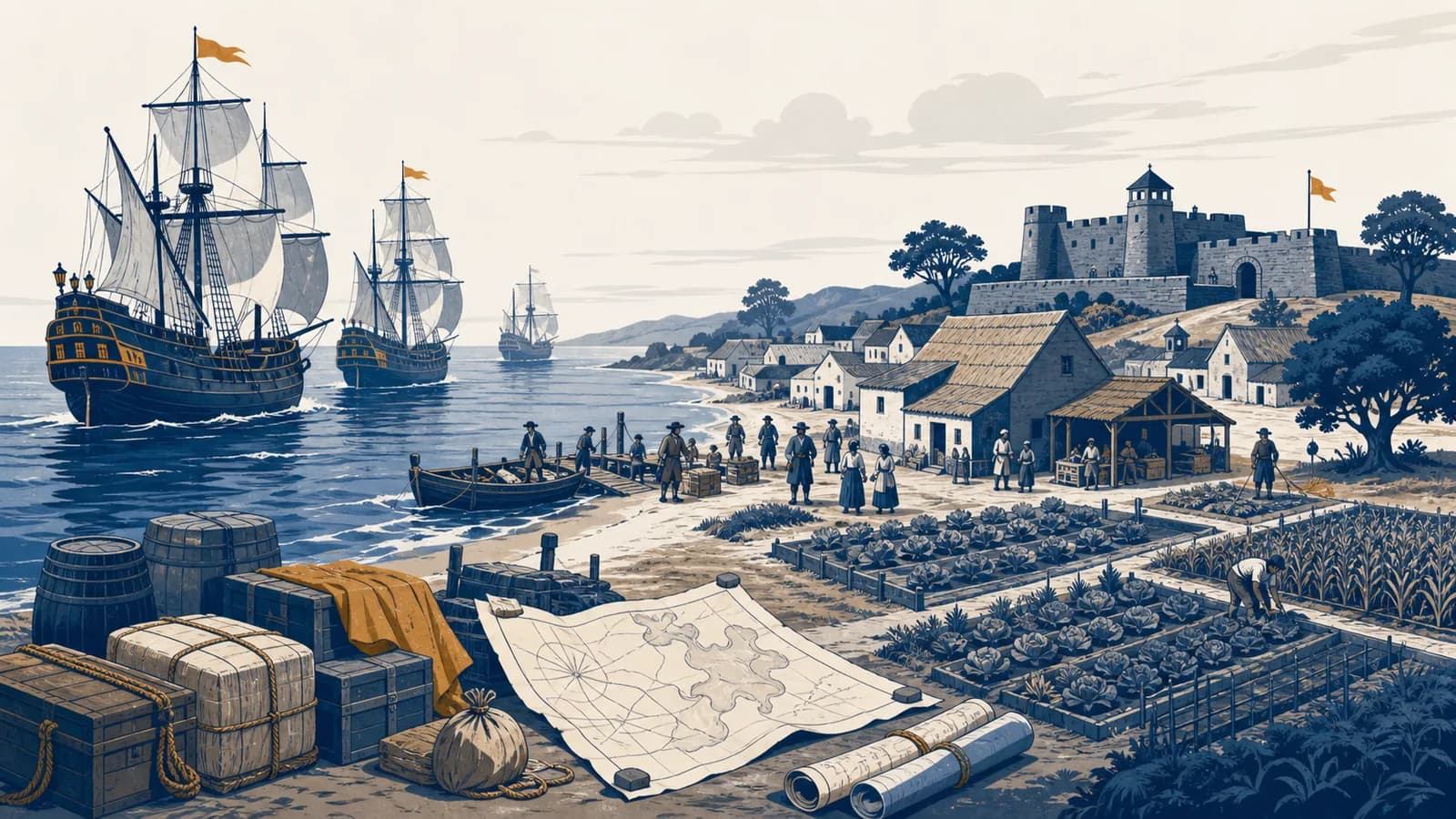
Exploration and colonization is a historical process that links long-distance investigation to the seizure, settlement, and control of land, people, and trade, in the context of expanding states and empires. The Age of Exploration, also called the Age of Discovery, describes the ocean voyages through which European powers mapped routes and reached territories already inhabited by other societies. Colonization followed when states, companies, settlers, and missionaries tried to make that contact permanent. The process existed because rulers and merchants sought trade, wealth, territory, converts, labor, and strategic advantage. It changed who controlled land and connected distant economies, often through conquest, forced labor, slavery, disease, and resistance.
What exploration and colonization actually are
Exploration is organized travel intended to gain geographic or commercial knowledge, while colonization is the creation of lasting outside control over a territory and its people. A voyage can explore without founding a colony, but imperial exploration often prepared the maps, claims, and routes that colonization required.
People have explored and founded colonies throughout recorded history. Phoenician ports around the Mediterranean, Greek settlements, Roman provinces, Austronesian settlement across the Pacific, Norse communities in the North Atlantic, and the expansion of Islamic trading cities all predate the European Atlantic empires. The familiar school topic usually focuses on European overseas expansion from the fifteenth century onward because it joined the Americas, Africa, Europe, and Asia into sustained systems of exchange and domination.
The phrase Age of Discovery presents events through European eyes. Christopher Columbus reached Caribbean islands in 1492, but the islands were already home to Taíno communities. Norse sailors had also reached North America centuries earlier. Europeans discovered routes and places that were new to them; they did not discover empty continents. The wording matters because it determines whose knowledge counts.
European sailors found unknown lands, claimed them, and spread civilization.
Sailors entered inhabited worlds, used local knowledge, and helped empires impose new political and economic systems that Indigenous peoples accepted, adapted to, negotiated with, or resisted.
This fuller account does not erase navigation, courage, or scientific skill. It places those achievements inside the institutions that financed them and the consequences that followed. A good historical explanation can hold maritime invention and colonial violence in the same frame.
How oceanic exploration worked
Oceanic exploration worked by combining state permission, merchant capital, navigational knowledge, suitable ships, disciplined crews, and information gathered along the route. Success depended less on one heroic captain than on a chain of finance, technology, logistics, translation, local pilots, and political bargaining.
A crown or company issued permission, supplied ships, or promised privileges. Investors accepted the risk of shipwreck, capture, or commercial failure in exchange for possible profits and monopolies.
Organizers acquired vessels, water, preserved food, trade goods, weapons, repair materials, and pay. Crews included sailors and officers, but could also include soldiers, priests, translators, craftspeople, and enslaved people.
Pilots estimated position using direction, speed, time, coastal observations, latitude measurements, charts, and accumulated experience. Logs and maps turned a single voyage into reusable knowledge.
Travelers depended on interpreters, guides, merchants, and rulers who knew coasts, currents, languages, markets, and rivalries. Europeans regularly built on knowledge already held by African, Asian, and Indigenous American communities.
A voyage had to produce something useful: cargo, tribute, geographic intelligence, diplomatic access, a strategic claim, or evidence that a future expedition might pay.
Navigation was difficult because longitude could not yet be measured accurately at sea. Latitude was easier to estimate by observing the Sun or known stars. Dead reckoning used a vessel's direction and estimated speed over time, but errors accumulated. Winds and currents therefore became practical infrastructure. Portuguese sailors learned Atlantic wind patterns that let them travel away from the African coast before turning toward Europe with favorable winds.
Ship types served different tasks. The caravel was small and maneuverable, useful for reconnaissance. Larger carracks carried more provisions and cargo. Lateen sails helped a ship work across the wind, while square sails performed well with a following wind. No single invention caused expansion. What mattered was the combination of hull design, rigging, charts, instruments, trained labor, and institutions able to repeat voyages.
Navigation was a knowledge system. A chart was valuable only when a crew could combine it with observation, calculation, remembered routes, and corrections made during the voyage.
The people who supplied that knowledge often disappear from famous voyage stories. Columbus relied on experienced Atlantic sailors. Vasco da Gama's expedition acquired pilots and commercial intelligence around the Indian Ocean. Spanish expeditions in the Americas depended heavily on Indigenous interpreters, messengers, porters, and allied armies. Exploration was always a contact between knowledge systems, even when later accounts credited a European commander alone.
Exploration versus colonization
Exploration gathers knowledge through travel; colonization converts contact into durable power through settlement, forts, law, taxation, land claims, labor control, or military occupation. The two can overlap, but evidence of a voyage does not by itself prove that a functioning colony or empire existed.
| Question | Exploration | Colonization |
|---|---|---|
| Immediate goal | Learn a route, locate resources, make contact, or test a commercial possibility | Hold territory, direct labor and trade, settle people, or govern a population |
| Typical evidence | Ship logs, maps, travel accounts, specimens, reports, and diplomatic gifts | Forts, farms, censuses, taxes, courts, land grants, missions, and permanent settlements |
| Time scale | A voyage or series of expeditions | Years, generations, or centuries |
| Main political claim | “We have reached and recorded this place.” | “We have authority to rule, settle, or extract value here.” |
A trading post could sit between these categories. Portuguese forts along African and Asian coasts were designed to control commerce more than large inland populations. A settler colony aimed to transfer people and reproduce an outside society on occupied land. A plantation colony organized land and coerced labor around export crops. A crown colony placed government officials under royal authority. These forms could change over time and coexist in one empire.
The distinction also prevents a common chronological error. An explorer planting a flag or reading a proclamation created a claim in European diplomatic practice, but it did not magically transfer possession. Actual control required ships, soldiers, settlers, food, alliances, administrators, and the ability to survive resistance. Claims on maps routinely exceeded power on the ground.
A map colors an enormous inland area as belonging to one European empire in 1700. Treat the color as a claim, then ask where that government had forts, officials, settlers, tax collection, or military reach. The answer may reveal a coastal network rather than complete territorial control.
This habit also improves the study of how ancient societies expanded and governed territory. An empire's borders were often zones of shifting tribute, alliance, and military influence rather than sharp lines resembling a present-day national border.
How exploration became colonial rule
Exploration became colonial rule when sponsors turned information and contact into institutions that could hold land, redirect trade, command labor, and enforce law. The conversion usually required repeated expeditions, local allies, violence or threatened violence, administrative records, and a supply line connecting colony to sponsor.
The sequence was not automatic or identical everywhere. Some contacts remained commercial for centuries. Some colonies collapsed because settlers lacked food, sponsors withdrew, disease struck, or residents resisted. Other conquests advanced quickly because invaders entered existing conflicts and gained powerful allies.
The Spanish campaign against the Mexica Empire shows the mechanism. Hernán Cortés did not overthrow Tenochtitlan with a few hundred Spaniards acting alone. His forces included many thousands of Indigenous allies, especially Tlaxcalans, who had their own reasons to oppose Mexica power. Spanish steel weapons, horses, and firearms mattered, but so did siege tactics, political fractures, translators such as Malintzin, and a smallpox epidemic during the conflict. Tenochtitlan fell in 1521, after which conquest still had to be converted into government, tribute, Christian missions, and contests over land and labor.
Colonial states made rule repeatable. Officials recorded people and property. Courts decided disputes according to imperial law, although local law and custom often survived. Tax and tribute systems moved goods toward capitals and ports. Missions sought religious conversion and sometimes gathered dispersed communities into supervised settlements. Land grants and labor regimes rewarded colonists while restricting Indigenous autonomy.
A treaty between European powers did not erase Indigenous sovereignty. The 1494 Treaty of Tordesillas divided claimed overseas zones between Spain and Portugal, but the peoples living in those zones neither negotiated nor accepted the division.
Private organizations could also govern. Chartered companies received monopolies and political powers from a state. They might sign treaties, build forts, command soldiers, coin money, or administer justice. This arrangement let a government shift costs and risks to investors while keeping strategic influence. Profit seeking and state power were therefore partners, not separate stories.
How trade, labor, and extraction made colonies function
Colonial economies functioned by reorganizing land, labor, and trade so that wealth flowed toward settlers, companies, and imperial governments. Taxes, monopolies, mines, plantations, and coerced labor converted political control into revenue, while armed force and unequal law protected the arrangement.
Mercantilist policies treated overseas possessions as sources of valuable goods and as captive markets. Governments tried to channel colonial trade through approved ports and merchants. Customs duties raised revenue, while exclusive trading rights enriched favored companies. Smuggling grew wherever official rules made goods scarce or expensive.
Extraction took different forms. Spanish America produced silver through mines including Potosí, using wage labor alongside coercive drafts and other unequal labor arrangements. Caribbean and Brazilian plantations produced sugar for Atlantic markets. In mainland North America, colonial economies included tobacco and rice plantations, family farms, fishing, the fur trade, shipbuilding, and commerce with Indigenous nations. There was no single colonial economy, but each depended on rules about who could own land, direct labor, and trade.
If cargo sells for 10,000 units and recorded costs total 7,500, the accounting profit is 2,500. Coerced labor can lower the buyer's recorded cost while imposing enormous human costs that the account book excludes.
That final distinction is essential. A plantation ledger might call an enterprise profitable because it counted an enslaved worker as property and ignored lost freedom, family separation, violence, and premature death. Economic records reveal how owners calculated, but they do not supply a complete measure of social cost.
European colonization and the Atlantic slave trade became tightly connected. Portuguese and then other European traders purchased or captured Africans and transported them across the Atlantic under brutal conditions. Enslaved people produced export commodities and created families, communities, religions, music, foodways, and resistance movements despite systems designed to treat them as property. African rulers and merchants participated in parts of the trade, but European colonial demand, shipping, finance, plantation law, and racial ideology expanded and entrenched it.
Industrial production later changed the scale and purpose of empire. Steamships, railways, telegraphs, factory weapons, and demand for raw materials supported new forms of control in the nineteenth century. The connection becomes clearer alongside the changes in factories, transport, energy, and labor.
How the Columbian Exchange changed environments and populations
The Columbian Exchange was the sustained movement of organisms, people, goods, and diseases between the Americas and Afro-Eurasia after 1492. It changed diets and landscapes across the world, while epidemic diseases caused catastrophic population loss among Indigenous Americans who lacked prior exposure to many pathogens.
Crops moved because farmers tested them in new climates and markets rewarded successful harvests. Potatoes and maize supplied calories in parts of Europe, Africa, and Asia. Cassava became important in tropical regions because it grew in difficult soils and could remain in the ground until needed. Sugarcane, already cultivated across parts of Asia and the Mediterranean, became the center of plantation systems in the Atlantic world.
Animals also changed land use. Horses transformed travel, hunting, warfare, and trade for many Indigenous peoples, especially on the North American plains. Cattle and sheep supplied meat, hides, wool, and traction, but grazing herds could damage fields and compete for land. Pigs reproduced quickly and could escape into local ecosystems.
Disease transfer was radically unequal. Smallpox, measles, influenza, and other infections traveled with people and trade. Many Indigenous American communities had little or no previous exposure to these diseases and therefore little acquired immunity. Epidemics killed leaders and knowledge holders, disrupted farming, weakened military defense, and caused further deaths through hunger and displacement. Disease helped colonizers, but it was not a complete explanation for conquest. Warfare, forced labor, food seizure, relocation, and political choices increased vulnerability and shaped who survived.
Environmental change was therefore political. A new crop can look like a simple biological transfer, yet someone chose where to plant it, whose land to use, and who would work. Plantation owners selected crops for export rather than local food security. Colonial governments protected those decisions with property law and force.
How colonized peoples resisted, negotiated, and survived
Colonized peoples were political actors who resisted invasion, negotiated alliances, used colonial courts, preserved knowledge, adapted imported tools, escaped coerced labor, and built new communities. Their choices shaped every colony, even where imperial records tried to portray conquest as complete and one-sided.
Armed resistance could defeat a colony, delay settlement, or raise its costs. The Pueblo Revolt of 1680 drove Spanish authorities from New Mexico for more than a decade. Maroon communities formed when enslaved people escaped and established independent settlements, sometimes defending them through terrain knowledge and alliances. Shipboard rebellions, work slowdowns, sabotage, and flight challenged slavery at different scales.
Negotiation was not surrender. Indigenous nations made treaties to gain trade, military support, recognized boundaries, or a pause in conflict. They could play rival empires against one another. In northeastern North America, French power relied heavily on alliances and commerce with Indigenous nations. Those partners pursued their own diplomatic and economic goals. The relationship was unequal in some settings and shifted over time, but it was never simply European command followed by passive obedience.
People also used an empire's rules against its agents. Indigenous communities brought lawsuits over land and labor. Enslaved and free people petitioned officials, purchased freedom where law allowed, formed mutual aid networks, and preserved family ties. Conversion to Christianity could be sincere, strategic, forced, or blended with older religious practices. Cultural survival often involved selective adaptation rather than an untouched tradition.
A rebellion proved that disorderly subjects rejected lawful government.
Which land seizures, labor demands, religious restrictions, broken agreements, or local conflicts made resistance a rational choice?
Resistance changed imperial policy. Officials sometimes reduced demands, recognized limited autonomy, redesigned defenses, or recruited former enemies. They could also answer revolt with massacre, forced removal, or tighter control. The outcome depended on population, geography, weapons, supplies, alliances, and competing wars.
Biography helps restore decision-making to people flattened by large labels such as “explorer,” “settler,” or “native.” Accounts of interpreters, diplomats, rulers, rebels, sailors, and captives connect this topic with the people whose choices altered historical events.
4 mistakes people make with exploration and colonization
Four common mistakes distort this history: treating continents as empty, confusing a claim with control, reducing conquest to superior weapons, and judging every encounter only by its final outcome. Correcting them reveals the local decisions and unequal institutions that made expansion possible.
1. “Explorers entered empty land”
European explorers entered populated territories with governments, farms, trade routes, laws, languages, and sacred places. Even regions with low population density were used through hunting, seasonal migration, controlled burning, or diplomacy. Calling them empty turned a colonial claim into an apparent fact and made land seizure easier to defend.
2. “A flag created effective ownership”
A ceremony created a written claim for an empire, not automatic control of the people present. Effective power required enforcement. When reading a claim, ask who witnessed it, who understood it, which authority recognized it, and what happened after the expedition left.
3. “Europeans won because they had guns”
Firearms offered noise, range, and psychological force, but early guns were slow to load and could be inaccurate. Steel blades, armor, horses, and ships also mattered. Still, alliances, epidemics, intelligence, supply, leadership, and conflicts within Indigenous political systems often mattered just as much. Technology works through people and circumstances.
4. “Colonization was inevitable after contact”
People living through first contact did not know the ending. Colonies failed, alliances changed, and European powers competed with one another. Indigenous nations sometimes restricted settlement or forced outsiders into negotiated relationships. Treating eventual conquest as inevitable hides choices and makes resistance look irrational even when it succeeded for generations.
Use a five-part test for any colonial claim: identify the land, the claimant, the people already there, the method of enforcement, and the evidence of actual control.
This test works on maps, textbooks, museum labels, political speeches, and legal arguments. It turns a broad story of “expansion” into specific questions about authority and evidence.
How colonial history shows up in maps, law, and museums
Colonial history appears in present-day borders, place names, land titles, treaty disputes, official languages, museum collections, and public monuments. These records are not neutral leftovers; they preserve decisions about ownership, classification, memory, and whose authority received legal recognition.
Maps can expose several layers at once. A coastline may carry a European name, an Indigenous name, and a national boundary drawn later. Survey grids can show how governments converted shared or seasonally used lands into saleable parcels. Straight borders sometimes reflect agreements between imperial governments more than local geography or community boundaries.
Law preserves colonial doctrines and documents. Courts may interpret old treaties, land grants, or crown proclamations in disputes over jurisdiction and resources. The key historical task is to read the document in context: who had the authority to sign, what each side believed it promised, which language controlled the written record, and whether later governments honored it.
A label says an object was “collected” during a military expedition. Look for the collector, the original maker or community, the circumstances of transfer, and the route into the museum. “Collected” might describe purchase, gift, excavation, seizure, or looting, and those are different histories.
Place names are evidence too. A city, river, or mountain may commemorate a monarch, explorer, colonial official, or Indigenous word reshaped by an outside language. Renaming debates are arguments about public authority and memory. Historical study cannot decide a policy by itself, but it can establish what a name commemorates and which voices earlier decisions excluded.
News about independence, migration, resource ownership, and cultural restitution often carries this older structure into the recent past. The link is rarely a simple straight cause, so historians trace the institutions and decisions between colonial rule and the present claim.
How historians judge explorers without flattening the past
Historians judge explorers by reconstructing the choices available in their own time, the rules and ambitions of their sponsors, the testimony of affected peoples, and the foreseeable consequences of their acts. Context explains a decision, but it does not automatically excuse violence or deception.
Two errors sit at opposite ends. Presentism can assume that a person had exactly today's knowledge and choices. Moral evasion can claim that “everyone thought that way,” even when people at the time objected, resisted, debated law, or proposed alternatives. Contemporary disagreement is especially useful evidence because it shows that an action was not beyond criticism in its own period.
A balanced assessment separates questions that are often bundled together. Was a navigator technically skilled? Did the expedition produce accurate information? What did the sponsor want? How did the commander treat crew members and people encountered? What institutions followed the voyage? Later commemoration adds another question: what values did a society promote when it chose that person for a monument or holiday?
Historical judgment becomes stronger when the claim is precise. “Columbus was brave” says little unless bravery is defined and connected to evidence. “Columbus crossed an ocean with uncertain charts, then participated in violent attempts to extract wealth and labor in the Caribbean” makes two claims that can be tested separately.
What caused European overseas expansion?
European overseas expansion grew from several connected pressures: demand for profitable trade, rivalry among states, Christian missionary goals, access to capital, and improvements in maritime practice. No single motive explains every expedition, and the balance changed by sponsor, region, and decade.
Asian spices, textiles, and luxury goods reached Europe through established networks involving Asian, Middle Eastern, African, and European merchants. European rulers and traders sought direct access to those markets and to West African gold. Ottoman power affected trade and diplomacy, but it did not simply “close” all eastern routes. Existing commerce continued while Atlantic states searched for alternatives and competitive advantages.
Political rivalry kept expansion moving. A route, port, or island could deny an opponent access as well as produce profit. Religious aims mixed with strategy and commerce. Missionaries sought converts, while rulers used Christian identity to justify claims and alliances. Improvements in ships and navigation made repeated ocean crossings more practical, but governments and investors still had to fund them.
The timeline gives the pattern without pretending that each event caused the next.
The voyage showed Portuguese sponsors that the Atlantic and Indian oceans were connected by sea around the Cape of Good Hope.
Sailing for the Spanish monarchs, Columbus crossed the Atlantic while seeking a westward route to Asia and began sustained Spanish contact with the Americas.
The Portuguese expedition connected an Atlantic route around Africa with the existing commercial world of the Indian Ocean.
Ferdinand Magellan died in the Philippines. Juan Sebastián Elcano commanded the surviving ship home, completing the first recorded circumnavigation.
Did colonization only happen in the Americas?
Colonization did not occur only in the Americas. European powers established trading posts, settler colonies, plantation zones, and territorial empires in Africa, Asia, the Caribbean, and the Pacific, while non-European states also conquered, settled, and governed lands beyond their earlier centers.
The form of control differed by place. In parts of Asia, Europeans initially operated from coastal forts within powerful existing states and commercial systems. In the Caribbean, plantation colonies and enslaved labor dominated. Large-scale settler colonization reshaped landholding and population in places including North America, Australia, and New Zealand. During the nineteenth century, European states imposed wider territorial rule across much of Africa.
Comparison should identify mechanisms rather than declare every empire identical. Ask how land changed hands, who moved, who supplied labor, which laws ranked populations, how taxes were collected, and how residents resisted. Those questions reveal both shared structures and local differences.
Is imperialism the same as colonialism?
Imperialism is the broader policy or practice of extending power over other societies, while colonialism usually involves sustained outside control of territory and population, often through administration or settlement. An empire can exert economic or military dominance without establishing a large formal colony.
Informal empire works through unequal treaties, debt, military pressure, commercial privileges, or control of ports and foreign policy. Formal colonial rule places officials and laws directly over a territory. The boundary can blur when a formally independent government has little freedom to refuse an outside power.
Settler colonialism is more specific. Settlers seek lasting access to land and build institutions that can displace, absorb, confine, or erase Indigenous political communities. This structure may continue after the colony becomes an independent state, because independence for settlers does not necessarily restore Indigenous land or sovereignty.
Exploration and colonization changed the making of history
Exploration and colonization changed history by connecting distant societies under unequal systems of exchange, rule, and migration. Studying the process shows how maps become claims, claims become institutions, and institutions leave evidence in law, wealth, language, borders, and public memory.
The topic also trains a wider historical skill: follow the mechanism between an event and its consequence. A ship reaching a coast did not by itself create an empire. Sponsors financed another voyage. Diplomats found allies. Soldiers or settlers secured a foothold. Officials recorded land and labor. Courts enforced new categories. Residents resisted, negotiated, or adapted. Each link needs evidence.
Use that chain the next time you meet a colored imperial map, a statue of an explorer, a disputed museum object, or a court case involving an old treaty. Ask who created the claim, who already lived there, how control actually worked, and whose account survived. Those questions connect the topic to the wider study of evidence, cause, power, and change across history.
The takeaway: Exploration produces contact and knowledge; colonization turns them into durable control. The difference becomes visible when you trace land, labor, law, trade, and resistance instead of stopping at the route on a map.