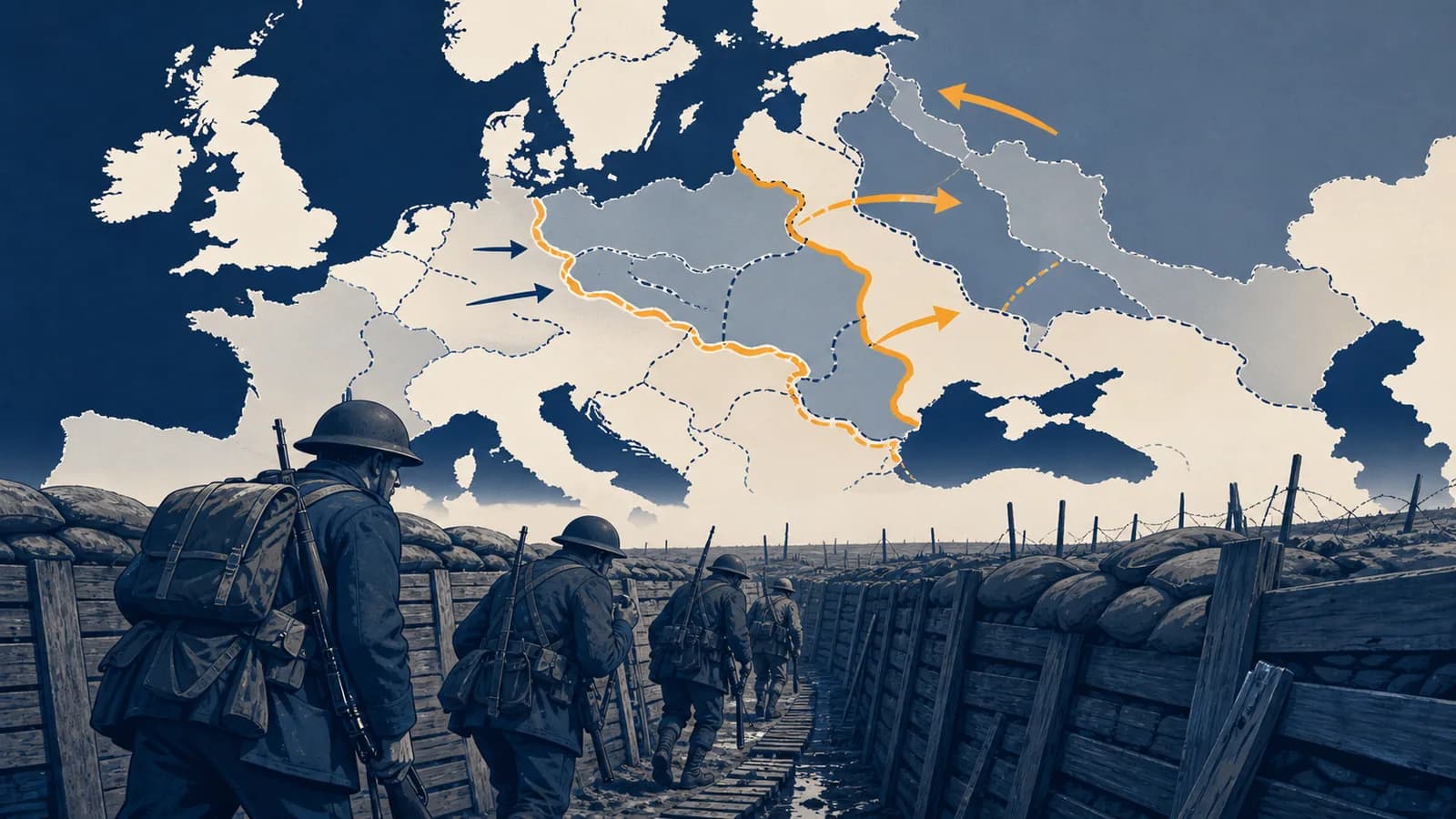
World War I and its aftermath is a historical period that shows how industrialized alliance warfare remade states, borders, economies, and societies, in the context of early twentieth-century world history. The causes of World War I, trench warfare, how World War I ended, the Treaty of Versailles, and the effects of the war belong to one chain of events. Historians study that chain because a war does not stop shaping lives when the shooting ends. Decisions made between 1914 and the early 1920s still appear in national borders, remembrance ceremonies, international law, political arguments, and news from former imperial territories.
What World War I and its aftermath actually is
World War I was a global war fought from 1914 to 1918 by two shifting coalitions, while its aftermath was the longer process of revolution, peacemaking, economic disruption, and imperial collapse that followed. The fighting ended before its political consequences did.
The main coalition called the Allies included France, Britain, Russia, and later Italy and the United States, among many other states and imperial forces. The opposing Central Powers were Germany, Austria-Hungary, the Ottoman Empire, and Bulgaria. These names can mislead. An alliance was not a single army under one government, and each member entered for its own reasons.
The war was global because European empires drew people, resources, ships, and territories into it. Soldiers fought in Europe, Africa, the Middle East, the Pacific, and at sea. Indian troops served the British Empire in several theaters. French colonial forces came from North and West Africa and other possessions. Japan, allied with Britain, seized German holdings in East Asia and the Pacific. The earlier history of overseas conquest helps explain these connections; the expansion and rule of colonial empires had built the routes and hierarchies that carried a European crisis across the world.
Those four dates mark different acts: a declaration of war, a new belligerent entering, a ceasefire, and a peace treaty. Treating them as interchangeable hides how wars actually end. Guns can fall silent while blockades, occupations, negotiations, revolutions, and local wars continue.
How Europe became vulnerable to a general war
Europe became vulnerable because military plans rewarded speed, alliances connected local rivals, empires competed for power, and nationalism challenged multinational states. None of these conditions made war automatic, but together they made a regional confrontation harder to contain once governments began mobilizing armies.
Armed peace made preparation look like protection
Before 1914, major states expanded armies and navies, developed mobilization timetables, and planned for wars involving several fronts. Germany feared a conflict against France in the west and Russia in the east. France expected another struggle with Germany after losing Alsace and part of Lorraine in 1871. Russia presented itself as a protector of Serbia while competing with Austria-Hungary in the Balkans.
Mobilization meant more than telling soldiers to report for duty. Governments had to summon reservists, assign railway cars, move horses and artillery, and deliver food and ammunition on a fixed schedule. Once a timetable began, leaders feared that stopping it would hand an opponent the advantage. A defensive precaution could therefore look like preparation for attack.
Alliances widened the possible battlefield
The Triple Alliance connected Germany, Austria-Hungary, and Italy, although Italy did not join their war in 1914 and later fought against Austria-Hungary. The Triple Entente linked Britain, France, and Russia through understandings rather than one simple promise that forced every member into any war. Alliances mattered, but officials still made choices during the crisis.
A rigid alliance machine switched on in 1914, leaving governments no choice but war.
Alliances shaped fears and options, but ministers, monarchs, generals, and diplomats chose ultimatums, mobilizations, declarations, and invasions.
Industrial capacity raised the stakes. Railways moved mass armies; factories produced shells, rifles, wire, chemicals, and replacement parts; telegraphs carried orders and reports. These were developments rooted in how industrial production transformed work and transport, then adapted to warfare on a scale earlier commanders had not controlled.
Nationalism could support states or break them apart
Nationalism was the claim that a people understood as a nation should have political loyalty, power, or a state of its own. French nationalism could strengthen France, while Serbian and South Slav nationalism threatened Austria-Hungary because that empire ruled many language and ethnic groups. National identity did not map neatly onto territory. Towns and regions often held mixed populations, so drawing a border for one nation could place another group under unwanted rule.
A cause is not a trigger. Militarism, alliance politics, imperial rivalry, and nationalism made a large war possible. The Sarajevo assassination supplied the immediate crisis through which leaders turned that possibility into war.
How an assassination became a world war
The assassination became a world war through the July Crisis of 1914: Austria-Hungary moved against Serbia, Russia mobilized in Serbia's support, Germany backed Austria-Hungary and attacked westward, and Britain entered after Germany invaded neutral Belgium. Escalation came through linked decisions.
On 28 June 1914, Gavrilo Princip, a Bosnian Serb nationalist, assassinated Archduke Franz Ferdinand, heir to the Austro-Hungarian throne, and his wife Sophie in Sarajevo. Princip belonged to a movement seeking to remove Bosnia from Austro-Hungarian rule. Serbian military conspirators had helped the assassins, but the exact reach of the Serbian government's knowledge was uncertain.
Austria-Hungary asked how Germany would respond to action against Serbia. German leaders gave support often called the blank cheque, reducing Vienna's fear of facing Russia alone.
On 23 July, it demanded Serbian compliance with severe terms. Serbia accepted much, rejected or qualified parts, and ordered mobilization.
Austria-Hungary declared war on Serbia on 28 July. Russia began military preparations and then general mobilization against Austria-Hungary and Germany.
Germany declared war on Russia and France. Its forces invaded Belgium to reach France, treating rapid action in the west as the answer to slower Russian mobilization.
Britain declared war on Germany on 4 August after the invasion of Belgium. British leaders also acted to prevent a hostile power from dominating the Channel coast and continental Europe.
The sequence matters because it shows a mechanism, not a falling row of identical dominoes. At several points, leaders considered mediation, partial mobilization, delay, or narrower military action. They rejected or mishandled those alternatives while working with incomplete information. Studying how individual leaders act inside larger forces helps separate personal responsibility from background conditions.
The final step followed because belligerents controlled worldwide empires and sea routes. Britain and France mobilized imperial resources. Fighting spread to German colonies. The Ottoman Empire entered on the Central Powers' side later in 1914, creating fronts in the Caucasus, Mesopotamia, the Sinai region, and the Dardanelles.
How industrial warfare worked
Industrial warfare joined mass conscription, factory production, rail supply, modern artillery, machine guns, aircraft, submarines, and field engineering. Armies could deliver destructive fire faster than exposed troops could advance, while states could replace men and matériel long enough to sustain years of attrition.
Firepower pushed soldiers below ground
On the Western Front, armies built connected trench systems after mobile operations failed to produce a quick victory in 1914. A typical system included a front trench, support trenches, reserve positions, communication trenches, dugouts, wire, machine-gun posts, and artillery behind the line. Trenches did not make soldiers safe. They reduced exposure to bullets and shell fragments while creating other dangers, including flooding, disease, rats, collapsing walls, raids, and bombardment.
Attackers faced a sequence of problems. Artillery first tried to cut wire, destroy defenses, and suppress guns. Infantry then crossed ground observed by defenders. Surviving defenders could emerge from deep shelters, while attackers moved beyond the range or schedule of their own barrage. If the assault captured a position, supplies and reinforcements still had to cross damaged ground before a counterattack.
An infantry unit takes the first enemy trench. Its telephone wire is cut, runners need time to cross shell holes, and the guns behind it do not know the unit's new position. Firing artillery risks hitting friendly troops, but stopping gives defenders time to counterattack. The problem is coordination under fire, not simply courage.
Commanders changed methods. They used shorter, more concentrated bombardments, creeping barrages that moved ahead of infantry, aerial observation, small assault groups, tanks, improved maps, and sound ranging to locate enemy guns. Tanks could cross wire and some trenches, but early machines were slow and mechanically unreliable. No invention solved the battlefield alone. Combined arms worked by coordinating infantry, artillery, aircraft, engineers, and eventually more capable armored vehicles.
Supply determined what armies could attempt
A shell had to be designed, funded, manufactured, inspected, shipped, unloaded, carried to a battery, and matched to a working gun before it affected a battle. The same chain applied to food, boots, timber, medical dressings, horses, fuel, and spare parts. Railways moved bulk loads toward the front, while narrower rail lines, trucks, wagons, animals, and people covered the final distance.
Technology changed old rules without removing old tools
Aircraft began with reconnaissance and artillery spotting, then fought other aircraft and bombed targets. Submarines attacked shipping, making civilian supply and neutral trade part of naval strategy. Poison gas caused fear and injury, yet wind, protective equipment, and delivery problems limited its ability to win a war by itself. Horses remained essential for transport even beside trucks, tanks, and aircraft. Industrial war was a mixture of new machines and enormous quantities of familiar labor.
The Western Front was not the whole war
The Western Front became the best-known theater because of its dense trench lines and huge battles, but the war also moved across eastern Europe, the Balkans, the Alps, the Middle East, Africa, Asia, and the oceans. Each theater had different distances, climates, and political goals.
The Eastern Front had movement and imperial collapse
The Eastern Front covered a much larger area than the Western Front, so continuous trench systems were harder to maintain. German and Austro-Hungarian forces fought Russia and Romania across shifting lines. Military defeat, food shortages, political distrust, and social conflict helped break the Russian state. The February Revolution of 1917 removed Tsar Nicholas II. The Bolsheviks seized power later that year and signed the Treaty of Brest-Litovsk with the Central Powers in March 1918, taking Russia out of the war at a severe territorial cost.
The Ottoman fronts joined military campaigns to mass violence
At Gallipoli, Allied forces tried and failed to force the Dardanelles and open a route toward Russia. Elsewhere, British imperial armies advanced through Mesopotamia and from Egypt into Ottoman territory. Arab forces revolted against Ottoman rule with British support, but wartime promises and secret agreements pointed toward conflicting postwar arrangements.
In 1915, Ottoman authorities began deporting Armenians from eastern Anatolia. Mass killing, starvation, exposure, and abuse accompanied the deportations. Historians and many governments recognize these events as the Armenian genocide. The present Turkish government disputes that designation. Stating both the documented mass violence and the dispute over official recognition is necessary because vocabulary here carries legal and political stakes.
Africa and the seas made logistics global
Allied forces attacked Germany's African colonies, and campaigns relied heavily on African soldiers and carriers. Disease, hunger, requisitioning, and forced labor harmed civilians far beyond formal battlefields. At sea, the British blockade restricted trade reaching the Central Powers. Germany's submarine campaign attacked shipping around Britain. Because Britain imported food and raw materials, merchant tonnage became a measure of national survival.
Do not use one front as a model for every soldier's war. A British infantryman near Ypres, a Russian nurse, an African carrier, an Ottoman conscript in the Caucasus, and an Indian cavalryman in France faced different institutions, climates, enemies, and risks.
How total war worked on the home front
Total war expanded the conflict into factories, farms, shipping, finance, food supply, information, and civilian labor. Governments directed production, borrowed money, rationed scarce goods, censored reports, and used propaganda because armies depended on the economic and political endurance of whole societies.
States converted economies for military use
Governments competed with civilian buyers for steel, chemicals, coal, transport, and labor. Shell shortages showed that peacetime purchasing systems could not feed mass artillery. States created ministries and boards to set priorities, contract with factories, and control materials. They raised taxes and issued war bonds, moving part of the cost into future budgets. Inflation reduced what wages and savings could buy when civilian supply fell and government demand rose.
Rationing managed scarcity and legitimacy
A ration system does not create food. It decides how a limited supply may be distributed. Submarine attacks, blockades, lost farm labor, damaged transport, and military purchases reduced civilian access to goods. If wealthy households could buy everything first, shortages could turn into unrest. Coupons, price controls, queues, and public kitchens were therefore tools of both supply management and political order.
Propaganda asked civilians to enlist, conserve food, buy bonds, and distrust enemy claims. Censorship restricted information that might assist an enemy or weaken morale. These systems were never complete. Letters, casualties in local communities, refugees, hospital trains, and shortages gave people evidence that official language could not erase.
Civilians became direct targets and strategic pressure points
Occupation, deportation, bombardment, blockade, and submarine warfare blurred the distinction between battlefront and home front. German forces occupied much of Belgium and parts of northern France. Civilians faced requisitions, restrictions, forced labor, and reprisals. Air raids and long-range shelling brought limited but frightening attacks to cities. The larger change was strategic: leaders increasingly treated an enemy population's food, work, transport, and morale as part of its capacity to fight.
How the war ended and the peace settlements worked
The war ended through military defeat, economic exhaustion, political collapse, and negotiated armistices, followed by several peace treaties rather than one universal settlement. The Treaty of Versailles dealt with Germany; separate agreements addressed Austria, Hungary, Bulgaria, and the former Ottoman order.
In spring 1918, Germany shifted forces from the former Eastern Front and launched major offensives in the west before growing United States strength could be fully deployed. The attacks gained ground but failed to break the Allied armies. German troops suffered losses that were hard to replace, and supply problems worsened. Allied counteroffensives then pushed the German army back. Meanwhile, Bulgaria, the Ottoman Empire, and Austria-Hungary sought armistices as their military and political positions collapsed.
The treaty ended Russia's war with the Central Powers and transferred vast territories out of Russian control.
German armies advanced but exhausted reserves without separating the Allied forces or ending the war.
Coordinated attacks, growing United States participation, and German weakness forced a retreat.
Revolution and political change produced a new government that accepted the armistice.
The ceasefire began at 11 a.m. on the Western Front. It stopped combat there but was not itself the final peace treaty.
At the Paris Peace Conference, victorious leaders pursued goals that overlapped only partly. France wanted security against another German attack. Britain wanted a stable European balance and protection of imperial interests. United States president Woodrow Wilson promoted national self-determination and a League of Nations, although the United States Senate later refused to ratify the Versailles treaty and the country did not join the League. Italy sought promised territory. Smaller states and colonized peoples also made claims, but they had unequal access and influence.
Versailles combined security rules, territorial changes, and liabilities
The Treaty of Versailles limited Germany's armed forces, demilitarized the Rhineland, transferred territory, removed German colonies, and created a basis for reparations. Article 231 assigned Germany and its allies responsibility for causing the loss and damage for which compensation was demanded. It is often called the war guilt clause, although its legal role inside the treaty was to establish liability for reparations.
The settlement also created the League of Nations, an organization meant to preserve peace through consultation and collective action. Its Covenant was built into the treaty. The League offered a forum and supervised mandates and other international work, but it lacked its own armed force and depended on member governments. The absence of the United States weakened its reach.
Self-determination was applied selectively
New or enlarged states appeared in central and eastern Europe, including Poland, Czechoslovakia, and the Kingdom of Serbs, Croats and Slovenes, later named Yugoslavia. Austria-Hungary disappeared as a state. Yet borders could not place every national group inside its preferred country. German speakers lived outside Germany and Austria, Hungarians outside Hungary, and many other minorities inside states identified with another majority.
Former German and Ottoman territories became League mandates administered by victorious powers. The language presented them as territories being prepared for self-government, but the system preserved foreign control. In the former Ottoman Middle East, British and French rule, wartime promises, local political movements, and later treaties produced conflicts over authority and borders. Turkey's present boundaries emerged only after the Turkish War of Independence and the Treaty of Lausanne in 1923, not directly from Versailles.
How World War I shows up in work, law, news, and daily life
World War I appears outside school whenever people interpret borders, preserve records, identify remains, clear old munitions, apply treaty law, report on nationalism, or organize public remembrance. The useful skill is tracing a present claim back through institutions and dated decisions without assuming a simple cause.
Archivists and historians test claims against records
A historian comparing a soldier's letter with a unit diary asks different questions of each. The letter can reveal fear, rumor, and personal experience. The diary can show orders, locations, and official losses, but may omit confusion or misconduct. Neither source is automatically true or false. Provenance, purpose, audience, timing, and corroboration determine what each can support.
Journalists use the aftermath to explain borders
News reports often describe a current border as a product of World War I. Sometimes that is a useful starting point, but it can compress several stages into one sentence. A careful reporter checks the wartime occupation, the mandate, later uprisings, local negotiations, subsequent treaties, and changes after independence. A 1916 plan, a 1919 conference, and a boundary finally administered years later are different evidence.
A social media post says one secret wartime agreement created every present border in the Middle East. Before sharing it, open maps from different dates and identify which lines were proposed, which were mandated, and which became state borders. The claim may contain one relevant fact while still giving the wrong mechanism.
Lawyers and diplomats encounter the period through treaties, state succession, minority protections, mandates, reparations, and rules governing warfare. The 1925 Geneva Protocol prohibited the use in war of chemical and biological weapons, responding in part to wartime gas attacks. It did not erase chemical weapons or settle every issue about production and possession, which later agreements addressed more fully.
Archaeologists, police, and explosive ordnance teams still deal with shells found in former battle zones. Museum staff preserve uniforms, photographs, oral histories, and machines while deciding how to describe colonial service and civilian suffering. Families meet the war through names on memorials, inherited letters, cemetery visits, and annual ceremonies. These are not passive traces. Choices about whose names appear and which events receive ceremonies shape public memory.
How did the war change women's lives?
The war expanded women's paid and public work in many countries, especially in transport, offices, agriculture, nursing, and munitions, but the changes differed by class, race, empire, and nation. Wartime employment opened opportunities without producing equal rights or permanent jobs everywhere.
As men entered military service, employers and governments recruited women into roles that had often excluded them. Women drove buses, handled clerical records, worked farms, made shells, and served as nurses near military operations. The work could bring wages and visibility, but munitions labor involved toxic chemicals and explosive danger. Many working-class women had already labored for pay before 1914, so the change was often the occupation they performed and the public recognition it received, not the invention of female employment.
After the armistice, returning soldiers and employers pushed many women out of wartime jobs. Political rights changed unevenly. Britain extended parliamentary voting rights in 1918 to women over 30 who met property conditions, while men could vote from 21 under the same reform. Germany's new republic granted women equal voting rights in 1918. The United States ratified the Nineteenth Amendment in 1920, but racial discrimination and local restrictions continued to block many women from voting. It is too simple to say service earned the vote as a single reward. Suffrage movements had organized for decades, and wartime work altered the political argument.
How did colonial soldiers and workers reshape empire?
Colonial soldiers and workers sustained imperial armies, encountered new places and political claims, and returned to societies burdened by wartime taxes, labor demands, and unequal treatment. Their service exposed the gap between Allied language about freedom and empires that denied subject peoples equal power.
Imperial governments did not draw on colonies in one uniform way. Some men volunteered, some were conscripted, and others were compelled into carrier labor. Military service could provide pay, status, travel, or training, while also imposing coercion, racism, separation, injury, and death. Colonial civilians supplied crops, animals, taxes, and transport. These costs belonged to the war even where no famous European battle occurred.
Afterward, activists used wartime promises and Wilsonian language to press demands for reform, national rights, or independence. Their politics did not arise from one speech or treaty. Existing movements, local grievances, veteran networks, labor action, and frustration with postwar rule combined in different ways. In India, Egypt, Korea, China, and other societies, 1919 brought major protests or political mobilization, but each had its own cause and course.
Colonial subjects had shared the sacrifice of a war fought for civilization and national rights.
Victorious empires redistributed colonies and mandates while keeping most colonized people outside equal control of government.
This contradiction did not cause immediate decolonization, but it gave organizers evidence and language. Veterans and workers could compare official promises with military segregation, unequal pay, political exclusion, and renewed colonial control. The aftermath therefore includes arguments that matured over decades, not only the borders drawn at peace conferences.
Did the Treaty of Versailles cause World War II?
The Treaty of Versailles contributed to grievances and instability after World War I, but it did not by itself cause World War II. The later war arose through the Great Depression, extremist politics, aggressive expansion, institutional weakness, and repeated choices by governments and voters.
Many Germans regarded the treaty as imposed and humiliating. Territorial losses, military limits, reparations, and Article 231 became powerful political symbols. The reparations issue also became tangled with Allied war debts, international loans, inflation, and arguments over Germany's ability and willingness to pay. Economic pain did not follow one straight line from a clause signed in 1919.
The Weimar Republic experienced attempted coups, political violence, and severe economic crises, yet it also had periods of stabilization and diplomatic cooperation. Adolf Hitler and the Nazi movement chose to turn resentment into a program of dictatorship, racial persecution, territorial conquest, and war. Conservative elites chose to help place Hitler in power in 1933. Foreign governments later chose policies of resistance, accommodation, or delay under changing conditions. Causation must preserve those choices.
A useful counterfactual is limited and specific: if reparations had been lower or enforcement different, some political conflict might have eased. That does not show that Nazi ideology, the Depression, the destruction of democratic safeguards, Japanese expansion, Italian Fascism, Soviet policy, or the decisions leading to the invasion of Poland were prewritten in 1919. The treaty created conditions that later actors used; it did not issue commands they had to obey.
World War I turns chronology into an explanation
World War I shows what historical thinking does: it separates background conditions from triggers, follows decisions through institutions, compares experiences across places, and tracks consequences beyond an official end date. Chronology becomes explanation when each link names the people, pressures, and mechanism involved.
Start with any claim about the war and make it more exact. If someone says alliances caused the war, ask which agreement changed which government's calculation during which week. If a map says a border came from Versailles, identify the treaty, administrative act, and later settlement that actually established it. If a memorial speaks for a community, look for who was included, who was absent, and when the inscription was chosen.
This method applies across the wider set of history explanations and methods. Events gain meaning through sequence, comparison, evidence, and consequences. World War I rewards close attention because its most familiar shorthand, trenches, alliances, Versailles, and remembrance, is accurate only after the mechanism underneath each word is restored.
The takeaway: Treat 1914 to 1918 as the fighting phase inside a longer transformation. Follow one decision at a time, test it against dated evidence, and then trace who carried its costs into the peace.