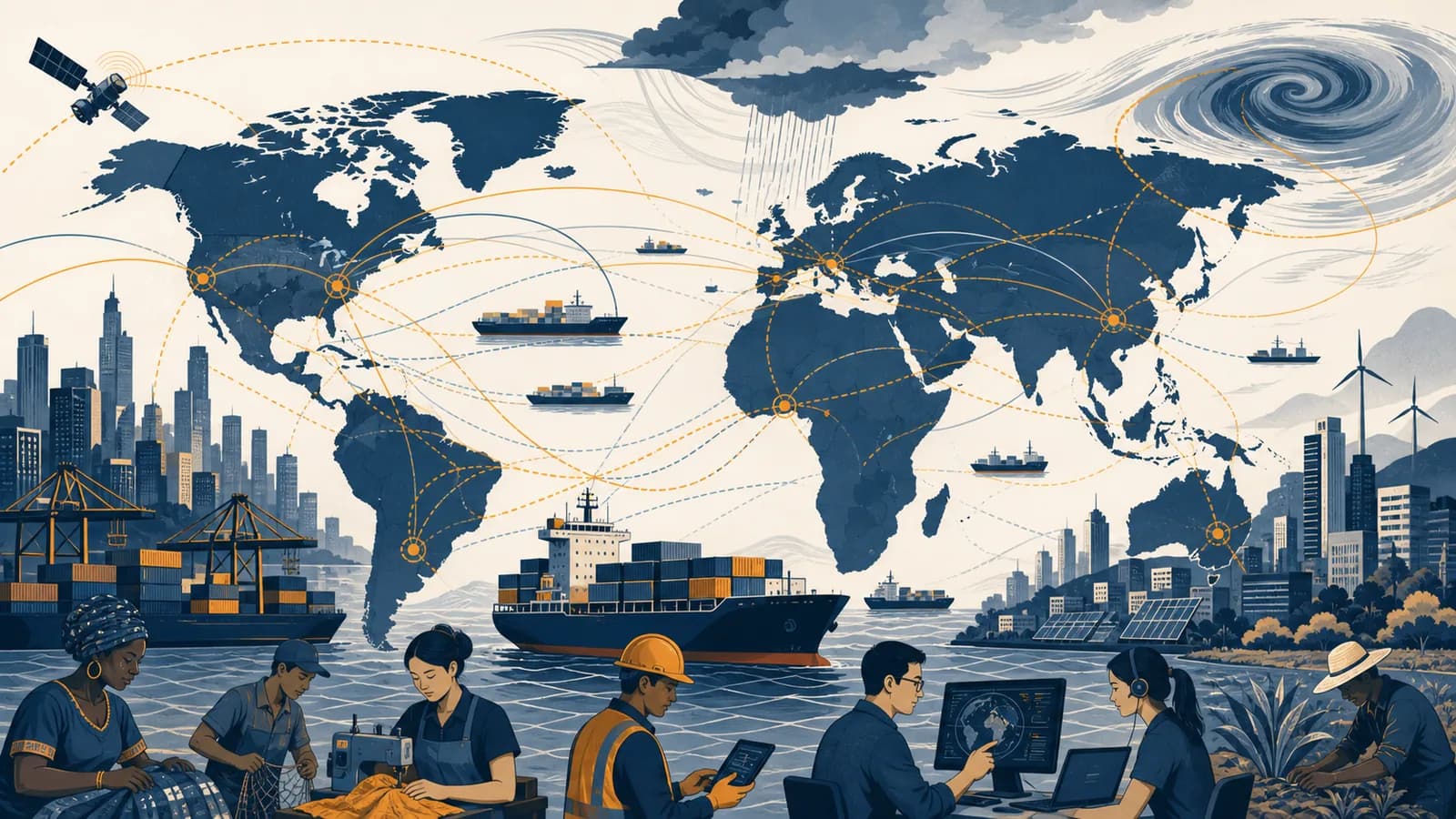
Globalization and modern challenges is a historical process that connects economies, governments, cultures, and people across borders, in the context of world history. A clear globalization definition must explain how global trade, migration, technology, finance, and international organizations make distant events affect local life. The process exists because people and institutions seek goods, labor, markets, security, knowledge, and influence beyond their own borders. Its benefits and costs are distributed unevenly, which is why globalization creates both cooperation and conflict. It also explains why climate change, pandemics, cyberattacks, supply chain disruptions, and financial crises cannot be understood within national borders alone.
A phone assembled in one country may contain minerals mined in another, chips designed in a third, software written across several time zones, and investment from pension funds around the world. One purchase can therefore connect a mine, a port, a bank, a patent office, and a household. Globalization is the system of relationships that makes those connections regular rather than exceptional.
What globalization actually is
Globalization is the growth of cross-border networks through which goods, money, people, information, rules, and environmental effects move. It changes history by making events in one place more likely to alter prices, jobs, laws, and choices somewhere else.
The word describes several linked processes, not a single policy. Economic globalization connects production, trade, investment, and finance. Political globalization creates agreements and institutions through which governments coordinate. Cultural globalization spreads languages, food, music, images, and habits. Technological globalization lowers the time and cost needed to send information or move cargo.
These processes reinforce one another. A cheaper shipping method makes international production easier. International production creates demand for common technical rules and faster payments. Those rules encourage more firms to buy and sell across borders. Workers then move toward new jobs, while films, recipes, and political ideas travel along the same communication routes.
Connection is not equality. Two countries can be tightly linked while having very different bargaining power, wages, legal protections, and exposure to risk.
Globalization also has a geographic pattern. Ports, financial centers, data cables, airports, border crossings, and industrial districts act as nodes. Routes between them carry different flows. A shipping lane carries containers; a fiber-optic cable carries data; a visa system regulates people; a banking network clears payments. Maps of these systems show why some places become hubs and others remain dependent on a small number of routes.
Historians ask who built each network, who set its rules, who gained access, and who paid the costs. Those questions prevent globalization from becoming a vague synonym for worldwide change.
How globalization works
Globalization works when technology reduces distance, institutions set shared rules, businesses divide production across places, and people respond through work, migration, consumption, or politics. Each connection creates feedback: more exchange produces pressure for more infrastructure, standards, and control.
The flow is not automatic. Governments decide which ships may enter, which products meet safety rules, which migrants may work, and which payments are lawful. Companies decide where to locate factories and store data. Workers bargain, move, organize, or retrain. Consumers change demand. A network grows only when enough of these decisions line up.
A faster ship, lower tariff, new road, trade treaty, or digital platform makes an exchange cheaper or legally possible.
Businesses place tasks where they expect the best mix of skill, cost, infrastructure, law, and access to customers.
Contracts, container sizes, accounting rules, product codes, and technical specifications let strangers combine work across borders.
A delay, strike, war, epidemic, sanction, or drought can interrupt the network, so firms and governments seek backups or tighter control.
Consider a bicycle company. It may design a frame near its main customers, buy aluminum made from imported ore, source gears from a specialist producer, assemble the bicycle near a port, insure the shipment through an international firm, and sell it online. Specialization can lower cost because each supplier repeats a task and develops skill and machinery for it. The same specialization also creates dependence. If one unusual gear is available from only one supplier, a small disruption can stop the whole assembly line.
Finance speeds the process. An importer may need credit before the goods arrive. Banks exchange currencies and check payment documents. Investors compare opportunities across countries. A change in interest rates or confidence can therefore move money rapidly, affecting exchange rates, borrowing costs, and employment far from the original decision.
Globalization versus international trade
International trade is the buying and selling of goods or services across borders; globalization is the wider system that also moves capital, people, information, production tasks, culture, and rules. Trade can occur without the deep integration associated with globalization.
A merchant in one country sells finished cloth to a buyer in another. The transaction crosses a border, but production may remain entirely domestic.
Design, finance, materials, assembly, advertising, software, and after-sales service occur in different countries under coordinated contracts and standards.
This distinction explains why a tariff on one imported product may not restore a complete domestic industry. A finished product is often the end of a chain of intermediate goods. A domestic factory may itself rely on imported tools, components, energy, or software. Raising the border cost of those inputs can make the local factory more expensive as well.
Globalization is also different from westernization. Western empires and firms have shaped many global systems, but cultural influence does not move in only one direction. Foods, religious practices, sports, music, political methods, and technologies are adopted and altered by people in many regions. A global form often becomes local in use.
Nor is globalization the same as cooperation. Countries can be connected through rivalry, debt, conquest, sanctions, espionage, or forced labor. A relationship may be global and deeply coercive. The history of oceanic exploration, conquest, and colonial rule shows how commercial networks were often built with military power and unequal law.
How did globalization develop over time?
Globalization developed in waves as states, empires, merchants, workers, and inventors built wider networks, then wars and crises broke or redirected them. No single starting date captures the process, because long-distance exchange existed long before the current global system.
Land and sea routes linked much of Africa, Asia, and Europe. Goods, beliefs, technologies, and diseases moved through chains of traders rather than one unified market.
Sustained contact joined the Americas to Afro-Eurasian networks. Crops, animals, pathogens, silver, settlers, and enslaved people crossed oceans under imperial power.
Steamships, railways, telegraphs, and mechanized factories increased the speed and volume of exchange while industrial empires seized territory and resources.
World wars, revolution, protectionism, and the Great Depression disrupted trade, migration, investment, and imperial systems.
Governments created new monetary, trade, security, and development arrangements while decolonization produced many newly independent states.
Container shipping, computing, satellites, aviation, and the internet made it easier to coordinate production and communication across long distances.
The timeline contains both exchange and violence. European conquest in the Americas connected ecosystems, but introduced diseases that devastated Indigenous communities. Atlantic plantation systems supplied global markets through enslaved labor. Industrial empires extracted raw materials and organized colonies around the needs of distant factories. These were mechanisms of integration, yet the terms were imposed.
The twentieth century shows that globalization can reverse. Before 1914, capital, migrants, and goods crossed many borders on a large scale. World War I shattered those networks. The interwar economic crisis encouraged protectionism and currency conflict. The historical setting in the causes and aftermath of the First World War helps explain why economic links did not prevent military conflict.
After World War II, governments tried to avoid another collapse in international economic coordination. The Bretton Woods conference of 1944 planned monetary institutions that became the International Monetary Fund and the World Bank. The General Agreement on Tariffs and Trade began in 1947. The World Trade Organization began in 1995 and incorporated an updated version of that agreement. These institutions did not create global exchange by themselves. They supplied forums, rules, loans, and dispute procedures that made some exchanges more predictable.
How global supply chains work
A global supply chain divides the creation and delivery of a product among suppliers in multiple countries. Lead firms coordinate specifications, contracts, schedules, transport, finance, and quality control, while each supplier contributes a material, component, service, or assembly task.
A product's value chain includes more than physical movement. Research, design, branding, patents, logistics, retail, repair, and data collection can generate value too. The company that owns a design or customer relationship may earn more than the factory that assembles the object, even if assembly is the most visible stage.
A fictional company sells a jacket for $100. The displayed price is not a $100 payment to the sewing factory. Suppose the retailer keeps $35 for stores, staff, returns, and profit; design and marketing receive $20; transport, insurance, and tariffs cost $10; fabric and zippers cost $20; cutting and sewing receive $10; and the remaining $5 covers administration. These assumed amounts add to $100 and show how a sale price can be split across tasks.
The arithmetic makes the example checkable. It also separates the retail price from the amount assigned to any single stage.
This is a transparent hypothetical, not a claim about the average clothing industry.
The example shows why the location of a factory does not reveal who controls the chain. Ownership of patents, platforms, financing, distribution, and customer data can determine bargaining power. Suppliers that perform standardized tasks may be easy to replace. A supplier with rare technical knowledge, specialized machinery, or access to a scarce material may negotiate better terms.
Efficiency often conflicts with resilience. A firm can reduce storage costs by receiving parts shortly before use. It can also concentrate orders with the cheapest supplier. Both decisions save money in ordinary conditions. During a port closure or conflict, the firm has little stock and few alternatives. Resilience measures include keeping larger inventories, approving backup suppliers, using more than one route, and designing products that accept substitute parts. Each measure usually adds cost.
| Supply chain choice | Ordinary advantage | Risk created | Possible response |
|---|---|---|---|
| Single specialized supplier | Consistent quality and lower coordination cost | One failure can stop production | Qualify a second supplier |
| Minimal inventory | Less money tied up in stock | Short disruption causes shortages | Hold safety stock for key parts |
| One shipping route | Simple schedules and contracts | Port or canal closure blocks delivery | Plan an alternate route |
| Lowest-cost location | Lower unit cost | Political, climate, or currency exposure | Spread production across regions |
Supply chain management is therefore historical thinking applied to operations. A manager studies past disruptions, maps dependencies, judges which risks can combine, and decides how much insurance is worth buying.
How globalization shows up in jobs, prices, and skills
Globalization changes work by altering which tasks can be traded, moved, automated, or performed remotely. It changes prices through competition and specialization, but wages and job security depend on bargaining power, training, location, law, and the speed of adjustment.
A factory worker may compete with imported products. An engineer may collaborate with a team abroad. A nurse may migrate to a country with higher pay, leaving a shortage at home. A farmer may gain access to export customers but face changing world prices. A video editor may sell services to clients without relocating. Each person meets a different part of the same system.
Trade can raise total income while still harming particular groups. Suppose opening trade allows two countries to specialize and produce more combined output. Consumers may pay less and exporting firms may hire. Yet a town built around an industry facing new import competition can lose jobs, tax revenue, local shops, and young residents. The national gain does not automatically compensate that town. Compensation requires policy, such as income support, retraining tied to real vacancies, transport, regional investment, or help moving. These measures are political choices.
Trade or investment increases total output, lowers some prices, or creates new jobs across an economy.
Which households gain, which lose, how quickly can workers adjust, and who pays for the transition?
Exchange rates provide another connection. If a country's currency becomes cheaper relative to others, its exports become cheaper for foreign buyers, all else equal. Imported goods become more expensive for domestic buyers. A weaker currency may help an exporter and hurt a shop that depends on imported stock. It can also raise the local cost of fuel, machinery, or medicines bought in foreign currency.
People meet globalization in job descriptions. Language ability, cross-cultural communication, logistics, cybersecurity, customs compliance, international accounting, translation, and supply chain analysis exist because organizations cross legal and geographic boundaries. A customs officer checks classifications and origin. A labor inspector examines workplace rules. A journalist traces the owners of a company. A procurement manager compares cost with political and environmental risk.
How globalization shows up in law, politics, and culture
Globalization does not remove governments; it changes the problems they must govern. States negotiate shared rules, compete for investment, police borders, regulate global firms, and answer voters whose jobs, identities, security, and environment are affected by cross-border flows.
International rules work through consent, pressure, and enforcement mechanisms. A treaty binds governments that join it under its terms. A trade agreement may permit a government to challenge another government's tariff. A court may have authority only where states have accepted its jurisdiction. A lender can attach conditions to a loan. A powerful market can influence foreign companies by requiring every product sold there to meet its standards.
National sovereignty therefore does not simply disappear. Governments pool authority when they expect cooperation to solve a problem they cannot manage alone. They can also reserve exceptions, refuse an agreement, or withdraw under specified rules. Their freedom is still constrained by consequences. Leaving a system may reduce outside control while raising costs for trade, travel, finance, or security.
The Cold War added another layer. The United States and Soviet Union organized rival alliances, aid programs, military networks, and economic relationships. Newly independent countries often faced pressure to choose sides, while some tried to remain nonaligned. The account of superpower rivalry, proxy conflict, and decolonization shows that global connection can divide the world into competing systems.
Culture moves through migrants, schools, tourism, religious networks, broadcasting, and online platforms. A cultural product rarely arrives unchanged. Audiences translate it, censor it, mix it with local forms, or reject it. Governments may promote a national language or subsidize domestic film. Communities abroad may preserve customs that change in their place of origin. Cultural globalization produces imitation, hybrid forms, and resistance at the same time.
Soft power is influence gained through attraction and credibility rather than direct payment or force. Universities, films, sports, public institutions, and foreign policy can all affect how a country is perceived.
Digital platforms concentrate private power. Their rules can determine which speech is visible, which seller reaches customers, and which data are collected. A government may regulate a platform, but users and servers can span many jurisdictions. This creates conflicts over privacy, taxation, competition, censorship, and national security.
How modern challenges cross borders
Modern challenges cross borders when their causes, effects, or solutions involve more than one jurisdiction. Climate change, pandemics, financial crises, cyberattacks, forced migration, organized crime, and supply shocks expose the gap between global systems and mainly national political authority.
Climate change is a collective action problem. Greenhouse gases mix in the atmosphere, so the climate effect does not remain inside the country where emissions occur. Every government can benefit from reductions made by others, while bearing the domestic cost of its own policies. This creates an incentive to delay or free ride. Agreements try to coordinate action, but countries disagree about historical responsibility, present capacity, development needs, and how costs should be shared.
Infectious disease follows movement networks. Air travel can carry an infected person across borders before symptoms become clear. A response may require local testing, national health systems, international reporting, research cooperation, manufacturing, and fair distribution of treatments. A weak link matters because an uncontrolled outbreak can seed cases elsewhere.
Financial contagion spreads through obligations and confidence. If one institution cannot pay its debts, lenders may fear that connected institutions are also unsafe. They reduce lending or sell assets. Falling prices damage other balance sheets, which can produce more selling. A local loss becomes a wider credit problem because institutions share counterparties and respond to the same signals.
Cybersecurity reveals the jurisdiction problem sharply. An attacker, server, victim, and payment service may each be in a different country. Investigators need evidence held under another legal system. Governments may disagree over what counts as crime, protest, espionage, or war. Technical connection is immediate; legal cooperation is slower.
Migration links opportunity and strain. People move for safety, family, education, or work. Destination countries may gain workers and skills, while origin countries receive remittances and diaspora connections. Origin countries can also lose trained staff. Destination communities may face pressure on housing or services when planning fails. Refugees have distinct legal claims from voluntary migrants, so treating every movement as one category hides important differences.
The pattern across these problems is a mismatch of scale. Markets, pathogens, emissions, data, and financial claims travel across borders. Most taxes, elections, police forces, and welfare systems remain national or local. Cooperation tries to bridge that mismatch, but cooperation itself raises questions about representation, enforcement, and fairness.
Does globalization erase national power?
Globalization limits some government choices but also gives states new tools. Governments still control law, taxation, public spending, citizenship, infrastructure, and much coercive force; their influence depends on state capacity, market size, alliances, resources, geography, and public trust.
A large consumer market can require foreign firms to follow its product rules. A small state may gain influence by joining a regional bloc. A government with effective tax administration can fund adjustment programs; a weaker one may offer investors concessions because it needs jobs and revenue. Globalization redistributes state power more often than it abolishes it.
Governments also create the infrastructure on which markets rely. Courts enforce contracts. Schools train workers. Ports and roads move goods. Central banks support payment systems. Customs agencies define legal entry. Calling a market global does not make it independent of public institutions.
Is globalization new?
Globalization is not wholly new, but its present speed, scale, density, and digital reach are historically distinctive. Earlier societies had long-distance trade and migration; newer systems can coordinate production, finance, information, and political reaction across continents almost immediately.
The best comparison measures a specific flow. Ask how long a message takes, how many borders a product crosses, how easily money moves, how large the participating population is, or how quickly a disruption spreads. The answer differs by period and region. A claim that globalization is either entirely ancient or entirely recent is too broad to test.
History also warns against assuming permanent expansion. The years after 1914 brought war, border controls, disrupted finance, and protectionism. Networks can shrink, split into rival blocs, or be redirected by policy and conflict.
Can deglobalization end global dependence?
Deglobalization can reduce selected cross-border flows, but ending global dependence is much harder. Governments and firms can relocate production, restrict investment, or build reserves, yet energy, minerals, climate, knowledge, disease, finance, and digital systems remain connected across borders.
Policy usually targets particular dependencies rather than all exchange. A country may support domestic medicine production, screen foreign investment in sensitive technology, or require multiple sources for energy. This is often called diversification, regionalization, reshoring, or strategic autonomy, depending on the method and political setting.
The trade-off can be tested. What failure is the policy meant to prevent? How likely is it? How costly would it be? Does the proposed backup actually use a different route, supplier, power source, or legal jurisdiction? Moving a factory closer does little if it still relies on the same single-source component.
Four mistakes people make with globalization
Most errors about globalization come from treating a complex historical system as a single force. Better analysis separates types of connection, identifies decision-makers, compares gains with losses, and traces cause through an actual network instead of assigning every change to openness.
1. Treating every global link as voluntary
Empires, slavery, unequal treaties, and military occupation created many cross-border networks through force. Even formally voluntary contracts can reflect large differences in bargaining power. Ask what alternatives each party possessed and which authority enforced the arrangement.
2. Assuming lower prices settle the argument
A cheaper product is a real benefit, especially for a household with little income. It does not answer questions about lost wages, unsafe work, pollution, tax avoidance, or dependence on one supplier. Good analysis keeps these effects visible and avoids pretending they share one simple unit of value.
3. Blaming globalization for every job loss
Trade can remove jobs, but technology, changing demand, business strategy, recession, exchange rates, and domestic policy can do so too. Evidence should identify the affected industry, timing, imports, productivity changes, and local labor market. A label is not a causal explanation.
4. Assuming connection produces peace
Economic ties can raise the cost of war, but they can also create fear about dependence, access, and vulnerability. Before 1914, European powers were economically connected and still fought. Leaders make political and military judgments; commerce influences those choices without controlling them.
The takeaway: Trace the flow, name the rule, identify the decision-maker, and compare who receives the benefit with who carries the risk.
Globalization makes world history visible in ordinary choices
Globalization connects large historical structures to daily evidence. A label, bill, job posting, news report, shipping delay, migration story, or privacy notice can reveal older systems of empire, industrialization, state-building, technological change, and international cooperation.
Try a source audit on one object you use. Read its country-of-origin label and identify the company that owns the brand. List its likely materials, transport needs, payment systems, data services, and legal standards. Then ask which part could fail without a substitute. The exercise turns a familiar object into a map of historical relationships.
News can be read in the same way. When a headline reports a tariff, sanction, strike, epidemic, currency fall, or shipping disruption, do not stop at the event. Trace the route through prices, contracts, jobs, government revenue, and household choices. Identify both the people able to change the rule and the people who must adapt to it.
This method connects globalization to the wider set of history explanations and case studies. History supplies the comparison that current debate often lacks: global systems were built by choices, they have changed direction before, and their costs have never been distributed automatically. The useful habit is to follow one connection far enough to see its machinery and its human consequences.