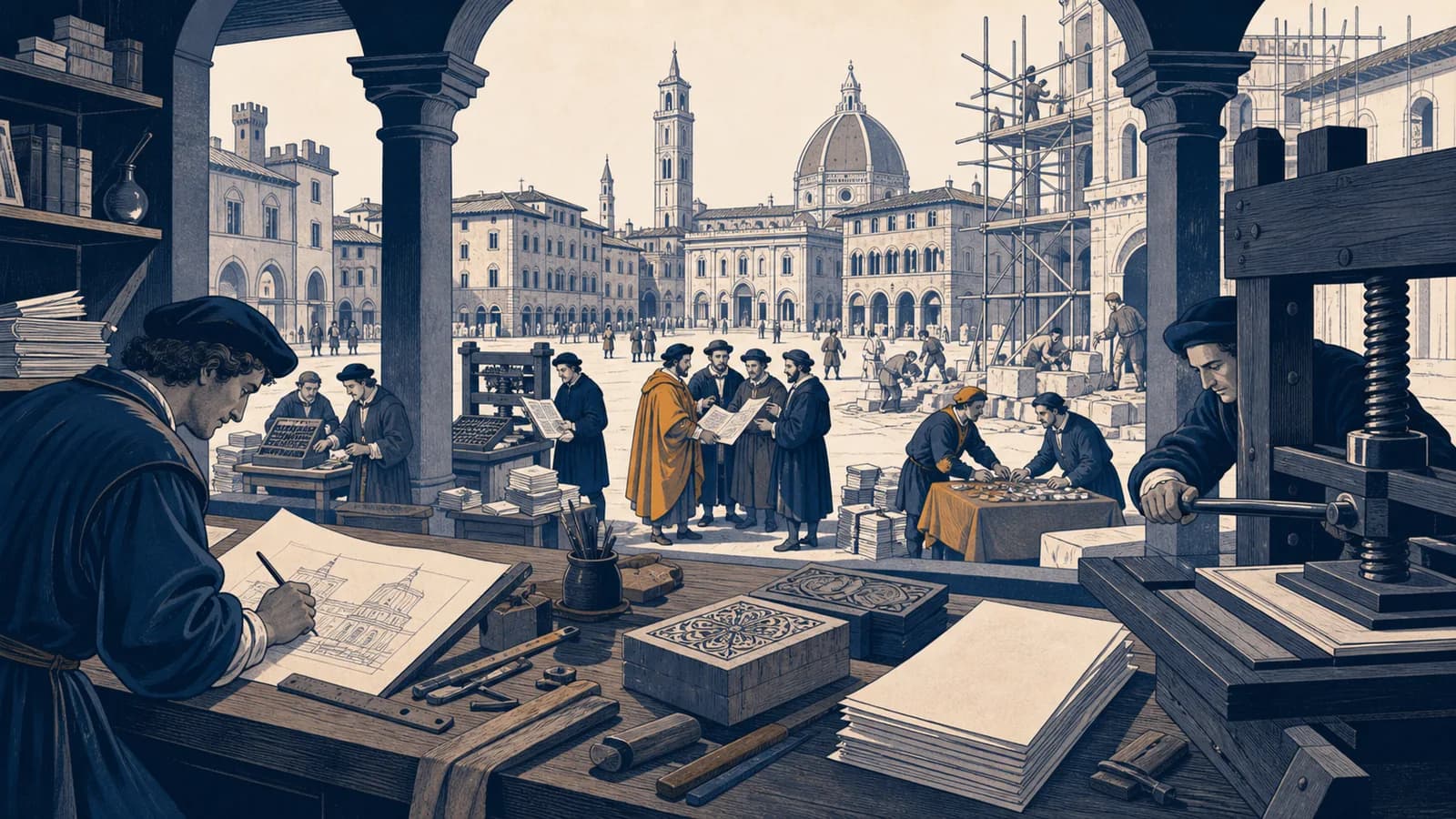
The Renaissance is a period of cultural and intellectual change that revived and reshaped classical learning, in the context of European history between the fourteenth and seventeenth centuries. The term means “rebirth” and answers a practical historical question: what was the Renaissance, when did it happen, and why did Renaissance humanism, art, science, trade, and politics develop together? Historians use the idea to connect changes that unfolded at different speeds across Europe. It exists as a period label because those changes shared people, texts, money, institutions, and methods, even though no single event started or ended them.
A Florentine merchant who paid for an altarpiece, a Venetian printer who produced a Latin classic, and a surveyor who measured a city wall took part in the same system. Wealth funded skilled work. Recovered texts supplied questions and models. Workshops turned ideas into objects. Courts, churches, markets, and schools decided which objects and ideas traveled.
What the Renaissance actually was
The Renaissance was a cluster of changes in learning, visual culture, political thought, and skilled practice, first especially visible in Italian cities and later adapted elsewhere in Europe. It was neither one event nor a complete replacement of medieval life.
The familiar dates are approximate. Italian developments associated with the Renaissance are often traced into the 1300s, while related movements north of the Alps became especially influential in the 1400s and 1500s. Some historians extend parts of the story into the 1600s. Dates vary because architecture, literature, painting, education, and government did not change on one schedule.
The word also describes a later interpretation. Italian writers portrayed their own age as a revival after cultural decline, and nineteenth-century historians helped establish “the Renaissance” as a named period. That label is useful only if it does not erase continuity. Renaissance scholars learned in medieval universities, artists worked for medieval institutions such as churches and guilds, and rulers inherited older forms of law and authority.
“Renaissance” means rebirth. It refers mainly to a claimed revival of Greek and Roman learning, not to the return of a lost civilization in unchanged form.
The revival produced new combinations. A Roman building could inspire a Christian church. An ancient lesson in rhetoric could train a diplomat serving a city republic. A Greek medical text could be printed, corrected, criticized, and eventually challenged through observation. Renaissance culture borrowed from the past in order to solve present problems.
These centuries are guideposts, not borders. A date is evidence only when it is attached to a specific change, place, and source.
How Renaissance humanism worked
Renaissance humanism worked by finding, comparing, editing, translating, and teaching ancient texts, especially works on language, history, ethics, and public life. Humanists treated precise reading and persuasive writing as skills that could improve education, government, and religious debate.
Humanism did not mean modern secular humanism, and it did not necessarily reject religion. Many humanists were committed Christians. Their distinctive method centered on the studia humanitatis, a course of study associated with grammar, rhetoric, poetry, history, and moral philosophy. The aim was to form people who could judge evidence, write clearly, speak effectively, and act in civic life.
Scholars searched monastic, cathedral, court, and private libraries for manuscripts, while Greek scholars and books moving west increased access to Greek works.
Hand-copied manuscripts contained missing lines, altered words, and accumulated errors. Comparing several copies helped an editor infer an earlier reading.
Vocabulary and grammar change over time. Humanists studied historical usage so that an old term would not be read through a later meaning.
Letters, schools, copied manuscripts, and then printed editions let corrections and arguments reach other readers.
Lorenzo Valla showed what this method could do. In the fifteenth century he analyzed the Latin of the Donation of Constantine, a document used to support papal claims to temporal power. Its vocabulary and style belonged to a later age than the document claimed, so Valla argued that it was a forgery. The case joins grammar to power: close reading changed what a political institution could plausibly cite as evidence.
A lawyer checking whether a contract clause was inserted later, or an archivist comparing versions of a speech, follows the same basic chain: identify the document, establish its date, compare copies, study word choice, and test the result against other evidence.
Humanism also shaped biography. Studying how historical figures are built from surviving evidence reveals why a famous name is not an explanation by itself. Letters, account books, drafts, objects, and hostile reports may show different versions of the same person.
The Renaissance versus the Middle Ages
The Renaissance and the Middle Ages are overlapping historical categories, not opposite civilizations. Renaissance culture developed from medieval trade, universities, religious institutions, and workshops, even as some writers claimed that they were restoring knowledge neglected by the centuries before them.
Medieval Europe forgot classical culture, then Renaissance thinkers rediscovered reason, realistic art, and individual achievement.
Classical texts remained in use, medieval scholars translated and debated ancient works, and artistic naturalism had medieval precedents. Renaissance creators changed the scale, setting, technique, and social uses of older resources.
The continuity is easy to see in institutions. Universities founded during the medieval period trained lawyers, physicians, and theologians who participated in later intellectual change. Banking methods and long-distance trade supplied credit and customers. Guild workshops trained painters, sculptors, metalworkers, and builders through apprenticeship. Churches remained among the largest patrons of art.
The difference often lies in emphasis and network effects. Italian humanists gave unusual prestige to classical Latin style. Patrons collected antiquities and commissioned buildings using columns, arches, domes, and proportional systems associated with Rome. Artists shared techniques for representing bodies and measured space. Print then multiplied texts and images more quickly than manuscript copying could.
A better comparison asks what changed, what continued, and for whom. The page on medieval institutions and everyday life supplies the earlier structures that Renaissance people inherited. Without those structures, the later changes look as if they appeared without causes.
That sentence is a rule for using any period label. Maps clarify patterns by simplifying them. Historians must then test the simplification against local evidence.
How patronage, workshops, and trade worked
Renaissance production worked through patronage and skilled workshops: a client supplied money, location, purpose, and constraints, while trained makers supplied designs, labor, materials, and technical judgment. Trade connected both sides to pigments, paper, books, credit, and wider markets.
A patron might be a pope, ruler, guild, confraternity, city government, monastery, prosperous merchant, or court official. Commissioning art could express devotion, decorate a civic building, preserve family memory, advertise status, or support a political claim. The contract might specify subject, size, materials, completion date, and price. Expensive blue pigment or gold leaf could be named because material carried meaning as well as cost.
The named master did not always make every visible mark. Workshops divided labor. Apprentices prepared panels and pigments, assistants copied designs or painted secondary passages, and a master handled the composition, difficult sections, negotiations, and quality control. Authorship therefore resembled a supervised studio more than the solitary-genius image common in popular culture.
Each arrow hides negotiation. A patron could reject a design. A workshop could substitute a material if supplies failed. Viewers could give a work meanings its buyer did not control. Successful objects brought more commissions, so reputation turned artistic decisions into economic opportunity.
Italian cities occupied valuable positions in Mediterranean and European commerce. Merchants used partnerships, credit, insurance, ledgers, and agents to manage risk across distance. That commercial wealth did not automatically cause great art. It created buyers, institutions, and logistical systems that could sustain specialists. Political competition among courts and cities added demand for impressive buildings, ceremonies, portraits, and gifts.
How printing changed the scale of the Renaissance
Printing with movable type changed the Renaissance by making many near-identical copies from one setting of type, lowering the labor needed for each additional copy and giving editors, printers, booksellers, teachers, and readers a larger shared field of texts.
Johannes Gutenberg’s mid-fifteenth-century work in Mainz combined movable metal type, oil-based ink, a press, and organized production into an effective European printing system. Printing existed earlier in East Asia, including woodblock printing and movable type. The European development belongs in a longer history of reproduction, not a story in which copying suddenly appeared.
Movable metal type and press production support long runs of consistent pages, including the Bible associated with his workshop.
Printers establish shops in other German cities and then in major European commercial and university centers.
Books, pamphlets, devotional works, classical editions, legal texts, and practical manuals circulate through linked markets.
Mechanically, a compositor arranged reusable pieces of type into lines and pages. After correction, workers inked the raised surfaces and pressed paper against them. The type could then be distributed and used for another work. Cutting and copying an entire page by hand still made sense for images, so printed books often combined type with woodcuts or engravings.
Print did not guarantee truth. It reproduced errors and propaganda as effectively as careful scholarship. It also did not end handwriting. Readers annotated printed pages, scholars exchanged manuscript letters, and officials kept handwritten records. Its main historical effect was to alter scale, speed, consistency, and the economics of copying. More readers could inspect the same wording, publish replies, and build on corrections.
Reproducible does not mean reliable. A printed claim still needs an author, date, intended audience, supporting evidence, and comparison with independent sources.
The same warning applies to a repost, scanned document, or viral chart. Cheap copying expands access and expands the reach of mistakes. Media literacy starts by separating the technology of distribution from the quality of the claim.
How Renaissance art made new claims about space and people
Renaissance art made new claims by joining observation, geometry, classical models, workshop knowledge, and patron demands. Artists used measured perspective, light, anatomy, pose, and architectural setting to make pictures persuasive, while images still served religious, civic, and political purposes.
Linear perspective is a method for projecting three-dimensional space onto a flat surface. In a basic one-point construction, parallel lines that recede directly away from the viewer appear to converge at one vanishing point on the horizon line. Objects are drawn smaller as their represented distance increases. The result is not simply “more realistic”; it organizes the scene for a particular viewing position.
If two equal objects stand at distances of 2 units and 4 units in this simplified model, the farther one appears half as tall.
The relation explains the visual effect, though a painter could construct it with drawn lines rather than algebra. Filippo Brunelleschi is traditionally associated with early fifteenth-century demonstrations of geometrical perspective in Florence. Leon Battista Alberti described a systematic method in his 1435 treatise on painting. Artists adapted the method instead of obeying it mechanically.
Knowledge of the body also came from several sources: living models, workshop patterns, ancient sculpture, medical traditions, and, for some artists, dissection. Greater anatomical study did not turn every picture into neutral science. A stretched pose could express grief. An idealized body could refer to antiquity or virtue. Portrait details could signal office, education, wealth, marriage, or family alliance.
Stand where the painted architecture seems most stable. Locate the horizon at the viewer’s eye level and follow receding floor tiles or ceiling beams toward a vanishing point. Then ask whose position the geometry assumes. Perspective can place the viewer inside a scene, below a ruler, or before a sacred event.
Museum conservators encounter the Renaissance as material work. Infrared imaging can reveal underdrawings beneath some painted surfaces. X-rays may show changes in dense pigments or metal supports. Pigment analysis can identify materials, while wood grain and panel construction can connect an object to regional workshop practice. No test alone gives an artist’s name. Attribution combines technical findings with documents, style, and provenance.
How Renaissance inquiry worked in science, engineering, and politics
Renaissance inquiry worked by combining inherited authorities with direct observation, mathematical description, instrument making, textual criticism, and practical experience. Its achievements helped prepare later scientific change, but Renaissance thinkers did not yet share one modern scientific method or institution.
Medicine shows the process clearly. Scholars read ancient authorities closely, but printed anatomical books let many readers compare the same claims and illustrations. Andreas Vesalius’s On the Fabric of the Human Body, published in 1543, used detailed anatomy to correct some errors inherited from Galen. Observation challenged authority at particular points; it did not erase everything ancient medicine taught.
In astronomy, Nicolaus Copernicus’s On the Revolutions, also published in 1543, presented a Sun-centered mathematical model. The model reorganized planetary motions but did not instantly persuade everyone or settle every physical question. Later observations and arguments were required. Historical change often works this way: a new model changes the problems that investigators must solve before it becomes a new consensus.
Engineering joined geometry to patronage and war. Architects had to estimate loads, organize labor, source stone and timber, and communicate designs. Military engineers surveyed ground and designed fortifications in response to artillery. Mapmakers combined measurements, reports, inherited geography, and political needs. A technically impressive map could still contain errors or serve conquest.
Political writers treated history as a source of cases. Niccolò Machiavelli examined how rulers gained, used, and lost power, especially in unstable Italian states. His work separated the description of effective political action from simple statements of moral ideals, though interpretations of his purpose remain disputed. Diplomats, secretaries, and ambassadors produced reports because governments needed current information about allies, rivals, finances, and armies.
A claim is accepted because an ancient writer, ruler, or institution states it.
A claim is compared with language, objects, measurements, observation, competing reports, and consequences. Respect for an old source can coexist with correction.
European states also funded oceanic voyages and claims to overseas territory. Cartography, navigation, finance, military force, and missionary goals became entangled with coercion and extraction. The account of how voyages became systems of colonization follows consequences that a celebratory “age of discovery” label hides.
How the Renaissance shows up in work and daily decisions
The Renaissance appears outside school whenever people authenticate documents, conserve objects, design visual space, study institutions, trace ownership, or judge copied information. Its methods survive as professional habits, while its objects and political myths shape museums, markets, cities, and media.
Archivists establish what a source is
Archival work begins before interpretation. A worker records origin, physical condition, sequence, handwriting, seals, later annotations, and links to related records. A letter attributed to a famous artist means little until its paper, ink, language, ownership history, and documentary context have been checked. Digital catalogues increase access, but the catalogue entry is itself an argument about identity and arrangement.
Conservators preserve evidence without pretending it is new
Conservation tries to stabilize an object while documenting treatment. Cleaning a painting can uncover color and detail, but removing later material may also erase evidence of use. Conservators test small areas, distinguish reversible from irreversible treatment, and record interventions so later specialists know which material belongs to the original object and which belongs to repair.
Designers direct attention with Renaissance tools
Architects, photographers, filmmakers, game designers, and illustrators still manage viewpoint, scale, light, proportion, and visual hierarchy. One-point perspective can make a corridor feel deep or force attention toward a product, doorway, or character. The technique carries a choice about where an imagined viewer stands.
Provenance researchers connect art, law, and money
Provenance is the documented chain of an object’s ownership and custody. Auction houses, museums, insurers, heirs, law-enforcement agencies, and buyers use it to test authenticity and lawful title. Gaps matter because an object may have been stolen, looted during war, exported illegally, or assigned an attractive history to raise its price. A confident label cannot replace records.
Citizens judge reproduction and persuasion
A social post and a printed pamphlet use different technologies, but both separate copying from verification. Ask who made the claim, who financed its circulation, what audience it targets, which emotion supports its message, and where its evidence can be checked. Renaissance rhetoric and print culture make information systems visible as systems of production.
Why the Renaissance began in Italian cities
The Renaissance became especially visible in Italian cities because urban wealth, Mediterranean trade, political competition, surviving Roman remains, strong craft traditions, and networks of courts, churches, schools, and merchants concentrated resources there. No single cause explains the pattern.
Florence, Venice, Milan, Rome, Naples, and other centers had different political structures and cultural markets. Florence’s guilds, banking families, republican offices, and workshops supported distinctive commissions. Venice’s maritime commerce and printing industry connected it widely. Rome drew papal resources into construction, scholarship, collecting, and art. Courts such as Mantua, Ferrara, and Urbino used culture to build prestige and diplomatic influence.
The fall of Constantinople to the Ottoman Empire in 1453 is sometimes presented as the event that brought Greek learning to Italy. Migration by Greek scholars did matter, especially for access to language and manuscripts, but Greek texts and teachers had already circulated westward. The date intensified an existing process rather than switching it on.
Competition helped patrons spend, but demand needed supply. Cities supported trained craftspeople, merchants who imported materials, notaries who wrote contracts, bankers who moved funds, and teachers who trained literate workers. The Renaissance formed through this connected infrastructure.
Use several causes at once. Wealth explains capacity, competition explains some demand, institutions organize work, and classical remains supply models. Each factor covers a different link in the chain.
How women experienced the Renaissance
Women experienced Renaissance change through family, work, religion, courts, workshops, writing, and patronage, but laws and customs restricted education, property control, officeholding, and professional recognition. Access differed sharply by class, place, marital status, and institutional setting.
Elite women could commission buildings and artworks, collect books, manage estates, conduct court diplomacy, or support writers. Isabella d’Este, Marchioness of Mantua, built cultural influence through collecting, commissions, correspondence, and political action. Her opportunities depended on rank and dynasty, so her life cannot stand for most women.
Women also worked in textiles, food production, retail, domestic service, agriculture, and family businesses. Some learned artistic practice in a father’s workshop or through a court connection. Sofonisba Anguissola developed an international reputation as a painter in the sixteenth century and worked at the Spanish court. Barriers to studying anatomy, entering guild structures, signing work, or receiving public commissions narrowed many women’s routes into professional art.
Convents could restrict freedom and also create communities of literacy, music, administration, and artistic production. Marriage contracts, dowries, wills, court cases, household accounts, devotional objects, and letters help reconstruct women’s experiences. The archive is uneven because institutions preserved some voices more carefully than others.
How Renaissance connections reached beyond Europe
Renaissance Europe was connected to Africa, Asia, and the Islamic world through trade, diplomacy, migration, warfare, translation, and empire. Materials and knowledge crossed borders, but exchange happened under unequal conditions and cannot be reduced to Europe simply collecting useful ideas.
European scholars inherited Greek philosophy partly through Arabic translations, commentaries, and scientific traditions developed across Islamic societies. Mathematical knowledge associated with India and transmitted through Arabic scholarship supported calculation. Mediterranean trade brought paper, pigments, textiles, ceramics, metal goods, spices, and luxury objects into European markets. Ottoman political and commercial power shaped European diplomacy, warfare, maps, and travel writing.
A Renaissance painting was therefore local and connected. Its ultramarine pigment might be made from lapis lazuli mined in Afghanistan and transported through long trade chains. Its cotton paper, metal compounds, textile patterns, or depicted luxury goods could carry other histories. Following a material backward turns style into economic geography.
After 1492, sustained European colonization of the Americas created violent new systems of conquest, forced labor, conversion, biological exchange, and extraction. European books and maps absorbed information gathered from Indigenous knowledge while often subordinating or misrepresenting Indigenous people. Atlantic slavery expanded within this changing commercial world. These developments are related to the Renaissance period, but they should not be treated as a triumphant extension of cultural rebirth.
Choose a blue cloak in an Italian altarpiece. Trace the mineral source of its pigment, the merchants who carried it, the workshop that ground it, the patron who paid for it, and the religious meaning assigned to the color. The object becomes a record of geology, labor, trade, price, and belief.
Those connected histories lead toward the longer history of global interdependence and its costs. The scale changes, but the questions remain recognizable: who controls movement, who receives credit, who bears risk, and whose records survive?
Four mistakes people make with the Renaissance
Four common mistakes distort the Renaissance: treating it as a sudden awakening, reducing it to famous geniuses, calling it purely secular, and presenting European expansion as innocent discovery. Each mistake removes the institutions and unequal relationships that made change possible.
1. Calling it a sudden break with a “dark” Middle Ages
This mistake treats period names as verdicts on whole societies. It hides medieval universities, translations, craft knowledge, trade, theology, literature, and artistic experimentation. Fix it by naming a precise continuity and a precise change. For example, churches continued to commission art, while new systems of perspective altered how some artists constructed pictorial space.
2. Explaining everything through isolated genius
Leonardo da Vinci and Michelangelo were extraordinary practitioners, but neither worked outside material systems. Paper makers, miners, quarry workers, apprentices, model makers, accountants, patrons, and messengers supported cultural production. Fix the mistake by tracing one work through its contract, materials, workshop labor, location, audience, and later reputation.
3. Assuming humanism replaced religion
Humanist education could serve Christian scholarship, preaching, church administration, or reform. Classical themes and Christian purposes often appeared together. Fix the mistake by asking what a scholar did with an ancient source, rather than sorting every thinker into “religious” or “secular” boxes before reading the evidence.
4. Treating exploration as a neutral spread of knowledge
Maps, navigation, and natural description produced knowledge, but ships also carried soldiers, settlers, enslaved people, missionaries, and claims of sovereignty. Fix the mistake by placing each voyage inside systems of finance, force, law, disease, extraction, and Indigenous resistance. Knowledge and power traveled together.
The takeaway: Explain a Renaissance change as a chain of people, institutions, materials, methods, and consequences. A name or invention starts the investigation; it does not finish it.
The Renaissance makes history visible as an evidence problem
The Renaissance shows how historians turn surviving texts, objects, buildings, and records into explanations. Its famous works matter, but the strongest history connects them to workshops, trade, belief, law, political authority, and the people whose labor received less recognition.
When you next see a Renaissance portrait, printed page, dome, map, or claim about a “genius,” slow the object down. Identify its maker and buyer. Follow its materials. Ask where it stood, who could use it, and what alternative evidence could challenge its story. That procedure turns admiration into historical analysis.
The same habit applies across the wider study of historical causes and evidence. Periods become useful when they organize questions without deciding the answers in advance. The Renaissance is not a simple victory of light over darkness. It is a test case in how knowledge is recovered, remade, financed, circulated, and used.