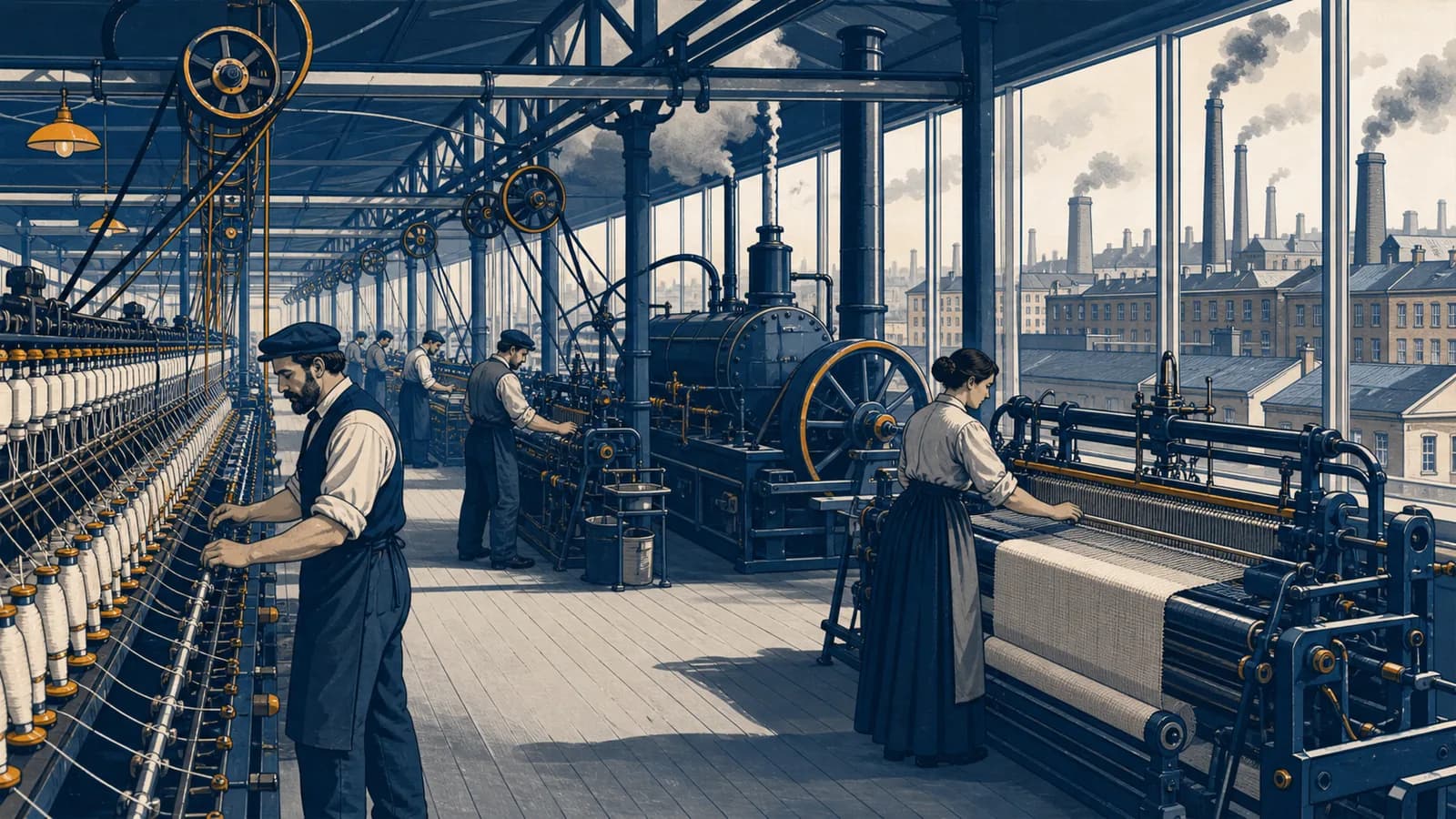
The Industrial Revolution is a long economic and social transformation that shifts production from hand tools and small workshops toward machine-powered manufacturing, in the context of industrializing societies. It began in Britain in the mid eighteenth century, then spread unevenly worldwide. The common questions, what was the Industrial Revolution, when did it start, and what were its causes and effects, all concern the same change: new energy sources, machines, factories, transport, capital, and labor reinforced one another. People built this system to make growing quantities of goods more cheaply and reliably, while merchants and states sought larger markets and power.
What the Industrial Revolution actually was
The Industrial Revolution was not one invention or a sudden break. It was a linked change in energy, production, transport, finance, work, and settlement that began in eighteenth-century Britain and turned industrial growth into a continuing process.
Before industrialization, most manufactured goods came from households, farms, and small workshops. A merchant might supply wool or cotton to families, who spun and wove it at home. Waterwheels powered some mills, mines supplied coal, and skilled artisans used specialized tools. Markets already stretched across oceans. The change was therefore not from a motionless rural past to instant machinery. It was from systems limited by local energy, variable hand labor, and slow transport to systems able to concentrate workers and machines, increase output, and repeat the process elsewhere.
This flow could feed itself. A mill owner invested profits in more spindles. Greater output reduced the cost of each piece of cloth. Lower prices widened the customer base. A larger market then justified a bigger mill, provided the owner could obtain raw cotton, fuel, labor, credit, and transport. The cycle was powerful, but it was never automatic. Failed firms, war, bad harvests, worker protest, and financial panic could interrupt it.
Historians use the word revolution because the accumulated changes altered how societies produced wealth and organized daily life. The process took generations, and older forms of work survived beside factories. A handloom weaver and a steam-powered mill could compete in the same district. The transition was revolutionary in its consequences, not because everything changed on one morning.
How the factory system worked
The factory system worked by bringing power, machines, raw materials, managers, and workers into one controlled site. Owners divided production into timed tasks, supervised quality and attendance, and used expensive equipment for more hours than a household normally could.
An owner or partnership paid for a building, machines, power equipment, raw material, wages, and credit before finished goods brought revenue.
A waterwheel or steam engine drove shafts and belts connected to many machines. One power source could therefore serve an entire room.
Instead of one artisan making a whole product, workers tended particular stages such as carding, spinning, weaving, checking, or packing.
Bells, clocks, overlookers, fines, and wage records coordinated people with machines whose value depended on regular operation.
Merchants moved output to domestic and overseas buyers. Successful owners used part of the return to expand capacity or adopt newer equipment.
A cotton mill makes the mechanism concrete. Raw cotton first had to be cleaned and carded so that its fibers lay in a workable direction. Spinning machines pulled and twisted the fibers into yarn. Looms crossed that yarn into cloth. Each stage had to supply the next at a useful rate. If spinning accelerated but weaving did not, yarn accumulated and capital sat idle. Factory management was partly the art of removing such bottlenecks.
A mill has 20 looms, and each loom can use 5 spools of yarn during a shift. The spinning room must supply spools per shift. If it supplies only 80, one fifth of the loom capacity cannot be used. The owner may add spinning machines, slow the looms, buy yarn, or accept lost output.
The example also shows why machinery did not remove the need for judgment. Engineers maintained power systems, mechanics repaired moving parts, clerks tracked orders, and workers learned the sound and feel of equipment. Machines changed skill. They reduced the market value of some craft knowledge while creating demand for other technical and administrative abilities.
How coal, steam, and machinery worked together
Coal supplied concentrated heat, steam engines converted heat into controlled motion, and machinery applied that motion to pumping, turning, lifting, spinning, and transport. Their interaction loosened production from the limits of muscle, wind, flowing water, and nearby forests.
Britain had used coal long before factories. The mining problem was water. As miners followed seams deeper underground, water entered the workings and limited access. Thomas Newcomen's atmospheric engine, first used in 1712, pumped water by creating a pressure difference. It consumed much fuel, but coal at a mine could be cheap enough to make pumping worthwhile.
James Watt patented a separate condenser in 1769. In older engines, repeatedly heating and cooling the same cylinder wasted energy. Watt's design condensed steam in a separate vessel, so the main cylinder stayed hot. Later arrangements delivered rotary motion suited to factory machinery. This was a chain of improvements involving inventors, iron founders, skilled builders, investors, and users, not a lone flash of genius.
If an engine receives 1,000 units of heat and produces 80 units of useful motion, its efficiency is . The remaining energy is not destroyed; it leaves mainly as unused heat.
The numbers in the worked example are illustrative, but the relation explains the business pressure. A more efficient engine could do the same work with less coal, or more work with the same coal. That mattered especially where fuel had to be transported. Better boring of cylinders, stronger iron, improved valves, and higher pressure also expanded what steam power could do.
Energy changed location. A water-powered mill had to stand beside a suitable stream. A steam-powered mill could operate where owners could bring in coal and water, often closer to workers, ports, canals, railways, and customers.
Coal also fueled iron production. Iron rails, boilers, beams, gears, tools, and engines then supported coal mining and steam power. This mutual demand linked sectors. A better pump made deeper mining possible. More coal supplied ironworks and engines. Cheaper iron made more machinery and rails possible. Industrialization advanced through these connections.
How transport and markets enlarged production
Transport networks enlarged industrial production by cutting the time, cost, and uncertainty of moving bulky inputs and finished goods. Canals, improved roads, steamships, and railways connected mines, factories, ports, farms, cities, and overseas customers into larger markets.
A factory needed more than a machine. Cotton mills needed regular shipments of raw fiber. Ironworks needed coal and ore. Growing cities needed food. If a canal could move heavy loads more cheaply than carts on poor roads, it changed which mines and factories could compete. Railways later added speed, scheduled service, and routes that did not follow navigable rivers.
The canal linked the Duke of Bridgewater's coal mines at Worsley with Manchester, showing how dedicated transport could serve an expanding industrial town.
The line used steam locomotives for freight and carried passengers, helping demonstrate a new transport system.
It connected a major port with a manufacturing center and operated scheduled steam services along the route.
Held in London's Crystal Palace, it presented machinery and manufactured products to an international public.
Markets were already international before steam railways. European empires had built shipping routes, commercial law, ports, plantations, and coercive labor systems. British textile production depended heavily on raw cotton grown by enslaved people in the United States before the American Civil War. Industrial growth and Atlantic slavery were distinct institutions, but they were economically connected through cotton, credit, insurance, and trade.
Those connections grew out of an earlier history. The account of how overseas conquest built trading networks and coerced labor systems explains why industrial markets cannot be understood only by looking inside British factories.
The First Industrial Revolution versus the Second Industrial Revolution
The First Industrial Revolution centered on textiles, coal, steam, iron, and factory organization, while the Second Industrial Revolution expanded steel, chemicals, electrical systems, petroleum, and mass production. The periods overlap, and historians use their boundaries as guides rather than fixed natural divisions.
Usually associated with Britain from the later eighteenth century into the early nineteenth century. Cotton machinery, steam engines, coal mining, ironworking, canals, and early railways formed its best known cluster.
Usually associated with the later nineteenth and early twentieth centuries. Steelmaking, electricity, synthetic chemicals, oil, telegraph and telephone networks, and standardized mass production expanded industrial capacity.
The distinction helps because industrial technology changed its material base. Iron rails could wear and deform under heavy traffic; mass-produced steel offered new combinations of strength and cost. Electricity could transmit power through wires and drive individual motors, so a factory no longer needed every machine connected to one central shaft. Chemical industries created dyes, fertilizers, and new processes on a large scale.
Still, the second phase did not replace the first. Coal continued to power steam engines. Textile mills remained important. Older machines operated beside electrical equipment. Different regions entered industrial growth through different sectors and at different times. Germany became a leader in chemicals and electrical engineering, while the United States combined abundant resources, a large internal market, corporate organization, and mass production.
Industrial capacity also altered the balance between states. Railways moved armies and supplies, steel built weapons and ships, and factories sustained prolonged war. The connection becomes visible in how mass industry reshaped World War I and its aftermath, where production, shipping, food, fuel, and labor were as significant as battlefield tactics.
How industrialization showed up in jobs, cities, and households
Industrialization changed daily life by moving many workers toward wage labor, drawing populations into fast-growing towns, altering family schedules, and surrounding households with cheaper manufactured goods. Its effects differed by occupation, gender, age, income, region, and phase of development.
Wage labor meant that more families depended on cash earned under an employer's rules. Household production did not disappear, and farming remained central for many people. Yet factory time differed from task-based work. A farm task followed weather and season. A powered mill coordinated hundreds of workers around machines, shifts, and delivery schedules. Being several minutes late could stop a production stage or bring a fine.
| Part of daily life | Typical industrial change | What a household noticed |
|---|---|---|
| Working time | Bells, clocks, shifts, supervisors, and machine pace | Less control over the start, speed, and end of a working day |
| Urban space | Dense housing near mills, workshops, transport, and markets | Shorter access to jobs, but often crowding and poor sanitation |
| Household income | Greater dependence on cash wages | Rent, food, fuel, clothing, and debt had to be covered through money income |
| Consumer goods | More standardized textiles, tools, utensils, and printed material | Some manufactured products became easier to obtain |
Rapid urban growth often outran drainage, clean water, housing, and waste removal. Overcrowded dwellings and polluted supplies helped diseases spread. Smoke and industrial waste damaged air and waterways. Municipal responses came slowly through sewers, waterworks, building rules, street improvement, sanitation, and public health administration. These projects show that a city is also a technical system, and population density exposes failures quickly.
Households gained access to goods that had once been expensive, but cheap goods did not guarantee a comfortable life. A family's position depended on wages, prices, rent, employment stability, illness, and the number of earners and dependents. Women and children worked in factories, mines, workshops, domestic service, agriculture, and home production. Industrial work could bring income while also imposing long hours, injury risk, and employer control.
A family comparing two jobs cannot judge by the weekly wage alone. One mill may pay more but require a longer walk, irregular layoffs, and purchases at higher town prices. The real comparison includes travel time, rent, food, injury risk, job stability, and which household member must give up other work.
The same method applies now. A salary is only one part of a job's value. Schedule control, commuting, safety, training, housing cost, and bargaining power shape what the wage can buy and what the work demands.
How workers, owners, and governments contested industrial rules
Industrial rules emerged through conflict among workers seeking security and control, owners defending property and profit, and governments balancing order, production, and reform. Trade unions, strikes, machine breaking, petitions, elections, investigations, and factory laws all shaped the settlement.
Workers did not simply accept machines or reject progress. Their actions depended on who owned a machine, what job it displaced, how wages were set, and whether workers had a voice. The Luddites of the 1810s attacked selected machines and property in English textile districts. Their targets were tied to labor disputes and changes in production, not a general fear of every technology.
Machine breaking was an irrational attempt to stop invention because workers did not understand technology.
Workers understood that machinery could change wages, skill, hiring, product quality, and bargaining power. Destroying equipment was one forceful tactic within a wider dispute over who controlled those changes.
Parliament gradually regulated some conditions. The Factory Act of 1833 restricted children's work in textile factories, required some schooling, and created a system of factory inspectors. The Mines and Collieries Act of 1842 barred women and girls, and boys under ten, from underground mine work. Such laws could be narrow, unevenly enforced, and shaped by contemporary ideas about gender and childhood. They still marked an important shift toward state responsibility for workplace conditions.
Unions tried to turn many separate employees into a negotiating body. Collective action could make it harder for an employer to replace one protester or cut one person's wage. Employers could respond with lockouts, dismissal, blacklists, or replacement labor. Governments sometimes treated worker organization as a threat to property and public order. Labor rights grew through repeated organization and political struggle, not as an automatic reward of industrial wealth.
Four mistakes people make with the Industrial Revolution
Four mistakes distort the Industrial Revolution: treating it as a single date, crediting isolated inventors, assuming machines automatically improved life, and describing Britain as a closed system. Correcting them reveals a gradual, collective, contested, and international transformation.
1. It happened all at once
Industrialization had no universal start day. An invention could exist for years before firms adopted it widely. A region might have mechanized cotton mills while nearby farming and craft production continued much as before. Dates such as 1769 or 1830 identify important developments, not the moment an entire society became industrial.
2. A few famous inventors caused everything
Named inventors matter, but inventions depended on accumulated knowledge, skilled labor, materials, finance, patents, customers, and repair networks. A useful device also had to survive real conditions and fit other parts of production. Watt's engine mattered partly because builders could make accurate components and businesses could find profitable applications.
3. More output meant immediate progress for everyone
Output can rise while working conditions remain dangerous and gains go mainly to owners or consumers. Over longer periods, industrial economies could support higher incomes, public works, and broader consumption. The timing and distribution of benefits depended on productivity, prices, public health, labor organization, political rights, and law.
4. Britain industrialized using only British resources
Britain had domestic coal, capital, skills, institutions, and a large commercial economy, but it was tied to overseas land, labor, trade, and empire. Cotton is the clearest case. A British mill's machines stood in Lancashire, while much of its fiber came from plantations across the Atlantic. The unit of analysis must be wider than the factory wall.
Did the Industrial Revolution improve ordinary life?
The Industrial Revolution eventually expanded productive capacity and access to goods, but its early gains were unequal and often accompanied by harsh work, polluted cities, disease, and insecurity. Any answer must specify the people, place, measure, and period being compared.
Consider two measures. Real income asks what wages can buy after prices are considered. Life expectancy reflects mortality but can be heavily affected by infant deaths, epidemics, sanitation, and migration. These measures may move differently. A worker might afford more cloth while living beside contaminated water. A national average might rise while one industrial district suffers.
Averages hide distribution. If an economy produces more but most new income goes to a small group, total output and ordinary living standards tell different stories. Ask who gained, who paid, and over what interval.
Industrialization did create the capacity to make abundant goods and fund large infrastructure. It also concentrated workers who could organize, newspapers that could expose conditions, and governments with increasing administrative reach. Reform was not built into the machine. Political action determined whether productive gains supported safer workplaces, sanitation, education, shorter hours, or only larger returns to owners.
A sound historical judgment therefore compares alternatives, not industrial life with an imaginary pleasant countryside. Preindustrial life included exhausting labor, disease, poor harvests, dangerous crafts, and deep inequality. The question is how risks and opportunities changed, which groups could respond, and why improvement came earlier in some places than others.
Why did industrialization begin in Britain?
Industrialization began in Britain because several favorable conditions interacted: accessible coal, commercial agriculture, skilled production, investment capital, expanding markets, transport networks, state institutions, and imperial trade. No single condition was sufficient, and historians continue to debate their relative weight.
Coal was useful because Britain had deposits that could serve major settlements and industries, but coal alone explains little. Many places possess resources without industrializing first. British producers also faced incentives to substitute machinery and fuel for labor in certain activities. Inventors and firms could draw on metalworking skill, scientific practice, workshops, credit, patents, and customers.
Agricultural change increased market production and helped support a growing nonfarm population. Enclosure changed landholding and access, benefiting some owners while displacing or pressuring some smaller cultivators and common users. Urban demand encouraged commercial farming. Workers moved for many reasons, including wages, family strategies, loss of rural opportunities, and population growth.
Political and financial institutions helped people pool capital, insure ships and cargoes, enforce contracts, and fund trade and war. Empire gave British merchants access to markets and raw materials through relationships marked by coercion and unequal power. Explanations that list only domestic inventions miss these global inputs. Explanations that name only empire miss the specific engineering, energy, wage, and institutional conditions that turned trade into mechanized production.
This sentence is a synthesis, not a quotation from a historical figure. Its value is diagnostic. If an explanation names one cause, test the missing connections. Coal without engines is fuel in the ground. An engine without customers is an expense. A market without transport may remain local. The causes worked as a system.
When did the Industrial Revolution end?
The Industrial Revolution has no universally accepted end date because industrialization continued in new sectors and regions. Historians often close its first phase in the early or mid nineteenth century, then describe later changes as a Second Industrial Revolution.
Period labels serve questions. A study of British cotton, coal, and steam may focus on roughly the later eighteenth and early nineteenth centuries. A study of steel, electricity, chemicals, and mass production extends into the decades around 1900. A global study must account for Japan's rapid industrial development after the Meiji Restoration of 1868 and later industrialization elsewhere.
The word end can also mislead because industrialization remains an active process. Regions still shift workers among agriculture, manufacturing, and services. Firms still reorganize production around new energy and communication systems. The original British transformation ended as a distinct historical episode, but the economic mechanism of investment, mechanization, scale, and market expansion did not.
Where can the Industrial Revolution still be seen?
The Industrial Revolution remains visible in railway corridors, canals, brick mills, workers' housing, port districts, polluted land, company records, time discipline, labor law, and global supply chains. Physical remains and ordinary routines preserve different parts of the same system.
An old mill building can reveal more than architectural taste. Multiple floors may have placed machines close to vertical power shafts. Large windows supplied daylight before electric lighting. A nearby river may have provided power, process water, or transport. Rows of compact housing show how employers and builders placed labor near the workplace. Canal cuts and railway viaducts record the effort required to move mass freight.
Documents expose relationships that bricks cannot. Wage books show occupations and pay differences. Accident reports show danger and official priorities. Advertisements reveal products and customers. Census records reveal household structure and migration. Parliamentary testimony must be read carefully because witnesses had motives and investigators chose questions, but it can preserve voices and details missing from company accounts.
Choose a former industrial site near you, or examine one through a map and digital archive. Locate its power source, transport link, worker housing, raw material route, and market. Then ask which part of the system would fail first if one connection disappeared.
Modern distribution centers and app-managed work also make factory logic recognizable. Managers break a process into measurable tasks, coordinate people with equipment, and track time and output. The technology differs, but questions about surveillance, bargaining power, injury, skill, and who receives productivity gains remain familiar.
Industrialization changed history by connecting systems
Industrialization changed history because machines became powerful when connected to energy, finance, labor, transport, law, and markets. Studying those connections explains both rising production and the conflicts over health, wealth, empire, work, and the environment that followed.
This is also a method for studying the subject. Do not stop at the inventor and invention. Trace the raw material backward, the finished product outward, the energy source downward, and the money through the firm. Identify who set the rules, who carried the risk, and who could challenge the arrangement. The same questions help connect this topic with the wider set of history guides.
The Industrial Revolution left no single balance sheet. It increased humanity's ability to transform matter and move goods, while multiplying demand for fuel and raw materials. It made some products common and some fortunes immense. It also created industrial hazards, new forms of dependence, and organized movements capable of contesting them.
The takeaway: Look for the system around the machine. The most useful evidence is often the connection between a technical change and a new rule, route, job, cost, or source of power.
Next time you see a railway cutting, a clocked shift, a cheap standardized product, or a debate about automation, identify the industrial logic inside it. Ask what input is being concentrated, which task is being reorganized, what bottleneck has moved, and who gains control. That habit turns the Industrial Revolution from a list of inventions into an explanation of historical change.