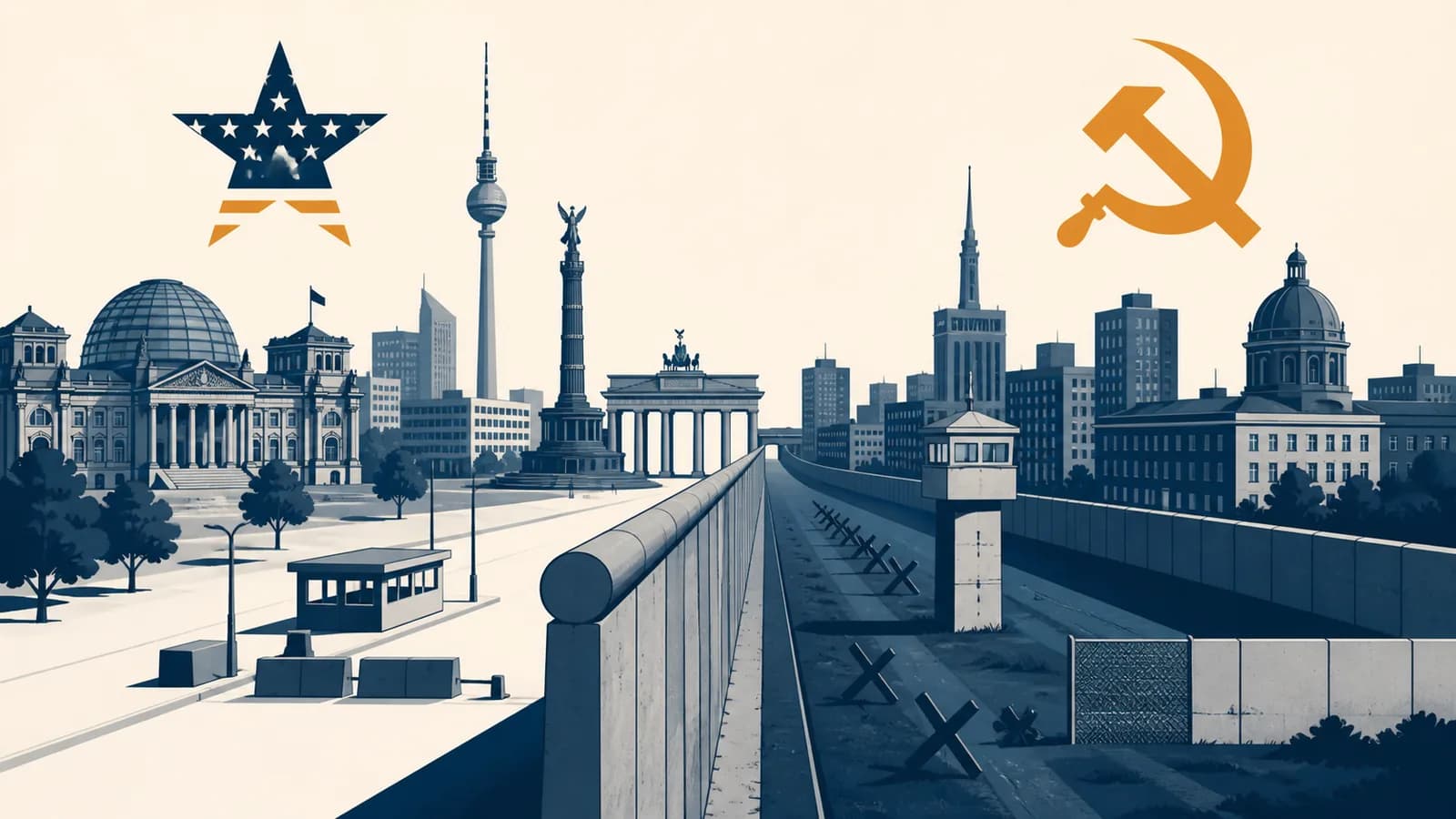
The Cold War is a global political and military rivalry that organized international power around competition between the United States and the Soviet Union, in the context of the postwar world. Usually dated from 1945 to 1991, the Cold War grew from disputes over security, ideology, and influence after World War II. Its causes, timeline, countries, arms race, proxy wars, and end explain why capitalism and communism became tied to a worldwide struggle. The rivalry existed because each superpower tried to protect itself and shape the international order without starting a direct nuclear war that could destroy both.
What the Cold War actually was
The Cold War was a sustained contest in which the United States, the Soviet Union, and their allies used military alliances, economic aid, propaganda, espionage, technology, and local wars to gain security and influence while avoiding direct war between the two superpowers.
The word cold distinguishes this rivalry from a direct shooting war between American and Soviet armies. The conflict was not peaceful. Millions of people fought or suffered in Korea, Vietnam, Afghanistan, Angola, and other battlegrounds. Governments were overthrown, borders were fortified, and nuclear weapons could be launched on short notice. It stayed cold only at the superpower level.
The United States led a bloc whose governments generally defended private ownership, market economies, and multiparty elections, although it also supported anti-communist dictatorships. The Soviet Union led a bloc built around communist party rule, state-directed economies, and governments aligned with Moscow. Neither side consistently lived up to the ideals it advertised. That gap between claims and conduct is evidence, not a side issue.
Capitalism and communism fought because their ideas were opposites.
Ideology shaped the rivalry, but military security, economic power, wartime damage, control of territory, domestic politics, and mutual fear also drove decisions.
The Cold War emerged from World War II. Germany and Japan had been defeated, European empires were weakened, and the United States and Soviet Union possessed unmatched military power. They had cooperated against Nazi Germany, but their alliance had rested on a shared enemy. Their incompatible plans for postwar Europe became visible once that enemy disappeared. The division makes more sense beside the causes and consequences of World War II and the Holocaust, because the armies, borders, and destroyed economies of 1945 set the starting conditions.
How the conflict grew out of the postwar settlement
The conflict grew as Soviet control of Eastern Europe met American efforts to build an open trading system and politically independent states. Each government treated its own moves as defensive and the other side's moves as expansion, creating a cycle of suspicion.
The Soviet Union had suffered invasion through Eastern Europe more than once, most recently in the war against Nazi Germany. Joseph Stalin wanted friendly governments along the Soviet Union's western border. Soviet-backed communist parties took control across much of Eastern Europe, often suppressing rivals rather than winning power through free competition. To Moscow, this belt of states was a security zone. To Washington and many Europeans, it looked like conquest.
American leaders wanted governments able to choose their own systems, access to overseas markets, and a Europe prosperous enough to avoid political collapse. In 1947, President Harry Truman asked Congress to support Greece and Turkey against pressure from communist movements and the Soviet Union. The Truman Doctrine made resistance to communist expansion an announced American policy. The Marshall Plan then offered American-funded recovery aid to European countries. Western European states accepted it; the Soviet Union rejected it and prevented governments under its control from joining.
Germany became the sharpest early test. The occupation zones controlled by the United States, Britain, and France were moving toward a West German state. In 1948, the Soviet Union blocked land access to the western sectors of Berlin, which lay inside the Soviet occupation zone. The Western Allies supplied West Berlin by air until the blockade ended in 1949. Later that year, the Federal Republic of Germany formed in the west and the German Democratic Republic formed in the east.
The security dilemma: one state adds defenses because it feels unsafe. Its rival sees a threat and adds defenses too. Both can become less safe even if neither planned to attack first.
This mechanism explains more than a list of hostile speeches. NATO was created in 1949 as a collective defense alliance linking the United States, Canada, and Western European members. The Soviet Union and its Eastern European allies formed the Warsaw Pact in 1955. An attack on one member could draw in an entire bloc, so a local crisis carried global risk.
How containment, alliances, and economic power worked
Containment aimed to prevent Soviet influence from spreading rather than invade and eliminate the Soviet state. The United States supported allies with troops, weapons, money, trade, and institutions, while the Soviet Union built its own alliances and supplied friendly governments and movements.
Containment was a strategy, not one fixed policy. In Western Europe, it meant economic reconstruction, permanent American military commitments, and NATO. In East Asia, it meant alliances with Japan and South Korea, support for Taiwan, and war after North Korea invaded South Korea in 1950. Elsewhere, it sometimes meant covert action or assistance to governments whose repression conflicted with American democratic language.
Officials judged that a country, government, or movement might move toward the rival bloc.
They could offer loans, weapons, advisers, trade access, intelligence support, or treaty protection.
Support made political pressure, rebellion, or invasion harder and more expensive for the opposing side.
A stronger ally might deter interference, but it could also become dependent, authoritarian, or willing to take new risks.
The Soviet system used comparable tools with different institutions. Moscow stationed forces in allied states, coordinated communist parties, organized the Council for Mutual Economic Assistance, transferred weapons, and backed selected revolutionary movements. It also used force to keep its own bloc together, including interventions in Hungary in 1956 and Czechoslovakia in 1968.
Economic power mattered because allies needed fuel, machinery, food, credit, and markets. Aid could rebuild a railway or stabilize a currency, while also tying a recipient's choices to a donor. A treaty showed commitment in public. A loan or arms shipment could produce dependence more quietly. Cold War power therefore moved through budgets and ports as well as missile bases.
How nuclear deterrence worked
Nuclear deterrence worked by convincing an opponent that an attack would bring unacceptable retaliation. Once both superpowers could preserve enough weapons to strike back after a first attack, neither could expect to win a nuclear war without suffering catastrophic destruction.
The United States used atomic bombs against Hiroshima and Nagasaki in 1945. The Soviet Union tested its first atomic bomb in 1949. Both later developed thermonuclear weapons, long-range bombers, land-based missiles, and submarine-launched missiles. These separate delivery systems made it difficult for one surprise attack to destroy every retaliatory weapon.
If the expected cost of retaliation exceeds the expected benefit of attacking, a rational decision-maker has reason not to attack.
The expression is a model, not a law of human behavior. Leaders can misread evidence, lose control of forces, or value outcomes differently. Deterrence also requires three things the inequality hides: the ability to retaliate, a believable willingness to do so, and communication that lets the opponent understand both. A weapon that the opponent does not know exists cannot deter. A threat that no one believes may fail too.
The Cuban Missile Crisis of October 1962 shows the system under strain. The Soviet Union placed nuclear missiles in Cuba, close to the United States. The United States announced a naval quarantine and demanded their removal. For thirteen days, leaders faced the risk that an interception, unauthorized action, or misunderstanding could escalate. The Soviet missiles were withdrawn; the United States publicly promised not to invade Cuba and secretly agreed to remove its Jupiter missiles from Turkey.
A radar report suggests incoming missiles. Waiting might confirm a false alarm, but it could leave less time to respond if the report is real. Launching quickly might turn an equipment error into nuclear war. Early-warning systems therefore create information problems as well as military power.
Arms control did not require friendship. It tried to place limits where mutual survival gave rivals a shared interest. The 1963 Limited Test Ban Treaty prohibited nuclear tests in the atmosphere, outer space, and underwater. The 1972 Anti-Ballistic Missile Treaty limited systems designed to intercept strategic missiles, partly because leaders feared that effective defenses might tempt one side to strike first. The 1987 Intermediate-Range Nuclear Forces Treaty eliminated an entire class of American and Soviet land-based missiles.
The Cold War versus a conventional war
A conventional war has opposing armed forces fighting each other openly as recognized belligerents. The Cold War was a wider system of rivalry in which the main opponents prepared for direct war but usually competed through allies, clients, covert operations, economic pressure, and persuasion.
| Feature | Conventional war | Cold War rivalry |
|---|---|---|
| Main combatants | Fight each other directly | Avoid direct superpower combat |
| Formal status | Often begins with invasion or declaration | Persists without a single declaration |
| Main tools | Military campaigns and occupation | Alliances, aid, threats, spying, propaganda, technology, and proxy wars |
| End point | Ceasefire, surrender, or peace treaty | Gradual political change and the collapse of one superpower |
The distinction prevents two opposite errors. Calling the era peaceful erases the people killed and displaced in its wars. Calling it World War III hides the restraint that kept American and Soviet troops from sustained combat against each other. Their armed forces did meet indirectly through advisers, pilots, intelligence, and supplied weapons, but leaders repeatedly tried to control escalation.
The phrase also describes a type of conflict rather than every event between 1945 and 1991. The Suez Crisis of 1956, the split between China and the Soviet Union, and disputes among NATO allies had their own causes. A strong explanation asks how Cold War pressures changed an event without assuming that Washington or Moscow controlled every actor.
How proxy wars turned global rivalry into local violence
Proxy wars occurred when a superpower armed, funded, advised, or protected local forces instead of fighting the rival superpower directly. Local participants pursued their own goals, so these wars were both Cold War contests and struggles over government, territory, class, ethnicity, or independence.
In Korea, the country had been divided after Japanese rule ended in 1945. North Korea invaded South Korea in 1950. A United Nations force led by the United States defended the South, while China entered the war after UN forces approached its border. The Soviet Union supplied the North. The 1953 armistice stopped large-scale fighting near the original dividing line, but it did not create a peace treaty.
Vietnam combined anti-colonial struggle, civil conflict, communist revolution, and superpower competition. The United States supported South Vietnam and eventually sent large combat forces. North Vietnam received support from the Soviet Union and China. American forces withdrew after the 1973 Paris agreement, and North Vietnamese forces captured Saigon in 1975. Reducing the war to superpower orders misses Vietnamese aims and the earlier struggle against French colonial rule.
After the Soviet Union invaded Afghanistan in 1979, it fought alongside the Afghan communist government. The United States, Pakistan, Saudi Arabia, and others supported mujahideen forces, while the conflict also followed Afghan political struggles that predated the invasion. Soviet forces withdrew in 1989. War continued because foreign withdrawal did not settle who would govern Afghanistan.
Proxy does not mean puppet. A local ally could reject advice, redirect aid, provoke a crisis, or pursue a war for reasons that mattered little in Washington or Moscow.
Support through a proxy lowered some political costs for a superpower, but it introduced control problems. Weapons could strengthen a faction that later pursued a different agenda. Secrecy weakened public oversight. Outside money could lengthen a war by giving combatants resources to continue after compromise might otherwise have become necessary.
How decolonization changed the competition
Decolonization created newly independent states whose leaders sought security, development, and freedom from foreign control. The superpowers competed for their support, but many governments refused permanent alignment and used Cold War competition to seek aid or room for independent policy.
European empires weakened during World War II, and independence movements pressed claims that imperial powers could no longer contain or justify. New states inherited borders, trade patterns, and institutions shaped by colonial rule. Their leaders confronted immediate questions about land, education, armies, industry, and political authority. Choosing an aid partner could influence all of them.
The label Third World originally referred to countries outside the American-led first bloc and Soviet-led second bloc, though it later became a misleading synonym for poverty. The 1955 Bandung Conference brought Asian and African states together around anti-colonial cooperation. The Non-Aligned Movement, formally established in 1961, sought autonomy from both military blocs. Non-alignment did not mean neutrality in every dispute, and its members often disagreed.
Superpower involvement could turn a domestic crisis into a longer international conflict. In the Congo after independence from Belgium in 1960, secession, army mutiny, foreign commercial interests, United Nations intervention, and superpower suspicion overlapped. In Angola after Portuguese rule ended in 1975, rival movements received outside support, including Soviet and Cuban aid to the MPLA and American and South African support for its opponents. Local political goals remained central.
This perspective connects the Cold War to how World War I and its aftermath redrew states and empires. Earlier mandates, borders, and nationalist movements helped shape later conflicts. It also explains why a two-bloc map can mislead: the largest states and many regional powers had interests that did not fit neatly inside either superpower plan.
How the Cold War showed up in work and daily life
The Cold War shaped ordinary life through military service, civil defense, schooling, scientific funding, industrial jobs, border controls, political suspicion, news, and consumer competition. People encountered the rivalry differently depending on their country, occupation, race, class, and freedom to dissent.
Intelligence analysts turned fragments into estimates
Intelligence work meant collecting satellite images, intercepted signals, public reports, and human testimony, then judging what they implied. Analysts had to separate capability from intention. A photograph might show a missile site, but it could not by itself reveal if leaders planned to use it. The work still appears in government, cybersecurity, journalism, and corporate risk analysis: identify the source, test competing explanations, and state uncertainty.
Engineers built systems where failure carried political risk
Missile guidance, radar, submarines, aircraft, communications networks, and satellites demanded large teams and public budgets. The Soviet launch of Sputnik in 1957 intensified American concern about science education and missile technology. The resulting space race produced genuine research, but prestige was part of the mechanism. A successful launch advertised a country's engineering ability and suggested that similar rockets might carry weapons.
Lawyers and diplomats wrote limits that enemies could verify
An arms agreement needs definitions. Which missile counts? Where may inspectors go? What evidence proves compliance? Diplomats translate political bargains into rules, while technical experts decide if satellites, sensors, or on-site inspections can verify them. The same problem appears in environmental treaties and trade agreements: a promise works better when conduct can be observed and violations have defined consequences.
Families lived inside rival information systems
Governments used films, posters, radio, textbooks, sport, and exhibitions to present their system as modern and humane. In the United States, anti-communist investigations damaged careers and narrowed acceptable political speech. In the Soviet bloc, censorship and secret police restricted opposition more systematically. Near fortified borders, daily choices could involve travel permits, separated relatives, or the danger of escape.
A government calls a foreign movement "freedom fighters" while its opponent calls the same people "terrorists." Check who supplies them, what they say they want, how they treat civilians, and which facts both descriptions omit. Cold War source analysis is still a practical news skill.
Material culture preserves these pressures. A fallout shelter sign records civil defense planning. A divided German family photograph records border policy. A household radio may show how stations crossed censorship barriers. Museums, archives, veterans' work, diplomatic services, and journalism all use such evidence to connect high policy with lived experience.
When did the Cold War begin and end?
The Cold War has no single uncontested starting day, but historians commonly place its beginning between the final months of World War II and the open division of Europe in 1947. It ended as Soviet power unraveled between 1989 and 1991.
Germany surrenders, occupation zones divide Europe, and disputes over Poland and Germany sharpen.
The Truman Doctrine and Marshall Plan commit the United States to resisting expansion and supporting European recovery.
The Soviet blockade and Western airlift display the division without producing direct battle.
Both sides bargain under intense time pressure and then improve crisis communication.
Negotiations, arms limits, and expanded contacts manage competition without ending it.
The Soviet invasion of Afghanistan follows other strains and helps end the period of détente.
Mass protests, reforms, and political decisions open borders; the Berlin Wall falls on 9 November.
The union formally ceases to exist in December, removing one of the two superpowers that defined the conflict.
A date is an argument about which mechanism matters. A 1945 start emphasizes incompatible occupation policies and the atomic bomb. A 1947 start emphasizes explicit American containment and hardened blocs. A 1991 end emphasizes the Soviet state's dissolution, while 1989 emphasizes the collapse of its Eastern European sphere. Dates organize evidence; they do not replace it.
What caused the Soviet Union to lose the Cold War?
The Soviet Union lost its superpower contest because economic weakness, costly military commitments, political rigidity, nationalist pressures, and reform interacted until its government could no longer maintain its empire or the union itself. No single American policy or Soviet decision explains the outcome.
The Soviet planned economy had achieved rapid industrialization and military production, but it struggled to reward efficiency, respond to consumer demand, and adapt information into flexible decisions. Military competition consumed skills and resources that could not also supply housing, food distribution, or modern civilian goods. Falling confidence made official claims less persuasive.
Mikhail Gorbachev, Soviet leader from 1985, pursued perestroika, or restructuring, and glasnost, or greater openness. He sought to improve socialism, reduce foreign tension, and make government more responsive. Openness exposed problems that censorship had hidden. Reform also weakened controls before stable replacement institutions existed. Political movements in Soviet republics gained room to demand sovereignty or independence.
In Eastern Europe, Gorbachev declined to use Soviet force on the scale earlier leaders had used it. Poland held partly free elections in 1989, Hungary opened its border, East Germans left through neighboring countries, and mass demonstrations pressed East Germany's government. Once the Berlin Wall opened, the symbol and machinery of division failed together. Germany reunified in 1990.
The failed coup by Soviet hardliners in August 1991 further weakened central authority. Republic leaders, especially Russian president Boris Yeltsin, gained power. In December, leaders of Russia, Ukraine, and Belarus declared that the Soviet Union no longer existed, and Gorbachev resigned. The United States remained a superpower, but "won" can obscure that Soviet citizens and Eastern Europeans made decisive choices inside their own societies.
Who was on each side?
The American-led bloc included NATO allies and other treaty partners, while the Soviet-led bloc included Warsaw Pact states and aligned governments. Membership changed, allies disagreed, and communist countries did not form one obedient camp, so two fixed team lists distort the history.
NATO began with twelve members in 1949 and later expanded during the Cold War. Its members linked North American power to Western European defense. Other American alliances connected the United States to countries including Japan, South Korea, Australia, and the Philippines. France remained in NATO but withdrew from its integrated military command in 1966, showing that alliance did not erase national policy.
The Warsaw Pact included the Soviet Union and several Eastern European communist states. Albania eventually withdrew, and Yugoslavia never joined. After a bitter split became public around 1960, communist China and the Soviet Union competed with each other. Their hostility became so serious that border forces clashed in 1969. Ideological similarity did not remove disputes over territory, leadership, or national interest.
Many governments shifted relationships or accepted help from both blocs. Egypt moved from major Soviet support toward a closer relationship with the United States under Anwar Sadat. India was a leading non-aligned state while maintaining substantial ties with the Soviet Union. Labels are useful starting points, but each country's policy needs evidence.
Four mistakes people make with the Cold War
Cold War explanations fail most often when they treat every conflict as a superpower plot, assume each bloc acted as one unit, mistake nuclear deterrence for safety, or turn the ending into a one-cause victory story. Each error removes actors or mechanisms from the evidence.
1. Every local conflict was controlled by Washington or Moscow
Local leaders made decisions for local reasons. Superpower weapons and money changed what was possible, but recipients bargained, concealed plans, and switched patrons. Start with the conflict's domestic history, then ask how outside support altered its duration, scale, or outcome.
2. Capitalist and communist blocs were internally united
Allies shared interests but also competed. The Sino-Soviet split divided the communist world. France challenged American leadership inside NATO. Smaller states could exploit alliance politics by threatening to defect, requesting more aid, or refusing a patron's preferred policy.
3. Deterrence made nuclear war impossible
Deterrence reduced incentives for deliberate attack, but accidents, false warnings, unauthorized actions, and miscalculation remained. The absence of nuclear war does not prove the system was safe. It shows that restraint, communication, procedures, and luck operated under dangerous conditions.
4. One leader or policy ended the Cold War
Leaders mattered because choices are made by people, yet their options came from economic conditions, institutions, protest, national movements, alliance pressures, and earlier decisions. A good causal answer connects levels rather than replacing a complex process with a heroic biography.
The takeaway: explain a Cold War event by identifying the local actors, each side's security problem, the tools used, the information available at the time, and the route by which one decision changed the next.
The Cold War still shapes how history is read
The Cold War matters because its alliances, borders, nuclear arsenals, intelligence systems, and political memories survived 1991. It also trains a central historical skill: explaining how ideology, material power, institutions, and individual choices interact without reducing events to one cause.
Its afterlife appears in divided Korea, NATO, nuclear strategy, veterans' memories, migration, and debates over intervention. States that emerged from the Soviet Union inherited borders and institutions from the union. Archives opened unevenly, allowing historians to test older claims against internal records while leaving some evidence inaccessible.
The best way to use this history is to inspect a current claim before borrowing a Cold War analogy. Identify the actors, compare their military and economic relationships, and ask which mechanism truly matches. A new rivalry is not automatically another Cold War merely because two powerful states compete.
The fall of the Soviet Union did not stop history or settle every dispute. The conflicts, globalization, political changes, and new power centers that followed belong to the wider story of contemporary history. For methods that connect this topic to evidence, cause, change, and interpretation, use the full set of history subject guides.
Choose one event, such as the Berlin blockade, Cuban Missile Crisis, or Soviet withdrawal from Afghanistan, and build a chain of cause and response. Mark what each actor knew at each step. The exercise turns a timeline into history: an explanation of people making constrained choices whose consequences changed the choices that came next.