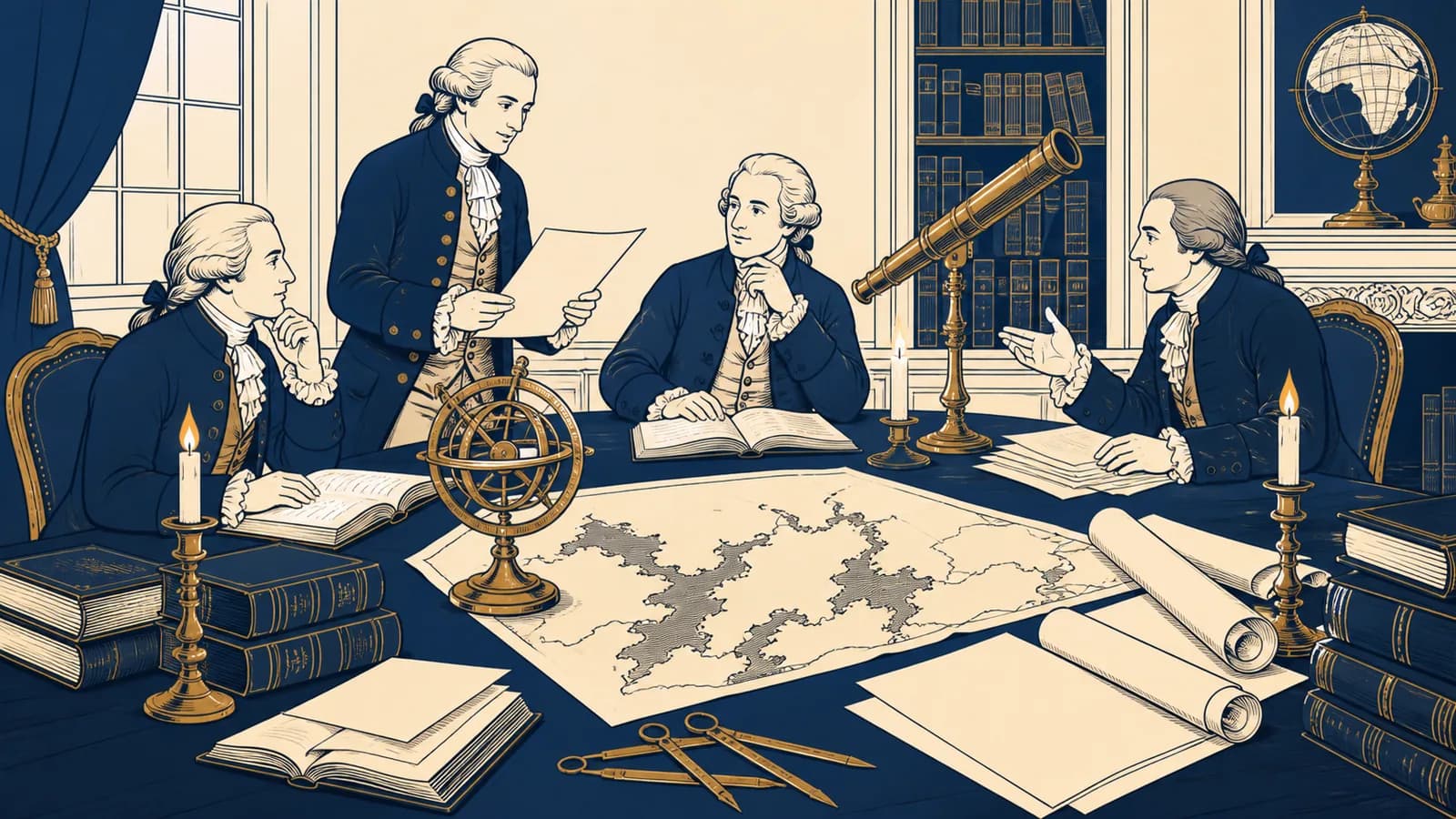
The Enlightenment is an intellectual movement that uses reason, evidence, and debate to judge authority, in the context of European politics, science, religion, and society during the late seventeenth and eighteenth centuries. Often called the Age of Enlightenment, it asked what government was for, where rights came from, and how people could know whether a claim was true. Enlightenment ideas exist because inherited rules can protect power without proving that those rules are fair or accurate. The movement supplied a method: make authority give reasons, compare those reasons with evidence, and revise institutions when they fail the people subject to them.
What the Enlightenment actually was
The Enlightenment was a connected argument, not a single doctrine. Writers, officials, scientists, printers, and readers disputed how knowledge should be tested and how political power should be justified, while disagreeing sharply about religion, equality, empire, property, and who counted as a citizen.
Most of the people later grouped under the label never joined an organization called the Enlightenment. They lived in different countries, wrote in different languages, and answered different problems. John Locke examined knowledge, toleration, and political authority in England. Voltaire attacked intolerance and arbitrary punishment in France. Montesquieu compared systems of law and government. Jean Jacques Rousseau asked how a political community could rule itself without turning citizens into subjects of another person's will. Immanuel Kant described enlightenment as the attempt to use one's own understanding.
Those thinkers did not produce a shared manifesto. Locke defended property in ways Rousseau would question. Voltaire admired enlightened rulers more than Rousseau admired rule from above. Some treated Christianity as compatible with reason, some favored deism, and some moved toward skepticism or materialism. What connects them is a repeated test: a tradition, law, or ruler should not be accepted solely because it is old, sacred, or powerful.
If the Enlightenment were a creed, its members would agree on government, religion, and equality. They did not.
The movement joined disputes through common habits: criticism, comparison, publication, evidence, and demands that authority explain itself.
This distinction matters because the movement could attack one hierarchy while preserving another. A writer might oppose censorship yet support monarchy. Another might defend universal human nature yet ignore enslaved people. The Enlightenment made certain questions harder for rulers to avoid, but it did not settle every answer.
How the Enlightenment method works
The Enlightenment method turns a received claim into a public argument. It identifies the claim, asks what reasons support it, tests those reasons against observation or comparison, exposes the conclusion to criticism, and treats revision as a strength rather than a surrender.
Imagine a king claims that his authority comes directly from God and therefore subjects may never remove him. An Enlightenment critic does not have to begin by disproving God. The critic can separate the links in the argument. How can anyone verify the king's special appointment? Does sacred authority excuse a ruler who destroys the community? If several kings claim divine approval while waging war against one another, what independent test decides between them?
Replace “everyone knows” with a sentence that can be examined, such as “a ruler may tax subjects without their consent.”
Ask whether the claim rests on scripture, custom, a royal command, observation, or an argument about human needs.
Examine other governments and ask what happens when the rule is applied consistently, including when a hostile ruler applies it.
A claim becomes open to correction when readers can inspect it, challenge its evidence, and propose a better explanation.
This method borrowed confidence from the success of early modern science, but political arguments cannot be settled by a laboratory experiment alone. No instrument measures justice. Political thinkers instead used history, travel reports, legal comparison, thought experiments, and claims about human motivation. The quality of their conclusions depended on the quality of those sources. False reports about distant societies could produce false theories even when the reasoning looked orderly.
Reason is not automatic truth. A valid chain of reasoning can still begin with a false premise, omit affected people, or disguise a preference as a universal law. Enlightenment criticism must also be applied to Enlightenment thinkers.
The lasting change was procedural. A person challenging a law could demand reasons that other people might inspect. That demand moved an issue away from obedience and toward justification. Courts, legislatures, scientific journals, investigative reporting, and public inquiries still use versions of this procedure.
How natural rights and the social contract work
Natural rights are protections people possess because they are human, while a social contract is the justification for political authority based on people's agreement or common interest. Together, these ideas make government conditional: power is legitimate only when it serves defensible public purposes.
The word natural does not mean that a right grows in forests or can be found under a microscope. It means the right is not created as a personal gift from a ruler. If a monarch grants freedom of speech as a favor, the monarch can withdraw it as a favor. If people hold a right independently of the monarch, government must give a public reason for restricting it.
Locke argued that people are naturally free and equal and that government exists to preserve rights, commonly summarized as life, liberty, and property. People authorize government, but authorization has conditions. A government that attacks the purposes for which it was formed can lose its claim to obedience. Rousseau developed a different model. For him, legitimate law expresses the general will of citizens acting as a political body, rather than the private wish of a king or the sum of selfish preferences.
The contract is usually a model, not a report of one meeting at which every ancestor signed a document. It asks what terms free and equal people could reasonably accept. That creates hard questions. Does silence count as consent? Can a child be bound by an agreement made centuries earlier? May a majority strip rights from a minority? Enlightenment political theory made consent central, but later constitutional design had to turn that ideal into elections, limits on office, protected rights, and legal procedures.
A city closes a newspaper because its reporting embarrasses the mayor. Under a favor model, publication exists at the mayor's permission. Under a rights model, the mayor must point to a lawful and narrowly justified restriction, and an independent court can test that justification.
Modern debates about warrants, voting rules, emergency powers, and protest still follow this structure. The immediate policy changes, but the underlying question remains: what authority has the state received, for what purpose, and under what limits?
The Enlightenment versus the Scientific Revolution
The Scientific Revolution changed explanations of the physical world through mathematics, observation, and experiment, while the Enlightenment extended habits of criticism into politics, law, religion, education, and economics. They overlap in people and methods, but they are not two names for the same event.
During the sixteenth and seventeenth centuries, figures including Nicolaus Copernicus, Johannes Kepler, Galileo Galilei, and Isaac Newton challenged inherited accounts of nature. Newton's Principia, published in 1687, showed that mathematical laws could explain motion on Earth and in the heavens. Its success encouraged a tempting analogy: if nature had discoverable laws, perhaps human society did too.
The analogy helped Enlightenment thinkers search for regular causes in trade, crime, education, and government. It also created risks. Human beings interpret rules and change their behavior, while planets do not debate gravity. A society cannot be reduced safely to a machine whose operator may rearrange people as parts.
The dates show overlap rather than a clean handoff. Scientific work continued throughout the Enlightenment, and political criticism existed before Newton. The connection is best understood as transferred confidence. Knowledge could advance when claims were exposed to disciplined testing, so reformers tried to build institutions that made criticism possible.
This is part of a longer change that also includes overseas contact, conquest, mapping, and commercial rivalry. The page on how exploration and colonization reshaped states and knowledge explains the networks that supplied European readers with new goods and reports, often through coercion and empire.
How print and the public sphere spread Enlightenment ideas
Print spread Enlightenment arguments by making texts reproducible, portable, and discussable among strangers. Books, pamphlets, newspapers, letters, and encyclopedias formed a public sphere in which readers could compare claims, circulate criticism, and build reputations beyond royal courts and church offices.
Printing did more than increase the number of copies. It changed the path an argument could take. A manuscript might remain inside a court or religious order. A printed pamphlet could move through booksellers, coffeehouses, reading societies, lending libraries, and private homes. A response could quote the original and reach some of the same readers. Controversy created a chain of claim, reply, and counterreply.
Denis Diderot and Jean le Rond d'Alembert's Encyclopédie made this ambition visible. Beginning publication in 1751, it assembled articles on arts, sciences, crafts, philosophy, and practical techniques. It treated the workshop as a site of knowledge and organized information so readers could follow connections. Authorities censored the project, yet publication continued through shifting permissions and clandestine work.
Access was unequal. Literacy, price, language, censorship, and distance controlled who could participate. Some readers heard texts read aloud rather than owning them. Women hosted salons and took part in literary culture, but formal academies and universities often excluded them. Governments licensed printers, seized books, and punished authors. Writers responded with pseudonyms, foreign publication, coded satire, and manuscripts passed hand to hand.
The mechanism has a modern parallel. A public claim becomes politically important when it can be copied, checked, answered, and connected to a community. Social media changes speed and scale, but it also shows the weakness of circulation without careful verification. Wide distribution proves attention, not truth.
How Enlightenment thinking shows up in government and law
Enlightenment thinking appears in government when officials must act under published laws, powers are divided, citizens are treated as sources of authority, and individual rights constrain majorities. These devices turn distrust of arbitrary rule into offices, procedures, appeals, and enforceable limits.
Montesquieu argued in The Spirit of the Laws, published in 1748, that liberty depends on preventing power from being concentrated without restraint. The familiar division among legislative, executive, and judicial functions is one institutional answer. Separation does not mean that each branch ignores the others. It means each has defined powers, and checks make it harder for one person or body to write, enforce, and judge its own commands.
Cesare Beccaria applied public reasoning to criminal law. In On Crimes and Punishments, published in 1764, he attacked torture and secretive, disproportionate punishment. Punishment, in his account, should follow known law and serve a public purpose such as preventing harm. Pain inflicted as revenge or spectacle does not become just because the state orders it.
The official decides case by case, hides the rule, applies it differently to favorites, and faces no independent review.
The law is public, the official must cite authority, similar cases receive similar treatment, and a separate body can hear an appeal.
Revolutions turned arguments into declarations and constitutions. The American Declaration of Independence in 1776 used natural rights and consent to justify separation from Britain. France's Declaration of the Rights of Man and of the Citizen in 1789 declared that people are born and remain free and equal in rights. Both documents made universal sounding claims while the societies producing them excluded many women, enslaved people, Indigenous peoples, and men without full political standing.
You meet the institutional legacy when a court requires a warrant, a legislature publishes a bill, a defendant hears the accusation, or an agency must explain a decision. These practices do not guarantee justice. They create points where power can be inspected and challenged.
How Enlightenment thinking shows up in economics and religion
In economics, Enlightenment thinkers examined trade and labor as systems with regular incentives rather than royal possessions. In religion, they defended toleration and tested clerical authority. Both applications asked whether coercive rules served the public or protected privileged institutions from competition and criticism.
Economic order could emerge without constant command
Economic liberalism argued that decentralized choices can coordinate production and exchange under stable rules. Adam Smith's The Wealth of Nations, published in 1776, criticized many monopolies and trade restrictions. His argument was not that selfishness magically produces goodness. Markets depend on justice, trust, competition, and limits on collusion, and Smith also wrote about sympathy and moral judgment.
Consider a licensed monopoly that alone may import a common good. Its legal privilege blocks rivals, so it can charge more or supply less without losing customers to another importer. Removing the exclusive license allows competition, but the state still has work to do: enforce contracts, punish fraud, maintain public works, and stop private actors from replacing a public monopoly with a cartel.
Religious toleration limited the reach of coercion
Toleration means that disagreement in belief does not by itself justify civil punishment. Europe had experienced destructive religious conflict, and Enlightenment writers challenged the assumption that political order required one enforced faith. Locke defended toleration among many Christian groups, though the boundaries of his toleration were narrower than modern freedom of religion.
Deists held that reason and observation could support belief in a creator without accepting every claim of revealed religion or church authority. Other thinkers remained orthodox believers, skeptics, or atheists. The shared political problem was practical: when rival groups each claim certainty, giving one group the machinery of state punishment turns theological disagreement into loss of liberty.
A school board chooses whether a disputed book may be removed simply because it challenges a dominant belief. An Enlightenment test asks for a public rule that could be applied consistently, evidence of actual harm, and a process in which reasons can be challenged.
The same reasoning appears in professional life. An economist checks incentives and unintended effects. A lawyer asks which published rule authorizes a decision. A journalist separates evidence from an official's status. Each practice treats an assertion as something to test, even when the speaker holds office.
How the Enlightenment's exclusions expose its limits
The Enlightenment's sharpest limit was the gap between universal language and restricted membership. Thinkers described natural freedom and human equality while European empires enslaved people, seized land, subordinated women, and classified populations through racial theories presented as science.
This was not a minor inconsistency outside the movement. Colonial trade, plantation wealth, military rivalry, and reports from conquered societies formed part of the world in which Enlightenment texts circulated. Some writers condemned slavery and conquest. Others justified hierarchy, invested in colonial systems, or treated non-European peoples as evidence for speculative stages of civilization.
Critics used the movement's own language against exclusion. Olaudah Equiano's 1789 narrative described enslavement and argued to a reading public against the slave trade. In 1791, enslaved people in the French colony of Saint Domingue began the revolt that developed into the Haitian Revolution. Haiti declared independence in 1804. The revolution forced a direct question: if rights are universal, on what grounds could France deny liberty to enslaved Black people?
Women also exposed the selective meaning of equality. Olympe de Gouges published the Declaration of the Rights of Woman and of the Female Citizen in 1791, rewriting revolutionary rights language to reveal its male boundaries. Mary Wollstonecraft's A Vindication of the Rights of Woman, published in 1792, argued that women's apparent intellectual weakness reflected denied education rather than natural incapacity.
This test prevents two errors. It prevents treating Enlightenment ideals as empty merely because their first advocates applied them selectively. It also prevents celebrating ideals while ignoring the people who forced societies to honor them more consistently. Rights expanded through conflict, organization, revolt, litigation, and political work, not through logic acting by itself.
The contradiction between universal ideals and organized mass violence did not disappear after the eighteenth century. The guide to the political systems, genocide, and global conflict of World War II shows why legal language and institutions need enforcement, public resistance, and historical memory.
What dates and places define the Enlightenment?
The Enlightenment has no universally agreed start or finish, but historians usually place its main European phase in the late seventeenth and eighteenth centuries. Its centers included Britain, France, the German states, Scotland, Italy, the Netherlands, and Atlantic colonies, each with different debates.
A timeline helps only if it marks developments rather than pretending that an intellectual movement switched on and off. Earlier natural law, Renaissance scholarship, the Reformation, religious wars, state building, and the Scientific Revolution supplied problems and methods. Revolutionary politics then carried Enlightenment language beyond the circles that first developed it.
His Two Treatises of Government and Letter Concerning Toleration were published in the aftermath of England's Glorious Revolution.
The Spirit of the Laws links political liberty to institutional design and the distribution of power.
The project gathers learned and practical knowledge while challenging established boundaries around authority.
The American Declaration of Independence and Smith's Wealth of Nations appear in the same year, addressing different forms of authority.
Rights, citizenship, sovereignty, and equality become matters of mass politics, violence, lawmaking, and war.
The first independent state in Latin America and the Caribbean born from a successful slave revolution confronts the racial limits of European rights claims.
The movement was European in its major publishing centers, but never sealed inside Europe. Atlantic commerce, Indigenous societies, Asian states, African slavery, colonial administration, and missionary reports shaped its evidence and imagination. Ideas also changed as people in colonies used them for purposes metropolitan writers had not intended.
What were salons, coffeehouses, and enlightened monarchs?
Salons and coffeehouses were social settings where some readers discussed news and ideas, while enlightened monarchs were rulers who adopted selected reforms without surrendering sovereignty. All three connected argument with power, but none created equal or unrestricted public participation.
Salons organized conversation through hosts and guests
A salon was a gathering, often in a private home, where invited participants discussed literature, philosophy, art, and politics. Some prominent salons were hosted by women who influenced guest lists and conversation even though women lacked equal access to formal institutions. Salons mattered as networks of reputation and exchange, but invitation made them selective.
Coffeehouses linked print with talk
Coffeehouses offered places where customers could read papers, exchange commercial information, and argue about public affairs. Their exact culture differed by city and clientele. Calling them the birthplace of modern democracy goes too far, since access depended on money, gender, status, and local rules. Their importance lies in repeated contact between printed claims and spoken criticism.
Enlightened monarchs reformed from above
Rulers such as Frederick II of Prussia, Catherine II of Russia, and Joseph II of the Habsburg lands corresponded with intellectuals or pursued reforms in law, administration, education, or religion. Historians call this enlightened absolutism. The phrase contains its tension: the sovereign might make government more rational while keeping final authority.
Reform is not the same as consent. A ruler can reduce torture or widen toleration for practical and moral reasons while still denying subjects the right to choose, dismiss, or overrule that ruler.
These narrower settings reveal how ideas actually move. A theory needs carriers, meeting places, patrons, printers, and audiences. It also encounters gatekeepers. Tracking those channels is more informative than imagining a brilliant book directly transforming an entire country.
Four mistakes people make with the Enlightenment
The most common mistakes turn the Enlightenment into a united club, pure praise of reason, an instant cause of revolution, or a completed victory for freedom. Each mistake removes disagreement, institutions, and excluded people from the historical record.
1. Treating every thinker as a liberal democrat
Many Enlightenment thinkers did not support universal suffrage or modern democracy. Some preferred constitutional monarchy, some accepted restricted electorates, and some hoped educated rulers would reform society. Terms such as liberty and equality also carried meanings narrower than they often do now. Read the proposed institution, not just the inspiring noun.
2. Treating reason as the opposite of all religion
The movement included devout Christians, advocates of toleration, deists, skeptics, and materialists. Arguments often targeted persecution, clerical privilege, or a particular doctrine rather than every form of belief. A simple contest between reason and religion erases the religious arguments for toleration and the theological background of natural law.
3. Saying philosophers caused revolutions by themselves
Ideas give people language for grievances and models for new institutions, but revolutions also require political breakdown, organized groups, material pressures, and choices made during events. France in 1789 faced a fiscal crisis and a conflict over representation. Quoting Rousseau did not empty the treasury or determine every later decision.
4. Assuming universal rights were universal in practice
Declarations could use universal language while laws preserved slavery, colonial domination, property qualifications, and male control of political office. The correct response is neither to ignore the declarations nor to confuse them with reality. Compare the stated rule with legal status, enforcement, and access to remedies.
A source becomes more useful when placed beside the conditions it addressed. The collection on people whose choices shaped major historical changes can help connect a writer's claims to offices, conflicts, audiences, and consequences without reducing an age to famous names.
The Enlightenment made authority answerable to criticism
The Enlightenment changed history by making public justification a standard against which power could be judged. It did not abolish domination, but it supplied arguments and institutions that subjects, citizens, reformers, and revolutionaries could use to challenge inherited authority.
Its deepest historical lesson is a mechanism. A claim of authority becomes less arbitrary when it must be stated publicly, supported with reasons, tested against evidence, limited by rules, and opened to reply. None of those steps guarantees a fair result. Together they create handles by which a bad result can be challenged.
That mechanism connects intellectual history with political, social, economic, and legal history. Ideas matter when people put them into printing systems, constitutions, court procedures, schools, markets, associations, and revolutions. Institutions matter because they decide whose argument receives a hearing and whose evidence counts. The wider set of guides to how historical change works follows those connections across other periods and problems.
The takeaway: When a government, employer, platform, school, or expert asks for trust, identify the source of its authority, the evidence behind its claim, the people affected, and the available appeal. That habit is an Enlightenment inheritance, and applying it to the Enlightenment itself is good history.
Notice the next rule you encounter in daily life. Ask who made it, what purpose it serves, what evidence supports it, and how a person can contest it. Then ask one more historical question: who was present when the rule was justified, and who had to fight to be included later?