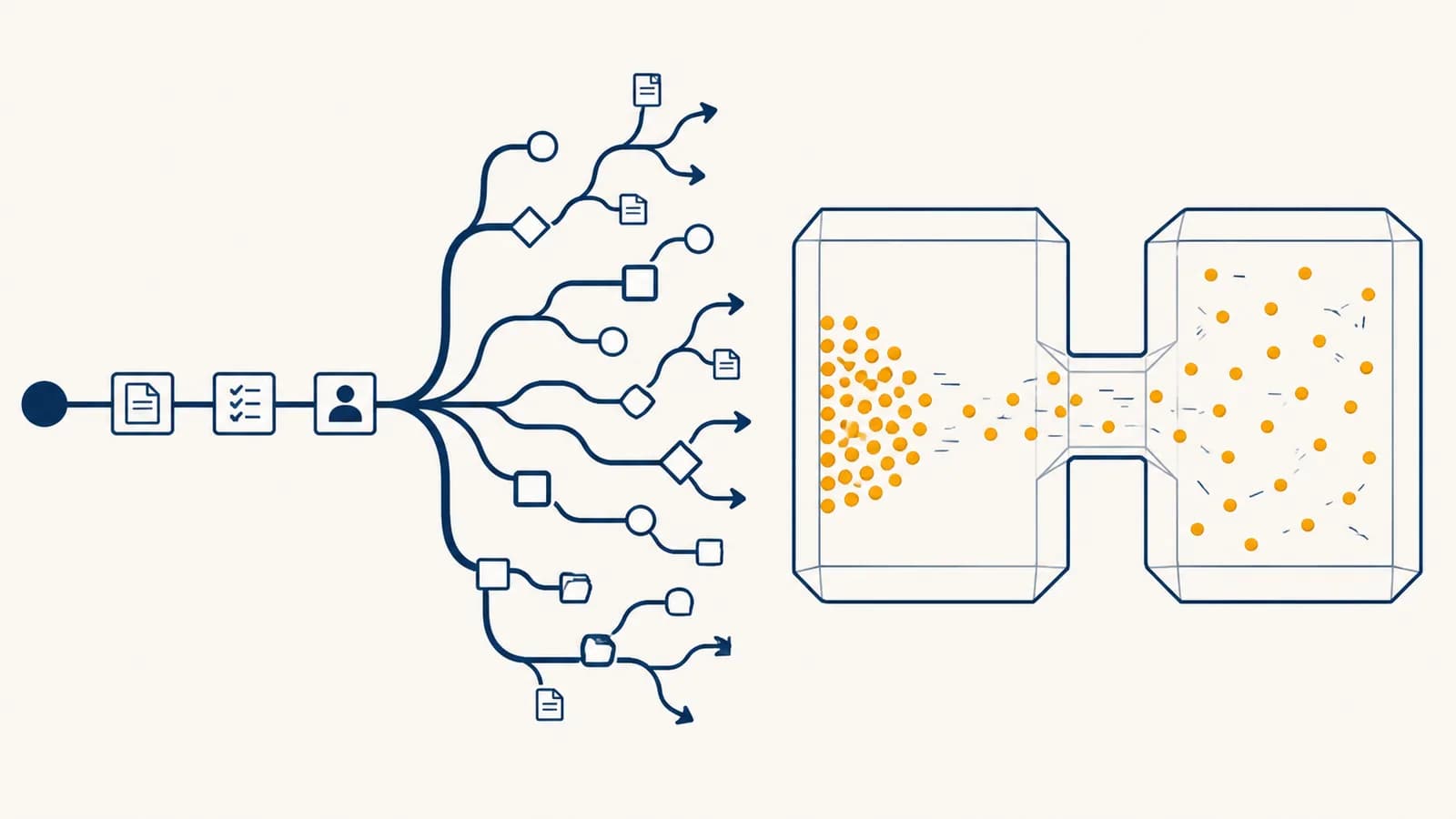
Entropy counts the hidden arrangements behind what you can see
Entropy is a measure of how many microscopic arrangements can produce the same visible condition. In physics, it explains why energy spreads and why many processes run naturally in one direction. In business, the idea helps identify operational disorder, information loss, duplicated work and the cost of reversing change. By the end, you can use entropy as a precise model, not a fancy synonym for chaos.
Imagine two boxes of gas connected by a valve. At first, all the molecules are trapped in the left box. Open the valve and they spread across both. Nothing pushes each molecule toward an equal split. Each one simply moves and collides. Yet there are vastly more possible arrangements with molecules in both boxes than with every molecule on one side. The spread-out condition is therefore overwhelmingly more likely.
The visible condition, such as pressure and temperature, is called a macrostate. The exact positions and momenta of all the molecules make up a microstate. Many microstates can fit one macrostate. Entropy connects those two levels.
If a macrostate can occur in 1,000 microscopic ways, its entropy is . A macrostate with more compatible microstates has greater entropy.
Here, is entropy, is the Boltzmann constant, and is the number of compatible microstates. The logarithm makes entropy additive: if two independent systems have and possibilities, the combined system has , while its entropy is the sum of their entropies.
Entropy means mess, confusion or anything a manager dislikes.
Entropy measures the multiplicity of a macrostate. A tidy-looking state can have high entropy, and a messy-looking state can have low entropy.
A shuffled deck illustrates the distinction. Every exact ordering of 52 cards is equally unlikely. The familiar sorted order is not physically special. We call it ordered because it matches a short human description. Entropy depends on how states are grouped and counted, not on whether a photograph looks neat.
Why does entropy tend to increase?
Entropy tends to increase because high-multiplicity macrostates can be realised in far more ways than low-multiplicity ones. Random microscopic motion is therefore much more likely to carry an isolated system toward the larger group of possible arrangements than back toward a rare arrangement.
Suppose four distinguishable particles can each sit on the left or right side of a box. There are possible location patterns. Only one places all four on the left. Six place two on each side. Even this tiny model favours a spread. With a macroscopic number of particles, the imbalance becomes so extreme that a spontaneous return to one side is possible in principle but fantastically improbable.
The second law of thermodynamics expresses this statistical direction. For an isolated system, total entropy does not decrease. Real machines, organisms and companies are not isolated. They take in energy and materials, create local structure, and send heat and waste into their surroundings. A refrigerator lowers entropy inside its cabinet by using electrical work and releasing more heat into the room.
Local order has a bill. A system can reduce entropy in one place only by consuming resources and increasing entropy elsewhere by at least as much.
This is why entropy supplies a direction without supplying a plan. The second law says that spilled milk will not gather itself back into a glass. It does not say which product to launch or which employee to hire. Business use begins only after the analogy is translated into specific mechanisms.
What does a company really inherit from thermodynamics?
A company inherits a useful pattern, not a literal physical law: unattended possibilities multiply, while a desired arrangement requires work to maintain. Files fork, exceptions accumulate and knowledge disperses. Calling this business entropy is valid only when the underlying states and maintenance costs are named.
A new process often begins with one approved route. Then a large customer needs an exception. A second office adopts different software. A regulation changes one form. A veteran employee keeps undocumented shortcuts in memory. Each change adds possible states to the operation. More states mean more combinations that staff must recognise, test and support.
The physical analogy is strongest at the level of probability and upkeep. There are usually many more ways for records to disagree than to match, many more undocumented workarounds than approved ones, and many more possible software configurations than tested configurations. Routine activity samples those possibilities. Without repair work, the operation drifts away from its narrow desired state.
The analogy has a boundary. A company has goals, incentives and people who can redesign rules. A gas does not. Thermodynamic entropy has units of joules per kelvin and belongs in physical calculations. Operational entropy is a chosen description of variation or uncertainty. Treating both as the same measurable substance produces impressive language and weak analysis.
A manager should therefore finish the sentence: entropy of what? Possible contract versions, routing choices, inventory locations, access permissions or interpretations of a policy are plausible answers. “The organisation feels chaotic” is not.
Where does operational entropy appear?
Operational entropy appears where many hidden states sit behind one simple label. A product, customer or task may look standard in a dashboard while carrying different terms, owners, formats or dependencies. Those concealed variations make errors likelier and recovery slower.
Consider a product listed as “available.” That macrostate might hide stock in the correct warehouse, stock reserved for another order, stock with an obsolete label or stock recorded only in a spreadsheet. The visible label compresses several operational microstates. Trouble begins when a decision assumes they are equivalent.
A support team promises a refund within five working days. One agent can approve it directly, another needs a supervisor, and a third must send a form to finance. The customer sees one policy. Inside the company, three routes create different delays, records and failure points.
Handoffs create similar branching. Every transfer can alter wording, strip context or introduce a new queue. If a request can be sent to four teams, each using two status labels, there are already simple route-status combinations. Add regions, customer types and exception codes, and the state space grows by multiplication.
Software configuration is another clear case. A small codebase can support many combinations of browser, device, feature flag, user role and data condition. Testing every combination soon becomes impossible. The practical response is not vague simplicity. It is to limit supported combinations, automate checks and isolate changes. The same reasoning explains why unreviewed code generation can multiply hidden software states faster than a team can inspect them.
Inventory, contracts and permissions follow the same pattern. A duplicate supplier record creates two places for an address to change. A custom clause creates another legal state to review. An old account creates another route into a system. None is automatically bad. Each carries an ongoing cost because the organisation must remember which state applies.
Can business entropy be measured without fake precision?
Business entropy can be measured through explicit proxies: count the variants, estimate their frequencies, and connect them to observable work such as corrections, searches or approvals. The result is a decision aid, not a universal entropy score that ranks every company.
Start with counts that preserve meaning. How many invoice templates are active? How many routes can an order take? How many versions of a policy are still in circulation? How many fields must be reconciled between two systems? These are not entropy by themselves, but they reveal the size of the state space.
Define the decision that variation makes harder, such as approving a refund or locating stock.
Name the routes, versions or conditions that staff must distinguish. Merge states only if they lead to the same action.
Use logs or a sample to find how often each state occurs. Record the sampling period and missing cases.
Track an observable consequence, such as touches per case, correction time or number of approvals.
Remove one source of variation, then measure the same quantities again under similar conditions.
Visible arithmetic protects the analysis. Suppose 80 of 100 orders use the standard route and 20 use an exception route. The exception share is . If a redesign moves 10 of those exception orders onto the standard route, the exception share becomes . The subject page on calculating and comparing percentages covers the foundation behind that check.
The example does not prove that the redesign is better. Exceptions may protect valuable customers or satisfy legal duties. Add outcome measures before deciding: error rate, completion time and customer harm may matter. A lower variant count is useful only if the remaining process still does the job.
What does information theory add?
Information theory turns uncertainty among possible messages or events into a quantity. Shannon entropy rises when outcomes are numerous and similarly likely, and falls when one outcome dominates. It can describe prediction difficulty, but it does not measure waste, confusion or moral value.
A fair yes-or-no outcome has bit of entropy.
The logarithm base two expresses uncertainty in bits. A fair binary choice carries one bit because one yes-or-no answer identifies the result. If the answer is almost always “yes,” observing it teaches less, so entropy is lower. This is a mathematical statement about probabilities, not a judgement about the quality of the answer.
A help desk can use the idea to compare ticket categories. If nearly every ticket belongs to one category, the next category is fairly predictable. If tickets are spread evenly across many categories, the next one is harder to predict. That uncertainty can guide staffing, routing and data collection. It cannot reveal the correct staffing plan on its own.
Prediction systems learn patterns in such distributions. A model may reduce uncertainty about the next word, a damaged component or a late payment by using available evidence. Machine learning from data explains how inputs, patterns and evaluation connect. Lower predictive uncertainty is useful only when the labels, costs and tests match the real decision.
Do not mix the equations. Shannon entropy is measured in bits when base two is used. Thermodynamic entropy is measured in joules per kelvin. Their mathematics is related, but a business dashboard cannot convert ticket uncertainty directly into waste heat.
Information itself has a physical carrier, such as magnetic domains, electrical charge or ink. That connection is real and studied in physics. It still does not turn every missing spreadsheet cell into a thermodynamic calculation. Choose the model that answers the question actually being asked.
How can a company reduce disorder without freezing useful change?
A company can reduce operational disorder by limiting needless variants, making state visible and assigning maintenance work. It should preserve variations that serve a tested purpose. The aim is controlled adaptability, because one rigid process can fail as badly as uncontrolled branching.
First, reduce the number of representations. One customer identifier is easier to maintain than separate names in sales, billing and support. A shared definition of “active customer” prevents teams from reporting different totals under the same label. Standardisation narrows the set of states that people must reconcile.
Second, make remaining state visible. Version numbers, owners, expiry dates and change histories tell people which case they are handling. A checklist externalises memory. An automated test checks the same condition repeatedly. Visibility does not remove variation, but it stops hidden variation from surprising the next person.
One owner, an explicit reason for each exception, an expiry date and a test that detects failure.
Approval added after approval, permanent exceptions and documentation that no longer matches the work.
Third, budget for upkeep. Databases need deduplication. Equipment needs maintenance. Policies need review. Training needs revision after the process changes. These tasks do not create a flashy new feature, but they supply the work that keeps the desired state probable.
History gives the pattern a larger scale. Factories concentrated machinery and divided production into repeatable tasks, but they also created maintenance schedules, inspection systems and management layers. Industrial production shows that standardisation and new complexity often arrive together.
Finally, delete obsolete paths. Retiring an old form, feature flag or permission removes states that can no longer create value. Deletion should be verified because an apparently unused route may still support a rare legal or safety case. Good pruning needs evidence and a recovery plan.
Good systems export disorder instead of pretending it vanished
Every maintained system pushes costs somewhere: heat into a room, obsolete parts into a waste stream, or coordination work onto people. Good design makes those transfers visible and chooses them deliberately. A clean dashboard is not proof that the underlying disorder disappeared.
A delivery platform may simplify ordering for customers while shifting difficult timing decisions to drivers and streets. A standard contract may speed sales while sending unusual cases to a legal queue. A tidy warehouse may depend on packaging waste and frequent transport. Each local improvement should be checked at the boundary where its unwanted variation leaves the system.
This boundary thinking connects physics to public decisions. A business can optimise its own route time while increasing congestion for everyone else. Study of human and physical systems in geography helps trace how transport, land use and economic activity affect one another across space.
The takeaway: Entropy is not a mystical force that ruins companies. In physics it counts compatible microscopic arrangements. In information theory it measures uncertainty. In business it is a disciplined prompt to count variants, expose hidden states, price maintenance and inspect where disorder has been transferred.
The most useful question is therefore specific: which possible states are multiplying, what work keeps the desired state likely, and who pays for the discarded variation? Answer those with counts and mechanisms, and entropy becomes more than a metaphor. It becomes a practical way to see why systems drift and what repair actually requires.