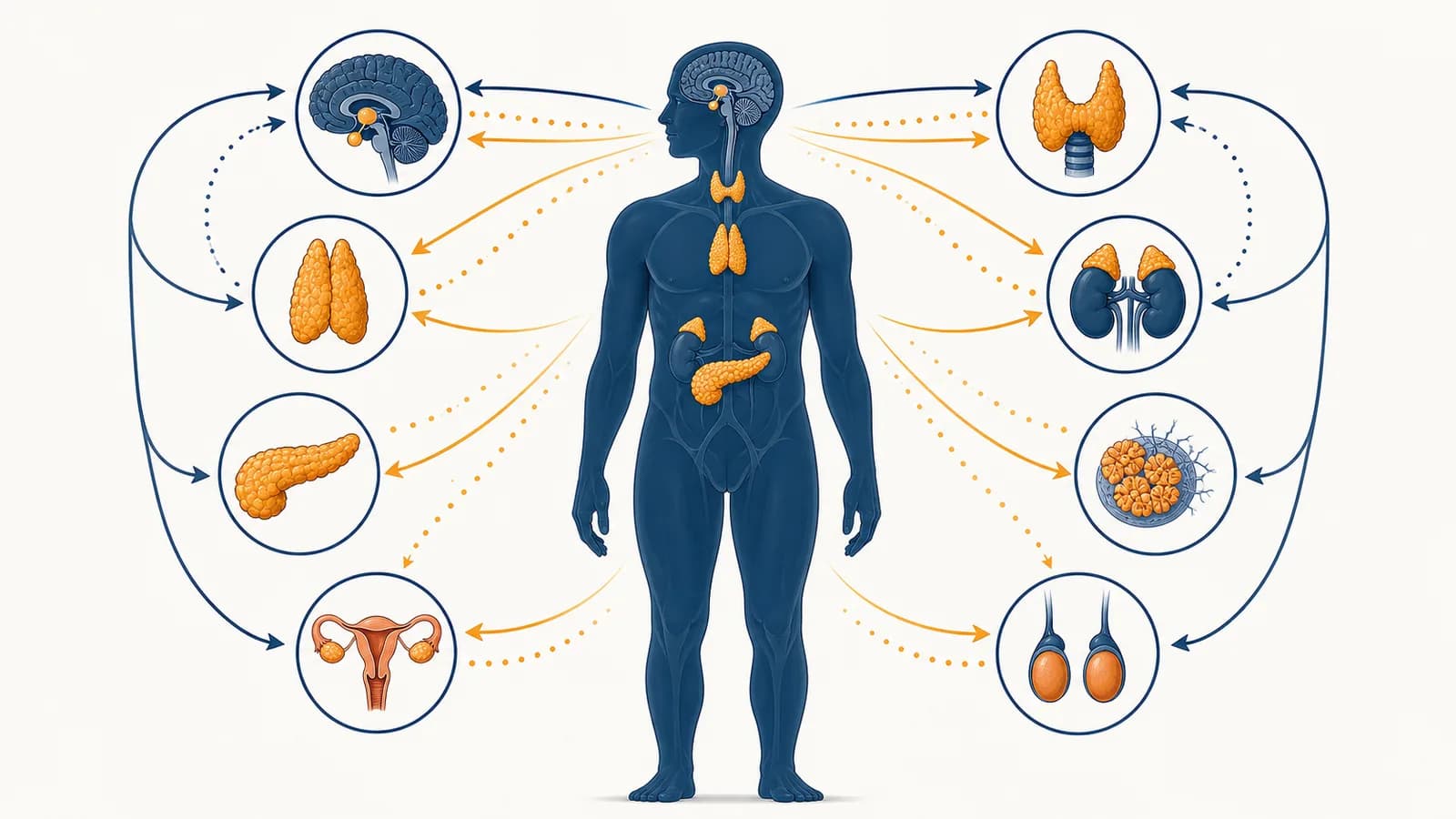
Endocrinology is a branch of biology and medicine that studies how hormones coordinate body functions, in the context of human and animal physiology. The endocrine system includes hormone-making cells, endocrine glands, target cells, receptors, and feedback loops. It controls blood glucose, growth, metabolism, reproduction, stress responses, water balance, and calcium balance. Endocrine disorders arise when a hormone signal is too strong, too weak, mistimed, or ignored by its target. An endocrinologist investigates those failures. This signaling system exists because trillions of cells must adjust their work together even when they are far apart.
What endocrinology actually is
Endocrinology is the study of hormones, the cells that release them, the tissues that detect them, and the feedback systems that regulate them. It asks how chemical messages control physiology and what happens when the message, receptor, or response fails.
The subject is larger than a list of glands. It includes a complete communication problem: what variable the body senses, which cell sends a signal, how that signal travels, which cells can read it, what those cells do, and how the response is stopped. A useful endocrine explanation follows that chain instead of saying only that a hormone “controls” something.
Endocrinology sits inside the wider study of Biology because it connects molecules to cells, organs, behavior, and whole-body survival. A molecular change in a receptor can alter how a liver stores glucose. An organ-level change in the thyroid can alter energy use in many tissues. The scale changes, but the causal chain remains traceable.
Doctors also use “endocrinology” for a medical specialty. Clinical endocrinology deals with conditions such as diabetes, thyroid disease, pituitary disorders, adrenal disorders, unusual growth, bone and mineral disorders, and some reproductive hormone problems. The science and the specialty share the same central question: does a signal produce the response that the body needs?
What hormones and endocrine organs actually are
A hormone is a chemical messenger released into body fluid that changes the activity of cells carrying a matching receptor. An endocrine organ is a tissue specialized for releasing hormones, although hormone-producing cells also occur in organs with many other jobs.
Hormones circulate widely, but they do not give instructions to every cell they pass. A cell must have the right receptor and the internal machinery needed to respond. Insulin can reach a neuron, a fat cell, and a skeletal muscle cell in the same blood, yet each cell may respond differently because it contains a different set of receptors, enzymes, transporters, and active genes.
Chemical type affects storage, transport, receptor location, and response time. Peptide hormones are water-soluble. Cells commonly store them in vesicles and release them by exocytosis. They travel dissolved in plasma and usually bind receptors on a cell membrane. Steroid hormones are lipid-soluble. Endocrine cells usually make them as needed, they often travel attached to carrier proteins, and they can enter cells to bind intracellular receptors. Thyroid hormones are amino acid derivatives, but their lipid-soluble behavior resembles steroid hormones in several important ways.
| Source | Example signal | Main target or controlled variable |
|---|---|---|
| Hypothalamus | Releasing and inhibiting hormones | Anterior pituitary secretion |
| Pituitary | TSH, ACTH, growth hormone | Other glands, growth, and metabolism |
| Thyroid | Thyroid hormones | Energy use and development |
| Parathyroid glands | Parathyroid hormone | Calcium and phosphate balance |
| Adrenal glands | Cortisol, aldosterone, epinephrine | Stress response, salt balance, circulation |
| Pancreatic islets | Insulin and glucagon | Fuel storage and blood glucose |
| Ovaries and testes | Sex steroids and inhibins | Reproduction and sexual development |
This table is a map, not a complete inventory. The kidneys release erythropoietin and renin. The heart releases natriuretic peptides. The digestive tract contains endocrine cells that signal about food. Fat tissue releases leptin and other messengers. The idea of a single “master gland” is therefore limited. The pituitary directs several glands, but the hypothalamus directs much of the pituitary, and many organs respond directly to blood chemistry.
How hormone signaling works
Hormone signaling works when a stimulus causes secretion, blood or local fluid carries the hormone, a matching receptor binds it, and the target cell converts that binding event into a response. Removal of the hormone and feedback then limit the message.
Pancreatic beta cells, for example, respond when glucose metabolism inside them changes after blood glucose rises.
Stored peptide hormone can leave in vesicles. Steroid-producing cells make hormone from cholesterol and release it across the membrane.
Water-soluble hormones circulate mainly in plasma. Many lipid-soluble hormones ride on carrier proteins, with a smaller free portion available to enter tissues.
Binding depends on hormone concentration, receptor number, and affinity. Cells without the receptor cannot read that message in the usual way.
The response may alter enzyme activity, ion movement, gene transcription, secretion, growth, or the movement of transport proteins.
Hormone secretion falls, receptors may become less responsive, and the liver, kidneys, or enzymes remove hormone from circulation.
Water-soluble hormones signal across the membrane
Most peptides cannot cross the lipid bilayer. They bind to an outer receptor, which changes shape and starts a signaling chain inside the cell. A G protein-coupled receptor may activate an enzyme that makes cyclic AMP. Cyclic AMP activates protein kinases, and those kinases add phosphate groups to selected proteins. One external binding event can therefore alter many internal protein molecules. This is signal amplification.
Insulin uses a different surface receptor. Its receptor is an enzyme-linked receptor with tyrosine kinase activity. Binding triggers phosphorylation inside the cell and starts several pathways. In skeletal muscle and fat cells, one result is movement of GLUT4 glucose transporters to the cell membrane, which increases glucose entry. This molecular detail belongs with cell receptors and signaling pathways, because endocrine effects are built from ordinary cellular machinery.
Lipid-soluble hormones can change gene expression
Steroid hormones cross the cell membrane and bind receptors in the cytoplasm or nucleus. The hormone-receptor complex can bind particular DNA control sequences and recruit proteins that increase or decrease transcription. The cell then changes which messenger RNAs and proteins it makes. Such responses often develop more slowly than a phosphorylation response, but they can persist because the cell has produced new proteins.
If the hormone concentration equals , the model gives , so half of the receptors are occupied.
This model shows why response does not usually rise in a straight line forever. As hormone concentration increases, fewer unoccupied receptors remain. It also shows what affinity means: a lower dissociation constant, , corresponds to tighter binding under this simplified one-site model. Real tissues add receptor recycling, several receptor types, competing molecules, and signaling steps after binding, so receptor occupancy and biological effect are not identical.
How feedback keeps body variables within working ranges
Endocrine feedback compares the body’s present state with its physiological needs and changes hormone release accordingly. In negative feedback, the response reduces the original disturbance. Positive feedback instead reinforces a process for a limited event, then another event stops it.
A household thermostat is an imperfect but useful model of negative feedback. A sensor detects temperature, a controller compares it with a setting, and an effector changes heat output. Endocrine systems rarely hold one exact set point. Meals, sleep, exercise, illness, menstrual cycle stage, age, and time of day can all shift the expected range. The controlled pattern may be a pulse or rhythm rather than a flat line.
The hypothalamus releases thyrotropin-releasing hormone, which stimulates the pituitary to release thyroid-stimulating hormone, or TSH. TSH stimulates the thyroid to make thyroid hormones. Rising thyroid hormone feeds back to the pituitary and hypothalamus, reducing further stimulation. If the thyroid itself fails, thyroid hormone can be low while TSH becomes high because the pituitary keeps asking for more output.
That pattern lets clinicians locate a fault. Low output from a target gland with high stimulating hormone suggests that the target gland cannot answer normally. Low target hormone with a low or inappropriately ordinary stimulating hormone can point higher in the control chain. Interpretation still requires clinical context because medication, severe illness, pregnancy, timing, and laboratory method can change results.
Positive feedback is less common. Near ovulation, sustained high estrogen can help produce a surge of luteinizing hormone, which promotes ovulation. During labor, cervical stretching increases oxytocin release, and oxytocin strengthens uterine contractions, which can increase stretching. Birth ends that loop. Positive feedback is useful when the body needs a process to reach completion rather than hover near a stable range.
A hormone value has no meaning by itself. Its partner hormones, time of collection, physiological state, symptoms, medicines, and the laboratory’s own reference interval determine what the result can support.
Endocrine signaling versus nervous signaling
Endocrine signaling usually sends chemical messages through circulation to distant targets, while nervous signaling sends electrical impulses along neurons and neurotransmitters across short synapses. The systems differ in delivery and timing, but they work together and sometimes use the same molecules.
Hormones enter blood or extracellular fluid. Responses can be widespread and may last from minutes to much longer, depending on the hormone, receptor, and changes produced.
Action potentials travel along selected neurons. Neurotransmitter release acts across a tiny synaptic gap, often producing a rapid and anatomically precise response.
The distinction is useful, but it is not a wall. The hypothalamus is nervous tissue that makes hormones. Its neurons release signals into vessels leading to the anterior pituitary, and other hypothalamic neurons make oxytocin and vasopressin for release from the posterior pituitary. Epinephrine can act as a hormone when adrenal tissue releases it into blood, while closely related signaling occurs at nerve endings.
The two systems cooperate when a threat appears. Sensory circuits process the situation quickly, sympathetic nerves alter heart activity and blood vessel tone, the adrenal medulla releases catecholamines, and a slower hypothalamus-pituitary-adrenal pathway increases cortisol. Calling all of this “adrenaline” hides several signals with different sources, targets, and time courses.
How endocrinology shows up in blood glucose control
Blood glucose control is an endocrine balancing system in which insulin generally promotes glucose use and storage after food, while glucagon helps maintain glucose availability between meals. The liver, muscle, fat, pancreas, gut, brain, and adrenal signals all contribute to the result.
After a carbohydrate-containing meal, digestion releases glucose that enters the blood. Pancreatic beta cells increase insulin secretion. Insulin promotes glucose uptake in skeletal muscle and fat, supports glycogen production in liver and muscle, encourages energy storage, and restrains liver glucose output. Blood glucose then moves back toward the range appropriate for that person and situation, which reduces the stimulus for insulin release.
Between meals, falling glucose changes pancreatic signaling. Alpha cells release glucagon, which acts mainly on the liver. The liver breaks down glycogen and makes new glucose from other molecules, then releases glucose to support tissues that need it. Exercise, stress, sleep, infection, and other hormones modify this balance. Glucose regulation is therefore not a duel between only two hormones.
Type 1 diabetes develops when immune destruction removes most insulin-producing beta cells. This is one place where immune responses and autoantibodies meet endocrinology. Type 2 diabetes involves impaired response to insulin and progressive difficulty producing enough insulin for the body’s needs. In both, glucose can remain high, but the underlying biology and treatment decisions are not identical.
Daily life exposes the mechanism. A person using insulin must match treatment to food, activity, current glucose, illness, and the insulin preparation’s action profile. Too little effective insulin can leave glucose high. Too much insulin relative to available glucose can drive it dangerously low. That is why insulin dosing is individual medical care, not an arithmetic rule that can be copied from another person.
How endocrinology shows up in clinics and laboratories
Clinical endocrinology turns symptoms and measurements into tests of a signaling pathway. Clinicians ask whether hormone production, stimulation, transport, receptor response, or feedback is abnormal, then combine history, examination, timed samples, imaging, and sometimes stimulation or suppression tests.
Symptoms often overlap. Fatigue can occur with thyroid disease, anemia, infection, sleep loss, depression, medication effects, or many other conditions. Excess thirst can suggest high blood glucose, but it also has other causes. An endocrine workup starts with a specific physiological question, not a request to measure every hormone. Broad testing increases the chance of finding a mildly unusual result that does not explain the problem.
A paired measurement can reveal the level of failure
Measuring a target-gland hormone with its controlling hormone is often more informative than measuring either alone. TSH and free thyroxine are a familiar pair. Cortisol may need interpretation with time of day and sometimes ACTH. Calcium is interpreted with albumin or an ionized calcium measurement, and parathyroid hormone can show whether the parathyroid response fits the calcium state.
Dynamic tests ask whether a system can respond
A stimulation test gives a controlled signal and measures whether hormone output rises appropriately. A suppression test asks whether a system can turn down when given an expected feedback signal. These are physiological experiments performed under clinical protocols. Timing, preparation, medication review, sampling, and assay choice matter, which is why unsupervised hormone testing can mislead.
A patient has repeated symptoms that could fit excess thyroid hormone. The clinician checks the history, pulse, medicines, supplements, and examination, then orders TSH and free thyroid hormone testing. A low TSH with high free thyroid hormone supports one branch of the explanation. Further tests can distinguish increased thyroid production from release caused by thyroid inflammation or hormone taken from outside the body.
Laboratories report reference intervals derived for a method and population. A reference interval is not a border between healthy and ill. Some healthy results fall outside it, and some ill people have results inside it. Immunoassays can also be disturbed by antibodies or supplements such as high-dose biotin, depending on the assay design. Repeating a measurement with suitable preparation or a different method may resolve a result that conflicts with the whole clinical picture.
Imaging answers structural questions. Ultrasound can show thyroid nodules, while magnetic resonance imaging can show the pituitary region. A visible nodule does not automatically explain a hormone abnormality, and a hormone abnormality does not always create a visible lesion. Structure and function are separate questions that must be connected with evidence.
5 mistakes people make with hormones
Common hormone mistakes confuse a messenger with a feeling, treat one result as a diagnosis, assume more hormone means more health, ignore timing, or blame every symptom on “imbalance.” Each error removes part of the pathway that makes endocrine evidence interpretable.
1. Calling one hormone the cause of one emotion
Hormones influence brain function, but an emotion is not a readout of one chemical. Context, learning, nervous activity, sleep, health, and several signaling systems interact. Cortisol is not simply “the stress hormone,” and oxytocin is not simply “the love hormone.” Those labels describe selected effects while hiding other jobs and conditions.
2. Treating a single unusual result as a diagnosis
Hormone secretion can be pulsatile, rhythmic, meal-sensitive, and stress-sensitive. A blood draw is one sample from a moving system. A clinician checks whether the result fits the symptoms, related hormones, collection conditions, medicines, and assay. Repetition is sometimes more informative than a dramatic interpretation.
3. Assuming more hormone produces a better response
Biology has working ranges. Excess thyroid hormone can strain the heart and reduce bone mass. Excess insulin can cause low blood glucose. Cells may also reduce receptor number or downstream responsiveness during prolonged stimulation. Hormone treatment aims to restore a needed signal, not maximize it.
4. Ignoring timing and biological rhythms
Cortisol normally varies across the day and is also released in pulses. Reproductive hormones change across cycles and life stages. Growth hormone secretion is pulsatile and linked with sleep. A collection time that is appropriate for one test may be poor for another. Meaning depends on the expected pattern.
5. Using “hormonal imbalance” as a complete explanation
The phrase does not identify a variable, gland, receptor, cause, or measured consequence. A testable claim is narrower: which hormone is suspected, what target response should change, what feedback partner should move, and which measurement would distinguish that explanation from alternatives?
This standard also helps with product claims. A supplement said to “balance hormones” should prompt specific questions about the hormone, evidence, dose, contaminants, interactions, and the people studied. A biological mechanism must be more detailed than a pleasing verb. If the pathway cannot be stated, the promise cannot yet be tested.
How puberty uses endocrine signals
Puberty begins when brain and pituitary signaling activates the gonads more strongly, increasing sex-steroid production and gamete-related development. Its timing and visible sequence vary, while growth hormone, thyroid hormone, nutrition, health, and inherited biology also shape the outcome.
The hypothalamus releases gonadotropin-releasing hormone in pulses. The anterior pituitary responds with luteinizing hormone and follicle-stimulating hormone. These act on ovaries or testes, which produce sex steroids, inhibins, and reproductive cells. Feedback changes as the system matures. Adrenal androgen production also contributes to body hair and skin changes, but it is a partly separate process.
Genes influence receptors, hormone synthesis, enzyme activity, and timing. The connection to genes, variants, and inheritance explains why some endocrine conditions run in families and why a change in one protein can alter an entire feedback loop. Environment and health matter too, so inherited influence is not a fixed timetable.
How stress hormones change the body
A stress response combines fast neural and adrenal catecholamine signals with a slower cortisol pathway, reallocating fuel and changing circulation, attention, and immune activity. It is an adaptive response to demand, but repeated or prolonged activation can carry physiological costs.
Sympathetic nerves can rapidly stimulate the adrenal medulla to release epinephrine and norepinephrine. Heart activity and blood flow distribution change, and stored fuel becomes more available. In the hypothalamus-pituitary-adrenal axis, hypothalamic corticotropin-releasing hormone promotes pituitary ACTH release, which stimulates cortisol production in the adrenal cortex. Cortisol feeds back on the pituitary and hypothalamus.
A stressful thought, an infection, low blood glucose, pain, and intense exercise do not create identical patterns. The word “stress” names a family of demands, not one laboratory state. Cortisol is necessary for ordinary physiology, including support of metabolism and circulation. The medical question is not whether cortisol is good or bad, but whether its amount and timing fit the body’s needs.
What an endocrinologist actually does
An endocrinologist is a physician who diagnoses and treats disorders of hormone production, hormone action, and endocrine organs. The work combines feedback-based reasoning with laboratory interpretation, imaging, medication management, and long-term monitoring of conditions that often affect several tissues.
A typical decision may involve adjusting thyroid hormone replacement, evaluating an adrenal or pituitary mass, managing diabetes technology, investigating unusual growth, or treating osteoporosis. Some reproductive hormone care overlaps with gynecology or urology. Surgery on endocrine organs is usually performed by a surgeon, while the endocrinologist often establishes the functional diagnosis and manages hormone needs before or after an operation.
The field also includes research and public health. Scientists study receptor structures, endocrine-disrupting chemicals, pancreatic islet biology, bone turnover, appetite signals, and new drug targets. Laboratory specialists improve assays. Nurses, diabetes educators, dietitians, pharmacists, genetic counselors, and imaging staff contribute different evidence to the same physiological problem.
Endocrinology makes whole-body biology testable
Endocrinology makes coordination visible: a change becomes a signal, a receptor converts that signal into cell activity, and feedback shapes the next signal. Following that chain links molecules and organs without treating the body as a set of disconnected parts.
The next time a hormone claim appears in news, advertising, sport, or a medical conversation, identify four things: the source, the target, the response, and the feedback. Then ask what was actually measured. A blood concentration, a symptom score, receptor activity, and a health outcome are different kinds of evidence, even when a headline treats them as interchangeable.
The takeaway: Hormones do not act as vague forces. They are specific chemical signals operating through receptors and regulated loops. Trace the pathway, compare connected measurements, and the endocrine system becomes a set of biological mechanisms that can be tested.