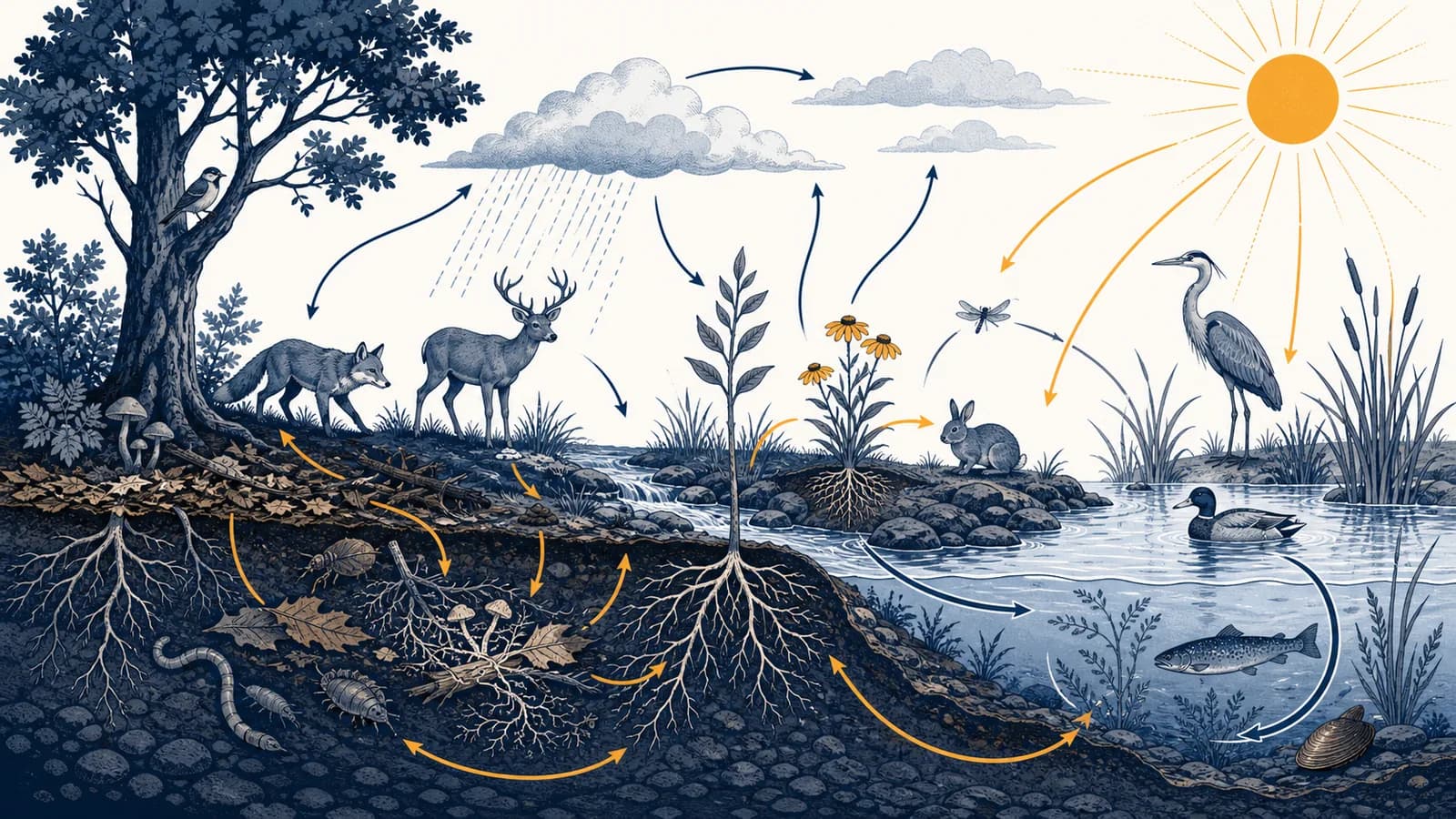
Ecology is a branch of biology that explains how organisms interact with one another and with their physical environment, in the context of living systems. It asks how ecosystems work, how energy moves through food chains and food webs, why populations grow or shrink, how communities change, and what maintains biodiversity. The field exists because no organism survives alone: every living thing depends on resources, conditions, and other organisms. Ecology connects those dependencies into testable explanations. It can explain why algae cover a lake, why a predator changes a forest, or why one species thrives in a city while another disappears.
What ecology actually is
Ecology is the scientific study of relationships among organisms and between organisms and their nonliving surroundings. Ecologists measure those relationships at several scales, then use observations, experiments, and models to explain patterns such as abundance, distribution, competition, and ecosystem change.
An ecological explanation links a pattern to a mechanism. Suppose fewer trout live in one stretch of river than in another. Counting the fish establishes the pattern. Ecology asks what produces it. The warmer stretch may hold less dissolved oxygen. Silt may cover gravel where trout lay eggs. A dam may block migration. An introduced predator may eat young fish. Several causes can act together, so ecologists compare sites, measure conditions, and test competing explanations.
The living parts of a system are called biotic factors. They include prey, predators, competitors, parasites, decomposers, and potential mates. The nonliving parts are abiotic factors, such as temperature, water, light, salinity, soil texture, oxygen, fire, and wind. The boundary is useful, but the two sides constantly affect each other. Tree roots alter soil structure. Earthworms mix organic matter into mineral soil. Beavers slow water and create ponds.
There are fewer trout in the warmer reach of the stream.
Higher temperature reduces the oxygen available to trout while also changing food supply and disease risk, which lowers survival or drives fish elsewhere.
Ecology sits inside the wider study of Biology, but it often borrows tools from chemistry, physics, geography, mathematics, and computing. A water sample may require chemical analysis. A migration map may come from satellite tags. A population forecast may depend on a mathematical model. The subject is defined by its questions, not by one instrument.
How ecological levels fit together
Ecologists organize living systems into nested levels: an organism belongs to a population, interacting populations form a community, and a community plus its physical environment forms an ecosystem. Larger regions contain many ecosystems connected by climate, water, movement, and evolution.
An organism is one individual living thing. A population is a group of the same species living in the same area at the same time. A community contains all the populations that interact in an area. An ecosystem includes that community and the flows of energy and matter through its physical surroundings. A biome is a broad ecological region shaped mainly by climate and dominant vegetation, such as tundra or tropical rainforest. The biosphere is the sum of all ecosystems on Earth.
The levels are nested, but causes can travel in either direction. A mutation that lets one plant tolerate salty soil begins within organisms and may eventually change a population. A regional drought acts across many ecosystems and changes the survival of individual plants. Ecologists therefore choose a scale that matches the question, then check whether processes at another scale could alter the answer.
Scale also includes time. A pulse of fertilizer can change a pond within days. Forest succession can take decades or longer. Evolution can change populations across generations, sometimes quickly when selection is strong. A study that lasts one afternoon may accurately measure insect visits but miss seasonal migration, rare storms, and delayed effects.
An ecosystem is not defined by size. A rotting log can be studied as an ecosystem, and so can an ocean basin. The useful boundary is the one that captures the processes being investigated.
How energy moves through an ecosystem
Energy enters most ecosystems as sunlight, becomes chemical energy when producers build organic molecules, and passes through consumers and decomposers. At every transfer, organisms use much of that energy for metabolism and release heat, so less remains available at higher trophic levels.
Plants, algae, and some bacteria are primary producers. Through photosynthesis, they use light energy to assemble carbon dioxide and water into energy rich organic compounds. The stored chemical energy can support new leaves, roots, offspring, and defensive chemicals. A herbivore obtains some of it by eating plant tissue. A predator obtains a smaller share by eating the herbivore.
A trophic level is a feeding position, not a permanent label attached to a species. A person eating beans acts as a primary consumer. The same person eating a fish that ate smaller animals occupies a higher trophic level in that food chain. Omnivores can feed at several levels, which is one reason real food webs are more accurate than simple chains.
Textbooks often use a rough ten percent transfer rule to illustrate energy loss between trophic levels. It is a teaching approximation, not a universal law. Transfer efficiency varies with the organisms, food quality, temperature, and what is measured. If producers store 10,000 kilojoules and the worked example assumes 10 percent passes at each step, herbivores receive 1,000 kilojoules, their predators receive 100, and the next level receives 10.
If herbivores store 800 kJ from 8,000 kJ of plant production, the transfer efficiency is 10%.
Energy is not recycled in an ecosystem. It enters, changes form, and eventually spreads into the surroundings as heat. Matter behaves differently. Carbon atoms and nitrogen atoms can be used repeatedly as organisms grow, die, decompose, and are eaten. Confusing energy flow with nutrient cycling hides one of ecology's most important distinctions.
How matter cycles through living and nonliving stores
Matter cycles when biological, chemical, and physical processes move elements among organisms, soil, water, air, and rock. Producers take up usable forms, food webs redistribute them, and waste or decomposition returns them for reuse, although some stores hold material for long periods.
Consider carbon. A plant takes carbon dioxide from the air during photosynthesis and uses the carbon to build sugars and other molecules. A caterpillar eats the leaf. Both plant and caterpillar release carbon dioxide through cellular respiration. If either dies, decomposers consume the remains and release more carbon. Some carbon enters soil, water, sediments, or long lived wood instead of returning immediately to the atmosphere.
Nitrogen follows a different route because most organisms cannot use the nitrogen gas that makes up most of the atmosphere. Nitrogen fixing bacteria convert it into compounds that can enter food webs. Other microbes transform nitrogen compounds during decomposition, nitrification, and denitrification. The details of these transformations belong partly to the biology of microbes and decomposition, because bacteria and archaea perform many chemical steps that plants and animals cannot.
A producer absorbs an available nutrient from air, water, or soil and incorporates it into living tissue.
Feeding moves nutrient atoms through the food web, while organisms use them to build cells and molecules.
Excretion, respiration, death, and decomposition return matter to nonliving stores in chemically altered forms.
The material may be taken up again quickly or remain in wood, deep soil, sediment, rock, ocean water, or the atmosphere.
Human actions can change the rate and direction of a cycle. Burning fuel rapidly transfers carbon from geological storage to the atmosphere. Applying nitrogen fertilizer adds biologically available nitrogen to fields. Rain and irrigation can then carry unused nitrate into streams, where extra nutrients may stimulate algal growth. When microbes decompose the algae, their respiration consumes dissolved oxygen. Fish can be stressed or killed even though the original input was a plant nutrient.
How populations grow, shrink, and level off
A population changes through births, deaths, immigration, and emigration. Its growth rate depends on how those flows balance, while food, space, disease, predation, weather, and human activity determine how many individuals survive and reproduce under particular conditions.
The basic population balance is bookkeeping. Births and immigrants add individuals. Deaths and emigrants remove them. If a pond begins with 100 frogs, records 24 births and 5 arrivals, then loses 10 frogs to death and 9 to departure, it ends with 110 frogs. The arithmetic is certain if the counts are correct. The ecological challenge is measuring hidden movements and explaining why each rate changed.
When resources are abundant, a population can show approximately exponential growth for a time. Each reproducing individual contributes offspring, and those offspring may later reproduce. The increase compounds. Unlimited exponential growth cannot continue in a finite system. Food becomes harder to find, territories fill, waste accumulates, or infection spreads more easily.
For the frogs, , so rises from 100 to 110.
Carrying capacity is the population size that a particular environment can support over time under stated conditions. It is not a fixed number carved into nature. Rainfall can increase plant food. A new disease can reduce survival. Habitat restoration can add nesting sites. The carrying capacity changes when the environment changes.
Density dependent effects strengthen as population density rises. Competition for territories and transmission of some infections are common examples. Density independent events, such as a severe freeze or volcanic eruption, can reduce a population regardless of how crowded it was. The categories describe how the effect relates to density, not how serious it is.
How niches and species interactions shape communities
Niches describe how species use their surroundings, while interactions determine how each species changes the success of others. Together, competition, consumption, cooperation, resource use, and environmental tolerance help determine which populations coexist and how a community responds when conditions change.
Niche versus habitat
A habitat is the physical place where an organism lives, while a niche is its way of living there, including the resources it uses, conditions it tolerates, timing of activity, and interactions with other species. Several species can share habitat without occupying identical niches.
A woodland is habitat for an owl, a woodpecker, a tick, and a fungus. Their niches differ. The owl hunts small animals, often in low light. The woodpecker searches bark and wood for invertebrates and may excavate cavities. The tick takes blood from hosts. The fungus digests dead material. Location alone does not describe these ecological roles.
An organism's fundamental niche includes the conditions and resources it could use without competitors, predators, or other biological restrictions. Its realized niche is the narrower range it actually occupies when those interactions occur. Experiments can reveal the difference. If one barnacle species spreads lower on a shore only after a competing species is removed, competition had restricted its realized niche.
The address: the forest canopy, stream gravel, salt marsh, human intestine, or underside of a leaf.
The mode of life: what the organism consumes, what consumes it, when it is active, and how it changes its surroundings.
Niche overlap helps explain competition. If two species rely on the same limiting resource in the same place and time, each reduces what remains for the other. Coexistence becomes more likely if they divide the resource. Birds may feed at different heights in the same tree, take different seed sizes, or forage at different times.
A niche is therefore not simply an organism's “job.” That shortcut can help at first, but a full niche includes temperature limits, water needs, breeding sites, vulnerability to enemies, and effects on the environment. It is a multidimensional set of requirements and relationships.
How species interactions reshape communities
Species interactions change survival, reproduction, abundance, and behavior within a community. Competition harms both participants, consumption benefits one at the other's expense, and mutualism benefits both. The strength and direction of an interaction can change with conditions and life stage.
Competition can happen within or between species
Competition occurs when organisms reduce one another's access to a limited resource. Oak seedlings can compete for light, water, and soil nutrients. Members of the same species often overlap strongly in their needs, but different species also compete. Competition may be direct, as in territorial fighting, or indirect, as when one plant absorbs water before another can reach it.
Predation can affect organisms the predator never eats
Predation changes prey numbers and prey behavior, with effects that can spread through a food web. If a predator reduces an abundant herbivore, plants may experience less grazing. The predator can also make herbivores avoid exposed feeding areas. This chain of direct and indirect effects is called a trophic cascade when it passes across trophic levels.
Parasitism usually depends on keeping the host alive for a time
A parasite obtains resources from a host and lowers the host's fitness. Ticks take blood, tapeworms absorb nutrients, and parasitic plants draw water or sugars from other plants. Parasites can alter food webs by changing host behavior, reproductive success, or vulnerability to predators.
Mutualism benefits both partners but still involves exchange
Mutualism is an interaction in which both species gain a benefit under the conditions being studied. A pollinating insect receives food while a plant receives pollen transfer. Fungi associated with roots can receive sugars while helping plants acquire mineral nutrients. If conditions change, the costs and benefits can change too.
Community effects are rarely captured by counting pairs alone. Removing one species can release a competitor, deprive a predator, or interrupt pollination. A keystone species has an effect on community structure that is large relative to its abundance. “Keystone” does not mean most common, strongest, or morally valuable. It describes the size of an ecological effect.
How ecological succession rebuilds a community
Ecological succession is directional change in community composition after new habitat appears or disturbance alters an existing community. Colonists modify resources and conditions, later species arrive or recover, and repeated interactions produce a changing mosaic rather than a guaranteed final state.
Primary succession begins where a surface lacks developed soil, such as newly exposed rock. Microbes, lichens, and plants that tolerate harsh conditions can trap particles and add organic matter. Soil formation permits other species to establish. Secondary succession begins after disturbance where soil, seeds, roots, microbes, or surviving organisms remain, as after many fires, storms, or abandoned fields.
Lava, retreating ice, fire, wind, farming, or another force creates open space and alters resources.
Seeds disperse in, buried roots resprout, mobile animals return, and microbes use newly available material.
They shade the surface, stabilize soil, add litter, consume resources, and create shelter or competition.
Some later arrivals replace early species, while repeated disturbance maintains patches at different stages.
The older idea of succession as a fixed march toward one permanent climax community is often too simple. Disturbances vary in severity and frequency. Seeds arrive by chance. Grazers favor some plants over others. Climate shifts. Many ecosystems are mosaics of patches with different histories.
Disturbance is not automatically damage. Some grasslands and forests contain species adapted to recurring fire. Fire can remove accumulated litter, release nutrients, open seed cones, or create sunny gaps. Yet an unusually frequent or intense fire can prevent recovery. Ecologists ask about the disturbance regime: its type, size, intensity, season, and recurrence.
How ecology shows up in farms, cities, and public health
Applied ecology uses knowledge of populations, interactions, nutrient cycles, and disturbance to make decisions in managed environments. It guides pest control, habitat design, disease prevention, restoration, fisheries, water treatment, and planning under changing climate and land use.
A farm is an ecosystem with deliberate inputs and removals
Farm ecology tracks how crops, soil organisms, pests, predators, water, and nutrients interact. Fertilizer can raise crop growth but also leave soluble nutrients vulnerable to runoff. Flowering field margins may provide food or shelter for pollinators and natural enemies of pests. Crop rotation can interrupt the life cycles of organisms tied to one host.
Integrated pest management begins with identification and monitoring, then combines biological, physical, cultural, and chemical controls. A pesticide may kill a pest, but selection favors resistant individuals if resistance traits already vary in the population. Repeated use can therefore change the pest population over generations, connecting ecology with inheritance, variation, and natural selection.
A city contains habitat, corridors, barriers, and heat
Urban ecology studies living systems in places built densely for people. Buildings create nesting ledges and barriers. Streetlights alter night behavior. Hard surfaces speed runoff and store heat. Parks, gardens, railway edges, and streams can serve as habitat or movement corridors. The arrangement of green space may matter as much as its total area.
A council wants fewer floods and cooler summer streets. Ecological design can combine shade trees, rain gardens, permeable ground, and connected planting. The plan must match tree species to soil volume and water supply, then monitor survival. Planting counts alone do not show whether the intended functions develop.
Disease risk depends on contact among hosts, vectors, and environments
Disease ecology explains how pathogens move through populations and how environmental conditions affect transmission. Standing water can provide breeding habitat for some mosquito vectors. Host density can change contact rates. Temperature can alter vector activity and pathogen development. These links do not mean one environmental change always produces one disease outcome, because immunity, behavior, sanitation, and health care also matter.
Managers use ecological evidence by comparing actions and monitoring responses. A restoration team may fence grazing animals from one stream reach but not another, then measure vegetation, bank erosion, water temperature, and aquatic insects over time. Good monitoring tests whether the mechanism worked, not only whether the project was completed.
What biodiversity actually measures
Biodiversity describes variation in life at genetic, species, and ecosystem levels. Ecologists measure more than a species count because communities with the same richness can differ greatly in abundance, relatedness, function, and distribution across space.
Species richness is the number of species present. Evenness describes how evenly individuals are distributed among those species. Imagine two ponds with four insect species and 100 insects each. Pond A has 25 individuals of every species. Pond B has 97 of one species and one of each other species. Their richness is equal, but Pond A is much more even.
Genetic diversity is variation within and among populations of a species. It can affect the range of responses available when conditions change. Ecosystem diversity concerns differences among habitats, communities, and ecological processes across a region. Functional diversity concerns what organisms do, such as pollination, nitrogen fixation, grazing, or wood decomposition.
Biodiversity can influence ecosystem function, but slogans hide the mechanism. Two plant species may use water at different soil depths. If one suffers during drought, the other may continue growing. Several pollinator species may operate in different weather or seasons. Such differences can spread risk, but species are not interchangeable parts, and adding a species does not guarantee a particular benefit.
Measuring biodiversity also depends on sampling. A researcher might place quadrats at random points, record every plant inside them, and compare repeated surveys. Birds may require timed counts or sound recordings. Tiny soil organisms may require DNA based detection. Each method misses something, so the sampling design must match the organisms and the question.
How ecology explains invasions and climate change
Ecology explains rapid environmental change by tracing how altered conditions, new species, and disturbed connections affect survival and reproduction. Biological invasions and climate change differ in cause, but both can reorganize ranges, interactions, food webs, and ecosystem processes.
How invasive species become ecological problems
An invasive species is a nonnative organism that spreads and causes ecological, economic, or health harm. Most introduced species do not become invasive, and origin alone does not predict impact. Problems arise when establishment, rapid spread, and damaging interactions occur together.
Transport by people can move organisms across barriers they would rarely cross unaided. Cargo, horticulture, pets, soil, ships, and canals all create routes. After arrival, a species still must survive, reproduce, and disperse. Abundant resources, repeated introductions, disturbed habitat, or release from familiar enemies may help, but no single explanation fits every invasion.
Impact comes through mechanism. An introduced predator may encounter prey with few defenses. A plant may form dense cover that changes light near the ground. An aquatic filter feeder may remove suspended food and redirect nutrients. A pathogen may reach hosts that lack prior exposure. Management should target the mechanism and invasion stage, since preventing arrival differs from containing a small population or reducing harm after wide establishment.
Nonnative does not automatically mean invasive. The useful questions are whether the organism spreads, what measurable harm it causes, and which ecological process produces that harm.
How climate change affects ecosystems
Climate change alters ecological conditions by shifting temperature, rainfall, snow, ice, sea level, ocean chemistry, and extreme events. Species respond through movement, timing changes, acclimation, evolution, or population decline, while interactions can change when partners respond at different rates.
A warmer average is only one part of the mechanism. Earlier spring warmth may trigger flowering before a pollinator becomes active. Reduced snow cover may expose soil and roots to winter temperature swings. Marine heat can push organisms beyond physiological limits. Higher carbon dioxide dissolving into seawater changes carbonate chemistry, which affects organisms that build calcium carbonate structures.
Range shifts are constrained by geography and habitat. A mountain species can move uphill only until no higher ground remains. A woodland species may be unable to cross farms, roads, or cities to reach cooler habitat. Mobile adults do not guarantee mobile populations if eggs, seeds, nesting sites, or food partners cannot move too.
Ecologists separate exposure, the climatic change experienced, from sensitivity, how strongly the organism is affected, and adaptive capacity, its ability to cope through behavior, physiology, dispersal, or evolution. This framework helps explain why two species in the same place can face different risks.
Four mistakes people make with ecology
Common ecological mistakes come from treating variable systems as fixed, mistaking correlation for cause, assigning moral labels to natural interactions, or assuming every intervention has only its intended effect. Better reasoning names the mechanism, scale, evidence, and uncertainty in each claim.
1. Treating balance as a permanent state
Ecosystems can persist while their populations and conditions keep changing. Seasons alter food and temperature. Disturbance creates patches. Predator and prey numbers may fluctuate. Stability can mean resistance to change, recovery after change, or low variation, and these are different properties. Calling nature “in balance” without defining the measure explains little.
2. Assuming correlation identifies the cause
Two variables changing together do not establish which process connects them. A bird decline and pesticide use might occur at the same time, but habitat loss, disease, weather, or changing observation effort could also contribute. Experiments, before and after comparisons, matched sites, and mechanistic measurements help distinguish explanations.
3. Calling predators bad and prey good
Ecological roles are descriptions, not moral verdicts. Predators kill prey, parasites harm hosts, and competitors reduce access to resources. Those interactions can also limit dominant populations, redirect behavior, and change community composition. Management decisions involve human values, but the underlying mechanisms should be described accurately.
4. Counting an action instead of its outcome
An ecological project succeeds only if the desired process or condition changes. The number of seedlings planted is an activity measure. Survival, canopy growth, temperature reduction, habitat use, or erosion control are outcome measures. Monitoring must continue long enough to detect failure, delayed effects, and maintenance needs.
The takeaway: Ask four things of an ecological claim: What changed, through which mechanism, at what spatial and time scale, and compared with what?
Ecology makes the rest of biology visible in place
Ecology connects cells, organisms, inheritance, behavior, and evolution to the environments where survival and reproduction actually happen. It turns a list of species into a system of causes, constraints, transfers, and feedbacks that can be observed and tested.
A leaf's stomata control water loss at the scale of cells, but their behavior also affects a plant's drought response and the water cycle of a forest. The mechanisms behind that first step are developed in how plants capture resources and regulate growth. Differences among individual plants can then alter competition, herbivore food, fire behavior, and which genes reach the next generation.
The same connections appear close to home. Notice where moss grows on a wall, which flowers receive insects at different hours, where rainwater pools after a storm, or which birds use a hedge instead of open pavement. Form a possible mechanism, identify a comparison, and decide what evidence would change your mind. That habit is ecology in practice.