


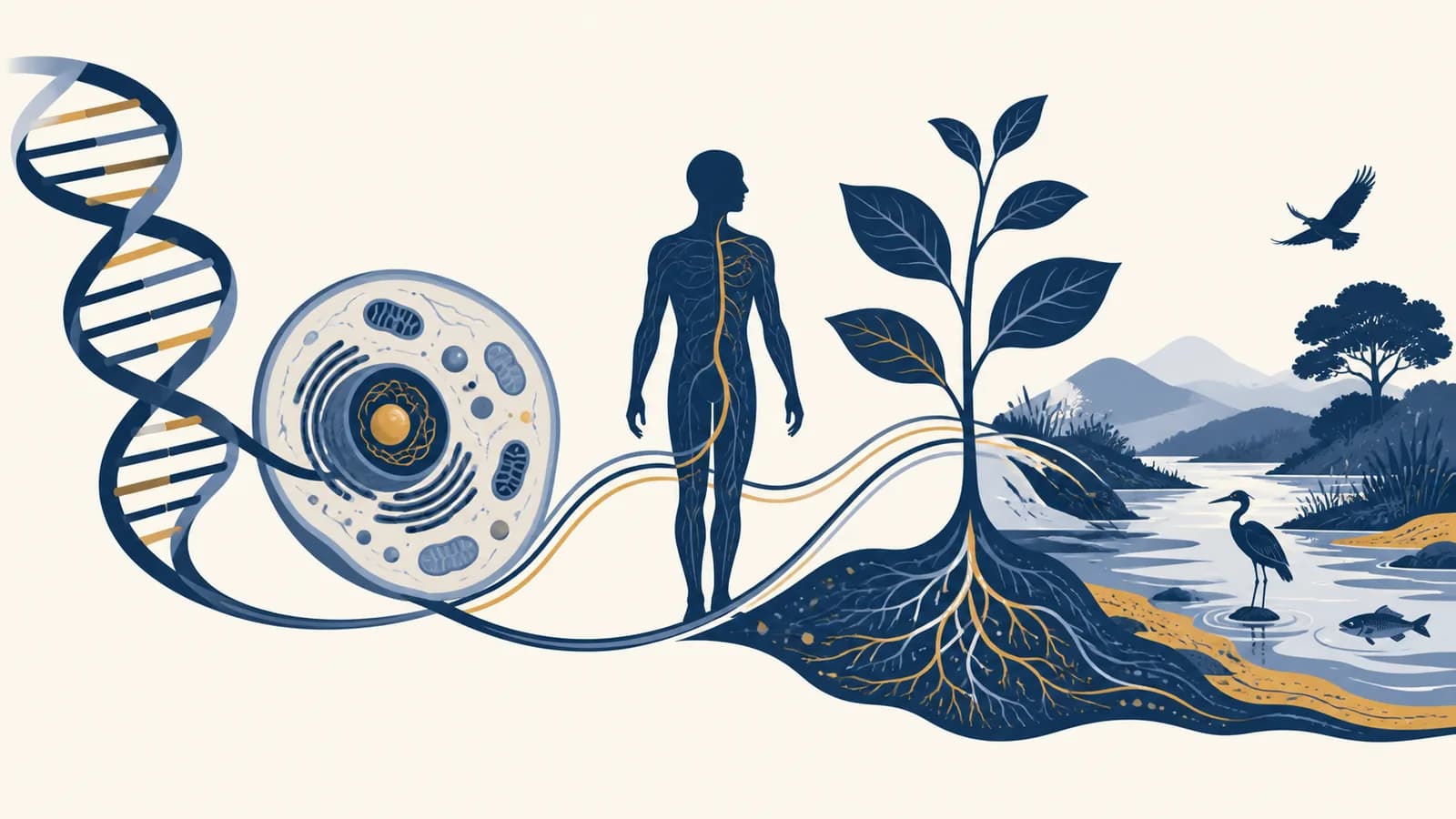
Biology explains how living systems work
Biology is the study of living systems that maintain themselves, reproduce, change and interact, in the context of Earth’s environments. It answers questions about what organisms are made of, how traits pass between generations, why bodies become ill, how species change and how living things affect one another.
The subject spans several scales. Molecules join to make cell structures. Cells cooperate in tissues and organs. Organisms exchange matter, energy and information with their surroundings. Populations change across generations, while communities reshape soil, water and air. Each scale has its own useful concepts, but no scale operates alone.
This sequence is a map, not a ladder of importance. A mutation in one DNA molecule can alter a protein, change a cell, affect an animal’s survival and become more common in a population. The reverse direction matters too. A drought changes which organisms survive, which hormones they release and which genes their cells activate.
Biologists look for mechanisms that can be tested. “The plant grew toward the window” is an observation. A biological explanation identifies how light receptors affect the distribution of a growth signal, how cells on one side elongate and how that unequal growth bends the stem. Naming a result is not the same as explaining it.
Life is organised chemistry. Living things obey the same physical laws as nonliving matter, but networks of reactions let them regulate internal conditions, use energy, store information and reproduce.
No single property gives a perfect border around life. A mule is alive but usually cannot reproduce. A seed may be inactive for a long period but can resume metabolism. Viruses contain genetic information and evolve, yet they depend on host cells to copy themselves. Biologists therefore use a cluster of features and state clearly which definition fits the question.
Cells are the working units of life
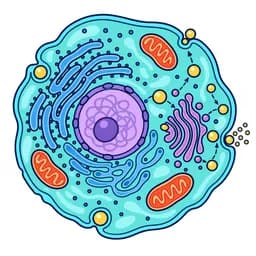
Every known organism consists of one or more cells, and every cell maintains a boundary, carries hereditary information and runs chemical reactions. Cell structures divide the work, while membranes control which substances cross between the cell and its surroundings.
A cell membrane is mainly a double layer of phospholipids with proteins embedded in it. Small nonpolar molecules can pass through the lipid region. Ions and many polar molecules need channels, carriers or energy-driven pumps. This selective movement lets a cell keep conditions inside different from conditions outside.
The page on how cells organise and divide follows membranes, organelles, transport and the cell cycle in greater detail. Those ideas explain why nerve cells can maintain electrical gradients, why intestinal cells absorb nutrients and why uncontrolled division can produce a tumour.
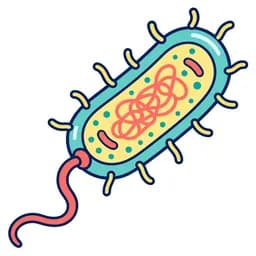
Prokaryotic cells, including bacteria and archaea, lack a nucleus. Eukaryotic cells keep most DNA inside a nucleus and contain membrane-bound compartments. Mitochondria transfer energy from food into ATP. In plants and algae, chloroplasts capture light energy. Ribosomes build proteins in every cellular form of life.
Particles move randomly, producing a net movement from higher concentration to lower concentration. The cell does not spend energy directly on this movement.
A membrane protein moves a substance against its concentration or electrical gradient. The process requires an energy source, often ATP or another ion gradient.
Cells also communicate. A signal molecule binds to a receptor with a compatible shape and chemical properties. The receptor changes, starting a chain of events inside the cell. That chain can open a channel, activate an enzyme or change gene expression. The same basic logic appears in taste, growth, inflammation and responses to medicines.
Genes store instructions, but cells decide how to use them
Hereditary information is encoded in DNA sequences, copied before cell division and passed to offspring. Genes influence traits by directing the production of functional RNA and proteins, while regulatory systems control where, when and how strongly each gene is used.
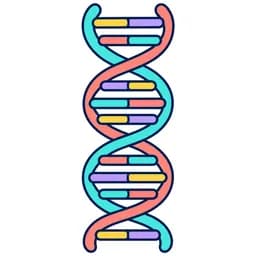
DNA is built from four nucleotide types. Their sequence can be transcribed into RNA. A ribosome reads messenger RNA in groups of three bases called codons and links amino acids into a protein. The protein then folds into a shape that allows it to bind, support, transport or catalyse.
These are textbook properties of the standard genetic code, not counts of genes. Several codons can specify the same amino acid, and stop codons end translation rather than adding an amino acid. Exceptions occur in some mitochondria and microorganisms, which is why biologists name the code being discussed.
Inheritance becomes visible when chromosome copies separate during meiosis and unite at fertilisation. The guide to patterns of inheritance and gene expression connects molecular events to family pedigrees, genetic variation and probability. It also explains why dominant does not mean common, beneficial or stronger.
Most traits are not controlled by one gene acting alone. Height, skin pigmentation and disease risk can involve many genetic variants, and environmental conditions can change the outcome. Even cells with nearly identical DNA become different tissues because they activate different sets of genes. A liver cell and a neuron use much of the same genetic library but consult different instructions.
If each parent passes a particular allele with probability , the probability that a child receives it from both is .
Life runs by transforming matter and energy
Organisms survive by taking in matter and energy, converting them through linked chemical reactions and releasing products. Enzymes make useful reactions fast enough, ATP transfers usable energy, and cycles of carbon, water and nutrients connect metabolism to the environment.
An enzyme binds particular reactants and lowers the activation energy needed for a reaction. It does not make an impossible reaction possible, and it is not used up each time it acts. Temperature, pH, reactant concentration and inhibitors can change its rate by affecting collisions or protein shape.
Photosynthesis stores energy by using light to build energy-rich carbon compounds. Cellular respiration releases usable energy by transferring electrons from fuel molecules through a series of reactions. Plants perform both processes: chloroplasts capture energy and carbon, while mitochondria help cells extract usable energy when needed.
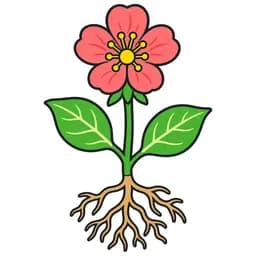
The arrows track energy transfers, not a reusable energy cycle. Energy eventually spreads as heat. Matter behaves differently: carbon atoms can move through air, plants, animals, decomposers, soil and water, then return to the atmosphere. The study of how plants capture resources and control growth explains roots, leaves, transport tissues and responses to light and gravity.
Microorganisms use a much wider range of energy sources than animals do. Some break down organic matter without oxygen. Others gain energy from inorganic chemicals. The section on bacteria, archaea, viruses and microscopic fungi shows how their metabolism drives decomposition, fermentation, disease and nutrient cycling.
A sealed compost bag warms because microorganisms break down organic molecules. Their respiration transfers some chemical energy into ATP and releases the rest as heat. Oxygen can become limited inside a compact, waterlogged pile, changing which microbes grow and which products accumulate.
Bodies keep changing conditions within workable limits
Multicellular organisms coordinate specialised cells so internal conditions remain compatible with life. Sensors detect change, control centres compare signals with a useful range, and effectors adjust processes such as temperature, water balance, blood glucose and gas exchange.
This regulation is called homeostasis. It does not hold the body at one unchanging value. Body temperature varies by location and time, hormone concentrations pulse, and blood glucose changes after a meal. Negative feedback reduces a departure from a regulated range. Positive feedback amplifies a process until a separate event stops it, as in blood clotting.
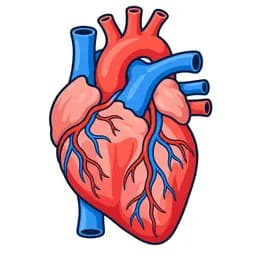
The overview of how organ systems cooperate in the human body links digestion, circulation, breathing, excretion and reproduction. Each system solves a transport or control problem, but its performance depends on the others. Lungs supply oxygen only if blood carries it and tissues receive it.
Receptors measure a condition, such as the concentration of glucose in blood.
Cells release a chemical signal or transmit an electrical one in response to the measurement.
Target cells alter transport, storage, movement or metabolism.
The response feeds back, so signal strength falls as the regulated condition returns toward its useful range.
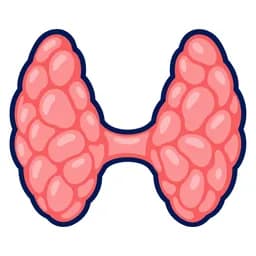
Hormones travel through body fluids and affect cells that carry the right receptors. The topic on hormones and long-range chemical control explains feedback loops involving growth, stress, reproduction and metabolism. Hormonal signalling is often slower than a nerve impulse, but its effects can spread widely and persist.
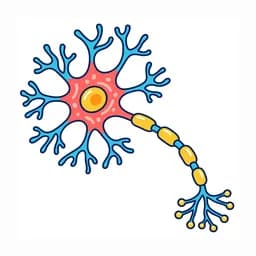
Nervous systems use electrical changes along cell membranes and chemical signalling across synapses. The guide to neurons, senses, movement and the brain follows how circuits turn inputs into responses. A thought or memory is not stored in a single floating molecule; it depends on changing activity and connections among cells.
Immune defence must recognise danger without attacking everything
Immune systems detect damage and infection, contain threats and build targeted responses. Protection depends on barriers, fast general reactions and slower recognition by specialised cells, all balanced against the risk of harming the body’s own tissues.
Skin and mucus block entry. If a pathogen crosses those barriers, innate immune cells recognise common signs of damage or microbial structure and release signals that promote inflammation. Increased blood flow and vessel permeability help defensive cells and molecules reach the affected tissue, but excessive inflammation can injure healthy cells.
Adaptive immunity adds specificity. B cells can produce antibodies whose binding sites match particular molecular features. T cells help coordinate responses or kill infected cells displaying particular fragments. Some activated cells persist as memory cells, allowing a faster response after later exposure. The page on immune recognition, vaccination and immune disorders traces these interactions without treating the immune system as a simple army.
These medicines target susceptible bacteria through features such as cell wall construction or bacterial ribosomes. They do not treat viral infections.
These interfere with stages of a virus’s replication cycle. Because viruses use host cell machinery, each treatment must target a usable difference or a virus-specific process.
Vaccination presents an antigen, or instructions that let cells make one, without requiring the person to experience the full disease. The resulting response can create immune memory. Vaccines do not form an invisible wall around the body, and no response is guaranteed in every individual. Their biological purpose is to prepare recognition and response before dangerous exposure.
Evolution explains both shared features and biological diversity
Evolution is change in inherited characteristics of populations across generations. Mutation and genetic reshuffling create variation, while natural selection, genetic drift and movement between populations change how common variants become. Over long periods, lineages can split and form new species.
Natural selection requires variation, inheritance and unequal reproductive success. If a heritable variant helps its carriers leave more surviving offspring in a particular environment, that variant tends to become more common. Individuals do not evolve because they need to. Populations change because inherited variants are passed on at different rates.
The account of natural selection, common ancestry and speciation shows how fossils, anatomy, geographical patterns and DNA sequences provide independent evidence. Evolution does not predict steady improvement. A trait is favoured only relative to current conditions and tradeoffs, and random events can strongly affect small populations.
The book presents natural selection as a mechanism for adaptation and argues that species share ancestry.
His pea experiments describe numerical patterns of inheritance, although their wider importance is recognised later.
The model, built using several lines of evidence including Rosalind Franklin’s X-ray diffraction work, suggests a mechanism for copying genetic information.
These documented dates mark changes in scientific explanation, not moments when nature changed. The modern evolutionary account combines inheritance with population-level processes. It also keeps developing as researchers compare genomes, observe microbial populations and test how development shapes the variations on which selection can act.
Antibiotic resistance is evolution observed. An antibiotic kills susceptible bacteria, while resistant variants survive and reproduce. The medicine does not teach an individual bacterium how to resist; it changes which inherited variants leave descendants.
Ecosystems are networks of feeding, competition and recycling
Ecology studies how organisms interact with one another and with physical conditions such as water, temperature and soil. Energy passes through food webs, matter cycles between living and nonliving stores, and population sizes change through births, deaths and movement.
A food chain is a simplified route through a food web. Producers build organic molecules, consumers obtain them by feeding, and decomposers break down dead material and waste. Organisms often occupy several roles. An omnivore can feed at different levels, while fungi may partner with roots as well as decompose matter.
The guide to populations, food webs and ecosystem change examines competition, predation, mutualism and disturbance. It also separates a habitat, the place an organism lives, from a niche, the set of resources, conditions and interactions that shape its way of living.
Population growth depends on birth, death, immigration and emigration. Abundant resources can permit rapid increase for a time, but food shortage, disease, predation and limited space can slow it. Carrying capacity is therefore not a permanent magic number. It changes as the environment and the population’s resource use change.
A stream loses insect species below a discharge pipe. A biologist does not infer the cause from location alone. They compare sites, measure variables such as temperature and dissolved oxygen, identify possible pollutants, repeat sampling and check conditions upstream. The pattern generates hypotheses; controlled comparison tests them.
Ecological explanations matter in farming, fisheries, town planning and conservation. Removing one species can change several feeding relationships. Adding fertiliser can increase plant or algal growth, then cause oxygen loss when microbes decompose the extra biomass. Effective decisions identify the chain of effects and the evidence for each link.
Biology advances by testing explanations against living variation
Biologists turn observations into testable hypotheses, design comparisons that isolate likely causes, measure outcomes and judge uncertainty. Experiments are powerful, but field studies, medical records, genome comparisons and models are also needed when direct manipulation is impractical or unethical.
A good investigation defines the independent variable, the measured response and the factors held constant. A control group shows what happens without the tested change. Replication reveals how much outcomes vary, while random assignment reduces systematic differences between groups. Blinding can reduce the effect of expectations on measurement or treatment.
Describe the result expected if the proposed mechanism is correct.
Change the factor of interest while controlling plausible alternatives.
Collect enough independent observations to distinguish a pattern from ordinary biological differences.
Compare prediction with evidence, report limits and change the model when results disagree.
Correlation can support a hypothesis, but it does not by itself identify cause. If people who sleep less report more illness, poor sleep might contribute to illness, illness might disrupt sleep or another factor might affect both. Study design and additional evidence are needed to separate those possibilities.
Technology expands what can be tested. Microscopes reveal structures, sequencing reads genetic information and labelled molecules track movement through cells. The topic on using cells, enzymes and DNA as tools covers genetic engineering, cloning, fermentation and diagnostic tests. A technique can be scientifically effective while still raising separate questions about safety, access and consent.
Biology is commonly misunderstood as a list of fixed facts
Biology includes names and classifications, but its main work is explaining processes in systems that vary. Categories help organise evidence; they are not always sharp natural boxes, and a typical pattern does not mean every organism or person follows it.
School diagrams often show one tidy cell, one straight food chain or one gene for one trait. These models are useful starting points because they isolate a mechanism. Trouble begins when the simplification is mistaken for the whole system. Real membranes flex, food webs branch and gene effects depend on other genes and conditions.
Organisms contain traits because evolution planned what they would need, and every feature must be perfectly adapted to its current use.
Selection acts on available inherited variation. History, tradeoffs, chance and changing environments can leave features that are adequate, repurposed or harmful in some conditions.
Another mistake is treating biological influence as destiny. Genes can affect risk without fixing an outcome, and environments can affect bodies without making all differences learned. A biological explanation can include probabilities, feedback and multiple causes. The honest answer is often conditional: this factor changes the likelihood under these conditions.
Everyday labels can also mislead. “Natural” does not mean safe, since venoms and pathogens are natural. “Chemical” does not mean artificial, since water, oxygen and DNA are chemicals. “Theory” in science does not mean a casual guess. It means a broad explanatory framework supported and tested through evidence.
This sentence is a summary, not a quotation attributed to a scientist. Useful categories make patterns visible and predictions possible. Responsible biology also reports overlap, exceptions and measurement limits, especially when evidence informs medicine, education, criminal justice or public policy.
Biology connects evidence about life to decisions beyond the laboratory
Biology meets chemistry in metabolism, physics in movement and electrical signalling, mathematics in probability and population change, geography in species distribution, and social subjects wherever evidence about living systems informs law, money or public choices.
Chemistry explains why molecular shape affects binding and why energy transfers drive reactions. Physics explains fluid flow through blood vessels, light capture in eyes and leaves, and voltage changes across membranes. Mathematics makes inheritance probabilities, growth rates and uncertainty explicit. Computer science helps compare genomes and model interacting systems.
Geography links climate, terrain and human land use to habitats. Economics enters when limited money must be allocated among health programmes or conservation plans. History shows how evidence, institutions and social beliefs shaped medical practice and agricultural change. Law sets rules for clinical trials, genetic privacy, pollution and the treatment of animals.
A town considering mosquito control needs several kinds of evidence. Biology identifies the mosquito life cycle and disease transmission route. Chemistry describes an insecticide’s behaviour. Statistics tests whether cases changed. Economics compares costs, while law and ethics address consent, environmental harm and fair treatment.
Daily decisions use the same habits on a smaller scale. A health claim should name the outcome measured, the comparison group and the size of the uncertainty. A garden problem requires identifying the organism, its resource needs and the conditions that favour it. A news report about a new gene needs a distinction between association and mechanism.
Jobs use different slices of the subject. A laboratory technician follows methods that prevent contamination. A nurse monitors changing body systems. A plant breeder studies inherited variation, while an ecologist samples populations and a policy analyst compares evidence about risk. All need accurate observation and a willingness to revise an explanation.
The takeaway: Biology connects molecules, cells, organisms and ecosystems through mechanisms that can be tested. Its strongest answers state the scale, trace cause through a system, account for variation and show where the evidence ends.
The subject becomes most useful when its parts stay connected. Genes act through cells, bodies depend on microbes and environments, and populations carry the results into future generations. Biology gives a disciplined way to explain those connections and to make better decisions about living systems.