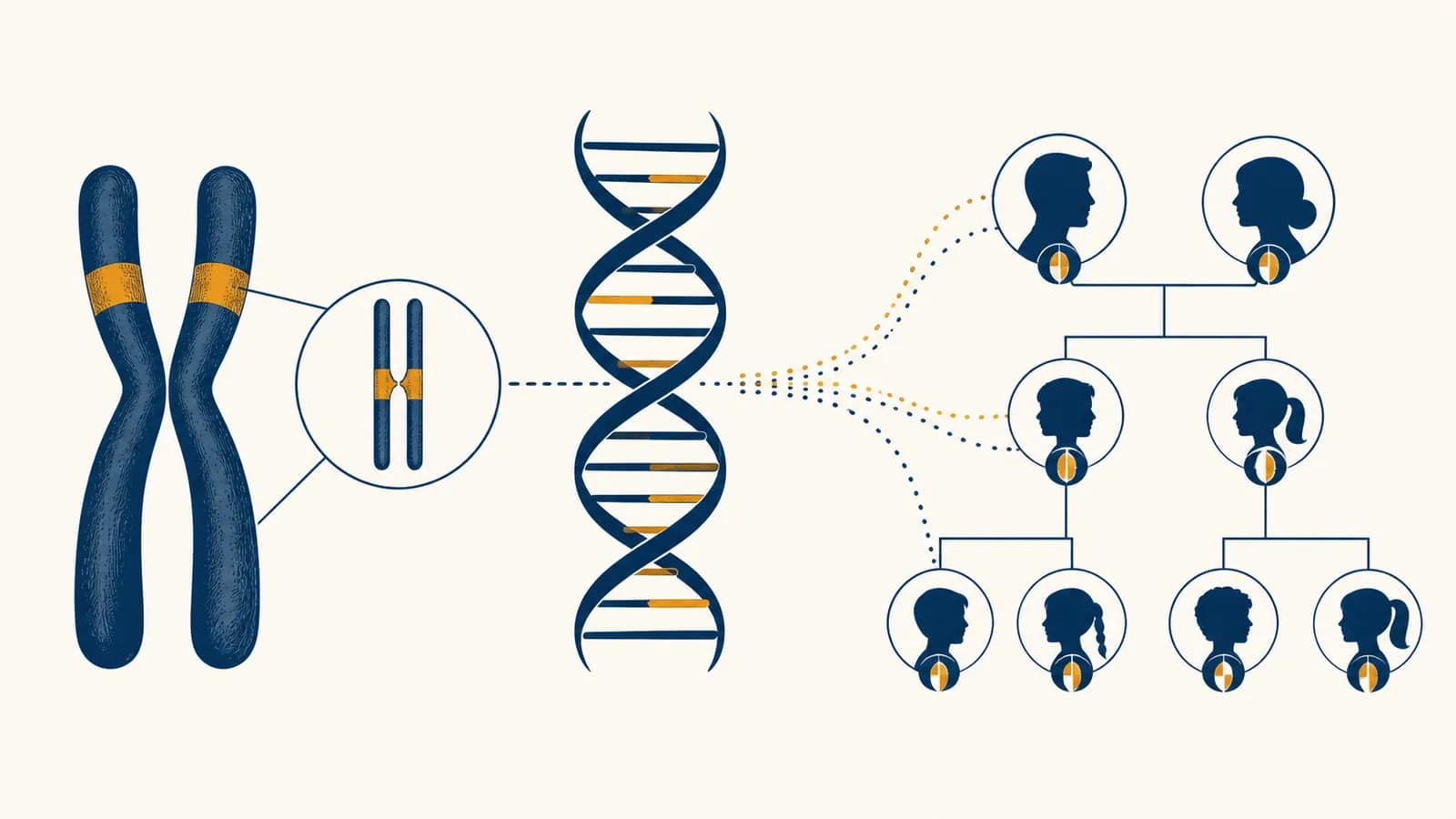
Genetics is a branch of biology that explains how biological information is inherited, expressed, and changed in living organisms. A genetics definition therefore begins with genes, DNA, chromosomes, heredity, and variation. The subject exists because cells need a reliable way to store instructions, copy them, use them, and pass them to new cells or offspring. Genetics explains why relatives resemble one another without being identical, how a DNA mutation can alter health, and why a trait may appear in one generation but seem absent in another.
What genetics actually is
Genetics is the study of inherited biological information: what the information is made of, how cells copy and read it, how parents transmit it, and how changes in it produce differences among individuals and populations.
The information is encoded mainly in DNA. A segment of DNA can contain instructions for making a functional RNA or a protein, plus nearby sequences that help control when that instruction is used. A gene is not a tiny finished trait. It is a piece of a molecular system that operates inside a cell and interacts with many other genes and with the environment.
Genetics sits inside Biology because inheritance affects every level of life. It helps explain the chemistry inside one cell, the development of an embryo, the resemblance between family members, and evolutionary change across a population.
Information is physical. A genetic instruction is a sequence of chemical units in DNA, not an invisible plan. Changing that sequence can change what a cell makes.
Consider the human ABO blood group. One gene, called ABO, has common versions that help produce A antigen, B antigen, or no functional antigen on red blood cells. A person inherits one version from each biological parent. The resulting pair helps determine blood type, but the outcome depends on how the versions interact. This is a small, useful model of genetics: a physical sequence, inherited copies, cellular activity, and an observable result.
How DNA stores and copies genetic information
DNA stores information in the order of four nucleotide bases, and cells copy that information by using each original strand as a template. Base-pairing rules let molecular machinery build a matching strand before a cell divides.
A DNA molecule contains two strands twisted into a double helix. Each strand has a sugar-phosphate backbone and a sequence of bases: adenine, thymine, cytosine, and guanine. Adenine pairs with thymine, while cytosine pairs with guanine. Because the partner of each base is constrained, either strand carries enough information to reconstruct the other.
During DNA replication, enzymes open a section of the helix. DNA polymerases add nucleotides to growing strands according to the pairing rules. Other enzymes proofread much of the new DNA and repair many errors. Replication is accurate, but it is not perfect. An uncorrected change can become a mutation that later copies inherit.
Enzymes separate the two DNA strands, exposing their base sequences.
Free nucleotides pair with the exposed bases, A with T and C with G.
Polymerases link nucleotides into new strands and correct many mismatches.
Cell division places a copied set of genetic information into each daughter cell.
DNA copying explains continuity within a body. Most cells in a person descend from the fertilized egg through repeated divisions. Their DNA is broadly similar because each division included replication. Differences still arise through mutation, gene regulation, and specialized cell development.
DNA versus genes versus chromosomes
DNA is the information-bearing molecule, a gene is a functional region within DNA, and a chromosome is one long DNA molecule packaged with proteins. These terms describe related objects at different scales, so they are not interchangeable.
A chromosome is imagined as one gene, and a gene is imagined as a complete instruction for one visible trait.
A chromosome contains many genes and regulatory regions. Most traits reflect several genes, cellular conditions, and environmental effects.
A typical human body cell has 46 chromosomes arranged as 23 pairs. One chromosome in each pair came from the egg and the other from the sperm. Human gametes usually contain 23 unpaired chromosomes, so fertilization restores the paired number. Mitochondria also contain a small amount of their own DNA, separate from the chromosomes in the nucleus.
| Term | Physical meaning | Example |
|---|---|---|
| DNA | A polymer whose base sequence stores information | The double-stranded molecule copied before cell division |
| Gene | A DNA region that contributes to a functional product | A region transcribed to help make beta-globin |
| Allele | A particular version of a genetic sequence | A common A, B, or O version at the ABO locus |
| Chromosome | A long DNA molecule packaged with proteins | Human chromosome 11, which carries the beta-globin gene |
| Genome | The full genetic material of an organism | Nuclear DNA plus mitochondrial DNA in a human cell |
The familiar X-shaped chromosome is a copied chromosome condensed for cell division. Each half is a sister chromatid containing a nearly identical DNA copy. For much of a cell's life, chromosomes are less tightly condensed and do not look like neat X shapes.
How genes become traits
Genes affect traits when cells transcribe DNA into RNA and often translate that RNA into protein. The products then participate in cell structures and chemical reactions, while regulatory signals control where, when, and how strongly genes are used.
In transcription, RNA polymerase uses one DNA strand as a template to build an RNA molecule. For a protein-coding gene, the cell processes the RNA into messenger RNA. A ribosome then reads the messenger RNA in three-base units called codons. Transfer RNAs bring amino acids, and the ribosome joins them into a chain that folds into a protein.
This pipeline is useful, but it is not the whole mechanism. Some genes produce functional RNAs that never become proteins. Proteins can be modified after translation. Regulatory proteins and chemical tags affect whether a gene is accessible. A liver cell and a neuron contain largely the same genome, yet they use different sets of genes. That selective expression helps them build different structures and perform different jobs. The cellular signaling behind those choices connects genetics with how hormones coordinate gene activity.
Melanin production requires a chain of cellular reactions. A genetic change that reduces the activity of one enzyme can alter how much pigment a cell makes. The visible result comes through chemistry, not because DNA itself has a color.
Genotype means the genetic variants an organism carries at one or more loci. Phenotype means an observable or measurable characteristic, such as enzyme activity, blood type, height, or disease symptoms. A phenotype can reflect genotype, environment, age, random events during development, and interactions among them.
How inheritance works
Inheritance works through meiosis and fertilization. Meiosis separates chromosome pairs into gametes, recombines DNA, and halves the chromosome number. Fertilization joins two gametes, giving an offspring one allele at each locus from each biological parent.
Before meiosis, a cell copies its chromosomes. Matching maternal and paternal chromosomes then pair. They can exchange corresponding DNA segments in crossing over. The first meiotic division separates homologous chromosome pairs. The second separates sister chromatids. The resulting gametes contain different combinations of alleles.
For a simple autosomal locus, suppose both parents have genotype Aa. Each can make gametes carrying A or a. Combining the possibilities gives AA, Aa, aA, and aa. Since Aa and aA are the same genotype, the expected ratio is one AA to two Aa to one aa.
For two Aa parents, each specific ordered pairing has probability one quarter.
The four outcomes are probabilities for each conception, not a schedule. Four children are not required to include one of every box. Each conception is a new sampling event, much as four coin tosses need not produce exactly two heads.
Dominance describes a relationship between alleles in a heterozygote. If Aa has the same measured phenotype as AA, A is dominant for that phenotype and a is recessive. Dominant does not mean common, beneficial, powerful, or guaranteed to spread.
How mutation and recombination produce variation
Genetic variation arises when DNA sequences change and when existing alleles are reshuffled. Mutation creates new variants, while crossing over, independent chromosome assortment, and random fertilization produce new combinations of variants already present in a population.
A substitution replaces one base with another. An insertion adds DNA, and a deletion removes it. Larger changes can duplicate, invert, or move chromosome segments. The effect depends on location and context. A mutation may change an amino acid, interrupt a regulatory site, shift a reading frame, or have no detectable effect.
Creates a new DNA sequence. It can occur through copying errors, DNA damage, mobile genetic elements, or other molecular events.
Rearranges existing sequence variants between paired chromosomes during meiosis. It creates new allele combinations without necessarily creating a new allele.
Only some mutations are heritable between generations. A mutation in a skin cell may spread to descendant skin cells, but it normally cannot enter a sperm or egg. A mutation in a cell lineage that produces gametes can be transmitted to offspring. This distinction separates somatic mutation from germline mutation.
Variation supplies the differences on which natural selection can act. Selection does not produce a needed mutation on demand. If a heritable variant changes survival or reproduction in a particular environment, its frequency may change across generations. Chance also changes allele frequencies, especially through genetic drift. The population consequences are developed further in population genetics and ecological change.
A mutation is not automatically harmful. Its effect may be harmful, beneficial, neutral, or dependent on the environment and on other alleles.
A classic context-dependent example involves variants in the beta-globin gene. Carrying two copies of a sickle cell disease allele can cause serious disease. Carrying one copy changes red blood cell biology in a way associated with protection against severe malaria. The same allele therefore cannot be assigned one universal value outside its genotype and environment.
How genetics shows up in medicine and forensics
Medical genetics uses family history, chromosome analysis, and DNA testing to investigate inherited conditions and treatment responses. Forensic genetics compares variable DNA regions to assess whether biological samples could share a source or indicate a biological relationship.
A clinician may order a targeted test when symptoms suggest variants in one gene, a panel when several genes can produce similar symptoms, or broader sequencing when the cause is unclear. A laboratory reads DNA, compares the sequence with a reference, checks data quality, and classifies detected variants using evidence such as population frequency, predicted molecular effect, family segregation, and clinical reports.
The test must match the medical decision, such as confirming a suspected diagnosis or identifying a drug response variant.
A laboratory extracts DNA from an appropriate sample and measures selected regions or a broader sequence.
Specialists combine molecular, clinical, family, and population evidence. A detected difference is not automatically a diagnosis.
A clinician and, when appropriate, a genetic counselor explain limits, possible next tests, and implications for relatives.
Screening and diagnosis answer different questions. A screening result estimates increased or decreased risk in a person without a confirmed condition. A diagnostic test investigates whether a condition is present. Both can produce false positives, false negatives, uncertain findings, or incidental findings. Consent and privacy matter because one person's result can reveal information about biological relatives.
A medicine is broken down by an enzyme, and variants in the enzyme's gene can affect how quickly that happens. A pharmacogenetic result may help a clinician select a dose or another drug, but kidney function, age, other medicines, and the quality of clinical evidence still belong in the decision.
Forensic laboratories often examine short tandem repeats, DNA regions where a short sequence is repeated a variable number of times. A profile across multiple regions can distinguish samples far better than one region can. A match does not by itself prove a crime, identify when material was deposited, or rule out laboratory error. Investigators must combine it with collection records and other evidence.
How genetics shows up in farming, conservation, and biotechnology
Applied genetics changes or tracks inherited variation to solve practical problems. Breeders select parents, conservation biologists measure diversity and relatedness, and biotechnology laboratories alter or transfer DNA to produce a chosen cellular function.
Plant and animal breeders do not need to see DNA directly to change a population. Repeatedly choosing parents with useful heritable traits can shift allele frequencies. DNA markers make selection more targeted by helping breeders track chromosome regions associated with disease resistance, yield, flavor, or other measured characteristics. Environment still matters, so lines must be tested under the conditions in which they will grow.
Conservation genetics can estimate relatedness, identify population structure, and detect low genetic diversity. Managers may use those results when planning breeding or habitat connections. A DNA result does not decide policy by itself. Population size, migration routes, disease, local adaptation, animal welfare, and community priorities also matter.
Experiments with pea plants describe consistent numerical patterns in inherited characteristics.
The model explains how base pairing can support information storage and copying.
A public international project produces a reference sequence covering nearly all euchromatic human DNA available with the technology of the time.
Genetic engineering directly changes DNA. A researcher can insert a gene, disable a gene, or edit a particular sequence. CRISPR systems can be programmed with a guide RNA that directs a DNA-cutting protein to a matching sequence. Repair after the cut can disrupt the target or install a designed change. Delivery, off-target changes, and unintended biological effects must then be tested. The laboratory methods and products belong to genetic engineering and biotechnology applications.
A DNA edit is a molecular change. A useful organism is the tested result of that change operating through cells, development, and environment.
The distinction matters in food, medicine, and research. Editing a sequence may be technically successful but fail to create the desired phenotype. It may also create an effect in one genetic background but not another. Researchers therefore confirm the sequence, measure gene activity, examine the organism, and compare it with suitable controls.
How pedigrees and probability answer family questions
Pedigrees record traits and biological relationships across generations, then use inheritance models to test which allele patterns fit the observations. They estimate possibilities and risks, but usually cannot identify a causal gene without additional evidence.
An autosomal dominant pattern often appears in successive generations, affects people of any sex, and can pass from an affected heterozygous parent to a child with probability one half. An autosomal recessive condition can appear in siblings whose parents show no symptoms because both parents are carriers. X-linked patterns depend on both the allele and the sex-chromosome combination inherited.
For an Aa by Aa recessive cross, an unaffected child has probability of being a carrier because two of the three unaffected genotype outcomes are Aa.
This calculation shows why a probability can change after new information arrives. Before phenotype is known, the chance of Aa is one half. Once an individual is known not to have the recessive aa phenotype, that outcome is removed. The remaining possibilities are AA, Aa, and aA, so two of three are carriers.
Real pedigrees can depart from clean textbook patterns. A person may carry a disease-associated variant but never develop symptoms, which is incomplete penetrance. Symptoms can differ in severity, which is variable expressivity. New mutation, mistaken family information, adoption, small family size, and conditions caused by several genes can also obscure a pattern.
How ancestry estimates and DNA matching work
Ancestry services compare selected parts of a person's DNA with reference datasets and with other customers. They infer statistical similarity and shared segments, so their categories and relationship estimates depend on the samples, algorithms, and family history available.
Most recent relative matching looks for long DNA segments that two people share. Close biological relatives tend to share more and longer segments because fewer generations of recombination separate them. More distant relatives may share a small amount or, at sufficiently distant relationships, no detectable segment at all.
Geographic ancestry estimates use people assigned to reference groups. An algorithm divides a customer's DNA into segments and estimates which reference groups each segment most resembles. Results can change when a company adds samples, redraws categories, or updates its model. A percentage is an estimate under that model, not a measurement of culture, nationality, or personal identity.
DNA can reveal unexpected relatives. Before uploading a sample, check who can access the data, whether it can be used for research or law enforcement, how deletion works, and what happens to the physical sample.
Mitochondrial DNA follows a direct maternal line because embryos normally receive their mitochondria from the egg. Y-chromosome testing follows a direct paternal line in people with a Y chromosome. Each traces only one narrow branch of a family tree. Autosomal DNA draws from many branches, but recombination makes the contribution from particular distant ancestors uneven.
Five mistakes people make with genetics
Most genetics errors come from treating probabilities as promises, genes as isolated commands, or categories as fixed natural boxes. Correct reasoning keeps the molecular mechanism, the inheritance pattern, and the limits of the evidence separate.
1. A dominant allele is assumed to be the most common
Dominance says how two alleles interact in a heterozygote for a defined phenotype. It says nothing by itself about population frequency. A dominant allele can be rare, and a recessive allele can be common. Frequency changes through selection, drift, migration, mutation, and population history.
2. A Punnett square is treated as a family schedule
A Punnett square gives expected probabilities under a stated model. It does not guarantee that four births will reproduce four boxes. It can also mislead if the trait involves multiple genes, linked loci, incomplete penetrance, unusual chromosome behavior, or environmental effects.
3. One gene is assumed to equal one trait
Some conditions are strongly influenced by variants in one gene, but even then symptoms can vary. Many familiar traits, including height and skin pigmentation, are polygenic. Each depends on variants at many loci, and environmental conditions add further variation. One gene can also influence several traits because its product acts in multiple tissues or pathways.
4. Genetic means inevitable
A genetic variant can be causal without producing the same outcome in every carrier. Risk variants alter probabilities. Disease-associated variants can show incomplete penetrance. Environment, age, sex, other genes, medical care, and chance events during development can change the phenotype. The exact mix depends on the trait.
5. Human genetic categories are treated as sharp racial boundaries
Human genetic variation is real, but socially defined racial categories do not divide humanity into discrete biological subspecies. Allele frequencies often vary gradually across geography, and people have mixed ancestry. For medicine, a patient's family history, exposures, measurements, and relevant variants are more informative than assuming biology from a broad label.
The takeaway: Start every genetics problem by naming the physical object, the process acting on it, and the scale of the claim. A DNA variant, an inherited probability, a cellular phenotype, and a population trend are connected, but they are not the same evidence.
Genetics connects molecules to populations
Genetics unites biology by connecting DNA chemistry with cell function, reproduction, organismal traits, and evolution. Following that chain turns inheritance from a pattern to memorize into a mechanism that can be tested at each level.
When you meet a genetic claim in a clinic, a court report, a food label, or a news story, ask four concrete questions. What sequence or chromosome is involved? How does it change RNA, protein, or cell behavior? How strong is the evidence connecting that change to a phenotype? Does the claim concern one person, a family, or a population?
Those questions expose missing steps. A variant can be measured accurately while its clinical meaning remains uncertain. A family pattern can suggest inheritance without identifying a gene. A population association can be genuine without predicting an individual's outcome. Good genetic reasoning preserves those boundaries, then connects them only with evidence.
The next useful observation can be simple. Notice which traits vary continuously rather than falling into boxes, which family resemblances skip generations, and which environmental changes alter a phenotype without changing DNA. Each case points back to the same working system: stored sequence, regulated expression, reproduction, variation, and selection.