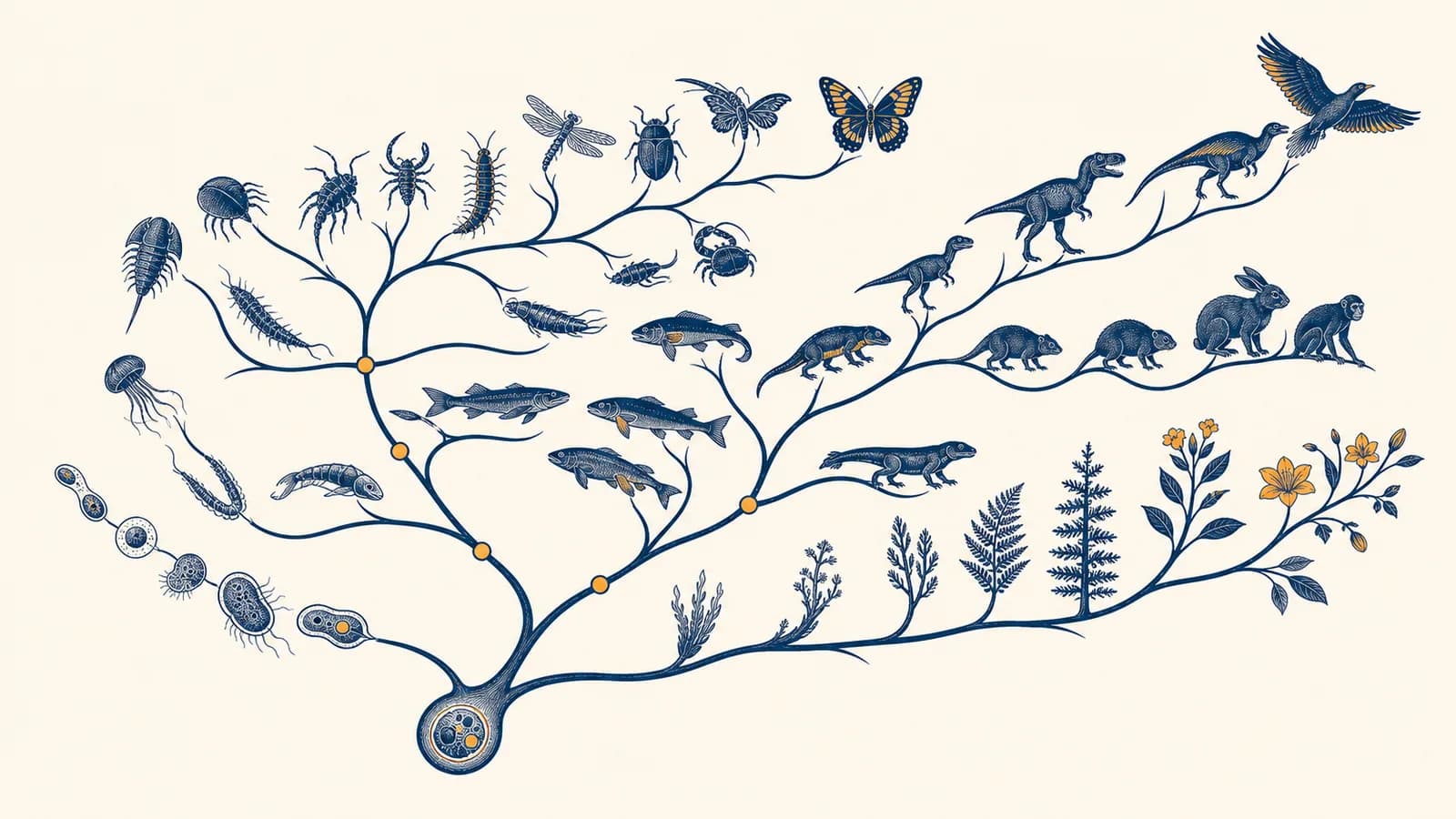
Evolution is a biological process that changes inherited traits in populations across generations, in the context of life reproducing in changing environments. The scientific theory of evolution explains how species change over time through natural selection, mutation, genetic drift, gene flow, and speciation. It exists because organisms differ, some differences are heritable, and individuals do not all leave the same number of surviving offspring. Evolution does not give organisms what they need. It records which inherited variants were copied into the next generation, then repeats that sorting over many generations.
What evolution actually is
Evolution is a change in the inherited composition of a population across generations. In genetic terms, it occurs when allele frequencies change. A population evolves even if no individual transforms and even if the change does not make the population better adapted.
An allele is a version of a gene or other inherited DNA sequence. Suppose a beetle population contains two alleles affecting shell color. If the brown allele accounts for 40 of every 100 copies in one generation and 55 of every 100 copies several generations later, that population has evolved. The definition says what changed. It does not yet say why.
Population, not individual. An individual beetle can grow, learn, heal, or age during its life. Evolution occurs when inherited variants become more or less common across generations in a population.
Several mechanisms can produce that change. Mutation creates new variants. Gene flow moves variants between populations. Genetic drift changes their frequencies by chance. Natural selection changes their frequencies because some inherited traits affect reproductive success. Nonrandom mating changes which allele combinations appear in offspring, although by itself it may alter genotype frequencies without changing allele frequencies.
The phrase theory of evolution does not mean an unsupported guess. In science, a theory is an explanatory framework that connects observations and makes testable predictions. Evolutionary theory connects inheritance, fossils, anatomy, development, geographical distribution, and directly observed changes in populations. It also links the study of Biology into one account of both life's similarities and its diversity.
How natural selection works
Natural selection works when individuals vary in an inherited trait and that variation affects survival or reproduction. Alleles linked to greater reproductive success tend to become more common, but only within the conditions that produced the advantage.
Individuals differ in traits such as enzyme shape, body size, flowering time, or behavior. Mutation and genetic recombination generate much of this variation.
A trait can respond to selection only if offspring tend to inherit the relevant differences. A scar is acquired, so the scar itself is not passed through DNA.
Predators, temperature, food, mates, disease, and competition affect which individuals leave offspring. The important outcome is successful reproduction, not simply staying alive longest.
If the advantageous variants are inherited, their alleles tend to occupy a larger share of the next generation's gene pool. Repetition can make the difference visible as adaptation.
Consider bacteria exposed to an antibiotic. Before treatment, a few cells may already carry a mutation or acquired resistance gene that reduces the drug's effect. The drug does not teach bacteria how to resist it. Susceptible cells die or stop reproducing, while resistant cells leave more descendants. Their inherited resistance becomes common in the surviving population.
Biologists call reproductive success fitness. Fitness is relative and local. A thick coat can raise fitness in a cold climate and lower it in a hot one. An allele that helps one sex attract mates might carry a survival cost. Selection therefore has no universal ranking of organisms and no fixed finish line.
How genes and populations change
Population genetics tracks evolution by counting alleles and the genotypes that contain them. Mutation supplies new alleles, recombination reshuffles existing ones, gene flow moves them, drift samples them by chance, and selection sorts them through unequal reproduction.
Diploid organisms carry two copies of most autosomal genes, one inherited from each parent. If a gene has alleles A and a, individuals can have genotypes AA, Aa, or aa. An allele can be common without being dominant, and a dominant allele can be rare. Dominance describes how alleles affect a trait in a heterozygote. It does not describe which allele will spread.
If 60 of 100 gene copies are A, then and .
The Hardy-Weinberg model gives a baseline for comparison. If a large population mates randomly and experiences no mutation, migration, selection, or drift, its expected genotype frequencies are for AA, for Aa, and for aa. Real populations rarely meet every condition. The value of the model is that a departure tells researchers which evolutionary causes to investigate.
Using and , the expected frequencies are for AA, for Aa, and for aa. These add to . In a sample of 100 individuals, that corresponds to expected counts of 36, 48, and 16. A persistent mismatch could signal selection, population structure, nonrandom mating, or another violated assumption.
Chance matters most in small populations. If a storm randomly kills most insects on an island, the survivors may carry an unrepresentative sample of the original alleles. This bottleneck can reduce genetic variation. If a few individuals establish a new population, their unusual sample creates a founder effect. Neither event needs an allele to be helpful.
Natural selection versus adaptation and acclimation
Natural selection is the sorting process, adaptation is an inherited feature or population change produced by selection, and acclimation is a reversible adjustment within one lifetime. Confusing them hides who changes, what is inherited, and how long the change takes.
Over generations, a high altitude population can evolve inherited differences affecting oxygen transport because some variants raise reproductive success in thin air.
After arriving at high altitude, one person may breathe faster and produce more red blood cells. Those bodily adjustments occur during that person's life.
An adaptation is not any useful feature. It is an inherited characteristic shaped by natural selection for a function in an ancestral environment. Bird feathers now serve flight, insulation, display, and protection. Evidence from fossils and development indicates that feathers existed before powered flight, so a feature can acquire a new function after it first evolves. Biologists call this co-option.
Adaptations also carry tradeoffs. A large peacock tail may attract mates while making escape harder. The human spine supports upright walking but is prone to mechanical strain. Selection modifies available structures rather than designing from scratch. Past history, developmental pathways, and competing demands constrain what can evolve.
Need does not cause a matching mutation. Mutations arise without regard to whether they would help. The environment changes which existing or newly arising variants leave more descendants.
Traits can also spread through sexual selection. If individuals with a color, song, or display gain more mates, alleles contributing to that trait may increase even when the trait costs energy or attracts predators. This is still natural selection in the broad sense because the difference lies in reproductive success.
How new species form
New species form when populations accumulate inherited differences and gene exchange between them falls enough for separate evolutionary paths to persist. Physical separation often starts the process, but ecological differences, mate choice, chromosome changes, and hybrid problems can also create reproductive isolation.
A species is often defined as a group whose members can interbreed and produce fertile offspring. That biological species concept works well for many sexually reproducing organisms, but not for fossils, organisms that reproduce asexually, or every case of hybridization. Researchers also use anatomical, ecological, and genetic definitions according to the evidence available.
Imagine a river dividing a mouse population. On one bank, dark rock favors mice that predators have trouble seeing. On the other, pale sand favors lighter fur. Mutations, drift, and mate preferences accumulate independently because few mice cross. Later contact does not guarantee reunion. Different courtship signals, breeding seasons, chromosome arrangements, or incompatible genes may prevent successful reproduction.
Isolation can occur without a geographic barrier. Two insect groups in the same area might begin mating on different host plants. If they emerge at different times and choose mates near their own host, gene flow falls. In plants, chromosome duplication can sometimes create reproductive isolation in a single generation because the new chromosome count pairs poorly with the ancestral count.
Speciation is branching, not a ladder. After a lineage splits, both branches continue evolving. One living species is usually not the ancestor of another living species. Humans and chimpanzees, for example, share an extinct common ancestor; neither modern species descended from the other.
How evidence shows evolution happened
Evolution is supported by independent evidence that converges on common descent and population change: dated fossils, shared anatomy, geographical patterns, DNA sequences, observed selection, and measured speciation. Each source tests a different prediction, and the patterns agree.
Fossils preserve ordered change
The fossil record places organisms in rock layers that can be ordered by superposition and dated with radioactive isotopes. Transitional fossils contain combinations predicted for changes between major groups. Tiktaalik, found in Arctic rocks dated to about 375 million years ago by established geological methods, combines fish features with a mobile neck and limb bones arranged like those of early land vertebrates.
Fossils do not form for most organisms, and erosion destroys many that do. A gap therefore does not imply that nothing lived during it. The useful test is whether discoveries occur in the predicted ages and environments. Paleontologists searching for forms near the fish to tetrapod transition targeted exposed rocks of the appropriate age, then found Tiktaalik there.
Anatomy and development preserve ancestry
Homologous structures share an underlying plan because they were inherited from a common ancestor, even when their current functions differ. A human arm, bat wing, whale flipper, and cat foreleg contain corresponding upper arm, forearm, wrist, and digit bones. Similarity alone is not enough. The detailed arrangement, development, and position make the ancestry claim testable.
DNA records relatedness
Closely related species generally share more DNA sequence variants and more matching genetic changes than distant relatives. Shared broken genes, inserted viral sequences at corresponding genome locations, and the same unusual mutations are especially informative because independent origin at the same place is less likely than inheritance from a common ancestor.
The book sets out extensive evidence for common descent and natural selection. Darwin did not know the molecular basis of inheritance.
Researchers reconnect Mendelian inheritance with observed variation, giving selection a mechanism for transmitting discrete inherited factors.
Mathematical models connect mutation, selection, drift, and gene flow with changes measured in wild and laboratory populations.
Direct observation completes the picture. Scientists can track allele frequencies in insects, fish, plants, viruses, and bacteria. They can compare populations before and after an environmental change, compete microbial strains under controlled conditions, and sequence descendants across generations. Evolutionary claims survive because they produce measurements that could have contradicted them.
How evolution shows up in medicine and farming
Evolution shapes medicine and farming whenever treatment, immunity, breeding, or pest control changes reproductive success. The practical task is to predict which variants will survive, how quickly they will spread, and what actions can slow unwanted adaptation.
A clinician sends a bacterial sample for culture and susceptibility testing. The laboratory grows the bacteria with different antibiotics. Results help identify a drug that inhibits this population, while avoiding an ineffective drug that would expose bacteria without controlling the infection.
Antibiotic resistance can arise through mutation or through genes transferred between bacteria. Every treatment creates selection, but resistance does not automatically appear after every dose. Risk depends on existing variation, population size, drug exposure, transmission, and biological costs. Using antibiotics only when indicated reduces unnecessary selection and preserves useful treatments.
Cancers also evolve within the body. A tumor contains cell lineages with different mutations. A drug may kill sensitive cells while a resistant lineage survives and expands. Combination therapies can make resistance harder because a cell may need several relevant defenses at once, although treatment design depends on cancer type and patient condition. This cellular evolution connects with how immune defenses recognize disease and change under pressure.
Vaccines do not cause a pathogen to plan an escape. They change the immune environment. Variants that spread despite existing immunity may gain a relative advantage, while many mutations do nothing useful or damage the pathogen. Surveillance teams compare genetic sequences and laboratory results to distinguish meaningful antigen changes from harmless variation.
Farmers and plant breeders also manage evolution. Repeated use of one herbicide can favor weeds carrying resistance alleles. Planting one crop variety across a large area can give a pathogen adapted to that variety many suitable hosts. Crop rotation, mixed control methods, resistant varieties, and refuges for susceptible insects can alter the selection pressures. These methods do not stop evolution. They change its likely direction and pace.
Selective breeding uses the same inheritance logic but with humans choosing which organisms reproduce. Dogs, maize, dairy cattle, and cabbages have changed because breeders repeatedly selected heritable traits. Artificial selection demonstrates how much variation populations contain, while natural selection differs in having no selecting agent with a goal.
How evolution shows up in ecosystems and daily decisions
Evolution changes ecological relationships, conservation choices, food production, and interpretations of health information. It appears wherever populations reproduce under pressure, so decisions about habitats, harvesting, pesticides, and disease control can become evolutionary experiments with real consequences.
Ecology and evolution act on different time scales, but those scales overlap. Predators change prey abundance, an ecological effect. If predators consistently catch slower prey and speed is heritable, prey allele frequencies may also change. Faster prey can then alter predator success. This feedback links evolution with how populations interact with each other and their environments.
Conservationists care about both head counts and genetic variation. A population can recover in number after a bottleneck yet retain little variation, which may limit its response to a new disease or climate shift. Moving individuals between isolated populations can restore gene flow, but managers must weigh benefits against disease transfer and disruption of local adaptations.
Fishing and hunting can impose selection when harvest consistently removes organisms with particular inherited traits. If large fish are taken before they reproduce, variants associated with earlier reproduction at smaller size may gain an advantage. Rules based only on current stock size can miss this evolutionary response. Size limits, seasonal closures, and protected areas alter which individuals survive to breed.
Daily decisions often involve claims that misuse evolutionary language. A product advertised as “designed by evolution” may still need clinical evidence. A claim that a behavior is “natural” does not show that it is healthy, fixed, or morally acceptable. Evolution describes origins and consequences; it does not supply ethical rules.
Read a resistance label as a population claim. “Resistant” means a tested population can survive an exposure that controls a susceptible comparison population. It does not mean every individual is invulnerable.
Evolutionary trees also affect practical identification. A tree is a hypothesis about branching ancestry, built from characters such as DNA sequences. Nodes represent common ancestors, and branch rotations do not change relationships. The closest relative is identified by the most recent shared ancestor, not by which tips sit next to each other on a page.
Four mistakes people make with evolution
Most errors about evolution come from assigning intention to a blind process, confusing individual change with population change, treating evolution as guaranteed improvement, or imagining living species arranged on a ladder. Each mistake makes a different prediction from the evidence.
1. Organisms evolve because they try
Effort can change an individual's strength or skill, but it does not direct mutations toward what descendants will need. Giraffes did not lengthen their necks by stretching and then pass the stretched tissue to offspring. Inherited differences in growth existed, and reproductive differences could change their frequency across generations.
2. Natural selection gives every trait a purpose
Some traits are side effects, products of drift, or remnants of ancestry. Blood is red because hemoglobin's chemistry absorbs and reflects particular wavelengths, not because redness itself must be useful. A feature needs evidence of selection before it is called an adaptation.
3. Evolution always produces progress
Evolution produces fit with current conditions, not inevitable complexity or perfection. Parasites can lose structures they no longer need. Cave animals can lose functional eyes when maintaining them brings costs without benefits. If conditions reverse, yesterday's adaptation can become today's disadvantage.
4. Humans are outside evolution
Human populations carry inherited variation and have changed across generations like other populations. Lactase persistence, disease related alleles, pigmentation, and high altitude physiology show recent selection in particular environments. Culture changes selection pressures, but it does not cancel inheritance, mutation, migration, or drift.
Species occupy higher or lower stages, and evolution aims toward humans.
Lineages split from common ancestors. Every living tip has survived the same span of time since its ancestors lived.
How fast does evolution happen?
Evolution can be detected within days in fast reproducing microbes or take millions of years to build large anatomical differences. Speed depends on generation time, heritable variation, population size, gene flow, and the strength and consistency of selection.
Calendar time alone is a poor clock because generations are the repeated opportunities for inheritance and sorting. Bacteria can pass through many generations while a long lived animal produces one. Strong selection on existing variation can shift allele frequencies quickly. Building a complex feature through many coordinated changes usually takes much longer.
Rapid evolution does not mean a whole species becomes unrecognizable overnight. A measurable change might be a small shift in average beak depth, flowering date, drug resistance, or allele frequency. Over longer spans, accumulated changes plus branching can produce the broad differences recognized in fossils and living groups.
Do individuals evolve?
Individuals do not evolve in the population genetic sense because their inherited gene pool is not replaced across generations. Individuals develop and acclimate. Populations evolve when the variants represented among reproducing members change in frequency over successive generations.
There is one useful complication. Cells inside an individual can form evolving populations. Bacteria in the gut reproduce and change; immune cell lineages undergo mutation and selection during an immune response; cancer cell lineages accumulate variants. The person still does not evolve into a new kind of organism, but cell populations within that person can evolve.
Learning also differs from biological evolution. A learned behavior may spread culturally within hours without a genetic change. Culture can then affect genetic selection. Dairy farming, for example, created an environment in which adults able to digest lactose could gain a nutritional advantage in some populations. Biological and cultural inheritance can interact without becoming the same process.
Evolution connects the rest of biology
Evolution connects molecular changes, organism traits, population patterns, and ecological relationships through inheritance across time. It turns biology from a catalogue of facts into a set of linked explanations that can be tested against DNA, bodies, environments, and history.
To analyze any evolutionary claim, identify the population, the inherited variation, the environmental condition, and the reproductive result. Then ask what alternative mechanism could explain the change. Selection is one answer, but drift, gene flow, mutation, or a measurement error may fit better.
The takeaway: Evolution is descent with inherited change, measured in populations and caused by identifiable mechanisms. Notice who reproduces, which differences are inherited, and what conditions do the sorting. Those questions turn a loose story about change into biological evidence.