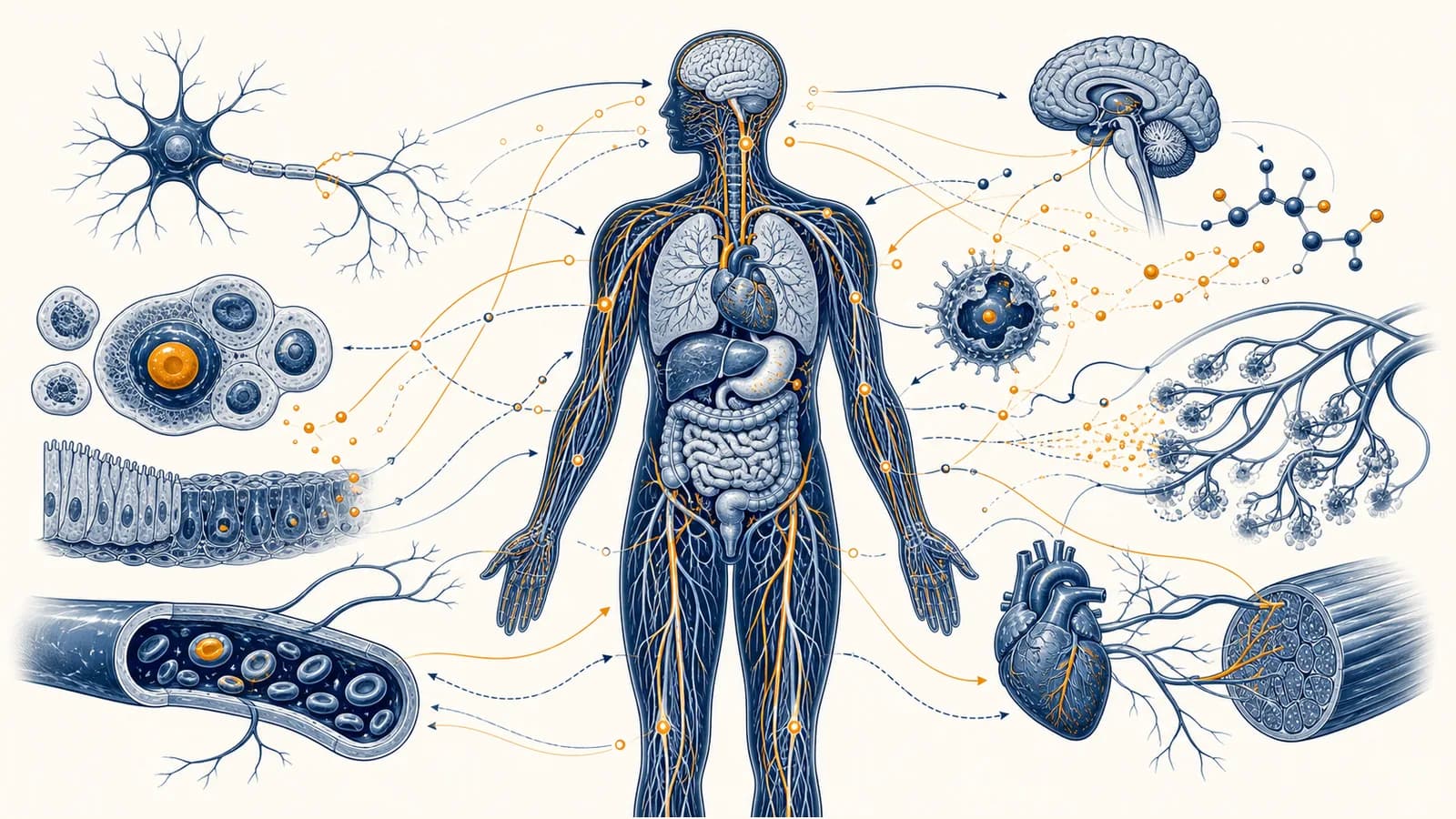
Human biology is a branch of biology that explains how the human body is built, functions, develops, reproduces, and responds to its surroundings, in the context of human life and health. It combines human anatomy and physiology with cell biology, genetics, immunity, and nutrition. The subject exists because survival depends on coordinated cells and organs keeping internal conditions within workable limits. A search for how the human body works often begins with named body systems, but those systems are linked: breathing changes blood chemistry, blood chemistry changes nerve activity, and nerve activity changes breathing.
What human biology actually is
Human biology is the study of people as living organisms, across levels that range from molecules and cells to organs, whole bodies, and populations. It asks what structures exist, what processes they perform, how they are controlled, and how variation affects health.
The useful starting idea is level of organization. Proteins and other molecules form working parts inside cells. Similar cells cooperate in tissues. Several tissues build an organ. Organs coordinate in systems, and all the systems together make an organism. A change at one level can spread upward. A changed DNA sequence may alter a protein, which changes a cell, which changes an organ and produces a symptom.
Structure and function are paired questions. Thin walls make lung air sacs good exchange surfaces. Long nerve cell extensions carry signals over distance. Folded intestinal surfaces expose more membrane to digested food. In each case, shape, material, and location help explain the job.
Human biology sits inside the broader study of Biology, but it concentrates on one species. That focus does not isolate humans from other life. Human cells use the same genetic code, membrane chemistry, and energy pathways found across many organisms. Comparisons with other species also reveal inherited features and later adaptations.
How cells keep a human body alive
Human cells stay alive by controlling what crosses their membranes, releasing usable energy from nutrients, building and repairing molecules, removing waste, and communicating with nearby or distant cells. Specialization divides this work among cell types while shared chemistry keeps them compatible.
The cell membrane is a selective boundary made mainly from a phospholipid bilayer with embedded proteins. Small nonpolar molecules can cross the lipid layer more readily than ions. Ions and many polar molecules need channels, carriers, or pumps. Diffusion moves particles down a concentration gradient. Active transport uses energy to move substances against a gradient or to maintain unequal concentrations.
Particles move through random motion from a region of higher concentration toward a region of lower concentration. No cellular energy is required for the movement itself.
A membrane protein uses an energy source, often ATP, to move a substance in a direction it would not move by diffusion alone.
Mitochondria transfer energy from food molecules into ATP through cellular respiration. ATP can then power muscle contraction, active transport, chemical synthesis, and other cell work. Oxygen allows cells to extract much more usable energy from glucose than fermentation alone. Carbon dioxide is produced and must be carried away.
Specialization changes which genes a cell uses, not normally which complete set of genes it owns. A neuron produces proteins for electrical signaling. A red blood cell develops a shape and protein content suited to gas transport, then loses its nucleus as it matures. A muscle fibre contains organized contractile proteins. These cells depend on one another because no specialized cell performs every task.
How homeostasis keeps internal conditions workable
Homeostasis keeps selected internal variables near ranges in which cells can function, even while the outside environment and the body's activity change. Receptors detect a shift, a control centre processes it, and effectors produce a response that usually opposes the shift.
Homeostasis is dynamic, not motionless. Body temperature, blood glucose concentration, blood pressure, acidity, and water balance move over time. Control systems limit harmful departures rather than pinning every value to one exact number. Set ranges can also change with sleep, activity, illness, and hormonal cycles.
Exercise increases heat production, so body temperature begins to rise.
Temperature-sensitive cells in the skin and brain report conditions to control regions in the brain.
The hypothalamus compares incoming information with the range the body is regulating.
Sweat glands release fluid and skin blood vessels widen, increasing heat transfer to the surroundings.
As temperature returns toward its regulated range, the signals driving sweating and widened vessels weaken.
This is negative feedback because the response counters the initial change. Positive feedback instead amplifies a process for a limited purpose. During childbirth, stretching of the cervix promotes oxytocin release, stronger uterine contractions increase stretching, and the loop continues until delivery ends it. Blood clotting also uses local amplification, but control mechanisms confine it to the damaged area.
Homeostasis does not mean every measurement is normal. A control system can be overwhelmed, its sensors can fail, or its effectors can stop responding. Persistent high blood glucose in diabetes is a failure of regulation, not a new healthy balance.
How body systems exchange materials and information
Body systems cooperate through flows of matter and signals. The digestive and respiratory systems supply nutrients and oxygen, the circulatory system distributes them, the kidneys and lungs remove wastes, and nervous and endocrine signals adjust each process to current demand.
The cardiovascular system links almost every tissue. The right side of the heart sends oxygen-poor blood to the lungs. The left side sends oxygen-rich blood to the rest of the body. Valves keep bulk flow moving forward, while pressure generated by ventricular contraction drives blood through arteries, capillaries, and veins.
Capillaries are exchange vessels. Their thin walls and vast branching network place blood close to cells. Oxygen and dissolved nutrients move toward tissues where their concentrations are lower or where transport processes take them up. Carbon dioxide and other wastes move into blood for removal. Fluid also moves across capillary walls under pressure and is largely returned through blood vessels and the lymphatic system.
At 70 beats per minute and 70 millilitres per beat, output is 4,900 millilitres per minute, or 4.9 litres per minute.
The worked value is an example, not a diagnosis or a fixed value for every person. During exercise, sympathetic nerve activity and circulating adrenaline can raise heart rate and contraction strength. Blood flow is redirected toward active skeletal muscle, while breathing becomes faster and deeper. Several systems change together because the same cells need more oxygen and produce more carbon dioxide and heat.
How the nervous and endocrine systems control the body
The nervous system sends rapid, targeted electrical and chemical signals, while the endocrine system releases hormones into the blood for slower or more widespread control. The two systems interact to regulate movement, attention, stress responses, growth, metabolism, and reproduction.
A neuron maintains unequal ion concentrations across its membrane. When incoming signals push the membrane past a threshold, ion channels open in sequence and an action potential travels along the axon. At many synapses, the arriving signal causes neurotransmitter release. The neurotransmitter crosses a tiny gap and binds receptors on another cell, changing that cell's activity.
The brain and spinal cord make up the central nervous system. Nerves outside them form the peripheral nervous system. Sensory pathways carry information inward, motor pathways carry commands outward, and interneurons process relationships between signals. A withdrawal reflex can activate muscles through spinal circuits before conscious awareness catches up, limiting contact with a harmful stimulus.
You stand quickly after lying down. Gravity shifts blood toward the legs, briefly reducing blood returning to the heart. Pressure sensors in major arteries signal the brainstem, which increases heart rate and tightens selected blood vessels. If compensation lags, reduced blood flow to the brain can make you feel lightheaded.
Hormones work only on cells with suitable receptors. Insulin, released by pancreatic beta cells when blood glucose rises, promotes glucose uptake in responsive tissues and encourages storage. Glucagon, released by pancreatic alpha cells when blood glucose is low, promotes processes that add glucose to the blood. Their effects depend on food intake, activity, liver stores, and tissue sensitivity.
The chemistry of nerve circuits, perception, learning, and brain disorders receives fuller treatment in the biology of the nervous system. Hormone production, feedback loops, and gland disorders belong more specifically to the study of endocrine control.
Anatomy versus physiology
Anatomy describes body structures and their physical relationships, while physiology explains the processes those structures carry out. The subjects answer different questions about the same body, so a complete explanation usually connects a visible feature to a measurable function.
Where is the left ventricle, how thick is its wall, which valves border it, and which vessels connect to it?
How does the left ventricle generate pressure, fill between contractions, eject blood, and adjust output during exercise?
A broken bone illustrates the distinction. An X-ray may show the anatomical location and alignment of a fracture. Physiology explains pain signaling, bleeding, inflammation, formation of a temporary repair tissue, bone deposition, and later remodeling. Treatment decisions need both. A well-aligned break can still heal poorly if its blood supply is damaged, while a living repair process cannot restore useful movement if the structure sets in the wrong position.
Anatomical terms also prevent ambiguous descriptions. The heart is superior to the diaphragm, the thumb is lateral to the little finger in anatomical position, and the skin is superficial to skeletal muscle. Medical teams use shared directional language because ordinary words such as above, inside, and left can depend on viewpoint.
How genes, development, and environment shape a person
A person's traits develop through interactions among inherited DNA variants, gene regulation, cell history, nutrition, physical conditions, social experience, and chance events. Genes supply molecular instructions and constraints, but most human outcomes are not produced by one gene acting alone.
Humans usually receive one set of 23 chromosomes from an egg and one set of 23 from a sperm. Twenty-two pairs are autosomes, and one pair consists of sex chromosomes. Chromosomes carry DNA, and sections of DNA can function as genes. Meiosis shuffles inherited variants through independent chromosome assortment and crossing over, so siblings usually receive different combinations.
Development begins when a fertilized egg divides. Early cells communicate through chemical signals, switch different genes on and off, move, change shape, and sometimes undergo programmed death. These processes build tissues and organs. Fingers separate partly because cells between developing digits die in a controlled pattern. Development is therefore organized construction, not simple enlargement.
A genetic association is not a fixed destiny. A variant can change probability without guaranteeing an outcome. Its effect may depend on other genes, age, exposure, nutrition, or behaviour.
Some traits have a simple inheritance pattern, but common traits such as height and blood pressure involve many genetic variants plus environmental influences. Even a strongly inherited enzyme difference may matter only after a certain exposure. This is why family history can be useful without serving as a prediction of exactly what will happen.
Natural selection and shared ancestry explain why the body contains both effective adaptations and awkward compromises. The anatomy of upright walking changes loads on the spine and pelvis. Immune defenses that attack pathogens can also damage tissues when misdirected. The larger framework is developed in evolutionary explanations of living traits.
How human biology shows up in clinics, sport, and public decisions
Human biology becomes practical when people interpret symptoms, choose tests, set training loads, design medicines, evaluate risks, or make public health rules. Good decisions connect a measurement to its mechanism and limits instead of treating one number as a complete answer.
Clinics use measurements as clues, not verdicts
A blood test samples a moving biological system. A value can change with meals, hydration, exercise, medicines, time of day, and measurement method. Clinicians interpret it alongside symptoms, history, physical examination, reference intervals, and sometimes repeat tests. A reference interval describes a distribution used by a laboratory; it does not draw a perfect line between healthy and ill.
Diagnostic tests also involve sensitivity and specificity. A sensitive test catches a high proportion of people who have a condition. A specific test correctly excludes a high proportion who do not. The chance that a positive result represents disease also depends on how common the condition is in the tested group. Testing people with no relevant risk can therefore produce false alarms even when the test itself performs well.
Training changes tissues through repeated stress and recovery
Exercise disturbs homeostasis. Muscle cells use ATP faster, ventilation rises, circulation changes, and heat production increases. Repeated endurance work can increase the machinery for aerobic energy transfer and improve oxygen delivery. Repeated resistance work can increase muscle protein and force capacity. Adaptation happens during recovery as cells respond to the earlier load.
A runner's pace drops on a hot day even though effort feels high. Sweating removes heat when it evaporates, but it also removes water. Blood must support active muscles and skin heat transfer at the same time. Slowing down can be a normal control response, not evidence that fitness vanished overnight.
Public health follows transmission pathways
Infectious disease control depends on how a pathogen leaves one host, survives or travels, enters another host, and avoids early defenses. Ventilation changes the accumulation of airborne particles indoors. Clean water and sewage treatment interrupt fecal transmission. Vaccination prepares adaptive immune responses before exposure. The relevant intervention follows the route of transmission rather than a generic idea of cleanliness.
Human evidence also guides drug development, prosthetics, workplace design, nutrition policy, and forensic examination. Laboratory methods can alter or measure cells, DNA, and proteins to investigate mechanisms or produce useful materials.
Three mistakes people make with human biology
Three common mistakes are treating body systems as independent, confusing a population average with a personal requirement, and assuming every symptom has one direct cause. Each mistake removes context that the body uses to regulate itself and that evidence needs for interpretation.
1. Drawing hard borders around body systems
Textbooks separate systems to make them learnable, but the borders are organizational. The kidneys belong to the urinary system, yet they also control blood volume, acid balance, electrolyte concentrations, and signals involved in red blood cell production. Bone is part of the skeletal system, but bone marrow produces blood cells and bone tissue stores minerals that other cells require.
When solving a case, track the material or signal instead of stopping at the system name. Low oxygen delivery might involve ventilation, gas exchange, hemoglobin, blood flow, or cellular use of oxygen. Breathlessness therefore does not identify one organ by itself.
2. Treating an average as an ideal for everyone
An average summarizes a group. It does not show the full distribution, explain variation, or establish what one person should measure. Heart rate differs with activity, age, temperature, medication, emotion, and fitness. A single reading gains meaning only after the conditions, method, trend, and relevant symptoms are known.
My result differs from the quoted average, so something must be wrong.
How wide is normal variation, how was this measured, what changes it, and does the difference affect function or risk?
3. Assigning one cause to a complex symptom
Fatigue, pain, dizziness, and nausea are outputs of many possible pathways. Dehydration and blood loss can both reduce effective circulation, but they require different responses. Pain can reflect tissue damage, inflammation, altered nerve signaling, or several processes together. A plausible mechanism is a hypothesis until evidence distinguishes it from alternatives.
This is also why a treatment that helped one person does not prove a shared cause. Improvement may reflect natural recovery, expectation, changed behaviour, or the treatment itself. Controlled comparisons are used because personal experience alone cannot separate these possibilities reliably.
How immunity remembers an infection or vaccine
Immune memory forms when an adaptive response selects lymphocytes that recognize a specific antigen, expands those cells, and leaves some as long-lived memory cells. Later exposure can trigger a faster, stronger response, although protection varies with the pathogen and immune change over time.
Innate defenses act first. Skin and mucus block entry, chemical signals recruit immune cells, and inflammation changes local blood flow and vessel permeability. These responses recognize broad signs of damage or infection. Adaptive immunity takes longer on first exposure because rare matching B and T lymphocytes must be activated and multiply.
B cells can mature into plasma cells that release antibodies. Antibodies bind specific molecular shapes and can block entry, mark targets for destruction, or help other immune processes. T cells can coordinate responses or kill infected cells. Vaccines present a harmless form, part, or instruction related to a pathogen so this learning can occur without the full disease process.
Immune memory is specific. Protection against one antigen does not create a general shield against every infection, and a pathogen that changes its exposed antigens may partly escape an older response.
How blood type affects a transfusion
Blood type affects transfusion because red blood cells carry surface antigens and plasma can contain antibodies against antigens a person lacks. An incompatible transfusion can make antibodies bind donor cells, causing clumping and destruction, so services type and crossmatch blood before use.
In the ABO system, type A red cells carry A antigen, type B cells carry B antigen, type AB cells carry both, and type O cells carry neither. Plasma antibody patterns usually oppose the missing ABO antigen. RhD status describes another important red cell antigen: positive means it is present, and negative means it is absent.
The phrase universal donor is an oversimplification. O negative red cells avoid A, B, and RhD antigens, which makes them useful in some emergencies, but blood contains many other antigen systems. Plasma compatibility also follows different rules because donor plasma carries antibodies. Transfusion teams match the component and patient, then monitor for reactions.
Human biology connects mechanism to evidence
Human biology turns what is present into an explanation of what happens. Cells exchange matter, organs create flows, control systems compare conditions with regulated ranges, and genes interact with development and environment. Evidence becomes useful when it is tied to one of those mechanisms.
A practical way to study any body process is to trace four things: the structure involved, the material or signal entering it, the transformation that occurs, and the output that follows. For breathing, trace air, gases, blood, and pressure. For digestion, trace food molecules, enzymes, membranes, and transport. For a reflex, trace stimulus, receptor, nerve pathway, and muscle response.
The takeaway: Notice a body change, then ask which variable changed, which cells detected it, which pathway carried the message, and which tissue acted. That chain turns a fact to memorize into a biological explanation you can test.