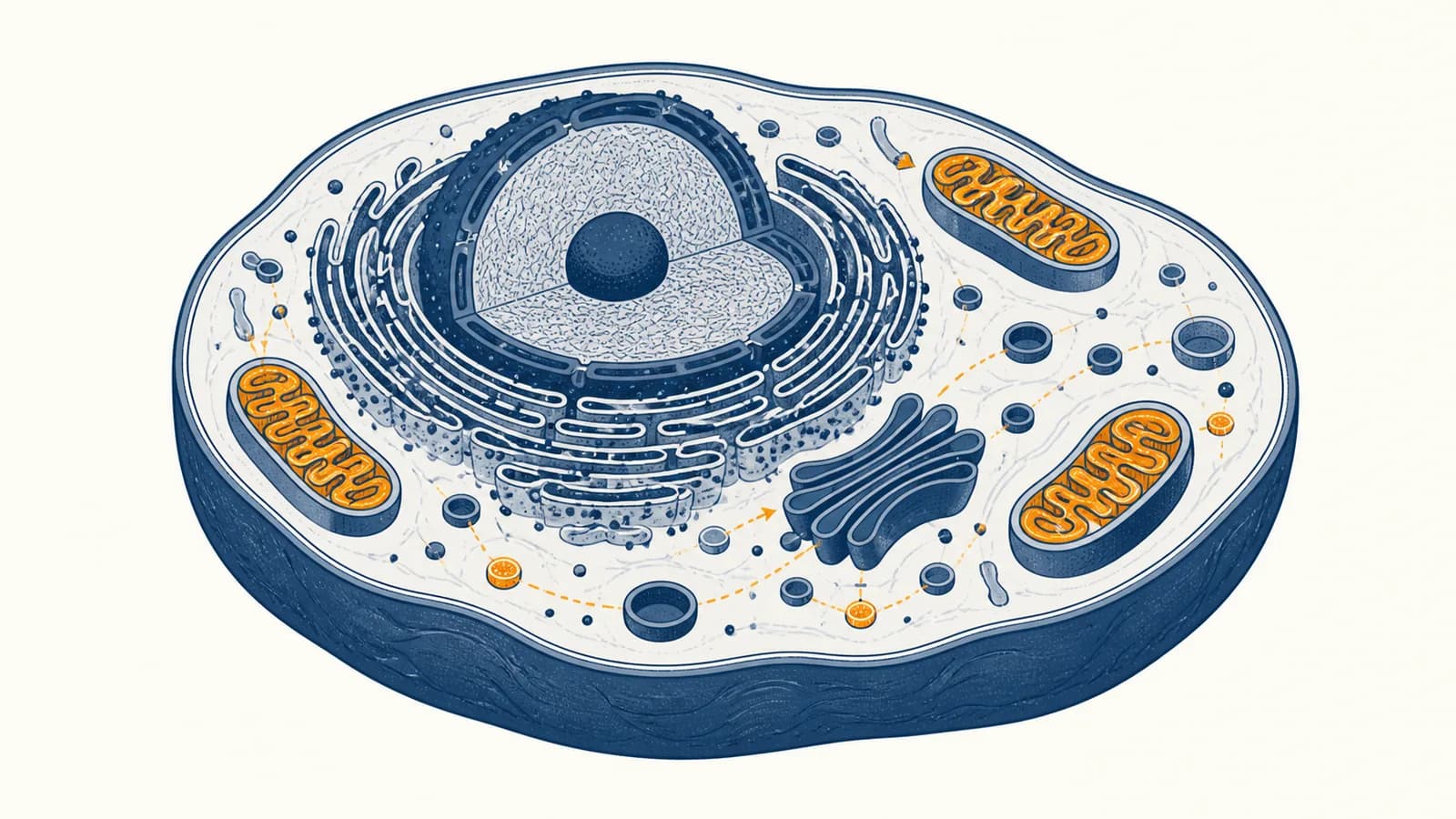
Cell biology is a branch of biology that explains how cells are built, operate, reproduce, and interact, in the context of living organisms. A cell is the smallest unit that can carry out all the basic processes of life. Cell structure and function depend on membranes, DNA, proteins, chemical reactions, and controlled transport. These systems exist because life must keep useful chemistry together, obtain energy and materials, remove waste, respond to change, and copy biological information. Some organisms consist of one cell. In a human, trillions of specialized cells cooperate while each one still manages its own boundary and internal conditions.
The same principles explain why salt can shrivel a cell, why antibiotics can kill bacteria without directly killing human cells, why a cut heals, and why a pathologist studies the shape of cells in a biopsy. Cell biology connects visible life to events too small to see without instruments.
What a cell actually is
A cell is a membrane-bounded system that maintains internal conditions, converts matter and energy, stores hereditary information, and can make new cellular material. It is the basic structural and functional unit of every organism, although cells vary greatly in size, shape, and specialization.
The boundary matters. A loose mixture of proteins, sugars, and DNA in water is not automatically alive. A cell membrane separates a controlled interior from the surroundings. Inside that boundary, linked reactions form metabolism. Instructions in DNA help the cell make RNA and proteins. Sensors detect conditions, transport proteins move selected substances, and repair systems correct some damage.
Cell theory summarizes three established ideas: all organisms are made of one or more cells, the cell is the basic unit of life, and new cells arise from existing cells. Viruses sit outside this definition because they do not have their own complete cellular machinery. A virus carries genetic material and uses a host cell to copy it.
Life is cellular. Every bacterium, oak tree, mushroom, and human is either one cell or a coordinated collection of cells. No known organism is built from a different basic living unit.
A typical diagram can make a cell look like a bag of labeled objects. A living cell is more active than that picture suggests. Molecules collide, membranes bend, protein motors carry cargo, filaments assemble and disassemble, and chemical gradients continuously change. Structure and process cannot be separated for long.
How cell membranes work
The cell membrane works as a selective, flexible barrier. A double layer of phospholipids blocks most ions and large polar molecules, while embedded proteins transport specific substances, receive signals, attach the cell to neighbors, and connect the membrane to internal supporting fibers.
A phospholipid has a water-attracting head and water-avoiding tails. In water, phospholipids arrange themselves with the heads facing the watery fluid and the tails tucked inward. The resulting phospholipid bilayer can reseal after a small tear because exposed tails are unstable in water.
Small nonpolar molecules such as oxygen can pass through the bilayer by simple diffusion. Charged particles cannot easily cross its oily interior. They use channel proteins or carrier proteins. Some transport needs no cellular energy because particles move down a concentration or electrical gradient. Other transport uses energy to push particles against a gradient.
Water movement across a selectively permeable membrane is called osmosis. Water tends to move toward the side with a higher effective concentration of dissolved particles that cannot cross. This movement can change cell volume. An animal cell in a strongly hypotonic solution gains water and may burst. In a strongly hypertonic solution, it loses water and shrinks.
A nurse uses a saline solution with a carefully controlled concentration for an intravenous infusion. Pure water would create a steep osmotic difference across blood-cell membranes. Water would enter the cells, causing them to swell and potentially rupture.
Cells also move bulk cargo. During endocytosis, membrane folds around material and pinches off as an internal vesicle. During exocytosis, a vesicle fuses with the membrane and releases its contents. Nerve cells use exocytosis to release neurotransmitters, and immune cells use endocytosis to engulf particles.
What organelles actually are
Organelles are specialized structures that organize particular cellular tasks. Membrane-bound organelles create separate chemical environments in eukaryotic cells, while non-membranous structures such as ribosomes and cytoskeletal fibers assemble proteins, support shape, and move materials without enclosing a separate compartment.
The nucleus stores most of a eukaryotic cell's DNA. Nuclear pores regulate traffic between the nucleus and cytoplasm. Ribosomes read messenger RNA and join amino acids into proteins. Ribosomes free in the cytosol often make proteins used there; ribosomes attached to rough endoplasmic reticulum often make proteins destined for membranes, organelles, or secretion.
| Structure | Main job | Mechanism or example |
|---|---|---|
| Nucleus | Protects and manages DNA | Transcription copies selected DNA sequences into RNA |
| Ribosome | Builds proteins | Matches RNA codons with amino acids |
| Rough endoplasmic reticulum | Makes and folds many exported proteins | Receives growing proteins from attached ribosomes |
| Golgi apparatus | Modifies and sorts cargo | Packages proteins and lipids into vesicles |
| Lysosome | Breaks down cargo | Acidic enzymes digest worn parts and engulfed material |
| Mitochondrion | Transfers energy into ATP | Uses electron transport and a proton gradient |
| Chloroplast | Captures light energy | Builds sugars through photosynthetic reactions in plants and algae |
The endomembrane system behaves like a changing transport network. A secreted protein may begin on a ribosome, enter the rough endoplasmic reticulum, travel in a vesicle to the Golgi apparatus, and leave in another vesicle. Molecular address tags help direct the cargo. The compartments do not work as isolated boxes.
The cytoskeleton provides tracks and force as well as support. Microtubules help separate chromosomes and guide vesicles. Actin filaments help cells crawl, contract, and change shape. Intermediate filaments resist pulling forces. Motor proteins consume ATP and walk along some of these fibers while carrying cellular cargo.
How cells turn food and light into usable energy
Cells transfer energy through coupled chemical reactions, usually using ATP as an immediate energy carrier. Respiration extracts energy from fuel molecules, while photosynthesis captures light energy to build energy-rich organic molecules. Neither process creates energy; each converts it from one form to another.
ATP, or adenosine triphosphate, can transfer a phosphate group to another molecule. That transfer changes the target molecule's energy or shape, allowing otherwise unfavorable work to proceed. Cells continually make and use ATP. It is better compared with a rechargeable intermediary than a permanent energy store.
In aerobic respiration, glycolysis begins breaking glucose in the cytosol. Products then enter mitochondria, where further reactions transfer high-energy electrons to carriers. An electron transport chain in the inner mitochondrial membrane uses those electrons to pump protons. Protons flow back through ATP synthase, a molecular rotary machine that helps make ATP. Oxygen accepts electrons at the end of the chain and contributes to water formation.
One glucose molecule is oxidized, while six oxygen molecules are reduced. The equation shows the overall balance, not the many enzyme-controlled steps.
Fermentation lets glycolysis continue when an electron transport chain cannot use oxygen. It regenerates a molecule needed by glycolysis, but captures much less energy from each glucose molecule than aerobic respiration. Yeast can produce ethanol and carbon dioxide. Working muscle cells can produce lactate faster when energy demand exceeds the rate supported by oxygen-dependent pathways.
Photosynthetic cells perform a complementary transformation. Chlorophyll absorbs light, electron transport builds a proton gradient across thylakoid membranes, and ATP synthase uses the gradient. Other reactions use the captured energy and carbon dioxide to build carbohydrate. The cellular mechanisms behind leaves and crops are developed further in how plants grow, transport materials, and capture light.
How cells store, use, and copy biological information
Cells store hereditary information in DNA, use selected sequences through RNA and proteins, and copy the DNA before division. Molecular proofreading limits errors, gene regulation controls access, and chromosome-separation machinery distributes the copied information to new cells.
How cells use DNA to make proteins
Cells use DNA by transcribing selected genes into RNA and translating many of those RNA messages into proteins. Base pairing preserves and copies information, while regulatory proteins and chemical marks control which genes are used in a particular cell, condition, or stage of development.
A gene is a DNA sequence whose use produces a functional RNA or contributes to a protein product. During transcription, RNA polymerase uses one DNA strand as a template and builds a complementary RNA strand. In eukaryotes, a messenger RNA is processed before leaving the nucleus. Sections called introns are removed, and the remaining sections are joined.
Regulatory proteins bind DNA and associated structures, making transcription more or less likely.
The enzyme pairs RNA nucleotides with exposed DNA bases and extends an RNA molecule.
A eukaryotic pre-mRNA is capped, given a tail, and spliced to produce mature messenger RNA.
Transfer RNAs match three-base codons and deliver amino acids, which the ribosome joins into a chain.
The amino-acid sequence drives folding, while cellular machinery may modify the protein and send it to the correct location.
DNA does not directly specify a finished trait such as eye color or blood clotting. It specifies functional products that participate in networks. A protein may act as an enzyme, receptor, signal, channel, antibody, or structural fiber. One gene can produce different RNA versions through alternative splicing, and a protein may be altered after translation.
A mutation changes a DNA sequence. Its effect depends on location and context. A base change may alter an amino acid, create a premature stop signal, change gene regulation, or have no detectable effect. The study of genes, inheritance, and variation follows these cellular events across parents, offspring, and populations.
How cell types differ and specialize
Cell types differ through their internal compartments, external structures, patterns of gene activity, and relationships with other cells. Prokaryotes and eukaryotes use different cellular plans, while cells within a multicellular organism specialize by producing different structures and proteins.
Prokaryotic cells versus eukaryotic cells
Prokaryotic cells lack a nucleus and the extensive membrane-bound compartments found in eukaryotic cells. Eukaryotic cells enclose DNA in a nucleus and divide many tasks among organelles. Both kinds have a plasma membrane, cytoplasm, DNA, ribosomes, and basic metabolic machinery.
Bacteria and archaea are prokaryotes. Their main chromosome occupies a nucleoid region rather than a nucleus. Many have a cell wall, and some carry extra DNA rings called plasmids.
Animals, plants, fungi, and protists are eukaryotes. Their chromosomes lie inside a nucleus, and organelles create specialized reaction spaces. Their internal transport and cytoskeleton are generally more elaborate.
Small does not mean simple in behavior. A bacterium can sense chemicals, swim toward nutrients, exchange DNA, regulate genes, and build a resistant community called a biofilm. It carries out these tasks without a nucleus. Its compact organization also lets gene expression respond quickly to changing conditions.
The difference creates medical targets. Bacterial ribosomes and cell-wall construction differ from human cellular structures. Some antibiotics interfere with those bacterial systems. Selectivity is not perfect, and bacteria can evolve resistance through mutation or acquired genes. A drug also cannot treat a viral infection merely because both viruses and bacteria can make a person ill.
Mitochondria and chloroplasts carry their own DNA and resemble bacteria in several ways. The endosymbiotic explanation is that ancestors of these organelles were free-living bacteria engulfed by another cell. A lasting partnership developed, and many genes moved or were lost over evolutionary time.
Plant cells versus animal cells
Plant and animal cells are both eukaryotic, but plant cells usually add a cellulose cell wall, chloroplasts in photosynthetic tissues, and a large central vacuole. Animal cells lack those features and often rely more on flexible membranes, extracellular matrix, and varied cell movement.
The cell wall sits outside the plant plasma membrane. It resists expansion when water enters, so water pressure can make a plant cell firm rather than burst. The large central vacuole stores water and solutes and contributes to this turgor pressure. A wilted plant often has cells that have lost water and pressure, not cells that have simply run out of food.
Chloroplasts capture light energy, but plant cells also contain mitochondria and perform cellular respiration. Photosynthesis supplies organic fuel and oxygen overall; respiration releases usable energy from fuel. Plant cells need respiration day and night, including in roots that normally receive no light.
Plants photosynthesize, while animals respire.
Photosynthetic plant cells photosynthesize and respire. Animal cells respire but do not photosynthesize. Both depend on controlled energy transfers inside cells.
Animal tissues use an extracellular matrix made of proteins and carbohydrates outside their cells. This matrix provides support, carries signals, and helps organize tissues. Bone is an extreme example: bone cells maintain a mineralized extracellular material that gives the tissue stiffness.
How cells communicate and become specialized
Cells communicate when a signal binds a receptor and triggers an internal response, while specialization occurs when cells use different sets of genes and maintain different structures. Most cells in one body share nearly the same DNA but produce different proteins in different amounts.
A signal may travel through blood, diffuse to a nearby cell, remain attached to a cell surface, or pass directly through a junction. The target cell must have a suitable receptor. Binding changes the receptor, starting a signal-transduction pathway. Enzymes may add phosphate groups to proteins, ion channels may open, and gene activity may change.
Insulin provides a concrete case. After blood glucose rises, insulin released by pancreatic cells binds receptors on target cells. The resulting signaling changes glucose uptake and metabolism. Insulin does not push glucose through the membrane itself. It changes the behavior of cell machinery.
Specialization is called differentiation. A muscle cell makes abundant contractile proteins and organizes them for force. A red blood cell loses its nucleus during development and fills with hemoglobin, trading repair and division capacity for efficient oxygen transport. A neuron extends long processes and maintains ion gradients that allow electrical signaling. These cell types connect through tissues, organs, blood, and nerves to support the whole body.
Cell identity is actively maintained. Transcription factors promote one gene program and suppress another. Chemical modifications to DNA and its associated proteins can make regions more or less accessible. Signals from neighboring cells and the extracellular matrix help stabilize identity or prompt change.
How cell division copies a living system
Cell division reproduces a cell by copying DNA, separating the copies, and splitting cellular contents. Eukaryotic cells coordinate these events through the cell cycle. Checkpoints can delay progression when DNA is damaged, replication is incomplete, or chromosomes are not attached correctly.
Before mitosis, a cell grows and duplicates its DNA during interphase. Each replicated chromosome consists of two sister chromatids joined together. During mitosis, chromosomes condense, attach to spindle microtubules, line up, and separate toward opposite ends. Cytokinesis then divides the cytoplasm.
The cell makes proteins and organelle material needed for division.
Each chromosome is replicated once, producing connected sister chromatids.
The mitotic spindle moves one copy of each chromosome to each future daughter cell.
An animal cell pinches inward; a plant cell builds a new dividing wall from the center.
Mitosis supports growth, tissue maintenance, and asexual reproduction. Meiosis is different. It includes two divisions after one round of DNA replication and produces cells with half the starting chromosome sets. In sexual reproduction, fusion of two such cells restores the usual number of sets.
Division is regulated by proteins whose activity rises and falls during the cycle. If regulation fails, a cell may divide despite DNA damage or ignore signals that normally restrain growth. Cancer is not one single cell-cycle error. It develops through accumulated changes that affect growth, survival, repair, interactions, and other cellular systems.
Chromosome copying is not chromosome doubling forever. DNA content rises before mitosis, then the copied chromatids are separated between two cells. Each daughter cell normally receives one complete set equivalent to the parent cell's original set.
How cell biology shows up in medicine, food, and laboratories
Cell biology appears wherever people diagnose disease, design drugs, grow food, test chemicals, or manufacture biological products. The practical task is often the same: observe a cellular process, change one condition, and measure how cell structure, survival, signaling, or gene activity responds.
A biopsy turns tissue architecture into evidence
A biopsy is a sample of cells or tissue examined for signs of disease. A pathologist may assess cell size and shape, nuclear appearance, tissue organization, division patterns, and molecular markers. These observations help classify disease because abnormal cellular behavior changes visible structure.
Cell culture makes controlled experiments possible
Cell culture keeps cells alive outside an organism under controlled conditions. Researchers manage temperature, nutrients, acidity, gases, surface attachment, and contamination. They can compare treated cells with an untreated control, but cultured cells are a model, not a complete body with circulation, nerves, and immune interactions.
A researcher testing a candidate drug grows matching cell populations. One receives only the solvent, and others receive measured drug concentrations. After a fixed time, the researcher measures survival or a target protein. Replicates help distinguish a repeatable effect from handling variation.
Fermentation turns cell metabolism into products
Yeast cells produce carbon dioxide that expands bread dough and ethanol that accumulates during brewing. Bacterial cells convert milk sugars and acidify yogurt. Industrial systems control temperature, nutrients, oxygen, and acidity because each condition changes enzyme activity, growth, and product formation.
Modern treatments can target molecules inside cells
Some drugs block receptors, enzymes, ion channels, DNA replication, or protein synthesis. Vaccines train immune-cell populations to recognize a target. Laboratory-made proteins can replace or supplement missing signals. Methods that use cells and biological molecules as tools explain how cultured cells can manufacture medicines and how genetic material can be edited or measured.
Good laboratory conclusions depend on scale and controls. A microscope image can reveal location, but not always function. A change in one molecular marker may accompany a response without causing it. Scientists combine imaging, chemical measurements, gene perturbations, comparison groups, and repeated experiments to test competing explanations.
What limits individual cells and cellular life?
Individual cells face physical limits on size, lifespan, transport, and self-maintenance, but life itself can persist through cell division and reproduction. The same constraints shape tiny single-celled organisms, specialized tissue cells, and lineages maintained across many generations.
What limits the size of a cell?
Cell size is limited mainly by transport distance, exchange across the membrane, and the cell's ability to control its contents. As a cell grows, volume increases faster than surface area, so each unit of cytoplasm receives less membrane area for exchanging materials.
For a cube with side length , surface area is and volume is . The surface-area-to-volume ratio is therefore . If the side length doubles from one arbitrary unit to two, surface area rises from 6 to 24 square units, while volume rises from 1 to 8 cubic units. The ratio falls from 6 to 3.
Real cells are not cubes, but the scaling problem remains. Cells respond by staying small, flattening, forming folds or projections, circulating internal material, or building transport systems. Intestinal cells have microvilli that increase exchange area. Long neurons solve a distance problem with cytoskeletal transport and electrical signals rather than simple diffusion alone.
Can cells live forever?
Most individual cells do not live forever. Cells accumulate damage, face programmed death, are replaced during tissue maintenance, or die with the organism. Some cell lineages can continue through many divisions, but continued lineage survival is different from one unchanged cell remaining alive indefinitely.
Apoptosis is controlled cell death. The cell dismantles internal components, fragments its DNA, and packages material for removal with limited leakage. Apoptosis shapes developing tissues and removes some damaged or dangerous cells. Necrosis, by contrast, often follows severe injury and can release cellular contents that promote inflammation.
Repeated division creates additional problems. DNA ends, replication errors, damaged proteins, and altered regulatory systems can affect future cells. Stem cells maintain tissues by producing cells that can remain stem cells or differentiate. Their behavior depends on signals from a local cellular environment called a niche.
Can one cell be a complete organism?
One cell can be a complete organism if it performs all functions needed for independent life. Bacteria, archaea, many protists, and some fungi are unicellular. Their single cell must obtain resources, regulate chemistry, respond, reproduce, and cope with environmental change.
A unicellular organism may still be highly organized. A ciliate uses surface structures to move and feed, maintains water balance with specialized compartments, and responds to chemicals. A bacterium can coordinate gene expression with nearby bacteria by sensing released signal molecules. Some single-celled organisms form colonies, but each cell's degree of independence varies.
Multicellularity changes the bargain. Specialized cells can perform narrow jobs efficiently, but they become dependent on other cells. A human neuron cannot obtain food from the environment or reproduce an organism. Multicellular life requires adhesion, communication, controlled division, shared transport, and mechanisms that limit cellular cheating.
4 mistakes people make with cells
Common cell-biology mistakes treat diagrams as literal, assign one structure only one job, confuse stored information with direct action, or assume all cells follow the same pattern. Correcting these errors makes unfamiliar examples easier to reason through from mechanisms.
1. Thinking cells are static bags of organelles
A textbook image freezes a changing system. Vesicles move, membranes recycle, proteins turn over, ions cross channels, and the cytoskeleton reorganizes. Even a cell that stays in one location maintains itself through constant molecular activity.
2. Calling mitochondria the source of all cellular energy
Mitochondria convert energy and help make ATP; they do not create energy. Glycolysis also makes ATP in the cytosol, and some cells rely heavily on it. Energy ultimately enters food webs mainly through captured light or chemical energy, then moves through reactions.
3. Assuming every cell contains every organelle
Cell contents match function and history. Mature human red blood cells lack nuclei and mitochondria. Photosynthetic leaf cells have chloroplasts, while most root cells do not. Bacteria lack membrane-bound nuclei entirely. A generalized diagram is a reference model, not a census.
4. Treating genes as tiny instructions for whole traits
Genes produce functional RNAs and influence protein production. Traits emerge through networks, environmental inputs, development, and interactions among cells. A DNA variant can matter strongly, weakly, or only under certain conditions. Cellular context determines what information does.
The takeaway: Explain any cellular event by tracking boundaries, materials, energy, information, and signals. Ask what crosses a membrane, which molecule changes, where energy comes from, and how the cell controls timing.
Cell biology makes the rest of biology mechanistic
Cell biology gives Biology a working scale between molecules and organisms. It explains how inherited information becomes structure, how organisms exchange energy and matter, how tissues maintain themselves, and how disease begins when cellular controls fail.
When meeting a new biological claim, locate the event. Identify the cell type, compartment, membrane, molecule, and timescale. If a signal is said to cause a response, trace its receptor and the steps after binding. If a treatment is said to work, ask which cellular process it changes and what evidence separates cause from correlation.
That habit turns facts into explanations. A leaf bending toward light, a wound closing, a bacterium resisting a drug, and a muscle using fuel look different at first. Each becomes testable once the relevant cells, transfers, and controls are named. Notice the next biological process around you, then follow it inward until the cellular machinery accounts for what you can see.