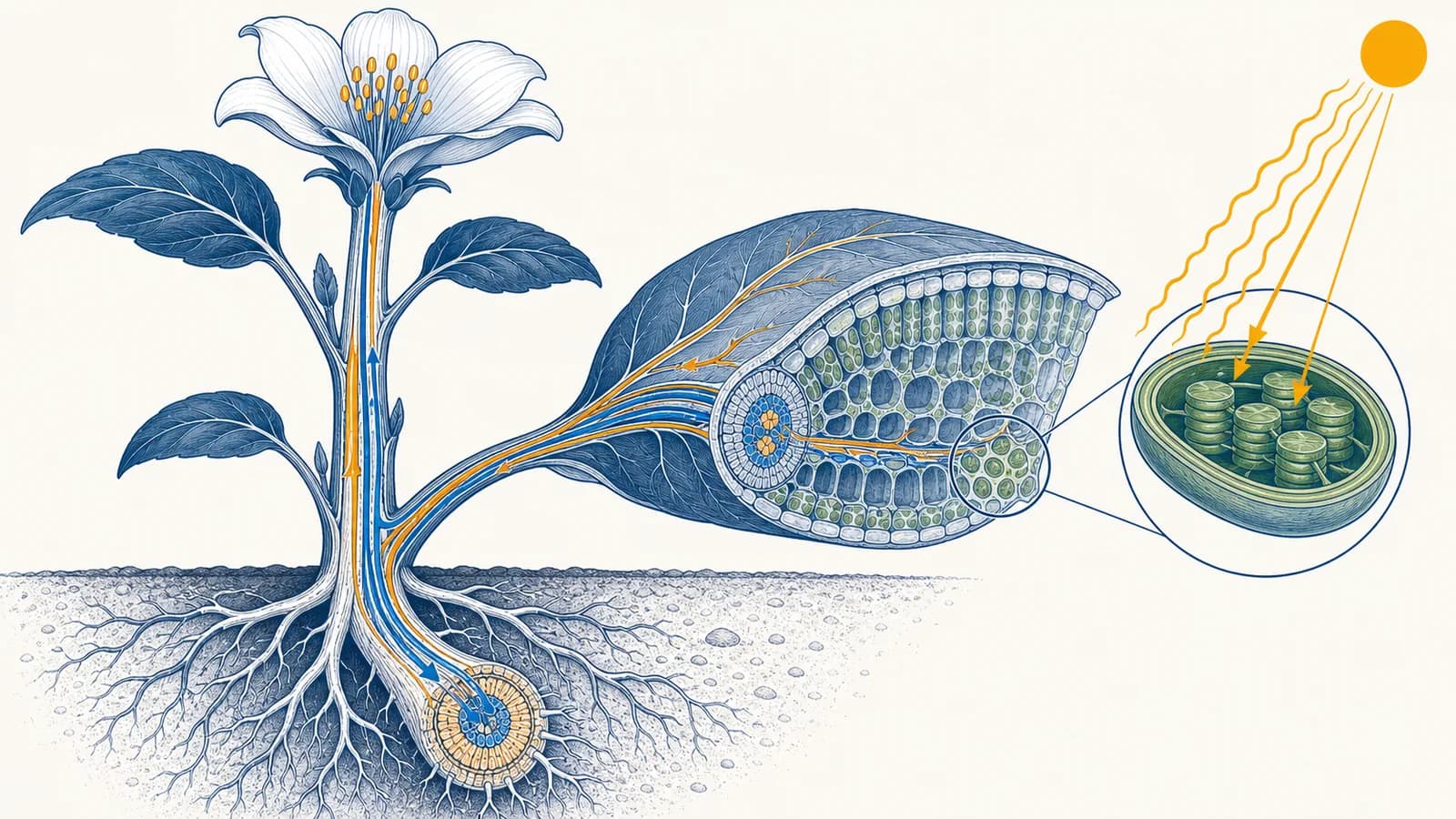
Plant biology is a branch of biology that explains how plants are built, grow, reproduce, respond, and survive, in the context of living systems and their environments. It covers plant cells, photosynthesis, respiration, transport, hormones, reproduction, and adaptation. These processes exist because a rooted organism must capture light, obtain water and minerals, move materials, repair damage, and produce offspring without walking to a new resource or shelter.
What a plant actually is
A plant is a multicellular eukaryote whose cells usually have cellulose walls, large water-filled vacuoles, and plastids. Most plants make sugars by photosynthesis, build bodies with repeating organs, and alternate between multicellular stages that produce spores and gametes.
The everyday word plant covers mosses, ferns, conifers, flowering plants, and their relatives. It does not mean any organism that is green or fixed in place. Green algae share ancestry with land plants, but classification boundaries depend on the scientific group being discussed. Fungi are a separate lineage. Seaweeds include organisms from several lineages, and some are not plants.
A typical flowering plant has three vegetative organ systems. Roots anchor the plant and absorb water and dissolved mineral ions. Stems hold leaves in useful positions and contain transport tissue. Leaves present a broad surface to light and exchange gases with the air. Flowers, fruits, and seeds belong to reproduction.
These parts are integrated rather than independent. A leaf loses water while taking in carbon dioxide. Roots replace that water. A stem connects the two. Sugars made in mature leaves are delivered to growing roots, buds, fruits, and seeds. Plant form is therefore a record of resource collection and distribution.
What makes a plant cell different
A plant cell is a eukaryotic cell distinguished by a cellulose-rich wall, a large central vacuole, and plastids such as chloroplasts. These structures provide support, store materials, and convert light energy, while the nucleus, ribosomes, and mitochondria perform familiar cellular work.
The plasma membrane controls movement into and out of the living cell. Outside it, cellulose fibres reinforce the cell wall. The wall resists expansion but is porous to water and many dissolved substances. It does not replace the membrane. Adjacent cells can communicate through narrow, membrane-lined channels called plasmodesmata.
The central vacuole contains cell sap. Water entering the vacuole pushes the membrane and cytoplasm against the wall. This turgor pressure helps a soft stem or leaf remain firm. When cells lose enough water, the membrane can pull away from the wall, a condition called plasmolysis. A wilted leaf is often showing loss of turgor across many cells.
A strong, porous layer outside the membrane. It limits expansion, helps maintain shape, and bears mechanical stress.
A selectively permeable boundary. Transport proteins in it regulate which ions and molecules cross.
Chloroplasts are plastids containing chlorophyll and the internal membranes used for photosynthesis. They occur mainly in green tissues exposed to light, not in every plant cell. Root cells normally lack developed chloroplasts. Other plastids may store starch or pigments. For the shared machinery of nuclei, membranes, proteins, and cell division, see how cells organize life.
Mitochondria matter just as much as chloroplasts. Plant cells carry out cellular respiration day and night, breaking down organic molecules to transfer usable energy to ATP. Photosynthesis stores energy in chemical bonds; respiration releases part of that stored energy for transport, synthesis, movement inside cells, and growth.
How photosynthesis works
Photosynthesis uses light energy to build carbohydrate from carbon dioxide and water, releasing oxygen as a by-product. Light-dependent reactions make ATP and reduced electron carriers, then carbon-fixation reactions use those products to assemble carbon compounds inside chloroplasts.
Six carbon dioxide molecules supply the six carbon atoms shown in one glucose molecule; the equation is a useful net summary, not a single chemical step.
In the thylakoid membranes, chlorophyll and accessory pigments absorb photons. Excited electrons pass through electron carriers. Their movement helps pump hydrogen ions across the membrane, creating a concentration and charge difference. Hydrogen ions then flow through ATP synthase, which joins phosphate to ADP. Another light-driven system transfers electrons to NADP+, producing NADPH. Splitting water replaces lost electrons and releases oxygen.
In the chloroplast stroma, the Calvin cycle incorporates carbon dioxide into an organic molecule. The enzyme RuBisCO catalyses the first major carbon-fixation step. ATP provides energy and NADPH provides high-energy electrons. The immediate output is a three-carbon sugar phosphate that can contribute to glucose, sucrose, starch, cellulose, amino acids, and many other compounds.
The equation can mislead if it is read as a promise that more light always means more sugar. Photosynthesis depends on interacting limits. At low light intensity, extra light can raise the rate. Once another factor becomes limiting, extra light has less effect. Carbon dioxide concentration, temperature, water supply, mineral nutrition, leaf age, and stomatal opening can each set the ceiling.
The oxygen released by photosynthesis comes from water. Experiments using oxygen isotopes showed that the oxygen atoms in released O2 trace back to H2O, not to CO2.
Plants also respire. During a sunny period, a healthy leaf may photosynthesise faster than it respires, so it takes in net carbon dioxide and releases net oxygen. In darkness, photosynthesis stops while respiration continues. The plant then consumes oxygen and releases carbon dioxide. Describing plants as organisms that only produce oxygen misses half of their metabolism.
How water, minerals, and sugar move
Plants use xylem to carry water and mineral ions mainly from roots upward, and phloem to distribute dissolved sugars and other organic solutes between sources and sinks. Evaporation from leaves drives much xylem flow, while pressure differences drive phloem transport.
Water crosses roots by gradients and selective transport
Root hairs extend the absorbing surface into water films around soil particles. Water moves through cell walls and across membranes toward regions with lower water potential. Mineral ions may enter through channels or active transport proteins. The endodermis forms a selective checkpoint around the root vascular tissue, forcing substances across a cell membrane before they reach the xylem.
Xylem works as a pulled water column
Xylem vessels are tubes made from dead cells whose end walls have largely disappeared. Lignin strengthens their walls. As water evaporates from moist cell surfaces inside a leaf and exits through stomata, curved air-water interfaces create tension. Cohesion between water molecules transmits that pull down continuous columns in the xylem. Adhesion to vessel walls also helps stabilize the columns.
Water changes to vapour from wet mesophyll cell walls.
Diffusion carries it toward the usually drier air outside.
Cohesion transmits the pull through the water column.
Water moves from the soil into root tissues and then xylem.
This transpiration stream does not require a mechanical pump like a heart. Its energy ultimately comes from the Sun, which supplies the energy for evaporation, and from the water-potential gradient between soil, plant, and atmosphere. Root pressure can sometimes push xylem sap, but it is not the main explanation for water reaching the tops of tall trees.
Phloem connects sugar sources to sugar sinks
A mature photosynthesising leaf is usually a source because it loads sucrose into phloem. A growing root tip, fruit, seed, or young leaf is a sink because it unloads and uses or stores sugar. Water entering loaded phloem raises pressure at the source. Lower pressure at a sink helps drive bulk flow along sieve tubes.
A gardener removes a complete ring of bark from a branch. Xylem deeper in the stem may still carry water upward, but much of the phloem in the bark is severed. Sugars accumulate above the cut, tissues below lose a supply route, and prolonged ring-barking can kill the branch or tree.
Direction depends on the source and sink, not simply on gravity. One phloem tube can carry sap toward roots while another carries it toward developing fruit. Seasonal roles also change. A storage root can be a sink when reserves accumulate, then become a source when new shoots grow.
How gas exchange balances carbon gain against water loss
Plants exchange gases mainly through stomata, adjustable pores in the epidermis of leaves and young stems. Open stomata let carbon dioxide diffuse toward photosynthetic cells, but they also let water vapour escape, creating a tradeoff between carbon gain and dehydration.
Each stoma is bordered by two guard cells. When guard cells accumulate solutes, water enters by osmosis and the cells become turgid. Their wall structure causes them to bow apart, opening the pore. When solutes and water leave, the cells become less turgid and the pore narrows. Light, internal carbon dioxide, humidity, water status, and chemical signals all influence this control system.
Carbon dioxide diffuses through an open stoma into internal air spaces and dissolves near mesophyll cells. Water vapour moves in the opposite direction because the leaf interior is usually moist and the surrounding air is less saturated. Wind can remove the humid boundary layer near a leaf, steepening the gradient and increasing water loss. Heat can do the same by increasing evaporation and the atmosphere's capacity to hold water vapour.
Carbon dioxide enters more easily, supporting photosynthesis. Water vapour also escapes more easily, which can cool the leaf but risks dehydration.
Water loss falls, but carbon dioxide entry also falls. If closure continues, carbon fixation slows even when light is abundant.
Plants in dry habitats often reduce this conflict with structural or biochemical adaptations. A thick waxy cuticle slows evaporation through the epidermis. Hairs and sunken stomata can trap humid air. Small or rolled leaves reduce exposed surface. CAM plants usually open stomata at night, store carbon in acids, and release carbon dioxide internally during the day. This saves water but limits how rapidly carbon can be acquired and processed.
How plants grow and respond without nerves
Plants grow through cell division in meristems, cell expansion, and controlled differentiation, while hormones and electrical or chemical signals coordinate responses. They lack brains and muscles, but they detect light, gravity, touch, damage, water, and seasonal cues through living cells.
Apical meristems at root and shoot tips make primary growth, which lengthens the plant. Lateral meristems such as vascular cambium make secondary growth, which thickens many stems and roots. New cells do not simply become larger copies of one cell type. Patterns of gene activity and position guide them toward xylem, phloem, epidermis, leaf, root, or reproductive tissue.
Cell expansion often depends on water uptake. A cell wall can loosen in selected regions, turgor pushes the wall outward, and new wall material stabilizes the enlarged form. Because walls constrain direction, uneven expansion can bend an organ. This is the physical basis of many tropisms.
Phototropism redirects a shoot toward light
Blue-light receptors detect uneven illumination near a young shoot tip. The signal changes distribution of the hormone auxin. In shoots, higher auxin on the shaded side generally promotes more cell elongation there. That side lengthens faster, so the shoot bends toward the light. The response changes growth; it is not the shoot swivelling like an animal limb.
Gravitropism gives roots and shoots opposite directions
Dense starch-containing organelles settle within gravity-sensing cells. Their position helps redirect auxin transport. In roots, a higher auxin concentration on the lower side inhibits elongation, so the upper side grows faster and the root curves down. In shoots, auxin promotes elongation on the lower side, so the shoot curves up.
A hormone is a signal, not a command with one fixed effect. Auxin can promote shoot-cell elongation yet inhibit root-cell elongation at concentrations found during gravitropism. Tissue, dose, developmental state, and other signals change the response.
Other plant hormones include abscisic acid, which participates in drought responses and seed dormancy; ethylene, a gas involved in fruit ripening and stress responses; gibberellins, which can promote stem growth and germination; and cytokinins, which influence cell division and shoot development. Their interactions resemble a network of changing sensitivities, not separate on-off switches. Comparisons with hormone signalling in animals reveal a shared principle: small chemical signals can coordinate distant tissues even though the organs and transport systems differ.
How sexual reproduction makes a seed
In flowering plants, sexual reproduction moves pollen to a stigma, grows a pollen tube to an ovule, and uses two sperm cells in double fertilisation. One forms the embryo; the other helps form endosperm, a tissue that nourishes developing seed structures.
A flower's anthers produce pollen grains, which contain the male gametophyte. Ovules inside an ovary contain the female gametophyte and egg cell. Pollination is the transfer of pollen to a compatible stigma. It may involve wind, water, insects, birds, bats, or other animals. Pollination is not fertilisation. It only places pollen where the next stage can begin.
A compatible pollen grain hydrates and germinates. Its tube grows through the style toward an ovule, guided by signals from surrounding tissues. Two sperm cells travel within it. One sperm nucleus fuses with the egg nucleus to form a diploid zygote. The other fuses with nuclei in the central cell, usually producing triploid endosperm in flowering plants. The zygote develops into an embryo, the ovule becomes a seed, and the ovary commonly develops into a fruit.
A seed contains a new plant embryo, stored food or access to endosperm, and a protective coat. Dormancy can prevent immediate growth even when the embryo is alive. Germination begins when the correct combination of water, oxygen, temperature, light, or chemical cues removes the block. Water rehydrates tissues and activates enzymes. Stored starch, oil, or protein is mobilised until leaves can support the seedling.
The life cycle alternates two multicellular generations
The diploid sporophyte produces haploid spores by meiosis. Spores grow by mitosis into haploid gametophytes, which produce gametes by mitosis. Fertilisation joins gametes and restores the diploid state. In flowering plants the visible plant is the sporophyte, while the pollen grain and embryo sac are tiny gametophytes. In mosses the conspicuous green plant is the gametophyte.
Asexual reproduction skips fusion of gametes. Runners in strawberries, tubers in potatoes, bulbs in onions, and cuttings used by growers can make genetically similar descendants. This preserves a useful genotype, but low genetic variety can leave a crop uniformly vulnerable to a pathogen or environmental change. The origin and sorting of inherited variation are treated more fully in evolution through selection and ancestry.
Plants versus fungi
Plants and fungi are different kingdoms with different nutrition, cell walls, storage compounds, and ancestry. Plants usually photosynthesise and build walls mainly from cellulose; fungi digest organic material outside their bodies, absorb the products, and build walls containing chitin.
| Feature | Plants | Fungi |
|---|---|---|
| Carbon source | Usually carbon dioxide fixed by photosynthesis | Organic molecules absorbed after external digestion |
| Main wall material | Cellulose | Chitin and other polysaccharides |
| Common storage carbohydrate | Starch | Glycogen |
| Body organization | Cells organized into tissues and organs in land plants | Usually networks of filaments called hyphae |
The confusion is understandable because both often grow from one place and both can reproduce with spores. Those similarities do not show close identity. Animals and fungi share a more recent common ancestor with each other than either shares with plants. A mushroom near a tree is the reproductive structure of a fungus, not a plant without chlorophyll.
The relationship is often cooperative. Mycorrhizal fungi grow around or within roots. Fungal filaments explore soil and can deliver mineral nutrients, while the plant supplies carbon compounds. Some associations are highly beneficial, some depend on conditions, and some become costly to one partner. Lichens are different partnerships, usually involving a fungus and a photosynthetic alga or cyanobacterium.
How plant biology shows up in farming, medicine, and climate
Plant biology guides crop breeding, irrigation, fertiliser use, disease control, drug discovery, habitat management, and climate research. Each application depends on a mechanism, such as stomatal control, nutrient uptake, inheritance, pathogen recognition, or carbon storage, rather than on plants being simply “healthy.”
Farmers manage limiting factors and tradeoffs
A yellow leaf does not automatically mean “needs fertiliser.” Nitrogen shortage can reduce chlorophyll and growth, but waterlogged soil can deprive roots of oxygen and block nutrient uptake. A high soil pH can make iron less available even when iron is present. Disease, root damage, or normal leaf ageing can produce similar colour changes. Diagnosis uses the pattern across old and young leaves, soil conditions, roots, weather, and sometimes tissue or soil tests.
Tomato leaves wilt on a hot afternoon. Adding water might help if the root zone is dry. If the soil is already saturated, more water can worsen oxygen shortage around roots. A grower checks soil moisture, root condition, air temperature, humidity, and whether plants recover after sunset before changing irrigation.
Breeders select plants with useful inherited traits and cross them to combine alleles. They then test descendants because inheritance reshuffles gene combinations and because performance depends on environment. Marker-assisted selection uses DNA markers linked to traits to screen seedlings. Gene editing can change a chosen sequence, but the resulting line still needs biological testing for growth, yield, quality, and unintended effects.
Plant compounds can become medicines or poisons
Plants make secondary metabolites that deter herbivores, attract pollinators, block competitors, filter ultraviolet light, or limit infection. Humans use some of these molecules as medicines, flavours, dyes, stimulants, and pesticides. A compound's natural origin does not establish safety. Dose, purity, route of exposure, metabolism, and interactions determine its effects.
Drug development may begin with a plant molecule, then isolate it, test its target and toxicity, alter its structure, and establish a controlled dose. Ethnobotanical knowledge can suggest candidates, but a traditional use and a clinical treatment answer different evidence questions. The living plant also varies with genotype, soil, stress, harvest stage, and processing, so an unstandardised preparation may not deliver a consistent amount.
Ecosystems store carbon in living tissue and soil
Photosynthesis moves carbon from atmospheric carbon dioxide into organic compounds. Respiration, decomposition, fire, and consumption return much of it. Some carbon remains in wood, roots, peat, or soil organic matter for longer periods. Estimating climate effects therefore requires both fluxes and stocks: how fast carbon enters and leaves, and how much remains stored.
Planting vegetation can restore shade, habitat, erosion control, and carbon storage, but species choice and site conditions matter. A tree that dies quickly or displaces a native ecosystem may not deliver the intended result. Researchers measure survival, growth, soil change, fire risk, water use, and what would have happened without the intervention.
4 mistakes people make with plants
Four common errors are treating plant food as soil fertiliser, assuming plant mass comes mainly from soil, confusing pollination with fertilisation, and describing every response as conscious behaviour. Each mistake hides a testable transport, chemical, or developmental mechanism.
1. “Plants get their food from soil”
Plants absorb water and mineral ions from soil, but most of the dry mass added during growth comes from carbon dioxide fixed into organic compounds. Calling fertiliser “plant food” blurs the distinction. Fertiliser supplies nutrients such as nitrogen, phosphorus, and potassium that plants use to build molecules and regulate processes. Light supplies energy, and carbon dioxide supplies most new carbon.
2. “Photosynthesis is the opposite of respiration”
The net equations look reversed, but the pathways use different enzymes, compartments, and energy transfers. Photosynthesis captures light energy and stores some of it in organic molecules. Respiration transfers energy from organic molecules to ATP. Plant cells respire continuously when substrates and oxygen are available, including while photosynthesis occurs.
3. “Pollination means a seed has formed”
Pollination only moves pollen to the receptive female structure. The pollen must be compatible, germinate, grow a tube, deliver sperm, and complete fertilisation. Development can still fail afterward. Frost, heat, nutrient shortage, genetic problems, or damage may stop embryos, seeds, or fruit from maturing.
4. “A plant response proves a plant has thoughts”
Plants sense stimuli, signal across tissues, remember some past conditions through altered cell states, and adjust future responses. Those observations are experimentally testable. Calling the result a thought adds a claim about subjective experience that the growth response alone cannot establish. Mechanistic language identifies receptors, signals, ion movements, genes, and changes in growth.
How do plants survive difficult conditions and obtain resources?
Plants survive difficult conditions by limiting damage, storing resources, and timing growth, while roots and leaves obtain the water, minerals, gases, and energy they need. The exact strategy depends on the species, life stage, season, and local environment.
Winter and drought demand different protections
Cold can slow enzymes, stiffen membranes, and form ice outside cells. Extracellular ice draws water out of cells and can cause dehydration; ice inside cells is especially damaging. Cold-acclimated plants change membrane lipids, accumulate protective solutes and proteins, and place buds behind scales. Deciduous trees withdraw useful nutrients from leaves before shedding them, reducing winter water loss when frozen soil limits uptake.
Drought responses begin before visible wilting. Abscisic acid contributes to stomatal closure. Roots can alter growth, leaves may roll or change angle, and cells accumulate solutes that help retain water. Long-term adaptations include waxy surfaces, reduced leaves, water-storing tissues, deep or widely spreading roots, and CAM metabolism. No design removes the tradeoff. Conserving water usually limits carbon dioxide entry or costs material that could have supported faster growth.
Do plants need soil, light, and oxygen?
Plants need resources that soil and light often provide, but they do not all require ordinary soil or continuous illumination. Most also need oxygen for respiration. The exact requirement depends on species, life stage, organ, and access to water, minerals, carbon dioxide, and usable energy.
Hydroponic plants grow without soil when roots receive water, dissolved mineral ions, oxygen, and physical support. Soil normally supplies those functions plus microbial partners, buffering, and anchorage. Replacing soil therefore means recreating its useful services, not proving roots need nothing.
Most green plants require light to maintain themselves, but seeds can germinate in darkness by using stored reserves. Shoots then need light before reserves run out. Parasitic plants can obtain carbon from hosts, and a few have lost photosynthesis entirely. Oxygen is needed for efficient cellular respiration. Waterlogged soil can harm roots because gas diffuses slowly through water and microbes consume available oxygen.
More water is not always better. Saturated soil can close air spaces, limit oxygen reaching roots, weaken active ion transport, and favour root-damaging microorganisms.
Artificial light can support growth if it supplies suitable wavelengths, intensity, and timing. Red and blue light drive much photosynthesis, while other wavelengths and day length affect form and flowering. A grow light also changes temperature and water demand. Managing one input can shift which other input becomes limiting.
How can you test what controls plant growth?
A useful plant-growth experiment changes one defined factor, measures a relevant response, keeps other conditions comparable, and uses enough independent plants to reveal biological variation. The result supports a limited causal claim only for the tested species, range, and conditions.
Suppose the question is how light intensity affects the early growth of radish seedlings. “Growth” needs an operational definition. Height is easy to measure but can be deceptive because shaded seedlings often elongate while producing little sturdy tissue. Dry mass, leaf area, and leaf number answer different versions of the question.
Within the chosen range, increasing light will increase seedling dry mass because more light can support more carbon fixation.
Set measured light levels as the independent variable and dry mass after a fixed interval as the dependent variable.
Use the same seed batch, water, nutrient solution, container size, temperature, planting depth, and growth time.
Use several independently grown plants at each level and rotate or randomly place containers to reduce position effects.
Graph light against dry mass, show variation, and look for a curve, plateau, outlier, or threshold rather than reporting only averages.
A control group provides a meaningful baseline. Replicates are separate experimental units, not repeated measurements of the same leaf. If all plants at one light level share one tray, tray conditions are tangled with light treatment. Good design spreads treatments across trays or treats each tray, not each plant, as the independent replicate.
Conclusions should match the evidence. If seedlings under the brightest tested lamp have more dry mass, the experiment does not prove that still brighter light will keep helping. Photosynthesis can saturate, heat can rise, and water can become limiting. The next experiment might test a narrower light range, control leaf temperature, or measure gas exchange directly.
The takeaway: Treat every plant as a working system. Trace where matter enters, where energy changes form, how signals alter cells, and which resource limits the next step.
Plant biology connects cells to ecosystems
Plant biology links molecular events in chloroplasts and membranes to the growth of organisms, the feeding of food webs, and the cycling of water and carbon. Following those links turns a green background into a set of observable, testable processes.
This topic brings much of the wider study of biology into one organism. Membrane transport explains root uptake. Enzymes explain carbon fixation. Gene regulation explains development. Reproduction explains inheritance. Competition, cooperation, and environmental limits explain where species live.
Choose a nearby plant and make a mechanism map. Identify a source of carbon, a route for water, a region of new growth, and a possible sink for sugar. Check the leaf surfaces for clues about water control. Look at which way new shoots and roots grow. Then change one safe condition, measure one response over time, and decide what the evidence actually supports.