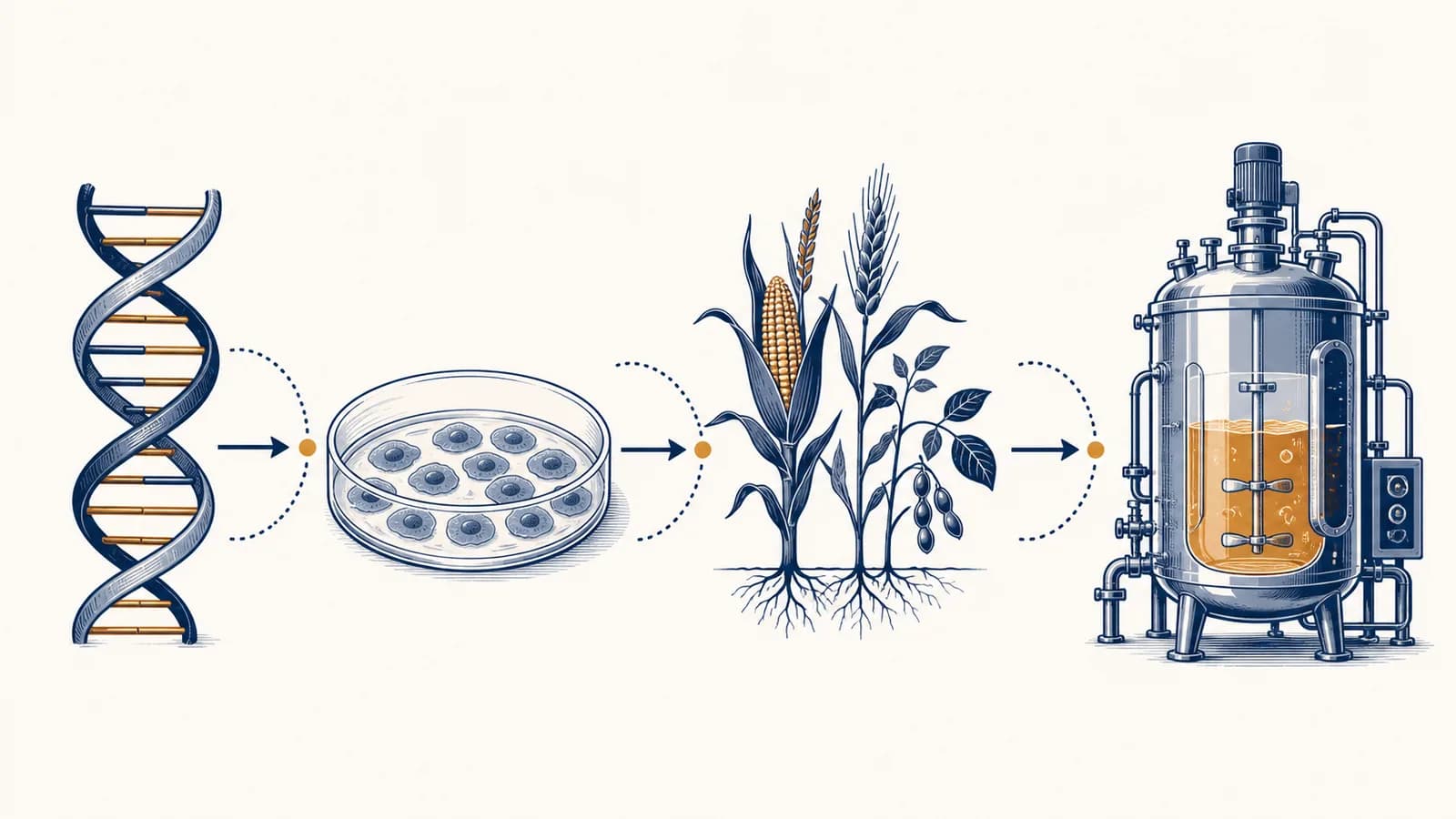
Biotechnology is a field of applied biology that uses living cells, biological molecules, and genetic information to make products or perform useful processes in medicine, agriculture, industry, and environmental work. A short biotechnology definition is “biology used as technology.” It includes ancient fermentation, modern genetic engineering, DNA sequencing, gene editing, cell culture, and diagnostic tests. Biotechnology exists because cells already perform difficult chemical jobs with high specificity, including copying DNA, recognizing molecules, and assembling proteins. People can study those jobs, control the conditions around them, and turn the results into medicines, foods, measurements, and manufacturing methods.
What biotechnology actually is
Biotechnology is the deliberate use of organisms, cells, enzymes, or genetic material to obtain a practical result. The result may be a physical product, such as insulin, or information, such as whether a sample contains a pathogen’s genetic sequence.
The word covers more than modifying DNA. A baker using yeast to make dough rise is using an organism’s metabolism. A laboratory growing human cells to test a medicine is using cell culture. A technician using an enzyme to copy DNA is using a biological molecule as a tool. Genetic engineering is one part of biotechnology, not a synonym for the whole field.
The input might be yeast, bacterial cells, plant tissue, an antibody, DNA, or a purified enzyme. The process might be fermentation, selective binding, DNA amplification, or growth in a nutrient solution. The output might be yogurt, a vaccine ingredient, a test result, or an enzyme used in laundry detergent.
This makes biotechnology a bridge between basic Biology and production. Basic research may ask how a receptor controls cell division. Biotechnology asks how that knowledge can be used, measured, manufactured consistently, and checked for safety.
A process can be biotechnological without changing a genome. Fermentation, antibody testing, tissue culture, and enzyme-based manufacturing all use biological systems even when no gene is edited.
What are the working parts of biotechnology?
Most biotechnology systems combine a biological agent, a chosen input, controlled conditions, a way to measure change, and a method for recovering the result. Changing any one part can alter yield, purity, cost, or biological behavior.
The biological agent does the work
A biological agent is the organism, cell, or molecule that performs the key transformation. Yeast converts sugars into carbon dioxide and ethanol. A restriction enzyme cuts DNA at particular sequences. An antibody binds a matching molecular shape. Living agents can reproduce and respond to their environment; isolated enzymes and antibodies cannot reproduce, but they can still perform highly selective tasks.
The conditions control what the agent does
Cells and enzymes work only within useful ranges of temperature, acidity, nutrients, oxygen, and time. Yeast supplied with sugar will not produce the same result under every condition. Oxygen availability can change which metabolic pathway dominates. Excessive heat can unfold an enzyme and distort its active site. In a factory, sensors and control systems keep these conditions within a validated range.
Measurement turns activity into evidence
A color change, fluorescence signal, electrical reading, DNA sequence, or measured concentration can reveal what happened. Controls make the reading interpretable. A positive control shows that the test can produce a signal. A negative control helps reveal contamination or background signal. Without controls, a bright tube or a growing culture may look convincing while proving very little.
These parts often work together. A company may place a human gene into bacterial cells, grow the cells in tanks, collect the protein the cells make, purify it, and use antibodies or chemical instruments to confirm its identity. Each stage answers a different question: Can the cell make it? How much was made? Is the product the intended molecule? Is anything unwanted mixed with it?
How does genetic engineering work?
Genetic engineering changes an organism’s DNA by adding, removing, or altering a chosen sequence. The changed sequence can modify a trait or instruct a host cell to make a product, but its effect depends on gene regulation and cellular context.
A gene is not a free-standing command. To express a protein, a cell needs regulatory DNA that helps start transcription, the correct reading frame, the machinery to translate messenger RNA, and raw materials for building the protein. A DNA sequence that works in one cell type may be silent or processed differently in another.
Define the trait or molecule needed, then identify a gene or regulatory sequence connected to it.
Researchers may assemble a DNA construct, insert it into a vector, or use a targeted editing system to change an existing sequence.
Methods include plasmids, modified viruses, electrical pulses, lipid particles, or direct physical delivery. The suitable method depends on the cell.
Not every cell receives the intended change. Selection and screening identify candidates for further testing.
DNA analysis checks the edit, while RNA, protein, or trait measurements test what the edit actually does.
A familiar production example is recombinant human insulin. Scientists can place DNA coding for human insulin, or its component chains, into microorganisms. The engineered cells copy the introduced DNA and use their ribosomes to make protein. Manufacturers then separate the desired material from cells and other molecules, process it as required, purify it, and test the final medicine. The gene provides information, while the cell supplies the molecular machinery.
The connection between DNA instructions and cell behavior rests on processes covered in how cells copy and express genetic information. A changed DNA letter matters only if it alters transcription, protein sequence, regulation, or another functional feature.
How does a biotechnology process move from idea to product?
A biotechnology product moves through design, small-scale testing, controlled production, purification, and quality testing. Success in a research tube is only the first step because larger equipment changes mixing, oxygen transfer, heat removal, contamination risk, and consistency.
Suppose a team wants yeast to produce an enzyme used in food processing. First, it chooses a gene and a yeast strain. Small cultures reveal whether the cells express an active enzyme. The team then tests temperature, acidity, nutrients, oxygen, and growth time. A condition that gives fast cell growth may not give the highest enzyme output, so the variables must be measured separately.
Scaling is an engineering problem as well as a biological one. In a small flask, oxygen enters across a large surface relative to the culture volume. In a large vessel, cells deep in the liquid may receive less oxygen unless gas flow and stirring are designed carefully. Stirring also creates forces that can damage fragile animal cells. Sensors track variables such as temperature, dissolved oxygen, and pH, while sterile connections reduce the chance that another organism enters the process.
Upstream processing grows or prepares the biological system
Upstream work includes preparing nutrients, maintaining a pure starter culture, increasing culture volume, and running the production vessel. The aim is to create conditions in which the biological agent makes the intended output reproducibly.
Downstream processing separates the useful product
Downstream work begins after production. Cells may be filtered or spun out. If the desired protein remains inside them, the cells must be opened. Several purification steps then separate molecules by size, charge, solubility, or binding properties. Each step can remove impurities but may also lose some product.
Quality control asks whether batches match
Quality control does not rely on one final glance. Tests may confirm identity, amount, biological activity, purity, sterility, and stability. A protein can have the correct mass yet fold incorrectly and fail to work. For a medicine, manufacturing records and validated methods matter because patients receive the manufactured batch, not the promising experiment that began the project.
A sensor reports that a fermenter is warming above its specified range. The operator cannot assume that a later purification step will erase the problem. Extra heat may change cell metabolism, lower product yield, or alter impurities. The batch record, sensor calibration, and product tests help determine what happened and whether the material can be used.
Traditional biotechnology versus genetic engineering
Traditional biotechnology uses biological variation and processes without directly rewriting a chosen DNA sequence, while genetic engineering intentionally changes defined genetic material. Both can alter useful traits, and both require testing because the final organism has many interacting genes.
People choose organisms with useful existing variation, cross compatible parents, or control growth conditions. Many DNA differences may be inherited together, and the precise genetic cause may initially be unknown.
People add or alter a defined sequence using molecular tools. The intended change may be narrow, but its biological effects still have to be measured in the whole organism.
Bread, cheese, yogurt, vinegar, and fermented vegetables rely on microorganisms and enzymes. Humans used these processes long before anyone knew that microbes existed. Selective breeding likewise changes the frequencies of gene variants across generations by choosing which organisms reproduce. Modern laboratories can make selection faster by reading genetic markers, but marker-assisted selection does not itself insert foreign DNA.
Genetic engineering can introduce a gene from another species, change a few DNA bases, switch a gene off, or alter when a gene is active. Precision of the intended DNA change does not guarantee a perfectly predictable organism. A protein may participate in several pathways, and environmental conditions may change the visible trait. Researchers compare edited organisms with suitable controls and examine more than the target sequence.
“Natural” and “engineered” do not measure risk. Risk depends on the organism, trait, exposure, dose, environment, and use. A familiar organism can cause harm, and an engineered organism can be contained and well characterized.
How does biotechnology show up in medicine?
Medical biotechnology uses cells and biological molecules to prevent, diagnose, monitor, or treat disease. It appears in vaccines, recombinant proteins, antibody medicines, genetic tests, cell therapies, and the manufacturing systems that make these products consistently.
Recombinant proteins let cells manufacture molecules that are difficult to collect from natural sources. Insulin is one example. Other engineered proteins can replace a missing factor, stimulate blood-cell production, or act as enzymes. The producing cell matters because bacteria, yeast, and animal cells process proteins differently. Some human proteins need chemical modifications after translation that bacteria do not naturally perform.
Monoclonal antibodies are laboratory-produced binding proteins selected to recognize a target. A diagnostic antibody may capture a pathogen protein on a test strip. A therapeutic antibody may block a receptor or tag a cell for immune attack. Binding is only the start of the mechanism. Location, dose, target abundance, and effects on other cells shape the result. The relationship between antibodies and defense is developed further in the biology of immune recognition.
Vaccines present information to the immune system
Vaccines expose the immune system to an antigen, or to instructions that cause cells to make an antigen, without requiring the normal course of the disease. Immune cells that respond can form memory populations. Later exposure to the pathogen can then trigger a faster, more effective response. Vaccine platforms include weakened or inactivated organisms, purified components, viral vectors, and nucleic acid instructions.
Cell and gene therapies change a patient’s biological material
Some therapies remove a patient’s cells, modify or select them, expand them under controlled conditions, and return them. Other approaches deliver genetic material directly into the body. Delivery is a central difficulty: the treatment must reach enough of the correct cells while limiting unwanted effects elsewhere. Long-term monitoring may be needed when a change can persist.
A genetic test identifies a variant in a tumor. The result is useful only if the sampled tissue truly represents the tumor, the test can detect that type of variant, and evidence connects the variant to a treatment response. A DNA result can guide a decision, but it does not make the decision by itself.
How does biotechnology show up in food, farms, and industry?
Agricultural and industrial biotechnology uses organisms or enzymes to improve crops, process food, manufacture chemicals, and treat waste. The useful trait may come from breeding, gene editing, microbial fermentation, or a purified enzyme working outside a living cell.
In crops, biotechnology may help identify seedlings carrying a useful gene variant, produce disease-free plants from tissue culture, or change a gene connected to a trait. A modified trait does not remove the need for field testing. Soil, weather, pests, and farming practice can change performance. To understand why the same genetic change can behave differently across conditions, see how plant growth responds to genes and environment.
Food biotechnology often uses microbial communities rather than a single purified organism. In yogurt production, bacterial enzymes convert lactose and produce lactic acid. The falling pH changes milk proteins and helps create the product’s texture and flavor. In bread, yeast metabolism releases carbon dioxide. Gas becomes trapped in the dough’s protein network, expanding it before and during baking.
One glucose molecule is represented as forming two ethanol molecules and two carbon dioxide molecules. Real yeast cells also direct material into growth and other products.
Industrial enzymes can replace harsher chemical conditions because their active sites favor particular reactions. Proteases break peptide bonds in proteins. Lipases act on fats. Cellulases break parts of cellulose. Their specificity can reduce unwanted products, but enzymes still need suitable temperature and pH. Engineers may modify an enzyme or search diverse organisms for a version that remains active under factory conditions.
Bioremediation uses metabolism to alter pollutants
Bioremediation employs organisms to transform or remove contaminants. Microbes may use an organic pollutant as a source of carbon or energy, changing it into other compounds. Plants can take up some contaminants from soil or water. The process is limited by access: a capable microbe cannot transform a chemical it cannot reach, and a transformed product must be checked because it may still be harmful.
A useful enzyme does not have to remain inside its original organism. Manufacturers can grow the organism, recover the enzyme, purify it, and add the enzyme directly to a food, textile, cleaning, or chemical process.
How do biotechnology tests find a gene or organism?
Biotechnology tests detect targets through selective pairing or binding, then convert that molecular event into a measurable signal. DNA tests use complementary sequences, while protein tests often use antibodies. Amplification can make a scarce target easier to detect.
Polymerase chain reaction, usually shortened to PCR, copies a chosen DNA region. Short primers are designed to bind on opposite sides of the target. Each cycle separates DNA strands, lets primers bind, and allows a heat-stable DNA polymerase to extend new strands. Repeating the cycle can produce many copies if the target and reaction conditions are suitable.
Starting with 10 target molecules, three ideal doubling cycles give molecules. Real reactions become less efficient and do not double perfectly forever.
A fluorescent signal can track copied DNA during the reaction. The cycle at which signal rises above a defined analytical threshold can help compare starting amounts, but interpretation depends on assay design, sample quality, controls, and calibration. A late signal could reflect a small starting amount, partial inhibition, or contamination. It is not automatically a diagnosis.
Sequencing reads the order of DNA bases
DNA sequencing determines the order of adenine, cytosine, guanine, and thymine in a sample. Software aligns sequence reads to a reference or assembles overlapping reads. Differences can then be identified. A sequence variant may alter a protein, change gene regulation, or have no known effect. Classification requires evidence rather than guesswork based only on rarity.
Antibody tests detect molecular shapes
In a lateral-flow test, liquid moves through a porous strip. Labeled antibodies can bind a target, and the resulting complexes can collect at a test line held by another binding molecule. A control line confirms that liquid traveled through the strip and that key reagents functioned. It does not prove that the sample was collected at the best time or that every possible error was excluded.
The assay detected or did not detect its defined target under specified conditions.
The result is combined with sample timing, symptoms, controls, detection limits, and other evidence to decide what it means.
How are safety, ethics, and regulation built into biotechnology?
Biotechnology safety combines hazard identification, exposure control, product testing, manufacturing records, and continued monitoring. Ethics asks who may be affected, who consents, how benefits and burdens are distributed, and which biological changes society is willing to permit.
A hazard is something capable of causing harm. Risk also considers the chance and extent of exposure. A microorganism that causes disease is a hazard, but the risk differs between a sealed validated system and an uncontrolled release. Laboratories use containment practices suited to the agent and procedure, including trained handling, protective equipment, controlled airflow where required, sterilization, and waste treatment.
Product oversight depends on what the product is and how it will be used. A food crop, a diagnostic device, a manufacturing enzyme, and a gene therapy do not present identical questions. Reviewers may examine molecular identity, toxicity, immune reactions, environmental effects, manufacturing consistency, or clinical evidence. The relevant test is linked to a plausible harm, not simply to the fact that biology was used.
Identify the organism, molecule, trait, or procedure that could cause harm.
Determine who or what could encounter it, by which route, and at what stage.
Add containment, testing, process limits, and follow-up that match the identified problem.
Ethical disagreements often concern distinctions that the laboratory result cannot settle alone. Editing cells in one consenting patient differs from editing embryos in a way that could pass to later generations. Using de-identified samples for a narrow test differs from placing identifiable genome data into a database for broad future use. Technical feasibility answers “can it be done?” Ethics and law also ask “under what conditions should it be done?”
What five mistakes do people make with biotechnology?
The most common errors are treating all biotechnology as gene editing, assuming a targeted DNA change has only one effect, confusing detection with diagnosis, ignoring scale, and judging safety by labels instead of evidence. Each error skips part of the mechanism.
1. Biotechnology always means genetic modification
Biotechnology includes fermentation, cell culture, antibody assays, tissue culture, and purified enzyme use. None requires a deliberate genome edit. Asking which biological agent and process are involved gives a clearer answer than sorting everything into “GMO” or “not GMO.”
2. A precise edit creates a perfectly predictable trait
Editing can precisely change a DNA target, but traits arise through gene regulation, protein networks, development, and environment. Verification therefore has at least two levels: confirm the DNA sequence, then measure the cell or organism. Off-target changes are one concern; unexpected effects of the intended on-target change are another.
3. A positive test settles the whole medical question
A test detects what it was designed to detect within a stated performance range. False positive and false negative results can occur. Sampling time, contamination, cross-reactivity, genetic variation, and detection limits all matter. A clinician interprets the result alongside symptoms, exposure, and other tests.
4. A process that works in a flask will work in a factory
Volume changes heat flow, mixing, oxygen delivery, cleaning, and contamination control. Production also needs consistent raw materials and a practical purification method. A cell that makes a tiny amount of a remarkable molecule may still be unsuitable for manufacturing if recovery destroys the product or costs too much.
5. Engineered means dangerous, or engineered means safe
Neither label is a risk assessment. The questions are specific: What changed? Could the product be toxic or allergenic? Can the organism spread? Who will be exposed? What evidence tests those possibilities? Familiarity and novelty can guide attention, but neither substitutes for measurements.
What are the limits of genetic tests and de-extinction claims?
Genetic tests can answer defined questions about the DNA they examine, while de-extinction projects may reconstruct selected sequences or traits. Neither can recover all the missing biological information, environmental influence, developmental history, or uncertainty surrounding a person or species.
Can a home DNA test tell a person everything about health?
A home DNA test can report selected variants that its method is designed to detect, but it cannot provide a complete forecast of health. Disease risk often involves many genes, environment, age, behavior, family history, and limits in the evidence.
Different tests examine different parts of the genome. A genotyping array checks predetermined sites, while sequencing can read a broader region but still faces gaps, difficult sequences, and interpretation limits. A “negative” result may mean that no tested variant was found, not that no relevant variant exists. A “positive” risk variant may change probability without making disease certain.
Before acting on a result, a person can ask four concrete questions: Which variants were tested? Was the finding confirmed with an appropriate clinical method? How strong is the evidence connecting it to disease? Would the result change care? Genetic counseling can help when the answer affects medical decisions or relatives.
Can biotechnology bring back an extinct species?
Biotechnology may recreate some traits or produce an organism genetically similar to an extinct species, but DNA alone cannot restore the original population, learned behavior, microbiome, ecological relationships, or vanished habitat. “De-extinction” therefore describes several different goals.
Old DNA is usually fragmented and chemically altered. Researchers can compare surviving fragments with genomes from living relatives and infer parts of the extinct sequence. They might edit selected variants into cells of a related species or attempt cloning if a suitable intact nucleus existed. Development would still require compatible egg cells, gestation or incubation, and healthy growth.
The resulting organism would live in a current ecosystem, not the one in which its ancestors evolved. A project must therefore distinguish spectacle from conservation benefit. Money, habitat, animal welfare, genetic diversity, and effects on living species remain biological constraints even if genome editing succeeds.
Who works in biotechnology, and what do they actually do?
Biotechnology work is divided among people who design experiments, grow cells, analyze data, build equipment, manufacture products, check quality, assess safety, and explain evidence to regulators or patients. Most products depend on coordinated specialist work rather than one inventor.
- Research scientists form hypotheses, design experiments, interpret results, and decide which questions to test next.
- Laboratory technicians prepare samples, run validated methods, maintain records, and notice when controls or instruments fail.
- Bioprocess engineers design culture, mixing, filtration, purification, and monitoring systems that can operate at production scale.
- Bioinformaticians write and use software to compare sequences, process large datasets, and distinguish biological patterns from technical noise.
- Quality specialists investigate deviations, verify methods, review batch records, and check that manufacturing follows defined procedures.
- Clinical and regulatory professionals connect laboratory evidence with patient safety, trial design, manufacturing standards, and legal requirements.
A school laboratory can develop the same habits at smaller scale. Label samples before starting. Change one planned variable at a time when possible. Include controls. Record actual observations rather than expected ones. Keep raw measurements. If the result is surprising, first check the sample, method, and instrument, then ask whether the biology offers a better explanation.
The sentence captures why the field mixes disciplines. Molecular biology can identify a mechanism, chemistry can characterize the product, engineering can make it at scale, statistics can quantify uncertainty, and ethics can define acceptable use. Weakness in any one area can stop an otherwise promising idea.
Biotechnology turns biological mechanisms into testable tools
Biotechnology belongs within biology because every useful tool still depends on cells, inheritance, metabolism, evolution, and ecological interaction. Its practical discipline is to connect a molecular cause to a measurable outcome, then test whether that connection holds outside one experiment.
The next time a label mentions enzymes, a news report mentions gene editing, or a clinic offers a molecular test, trace the mechanism. Identify the biological agent, its input, the controlled conditions, the measured signal, and the decision made from that signal. Then look for the control that could show the process failed.
The takeaway: Biotechnology does not make biology behave like a simple machine. It makes selected biological processes useful by defining the parts, controlling the conditions, measuring the output, and testing the limits.