Thermodynamics is a branch of physics that explains how energy moves and changes form, in the context of heat, work, temperature, and matter. The laws of thermodynamics connect heat transfer, internal energy, entropy, pressure, volume, and temperature. They exist because energy changes obey strict limits: energy is conserved, heat has a preferred direction, and no engine can turn all supplied heat into useful work. These rules explain why coffee cools, refrigerators warm the kitchen, engines need exhausts, sweating cools skin, and power stations cannot be perfectly efficient.
What thermodynamics actually is
Thermodynamics is the study of large collections of particles through measurable quantities such as temperature, pressure, volume, energy, and entropy. It predicts the possible direction and final balance of a process without tracking every atom or molecule along the way.
A cup of water contains an enormous number of molecules. Following each collision would be impossible and unnecessary. A thermometer, pressure gauge, and scale can instead describe the water with a few macroscopic properties. Thermodynamics connects those properties and tells us what changes are allowed.
The subject grew from practical questions about steam engines, but its laws apply much more widely. They govern chemical reactions, weather, batteries, muscles, stars, air conditioners, and information processing. Thermodynamics does not describe every detail of how fast a process happens. It sets the energy accounts and identifies the direction in which change can occur.
Thermodynamics studies constraints. It can show that a proposed machine is impossible even before anyone chooses its materials, dimensions, or operating speed.
Three words organize most problems. A system is the matter or region being studied. The surroundings are everything outside it. The boundary separates them. Choosing that boundary changes the bookkeeping, so it must be stated clearly.
How systems, states, and equilibrium work
A thermodynamic system is described by state variables whose values do not depend on the path taken to reach them. Equilibrium exists when measurable properties stop changing and there are no unbalanced thermal, mechanical, or chemical differences inside the system.
Open, closed, and isolated systems exchange different things
An open system exchanges both matter and energy with its surroundings. A running car engine takes in fuel and air, releases exhaust, rejects heat, and delivers work. A closed system exchanges energy but not matter. Gas sealed inside a piston can be heated and can push the piston, while the gas itself remains enclosed. An isolated system exchanges neither matter nor energy. Perfect isolation is an idealization, although a well insulated sealed container can approximate it for a limited time.
A state needs enough independent variables
Pressure, volume, temperature, internal energy, and density are examples of state variables. For a fixed amount of an ideal gas, pressure, volume, and temperature are linked by the ideal gas equation, so specifying two fixes the third.
For one mole at 300 K in a volume of 0.0249 m³, the pressure is about 100,000 Pa because .
The equation is an approximation for real gases. It works best when particles are far apart and their attractions matter little. At high pressure or near condensation, molecular size and attraction become important, so more detailed equations are needed. Those molecular effects connect thermodynamics with how material properties emerge from structure.
Equilibrium removes the gradients that drive change
A temperature difference drives heat transfer. A pressure difference drives expansion or fluid flow. A concentration difference can drive diffusion. At equilibrium, those driving differences have disappeared or balance one another. Thermodynamics often compares an initial equilibrium state with a final one, even if the events between them are complicated.
How temperature, heat, and internal energy work
Temperature describes thermal state, heat is energy transferred because of a temperature difference, and internal energy is energy stored in microscopic motion and interactions. These quantities are related, but they are not interchangeable and they use different bookkeeping rules.
Temperature tells which way heat will flow when two bodies can exchange energy: spontaneous heat transfer goes from the body at higher temperature to the one at lower temperature. In microscopic terms, temperature is tied to how energy is distributed among available molecular motions. It is not simply the total motion of all particles.
Internal energy, usually written , includes the microscopic kinetic energy of particles and potential energy in their interactions. It does not include the motion of the whole object across a room or its gravitational potential energy as a whole. Internal energy is a property of the system's state.
Heat, written , is energy in transit across a boundary due to a temperature difference. A body contains internal energy, not heat. Once transferred energy enters the body, it becomes part of the body's internal energy or contributes to work and other energy changes.
“The metal spoon contains more cold than the wooden spoon.”
Both may begin at room temperature. Metal conducts energy away from warm skin faster, so the metal feels colder.
Heat crosses a boundary by conduction, convection, or radiation. Conduction transfers energy through collisions and interactions within matter. Convection carries internal energy with moving fluid. Radiation transfers energy by electromagnetic waves and needs no material medium.
The rate of transfer belongs to heat transfer physics, while thermodynamics tracks the total energy and allowed direction. Insulation slows transfer but does not change the equilibrium eventually approached. A vacuum flask reduces conduction and convection; reflective surfaces reduce radiation.
Heat versus temperature
Heat is energy crossing a system boundary because temperatures differ, while temperature is a state variable that determines the direction of that transfer. A large cool object can contain more internal energy than a small hot object, despite having a lower temperature.
Consider a bathtub of water at 35°C and a mug of water at 90°C. The mug has the higher temperature, but the bathtub contains much more water. Relative to the same reference state, its much larger mass can give it more total internal energy. Temperature measures thermal condition, not total stored energy.
For a substance that stays in one phase and whose specific heat capacity is nearly constant, the energy needed for a temperature change is:
Heating 0.50 kg of water by 10 K requires about 20,900 J, using .
The value 4180 J per kilogram per kelvin is a standard approximate specific heat capacity for liquid water near room temperature. It means water needs much more energy for a given mass and temperature rise than many metals. This helps oceans moderate coastal temperatures and lets water carry energy effectively in heating systems.
Temperature differences can be measured in kelvins or degrees Celsius with the same numerical size: a rise of 10°C is a rise of 10 K. Absolute temperatures in formulas such as the ideal gas law must use kelvins. Zero kelvin is absolute zero, equivalent to minus 273.15°C by definition of the Celsius scale.
How the first law of thermodynamics works
The first law states that a system's internal energy changes only when energy crosses its boundary as heat or work. With work done by the system counted as positive, the energy account is .
The sign convention must be declared because textbooks sometimes define work with the opposite sign. Here, is positive when heat enters the system and is positive when the system does work on its surroundings.
Draw the boundary and decide whether matter can cross it.
Record heat entering or leaving and work done by or on the system.
Use for the convention stated above.
Heating without enough outward work should raise internal energy, while expansion can lower it.
Suppose 500 J of heat enters gas in a cylinder and the expanding gas does 200 J of work on a piston. Its internal energy rises by 300 J:
Energy has not vanished. Part remains inside the gas and part leaves through mechanical work.
Work is energy transfer by an organized force acting through a distance. For a gas expanding slowly against constant external pressure, boundary work is . On a pressure against volume graph, work is represented by area under the process curve. The details of that curve matter, so heat and work depend on the path, unlike internal energy.
This law is conservation of energy applied to thermal systems. The broader ideas of work, energy rate, and machine output appear in the physics of energy and power. The first law blocks a perpetual motion machine that produces energy without an energy source.
How entropy and the second law work
Entropy is a state variable that measures how widely energy is distributed among the microscopic arrangements available to a system. The second law says the total entropy of an isolated system cannot decrease during a spontaneous process.
The first law says energy is conserved, but conservation alone does not explain direction. A warm mug heats a cool room, yet the room does not spontaneously surrender energy to make the mug warmer. Both directions conserve energy. The second law distinguishes the naturally occurring direction.
For a reversible transfer of a small amount of heat at absolute temperature , entropy change is defined by . A reversible process is an ideal limit carried out through changes so small that the system remains arbitrarily close to equilibrium. Real processes involve finite differences and produce entropy.
Place equal masses of the same liquid at 350 K and 300 K in an insulated container. Energy lost by the hotter portion equals energy gained by the cooler portion, so the final temperature lies between them. The hot part loses entropy, the cold part gains more entropy than the hot part loses, and total entropy increases.
A statistical view makes the direction less mysterious. There are vastly more microscopic arrangements in which energy is spread through both portions than arrangements in which excess energy happens to gather in one. Entropy is related to the number of accessible microscopic arrangements by Boltzmann's relation:
If a macrostate has more accessible arrangements, its entropy is higher. The logarithm makes entropy additive for independent systems.
Entropy is often described as disorder, but that shortcut can mislead. A neatly stacked deck is visually ordered, yet thermodynamic entropy concerns accessible microscopic states and energy distribution, not tidiness. Entropy can decrease in one place if a larger increase occurs elsewhere. A refrigerator lowers entropy inside its cabinet while its motor and condenser release enough energy to increase the total entropy of the kitchen and appliance.
“Quality” here means ability to produce useful work under the available conditions. Thermal energy at nearly the same temperature as the surroundings has little capacity to drive change. This is why waste heat matters even though its energy remains present.
How gases and phase changes respond to energy
Gases change pressure, volume, and temperature as energy enters or leaves, while phase changes rearrange particles without necessarily changing temperature. The response depends on constraints, material properties, and the path taken through the system's state space.
Compression and expansion couple motion to temperature
Compress a gas quickly and work is done on it. With little time for heat to escape, its internal energy and temperature rise. Let a gas expand quickly and do work, and its temperature can fall. A bicycle pump becoming warm is a familiar example of compression heating, with some additional heating caused by friction.
An isothermal process holds temperature constant. An adiabatic process transfers no heat across the boundary. An isobaric process holds pressure constant, and an isochoric process holds volume constant. These names specify constraints; they do not mean every other property remains fixed.
Latent heat changes phase rather than temperature
At a phase transition under fixed pressure, added energy can separate or rearrange particles instead of raising temperature. Melting ice at its melting point produces liquid water at the same temperature until the phase change is complete. The required energy is calculated using latent heat:
Melting 0.10 kg of ice at 0°C requires about 33,400 J, using the standard latent heat of fusion of water, .
Boiling point depends on pressure. Lower external pressure lets bubbles of vapour grow at a lower temperature, which is why water boils below 100°C at high altitude. A pressure cooker raises pressure and therefore raises the boiling temperature, allowing food to cook in hotter water and steam. The forces and motion within liquids and gases are developed further in how fluids behave under pressure and flow.
How thermodynamics shows up in engines, homes, and living bodies
Thermodynamics appears wherever energy is converted, transferred, or stored. Engines turn part of a heat flow into work, buildings control unwanted heat transfer, and organisms transform chemical energy while continually releasing heat to their surroundings.
Heat engines need a hot source and a cold sink
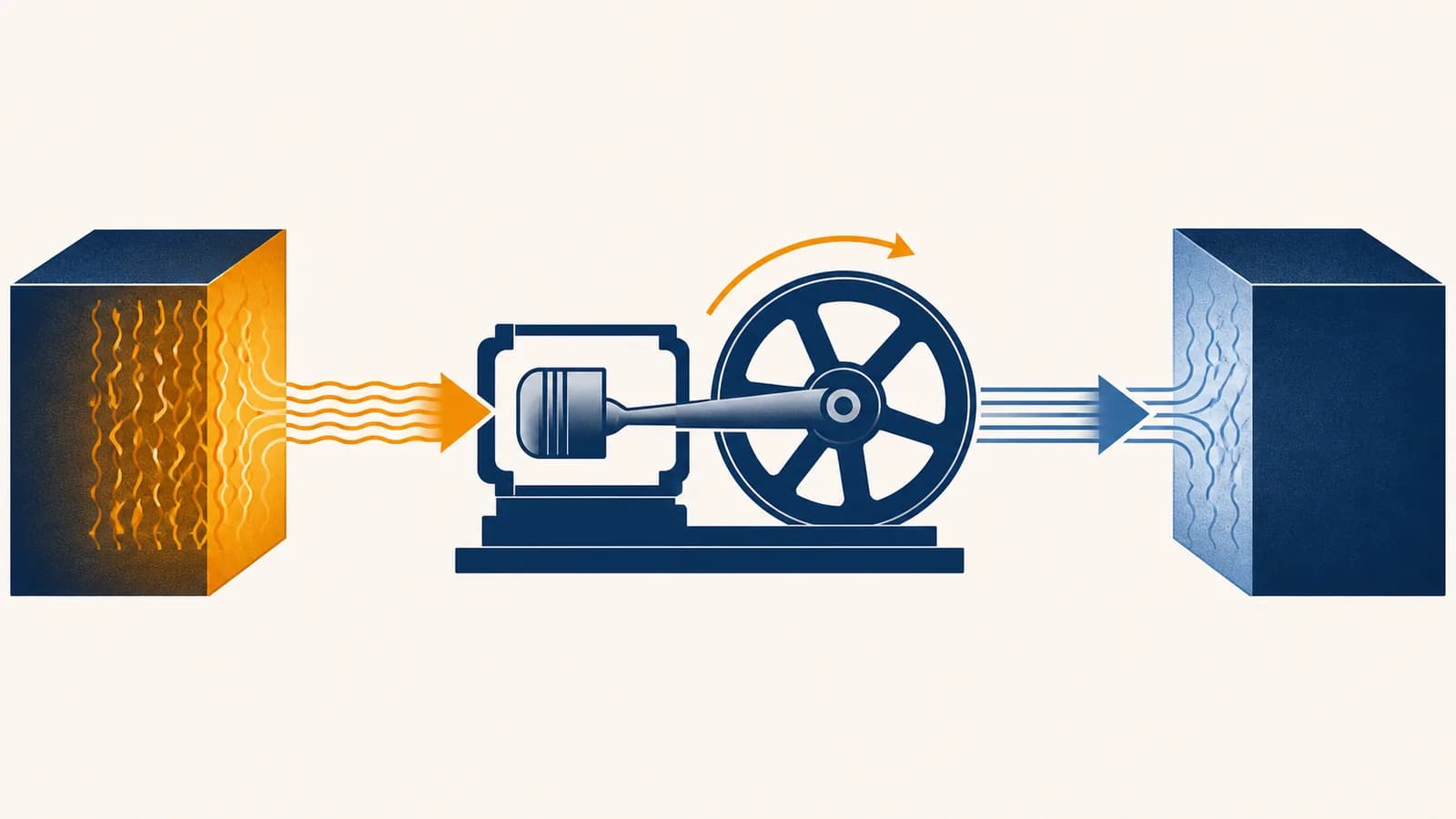
A heat engine absorbs energy from a high temperature source, produces work , and rejects energy to a lower temperature sink. Over a complete cycle, the working substance returns to its starting state, so its net internal energy change is zero and .
Car engines, gas turbines, and steam turbines use different working substances and mechanisms, but the same energy account applies. Friction, turbulence, combustion away from equilibrium, and heat leakage produce entropy and reduce useful output.
Refrigerators move energy against its spontaneous direction
A refrigerator uses work, usually supplied by an electric compressor, to move thermal energy from a cold compartment to a warmer room. A refrigerant evaporates at low pressure inside the cabinet, absorbing energy. Compression raises its pressure and temperature. It then condenses in outside coils and releases energy to the room.
Leaving the door open cannot cool a closed kitchen. The appliance removes some energy from nearby air but returns that energy through its condenser, along with the electrical work supplied to the compressor. The kitchen gains energy overall.
Buildings manage all three heat transfer routes
Wall insulation slows conduction. Sealed air spaces reduce convection. Low emissivity coatings reduce radiative transfer through windows. Drafts carry warm or cool air across the building boundary, so air sealing changes the heating load. A thermal camera can reveal surface temperature patterns, but interpreting them requires attention to surface emissivity and weather conditions.
Living bodies are open thermodynamic systems
A person takes in matter and chemical energy, does mechanical and electrical work, stores some energy, and releases heat and waste. Sweating cools because evaporation requires energy, which is drawn partly from skin. Moving air speeds evaporation when the surrounding air is not already saturated with water vapour. Humid air makes this route less effective.
These examples also show why the choice of boundary matters. A refrigerator alone loses energy through its condenser, but the refrigerator plus kitchen gains electrical energy from outside. A human body can lose internal energy while the room gains it. The equation stays consistent when every crossing is counted.
Five mistakes people make with thermodynamics
Most errors in thermodynamics come from mixing up stored quantities with transfers, ignoring the system boundary, or applying an equation outside its conditions. Clear definitions and a signed energy account prevent these five common mistakes.
1. Treating heat as something stored in an object
An object stores internal energy. Heat names energy while it crosses a boundary because of a temperature difference. Saying “heat enters the pan” is useful; saying “the pan contains 500 joules of heat” confuses a transfer with a state property.
2. Assuming higher temperature means more total energy
Temperature is not total internal energy. Mass, phase, chemical composition, and molecular structure also matter. A spark can have a high temperature but transfer little energy because it contains very little matter. A warm bath can transfer much more.
3. Forgetting to define the system boundary
Energy that seems to disappear usually crossed an unstated boundary. In a braking car, organized kinetic energy becomes internal energy in brakes, tyres, road, and air. Expanding the chosen system reveals the conserved total, while mechanics accounts for the forces, motion, and work.
4. Reading “entropy increases” as “everything becomes messy”
Entropy is a quantitative state variable, not a judgment about visual order. Local structure can form while total entropy increases. Water can freeze in a cold environment because the latent energy released to the surroundings produces an entropy increase that can exceed the water's entropy decrease.
5. Believing energy conservation guarantees complete usefulness
The first law preserves total energy, but the second law limits conversion to useful work. After mechanical energy becomes low temperature thermal energy spread through the environment, the energy still exists. Recovering all of it would require a colder sink and would itself produce entropy.
How efficiency limits engines and refrigerators
Thermal efficiency compares an engine's useful work with the heat supplied, and the second law sets an upper limit based on source and sink temperatures. Refrigerators use a different measure because their desired output is heat removed, not work produced.
For an engine, efficiency is . If an engine absorbs 1,000 J from a hot source, produces 300 J of work, and rejects 700 J, its efficiency is 30 percent. Energy conservation alone would allow 100 percent, but the second law does not allow a cyclic heat engine to convert all heat from a single source into work.
Between reservoirs at 600 K and 300 K, no heat engine can exceed , or 50 percent. Temperatures must be absolute.
The Carnot value describes an ideal reversible engine. A real engine operates below it because finite temperature differences, friction, mixing, electrical resistance, and other irreversible processes generate entropy. Raising the hot reservoir temperature or lowering the cold reservoir temperature can raise the theoretical limit, but materials and environmental conditions constrain both.
A refrigerator is rated by coefficient of performance, . This ratio can exceed one without violating conservation, because the electrical work does not create all the energy delivered at the condenser. The machine moves from the cold space and adds work, so it releases to the room.
How the zeroth and third laws complete the picture
The zeroth law makes temperature measurement logically consistent by defining thermal equilibrium as transitive. The third law describes entropy near absolute zero and establishes that absolute zero cannot be reached by a finite sequence of ordinary thermodynamic operations.
The zeroth law gives thermometers meaning
If system A is in thermal equilibrium with system C, and system B is also in thermal equilibrium with C, then A and B are in thermal equilibrium with each other. System C can be a thermometer. Its repeatable physical property, such as electrical resistance or gas pressure, provides a temperature reading.
This law sounds obvious because temperature scales already embody it. Logically, however, it supplies the relation that allows separate objects to be assigned the same temperature without placing every pair in direct contact.
The third law sets the low temperature reference
For a perfect crystal, entropy approaches zero as temperature approaches absolute zero. The “perfect crystal” condition matters because structural alternatives or disorder can leave residual entropy. The law supplies a reference for calculating absolute entropies and helps explain low temperature behaviour.
Zero kelvin is not simply “very cold.” It is the lower limit of thermodynamic temperature. Quantum systems retain zero point motion, so absolute zero does not mean every particle becomes motionless.
Cooling becomes progressively harder near absolute zero. Each further reduction demands increasingly careful isolation and specialized methods. The unattainability statement prevents treating zero kelvin as an ordinary endpoint that can be reached through a finite practical procedure.
Thermodynamics ties microscopic motion to the whole of physics
Thermodynamics turns countless microscopic events into testable laws for energy, direction, and limits. It links mechanics, electricity, materials, and fluids by asking the same disciplined questions: what is the system, what crosses its boundary, and what must increase?
The subject is powerful because it ignores details that do not affect the energy account. A steam turbine and a living cell have very different mechanisms, yet both must conserve energy and produce entropy. Microscopic models explain where properties come from; thermodynamics says which overall changes are possible.
Notice the next cooling drink, compressed bicycle pump, fogged window, or humming refrigerator. Mark an imaginary boundary around it. Identify matter crossing, heat crossing, work crossing, and changes stored inside. Then place the example alongside the wider set of physics ideas and applications.
The takeaway: Energy never disappears, but its location, form, and ability to do useful work change. Thermodynamics provides the accounting rules and the direction rule for every such change.