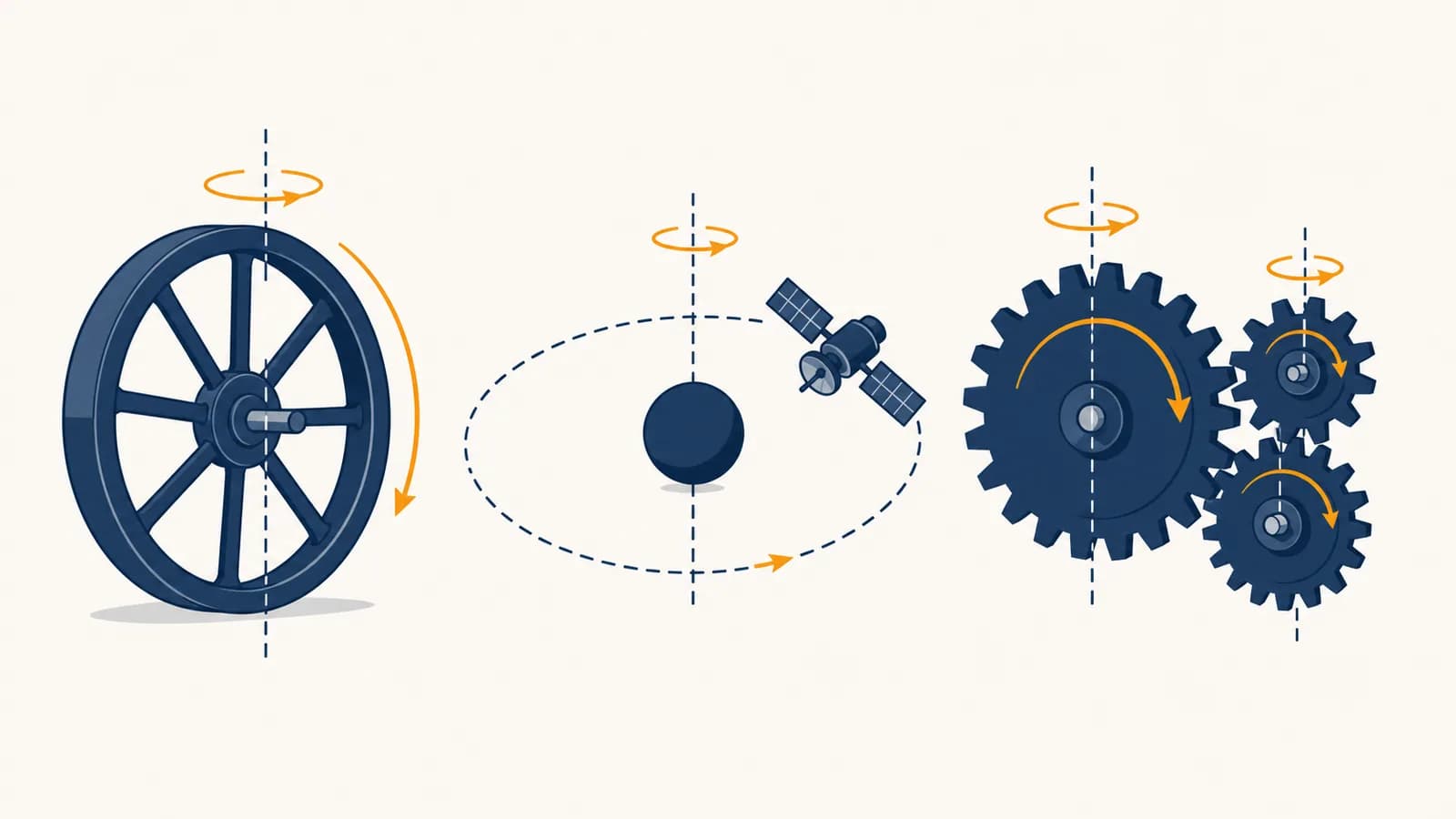
Circular and rotational motion is an area of mechanics that describes how objects travel around a centre or turn about an axis, in the context of forces, energy, and momentum. Circular motion follows a curved path; rotational motion turns a body itself. The main ideas are centripetal force, angular velocity, torque, rotational inertia, angular momentum, and rotational kinetic energy. They exist because ordinary straight-line equations cannot fully describe changing direction or the effect of a force applied away from an axis. These ideas explain tyres gripping a bend, centrifuges separating samples, motors spinning shafts, and satellites staying in orbit.
What circular and rotational motion actually are
Circular motion is the movement of an object along a circular path, while rotational motion is the turning of an extended object about an axis. The two can occur separately, but rolling wheels and orbiting, spinning bodies can display both at once.
A stone tied to a string and swung in a horizontal circle has circular motion. If the stone is treated as a small particle, its own orientation does not matter. Every point on a rigid disc spinning on an axle, by contrast, circles the axle while the disc changes orientation as a whole. That is rotational motion.
The axis of rotation is the line about which a body turns. It may pass through the body, as in a bicycle wheel, or lie outside it, as when a door swings around its hinges. A point at distance r from the axis traces a circle of radius r. Points farther from the axis cover more distance during the same turn.
Track one position around a centre. Radius, speed, and inward acceleration describe the motion.
Track the angle of the whole object. Torque, rotational inertia, and angular acceleration describe how its spin changes.
A rigid body is an ideal object whose shape does not change. Real wheels, shafts, and blades deform slightly, but the approximation works when that deformation is too small to affect the question. If deformation matters, the physics of stress and stiffness joins the description.
How angular quantities describe rotation
Angular position states an object's orientation, angular velocity states how quickly that orientation changes, and angular acceleration states how quickly angular velocity changes. These quantities give every point on a rigid body one shared description, even though their linear speeds differ.
An angle in rotational physics is usually measured in radians. One radian subtends an arc whose length equals the radius. A full circle contains radians, so . Radians make the connection between angle and distance direct:
At a radius of 0.50 m, a turn of 2 rad sweeps an arc of .
Angular velocity is , measured in radians per second. Angular acceleration is , measured in radians per second squared. The signs depend on a chosen positive direction. Counterclockwise is often positive on a flat diagram, but either choice works if it is used consistently.
For a rigid object, all points share , but their tangential speeds depend on radius:
A point 0.20 m from an axis turning at 10 rad/s moves at . A point at 0.40 m moves twice as fast.
Frequency counts revolutions per second, in hertz. Period is the time for one revolution. Since one revolution is radians, the relations are and . A fan completing 5 revolutions each second has , , and .
How centripetal acceleration and force bend a path
Centripetal acceleration is the inward acceleration required for circular motion, and centripetal force is the net inward force that produces it. Acceleration changes the velocity direction, and both the acceleration and the net force point toward the circle's centre at that instant.
Velocity includes direction. An object moving at constant speed around a circle therefore has changing velocity and must be accelerating. During a short time interval, the velocity arrow rotates slightly. Subtracting the old velocity from the new one gives a change that points inward. As the interval becomes smaller, the inward direction becomes exact.
A car travelling at 12 m/s around a curve of radius 36 m needs toward the centre.
The square on speed matters. Doubling speed makes the required inward acceleration four times as large. Doubling radius at the same speed halves it. This is why a bend that feels gentle at low speed can demand much more tyre grip at high speed, and why broader curves are easier to follow.
Constant speed does not mean zero acceleration. In uniform circular motion, speed stays fixed but the velocity direction changes continuously, so acceleration is nonzero.
If speed changes as well as direction, the object also has tangential acceleration . The inward and tangential components are perpendicular. Their combined magnitude is . A carousel starting up has both until it reaches steady speed.
Real forces supply the inward result
Centripetal force is the name for the net inward force that produces centripetal acceleration. It is not a new kind of force. Tension, gravity, friction, a normal force, or a combination of forces can supply it.
Newton's second law gives the required net inward force:
For a 0.50 kg ball moving at 6.0 m/s on a 2.0 m radius, the net inward force is .
To solve a circular-force problem, first draw only real forces. Then choose the inward direction and add the components of those forces along it. Set that net component equal to . Do not add a separate centripetal-force arrow, because doing so counts the inward result twice.
The required acceleration points from the object toward the centre of its circular path.
Include forces such as weight, tension, friction, and contact forces, with their actual directions.
Add the force components toward the centre, subtract those pointing away, and set the result equal to .
For a satellite in a nearly circular orbit, gravity supplies the inward force. Setting gives . The satellite is continually falling toward Earth, but its sideways motion carries it around the curved surface. The orbital body's mass cancels. The wider account of how gravity sets orbital motion connects this result to elliptical orbits and gravitational fields.
Circular motion versus rotation
Circular motion describes the path of a chosen point around a centre, whereas rotation describes the changing orientation of an extended body about an axis. A body can orbit without rotating, rotate without orbiting, or combine both forms of motion.
The centre of mass travels around an external point. An ideal satellite could keep the same orientation relative to distant stars while it orbits.
The body turns about an axis through itself. A laboratory rotor can spin while its centre of mass stays fixed.
Earth does both: it rotates about its own axis and revolves around the Sun. The Moon also rotates once per orbit relative to distant space, which is why nearly the same lunar face points toward Earth. This condition is called synchronous rotation. It is rotation, not an absence of rotation.
A rolling wheel adds translation. Its centre moves forward while the wheel rotates about its axle. Relative to the ground, different points on the rim have different instantaneous velocities. The bottom contact point can be momentarily at rest while the top point moves at twice the centre's speed, provided the wheel rolls without slipping.
How torque and mass distribution control rotation
Torque measures the turning effect of a force about a chosen axis, while rotational inertia measures the object's resistance to that effect. Angular acceleration depends on both, so the same push can produce very different motion in objects with different mass distributions.
A 30 N force applied perpendicular to a wrench 0.25 m from the bolt produces .
The perpendicular distance is the shortest distance from the axis to the force's line of action. Pushing directly toward a hinge gives zero torque because that line passes through the axis. Pushing perpendicular to a door at its handle gives much more torque than pushing near the hinge with the same force.
Net torque produces angular acceleration in the same structural way that net force produces linear acceleration:
If a wheel has and receives a net torque of 6.0 N m, then .
Torque has direction as well as magnitude. The right-hand rule assigns the direction along the rotation axis: curl the fingers of the right hand in the tendency to rotate, and the thumb points in the torque direction. In a flat problem, this often reduces to clockwise or counterclockwise signs.
A mechanic chooses a longer breaker bar for a stuck bolt. The longer handle increases , so the same hand force produces more torque. The tool changes mechanical advantage, not the required turning angle.
Mass distribution sets rotational inertia
Rotational inertia, also called moment of inertia, measures how strongly an object resists angular acceleration about a specified axis. It depends on total mass and on how far that mass lies from the axis, with distant mass weighted by distance squared.
For particles, . Moving a piece of mass twice as far from the axis makes its contribution four times as large. That sensitivity explains why shape and axis matter. A compact disc and a thin ring with the same mass and radius do not respond equally to the same torque.
| Rigid body | Axis | Moment of inertia |
|---|---|---|
| Point mass | Distance away | |
| Thin ring | Through centre, perpendicular to ring | |
| Solid disc | Through centre, perpendicular to disc | |
| Uniform rod | Through centre, perpendicular to rod | |
| Uniform rod | Through one end, perpendicular to rod |
Consider a thin ring and a solid disc, each with mass 2.0 kg and radius 0.30 m. The ring has . The disc has . Under the same net torque, the disc gets twice the angular acceleration because more of its mass sits closer to the axis.
The axis must always be named. A rod is easier to turn about its centre than about one end. Engineers use mass distribution to control how quickly machine parts respond, while athletes alter body shape for the same reason. Pulling limbs inward reduces rotational inertia; extending them increases it.
How rotational energy and angular momentum behave
A rotating body stores kinetic energy and carries angular momentum. Rotational kinetic energy depends on moment of inertia and angular speed squared, while angular momentum depends on both linearly. Each quantity is conserved only under the relevant physical conditions.
For fixed-axis rotation, . If and , then . Doubling angular speed would quadruple the energy. Motors must supply that energy, and brakes must remove it, usually converting it into thermal energy. The broader account of energy transfer and power shows how rate enters motor and brake calculations.
Angular momentum for a rigid body about a fixed principal axis is . Net external torque changes it according to . If external torque is negligible, total angular momentum stays constant.
A skater pulling the arms inward illustrates conservation, but the mechanism needs care. Internal muscle forces rearrange mass and do work, so rotational kinetic energy can change even while angular momentum remains fixed. Conservation of angular momentum does not automatically mean conservation of kinetic energy.
How circular and rotational motion show up in real work
Circular and rotational mechanics governs any system with wheels, shafts, rotors, bends, or orbits. Workers use it to select motors, balance machinery, set safe speeds, interpret laboratory samples, and predict how vehicles respond to steering and braking.
Machines trade torque for angular speed
Gears transmit rotation through contacting teeth. At their contact, ideal gears share the same tangential speed, so . A larger driven gear turns more slowly but can provide more torque. Ignoring losses, power is conserved: . Real bearings and teeth dissipate some energy as heat and sound.
Motor designers must account for both steady torque against loads and extra torque needed to accelerate the rotor. A machine with large rotational inertia starts slowly unless the motor supplies a large net torque. Flywheels deliberately use rotational inertia to smooth speed changes and store kinetic energy between power strokes.
Vehicles need inward tyre force
On a level road, static friction between tyres and road supplies the car's horizontal inward force during a turn. If the required exceeds the available friction, the tyres cannot follow the intended circle. The car then takes a path with less curvature, often described as sliding outward, although no mysterious outward force is pushing it in an inertial frame.
Engineers also balance wheels and shafts. If a rotating part's centre of mass does not lie on its axis, the bearings must repeatedly pull the off-centre mass inward. The changing load causes vibration, noise, and wear. Adding or removing a small balancing mass can move the centre of mass back toward the axis.
Laboratories separate materials by rotation
A centrifuge spins samples so their components experience different motion through a fluid. The tube wall provides inward force to the sample, while particles move relative to the fluid according to their density, size, shape, buoyancy, and drag. Rotation does not create gravity; it creates the acceleration conditions under which components separate.
Laboratory protocols commonly specify rotational speed and sometimes relative centrifugal acceleration. Revolutions per minute alone do not determine acceleration because rotor radius also matters. Using , the same angular speed produces a larger centripetal acceleration farther from the axis. The drag and buoyancy involved connect rotation to how fluids exert forces.
Radius belongs in every centrifuge comparison. Two rotors at the same revolutions per minute can produce different accelerations if their sample tubes sit at different radii.
5 mistakes people make with rotational motion
Most errors in rotational mechanics come from treating direction, radius, or axis as optional. Reliable solutions identify the centre and axis first, separate real forces from calculated net effects, and keep angular quantities distinct from their linear partners.
1. Calling centripetal force a separate force
Centripetal force is the net inward component of real forces, not an additional interaction. For a ball on a string, tension may supply it. For an orbiting satellite, gravity supplies it. Draw the interactions first, then calculate their inward sum.
2. Treating centrifugal force as an outward interaction
In an inertial frame, a released object travels along its instantaneous tangent because the inward force has disappeared. It does not shoot radially outward. A centrifugal term can be introduced in a rotating reference frame, but it is an apparent force used because that frame accelerates.
3. Mixing angular speed with tangential speed
Every point on a rigid wheel shares the same angular speed, yet points at different radii have different tangential speeds. Use and check the units. Radians per second and metres per second answer different questions.
4. Calculating torque with the full distance every time
Only the perpendicular lever arm counts. A large force aimed nearly through the axis can produce little torque. Use or find the shortest distance from the axis to the line of action.
5. Assuming conservation without checking external influence
Angular momentum is conserved when net external torque is zero or negligible for the chosen system. Rotational kinetic energy is conserved under different conditions. Friction can reduce mechanical energy while angular momentum of a larger isolated system remains conserved.
How rolling without slipping works
Rolling without slipping occurs when the contact point between a wheel and the surface is instantaneously at rest relative to that surface. The centre's speed and angular speed then obey , linking translation and rotation.
The velocity of any point equals the centre's translational velocity plus its velocity around the centre. At the bottom, the rotational contribution points backward with size , cancelling the centre's forward speed. At the top, it points forward and adds, giving .
Static friction can create the torque needed to start or change rolling, but it does not always point backward. Its direction depends on which way the contact point would slip without friction. A powered wheel, a freely rolling wheel, and a braking wheel can require different friction directions.
Mark one spot on a tyre and watch it near the ground. During steady rolling, it slows toward zero at contact, then speeds up as it rises. Its path relative to the road is a cycloid, not a circle.
How banked turns reduce reliance on friction
A banked turn tilts the surface so its normal force has a horizontal component toward the centre. At one design speed, that component can provide the required centripetal force without any sideways friction between vehicle and surface.
For an ideal banked curve of angle , vertical balance gives , while the inward component gives . Dividing the equations removes and :
For , , and , , so .
At other speeds, friction may act up or down the slope to help produce the needed horizontal force while maintaining vertical balance. Roads, tracks, and aircraft turns use the same vector logic, although their design must include changing loads, surface conditions, and safety margins.
How apparent weight changes in vertical circles and rotating habitats
Apparent weight is the support force a person feels, and circular acceleration can make it differ from gravitational weight. In vertical loops it changes with position; in a rotating habitat, the wall's inward normal force can imitate weight.
At the bottom of a vertical circle, the inward direction is upward. For a rider, , so the seat force is . At the top, both gravity and a downward seat or track force may point inward, so the support force can be smaller.
In a rotating cylindrical habitat, a person moves in a circle with the wall. The wall pushes inward with . The person interprets that contact force as weight. To match an apparent gravitational field , designers would choose . A larger radius permits a lower angular speed for the same apparent weight and reduces differences between acceleration at the feet and head.
Apparent weight is a contact force. A scale reports the normal force on it, not gravity directly. Circular acceleration can therefore change the reading even when stays the same.
Rotation connects force, motion, and energy across physics
Rotational mechanics extends the same physics used for straight motion: force becomes torque, mass is joined by rotational inertia, and linear momentum has an angular counterpart. The axis and radius reveal how those familiar laws act on turning systems.
When you meet a wheel, bend, rotor, orbit, or spinning body, identify the axis and mark the centre first. Then ask which quantity the situation needs: inward force for a curved path, net torque for changing spin, energy for work and heating, or angular momentum for an isolated rearrangement.
The takeaway: Circular motion requires an inward net force, while changing rotation requires a net torque. Radius and mass distribution decide how strongly a real object responds.
Those connections place rotation beside forces, waves, fields, and energy in the wider structure of school physics. Watch a turning bicycle wheel or a door today: locate the axis, compare the speeds of two points, and notice where an applied force would create the largest torque.