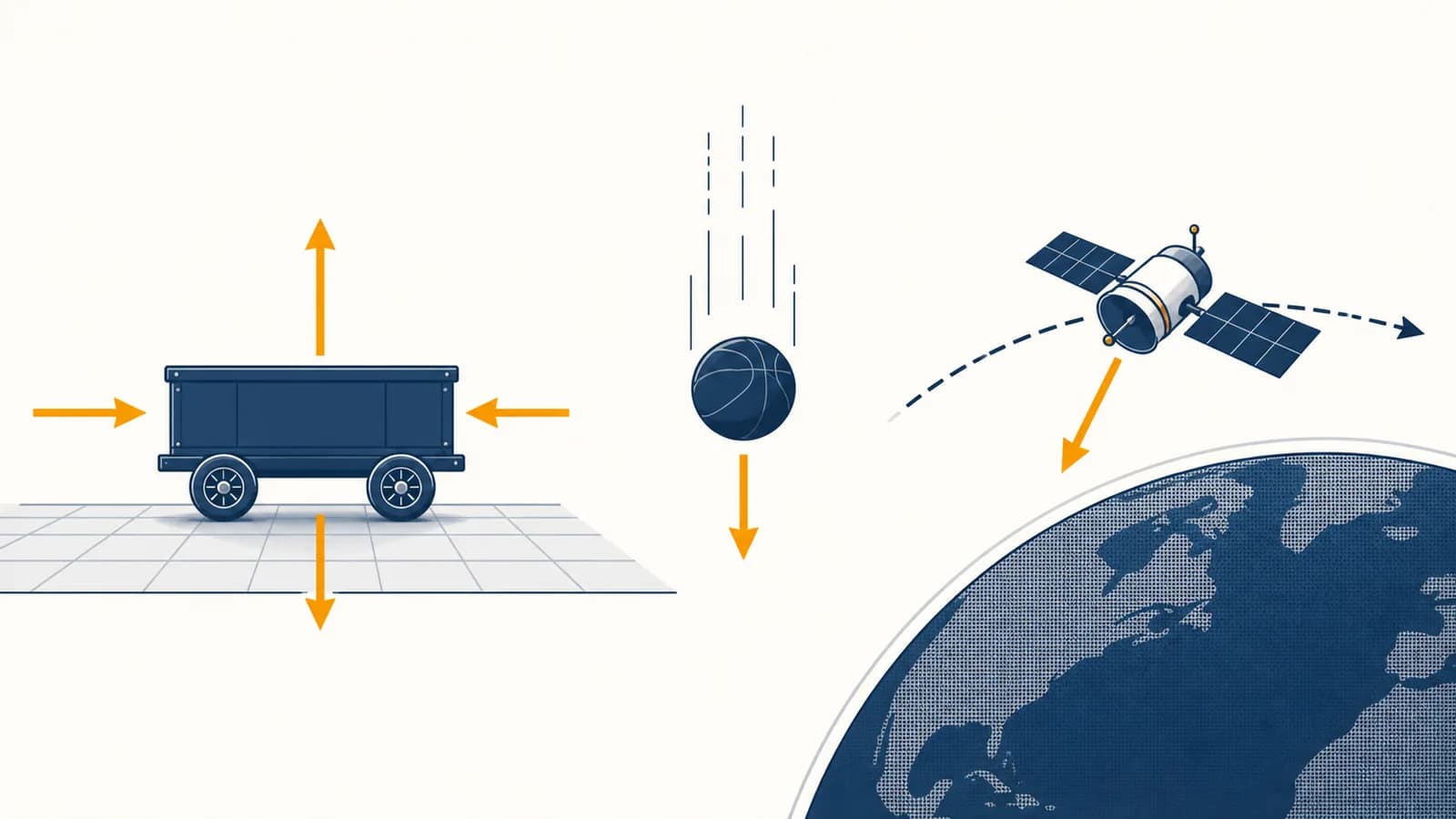
Newtonian mechanics is a physical theory that predicts how objects move when forces act on them, in the context of speeds far below the speed of light and objects much larger than atoms. Also called classical mechanics, it connects force, mass, acceleration, momentum, gravity, and motion through a small set of mathematical laws. The theory exists because motion that looks complicated can often be reduced to measurable causes and calculated effects.
A dropped phone, a braking bicycle, a crane cable, and a satellite all pose the same basic problem: what forces act, and how will the motion change? Newtonian mechanics answers by defining the object or group of objects to study, tracking position and velocity, identifying external forces, and applying equations that can be checked against measurements.
What is Newtonian mechanics?
Newtonian mechanics is the system of laws and definitions used to relate an object's motion to the forces acting on it. It describes ordinary objects accurately when quantum effects, extreme gravity, and speeds near light speed do not control the result.
The system separates a problem into three kinds of quantity. Kinematic quantities, such as position, velocity, and acceleration, describe motion. Dynamic quantities, such as force and mass, explain changes in motion. Conservation laws track quantities such as momentum and mechanical energy across an interaction.
These quantities belong to a model, not to a photograph of every detail. A mechanic predicting a car's stopping distance can treat the car as one object. An engineer checking an axle may split the same car into wheels, bearings, suspension, and body. A useful model keeps the parts that affect the question and leaves out details that do not.
A model has a boundary. Forces exerted by objects outside that boundary are external. Forces between parts inside it are internal. Changing the boundary can change which forces appear in the calculation, even though the physical event stays the same.
Newton's laws do not say that every object must be simple. They provide rules for building a simplified account whose predictions can be tested. That habit, define, measure, calculate, compare, is central to how physical theories connect observations and equations.
How is motion described before forces are added?
Motion is described by measuring position relative to a chosen reference frame, then finding how position changes with time. Displacement records a change of position, velocity records the rate of that change, and acceleration records the rate of change of velocity.
A reference frame supplies an origin, coordinate directions, and a clock. On a straight road, a signpost might be position zero and east might be positive. A car at position 60 metres is not said to have travelled 60 metres unless its starting position is known. If it began at 20 metres, its displacement is 40 metres.
A runner whose position changes by 100 m in 12.5 s has an average velocity of 8.0 m/s in the chosen positive direction.
Distance and speed discard direction. Displacement and velocity keep it. A runner who completes one 400 metre lap returns to the starting position, so the displacement and average velocity for the lap are zero. The distance is 400 metres, and the average speed is not zero.
Acceleration is often misunderstood as speeding up. It means any change in velocity, including slowing down or turning. A car moving east while braking has a westward acceleration. A car moving around a bend at steady speed accelerates because its velocity changes direction.
For constant acceleration in one dimension, the motion can be calculated without following every instant separately. The equations below follow from the definitions of velocity and acceleration, provided acceleration really is constant over the interval.
Starting from rest at 2.0 m/s² for 5.0 s gives a displacement of 25 m: one half times 2.0 times 25.
A graph makes the same relationships visible. The slope of a position versus time graph is velocity. The slope of a velocity versus time graph is acceleration. The area between a velocity graph and the time axis is displacement. These are geometric statements about rates and accumulated change, not extra laws of motion.
How do Newton's three laws work?
Newton's three laws connect forces and motion in an inertial reference frame. The first defines force-free behavior, the second calculates acceleration from net external force, and the third states that interactions produce equal and opposite forces on different objects.
The first law defines the motion that needs no explanation
Newton's first law states that an object remains at rest or moves with constant velocity unless a net external force acts on it. Constant velocity means constant speed in a straight line. Rest is simply the special case in which that velocity is zero.
This law rejects the everyday impression that motion always requires a continuing push. A sliding box stops because friction acts, not because motion naturally runs out. In deep space, far from substantial external forces, an object can coast without fuel. A spacecraft fires an engine to change velocity, not to preserve an unchanged velocity.
The law also identifies inertial frames, reference frames in which force-free objects have constant velocity. A smoothly moving train is approximately inertial. A train that accelerates, brakes, or turns is not. Inside the accelerating carriage, loose objects seem to move without an ordinary force pushing them toward the back, so calculations in that frame require an added apparent force.
The second law turns a force diagram into an acceleration
Newton's second law states that the net external force on an object equals the rate at which its momentum changes. When mass is constant, it becomes the familiar equation that net force equals mass times acceleration.
A 4.0 kg cart under a net 12 N force accelerates at 3.0 m/s² in the direction of that net force.
The sigma means add every external force as a vector. It does not mean choose the largest force. If a 20 newton push acts right and friction acts with 8 newtons left, the net force is 12 newtons right. A 4 kilogram object then accelerates right at 3 metres per second squared.
Mass measures inertia, the resistance to acceleration. Under the same net force, doubling the mass halves the acceleration. Under the same mass, doubling the net force doubles the acceleration. Those proportional relationships are more useful than memorizing the symbols alone.
The third law keeps the two sides of an interaction connected
Newton's third law states that if object A exerts a force on object B, object B simultaneously exerts an equal force in the opposite direction on object A. The pair shares one interaction, but its two forces act on different objects.
A truck exerts a larger force on a small car during a collision because the car suffers more damage.
The contact forces are equal in magnitude and opposite in direction. The vehicles can have different accelerations because their masses differ, and different damage because their structures deform differently.
Third law partners never cancel on a force diagram for one object because only one member of the pair acts on that object. A book pushes down on a table, and the table pushes up on the book. For the book's diagram, the upward table force can balance Earth's downward gravitational force. The book's downward force on the table belongs on the table's diagram.
Mass versus weight: what is the difference?
Mass is an object's inertia and is measured in kilograms, while weight is the gravitational force acting on that mass and is measured in newtons. Mass remains the same when location changes, but weight changes when the local gravitational field changes.
Near Earth's surface, weight is well approximated by mass multiplied by the local free-fall acceleration. Textbook calculations commonly use 9.8 metres per second squared for this acceleration. The precise local value varies slightly with altitude, latitude, and nearby geology.
A 60 kg person has a weight magnitude of about 588 N where g is 9.8 m/s².
A bathroom scale usually reports kilograms, but its sensing element responds to contact force. Standing still on a level floor, the scale's upward normal force matches weight, so it can infer mass. In an accelerating lift, the normal force changes even though mass and gravitational force are nearly unchanged. The scale reading rises while the lift accelerates upward and falls while it accelerates downward.
A 60 kg passenger stands in a lift accelerating upward at 1.2 m/s². The floor must both support the passenger's 588 N weight and provide a 72 N upward net force. The scale therefore experiences a 660 N contact force and reports a larger apparent weight.
Orbiting astronauts are not beyond gravity. They feel weightless because the spacecraft and everything inside it are falling together, so the floor does not need to support them. The distinction becomes clearer in the explanation of gravitational fields and orbits.
How do forces combine in free-body diagrams?
A free-body diagram represents one chosen object and every external force acting on it as a labeled arrow. The arrows are then split into coordinate components and added, allowing Newton's second law to be applied separately along each axis.
The phrase free body means mentally isolate the object from its surroundings. Replace each physical contact with the force that contact exerts. Replace relevant long-range interactions, such as gravity, with their forces. Do not draw velocity or acceleration as forces, and do not include forces the object exerts on something else.
Name the object or group whose motion you want. Draw it as a box or dot, separated from everything outside the boundary.
Ask what touches the system and what acts across a distance. Common answers are gravity, a surface, a rope, a spring, air, or an engine's thrust.
Each arrow starts on the object and points in the force direction. Labels should identify both the force type and, when helpful, the agent exerting it.
On a slope, placing one axis parallel to the surface often leaves fewer forces to split into components.
Add signed components, set each sum equal to the corresponding mass times acceleration, and solve with units attached.
Consider a 10 kilogram crate pulled horizontally with 50 newtons while kinetic friction opposes the motion with 20 newtons. Vertically, the floor's normal force balances the 98 newton weight, so vertical acceleration is zero. Horizontally, the net force is 30 newtons, giving an acceleration of 3.0 metres per second squared.
A normal force is not automatically equal to weight. It is the perpendicular force a surface exerts, and its value is whatever the motion and other forces require. On a slope it is usually smaller than weight. If someone pulls upward on a bag while it remains on the floor, the floor supplies less normal force. If the bag loses contact, the normal force becomes zero.
After solving, check the direction and scale. If the calculated acceleration points opposite the net force, a sign was mishandled. If balanced vertical forces produce vertical acceleration, the force list or equation is inconsistent. Units offer another check: newtons divided by kilograms must reduce to metres per second squared.
How do momentum and impulse work?
Momentum is mass multiplied by velocity, and impulse is the change in momentum caused by a force acting over time. In an isolated system, total momentum stays constant because internal interaction forces produce equal and opposite momentum changes.
A constant 200 N force applied for 0.15 s delivers an impulse of 30 N·s, equal to a momentum change of 30 kg·m/s.
For a constant force, impulse is simply force multiplied by duration. The same momentum change can come from a large force over a short time or a smaller force over a longer time. This is why padding helps in a collision. If a helmet liner increases the time over which a head stops, the average force required for the same change in momentum is reduced.
Conservation of momentum applies to a defined system when its net external impulse is zero or negligible during the event. Imagine a 2.0 kilogram cart moving right at 3.0 metres per second colliding and sticking to a stationary 1.0 kilogram cart. Initial momentum is 6.0 kilogram metres per second right. The joined 3.0 kilogram mass must therefore move right at 2.0 metres per second.
Momentum can be conserved while kinetic energy decreases. In a sticking collision, some organized motion becomes thermal energy, sound, and deformation. Conservation of momentum and conservation of kinetic energy are separate tests.
Kinetic energy depends on speed squared, so it behaves differently from momentum. A complete treatment of work, stored energy, efficiency, and rates of transfer belongs with how energy and power are calculated. Newtonian mechanics uses both approaches because one may make a problem much shorter than the other.
How does Newtonian mechanics show up in vehicles, structures, and sport?
Newtonian mechanics appears wherever people predict loads, stopping distances, trajectories, collisions, or stability. Engineers and technicians turn measured masses, speeds, dimensions, and force limits into models, then compare their predictions with tests and include safety margins for uncertainty.
Vehicles translate tire forces into controlled acceleration
A car accelerates forward because driven tires push backward on the road and the road exerts forward static friction on the tires. The engine supplies torque, but the road supplies the external horizontal force on the whole car. On ice, the available friction may be too small for the requested acceleration, braking, or turn.
Braking distance has two parts. During reaction time, the vehicle continues approximately at its original speed. During braking, tire forces produce a backward acceleration. If braking acceleration stays roughly constant, the braking distance grows with the square of initial speed. Doubling speed therefore requires four times the braking distance under the same conditions, before reaction distance is added.
Stopping from 20 m/s with a constant acceleration of −5.0 m/s² takes 40 m after braking begins. At 10 m/s under the same acceleration, it takes 10 m.
Actual road tests matter because tires, temperature, slope, brake condition, and surface water change the force available. The equation reveals the relationship, but its input acceleration must come from an appropriate physical model or measurement.
Structures redirect forces through connected parts
A stationary bridge has zero acceleration, so the net force and net turning effect on it are zero. That does not mean no forces act. Its deck carries its own weight and traffic loads, beams bend, members experience tension or compression, and foundations push upward through contact with the ground.
Engineers trace a load path: the route forces take through deck, joints, supports, and soil. Newton's laws apply to each chosen part. If one joint carries an unexpected direction or magnitude of force, the free-body diagram exposes the mismatch before a more detailed stress calculation begins.
Sport turns force direction and contact time into performance
A sprinter accelerates by pushing backward and downward on the ground. The ground's forward and upward forces change the runner's momentum. A jumper extends the time and distance over which muscles push before takeoff, building upward speed. A catcher moves a glove backward with the ball, extending stopping time and reducing average force.
A 0.15 kg ball arrives at 20 m/s and stops. Its momentum changes by 3.0 kg·m/s. If the glove stops it in 0.030 s, the average force magnitude is 100 N. If the glove moves back and doubles the stopping time, the same momentum change requires an average of 50 N.
Turning adds another requirement: an inward net force. A cyclist leans so the combined effects of gravity and the road force do not tip the bicycle outward. The geometry of turning bodies, torque, and angular momentum is developed further in the mechanics of circular and rotational motion.
3 mistakes people make with Newton's laws
Most errors in Newtonian mechanics come from mixing descriptions of motion with causes of motion, combining forces that act on different objects, or using a familiar formula without checking its conditions. Three checks prevent many wrong answers.
1. Treating velocity as if it were a force
An object moving right does not need a rightward net force. It needs a rightward net force only to accelerate right. If it moves right while slowing, its acceleration and net force point left. If it moves right at constant velocity, its net force is zero.
This distinction matters while interpreting diagrams. A velocity arrow describes state. A force arrow describes an interaction. Acceleration links them by describing how the velocity changes, not by showing where the object is already going.
2. Cancelling a third law pair on one object
Equal and opposite third law forces act on different objects, so they cannot cancel in the net force calculation for either object alone. The table's force on a book belongs in the book's diagram. The book's force on the table belongs in the table's diagram.
Forces cancel only when they act on the same chosen system and add to zero as vectors. If the system includes both book and table, their contact forces become internal and cancel within that larger system. Earth still pulls on the combined system, and the floor or ground supplies an external support force.
3. Assuming every stated quantity belongs in one formula
A formula is valid under particular conditions. Constant acceleration equations require constant acceleration. Mechanical energy conservation requires accounting for transfers such as frictional heating. Momentum conservation requires negligible net external impulse during the interval. A supplied number may be irrelevant or may be intended for a later step.
Choose an equation because it contains the symbols listed in the question, then substitute immediately.
Choose a system, state the interval, identify interactions, decide what is constant or negligible, then select an equation licensed by those assumptions.
A reliable final check asks what a limiting case would do. If friction goes to zero, should the predicted resistance disappear? If mass becomes very large under a fixed force, should acceleration shrink? A formula that fails the obvious limit usually contains a sign, algebra, or modeling error.
How does friction work in daily motion?
Friction is a contact force parallel to a surface that opposes actual sliding or the tendency to slide. Static friction adjusts up to a limit, while kinetic friction acts during sliding and is often modeled as proportional to the normal force.
Static friction is not always equal to its maximum value. A stationary crate pushed with 10 newtons experiences 10 newtons of static friction in the opposite direction if the surface can supply it. Push with 20 newtons and static friction can rise to 20 newtons. Only at the threshold of slipping does it reach its limiting value.
If a sliding box has a 200 N normal force and the modeled kinetic coefficient is 0.30, the kinetic friction magnitude is about 60 N.
The coefficients are measured properties of a pair of surfaces under specified conditions. They have no unit. The simple model is useful for dry surfaces, but real friction can depend on speed, temperature, contamination, wear, and material deformation. Tires on wet pavement and lubricated machine bearings need more detailed models.
Friction does not always oppose an object's direction of travel. It opposes slipping at the contact. A rolling driven tire pushes the road backward, so static friction from the road acts forward on the tire. A box resting on a truck that accelerates forward also needs forward static friction to accelerate with the truck.
Walking requires friction. Your foot pushes backward on the ground. Static friction from the ground pushes you forward, provided the foot does not slip. A low-friction surface limits that forward force.
Air resistance is also often called friction, but it follows different models. At low speeds through a viscous fluid, drag may be roughly proportional to speed. For many larger objects moving through air, drag is approximately proportional to speed squared over a useful range. As a falling object speeds up, drag grows until it can balance weight, producing terminal velocity.
How does Newtonian mechanics explain orbital motion?
An orbit occurs when gravity continually accelerates an object inward while its sideways velocity carries it forward, causing it to fall around a planet rather than strike the surface. Newton's laws convert the gravitational force into the curved path's acceleration.
A circular orbit is not force-free. Velocity changes direction at every moment, so the orbiting object accelerates toward the center. Gravity supplies that centripetal acceleration. No additional outward force acts in an inertial frame, although an outward apparent force can be introduced when calculating in a rotating frame.
For a circular orbit, setting gravitational acceleration equal to centripetal acceleration gives the orbital speed. A larger orbital radius gives a lower circular orbital speed around the same central mass. Real orbits can be elliptical, and the object's speed then changes along the path while total mechanical energy and angular momentum remain constant in the ideal two-body model.
Space missions add timed engine burns, atmospheric drag, the gravity of several bodies, and small corrections. Computers apply Newtonian equations in short time steps, updating acceleration, velocity, and position repeatedly. The underlying mechanism stays recognizable even when an exact closed-form solution is unavailable.
Where does Newtonian mechanics stop being accurate?
Newtonian mechanics becomes an approximation when objects move near light speed, when gravity strongly curves spacetime, or when atomic-scale quantum behavior controls the result. It remains extremely effective for most machines, buildings, projectiles, and everyday motion.
Special relativity replaces Newtonian relationships between space, time, momentum, and energy at speeds that are a substantial fraction of the speed of light. General relativity describes gravity as spacetime geometry and is needed for high precision or strong gravitational fields. Quantum mechanics describes probabilities, states, and measurement outcomes at atomic and subatomic scales.
The boundary is not a sudden line where Newton's laws fail completely. A good approximation has an error small enough for the purpose. Newtonian calculations can guide a spacecraft through much of a mission, while relativistic corrections may still matter for precise timing or navigation. The required accuracy decides which model is adequate.
299,792,458 m/s is the speed of light in vacuum fixed by the SI definition. Ordinary road and sports speeds are such a tiny fraction of it that Newtonian velocity and momentum equations are excellent approximations.
Classical mechanics also assumes that quantities such as position and velocity can be treated as definite to the precision needed. That assumption works for a ball and fails as a full account of an electron. The broader framework and the experiments that force these changes appear in studies of modern physics.
Newtonian mechanics makes physics testable
Newtonian mechanics turns a visible change in motion into a testable account of interactions. Its lasting value is the method: define a system, measure its state, identify external forces, calculate a prediction, and compare that prediction with evidence.
The laws reward careful observation. Notice which way a passenger tilts when a bus accelerates. Watch how a ball's velocity changes before and after contact. Trace how a shelf transfers a load into brackets and a wall. Each case invites the same disciplined question: what is the chosen system, and what external interactions change its momentum?
The takeaway: Motion does not reveal its cause by itself. Separate velocity from acceleration, draw forces only on the chosen system, and use the net force to predict change. Then test the prediction against the motion you can measure.
That sequence links mechanics to the rest of physics. Energy methods summarize transfers, field theories describe forces across space, and later theories refine the rules under extreme conditions. Newtonian mechanics supplies the first clear example of how a compact model can explain ordinary events and expose exactly where a better model is needed.