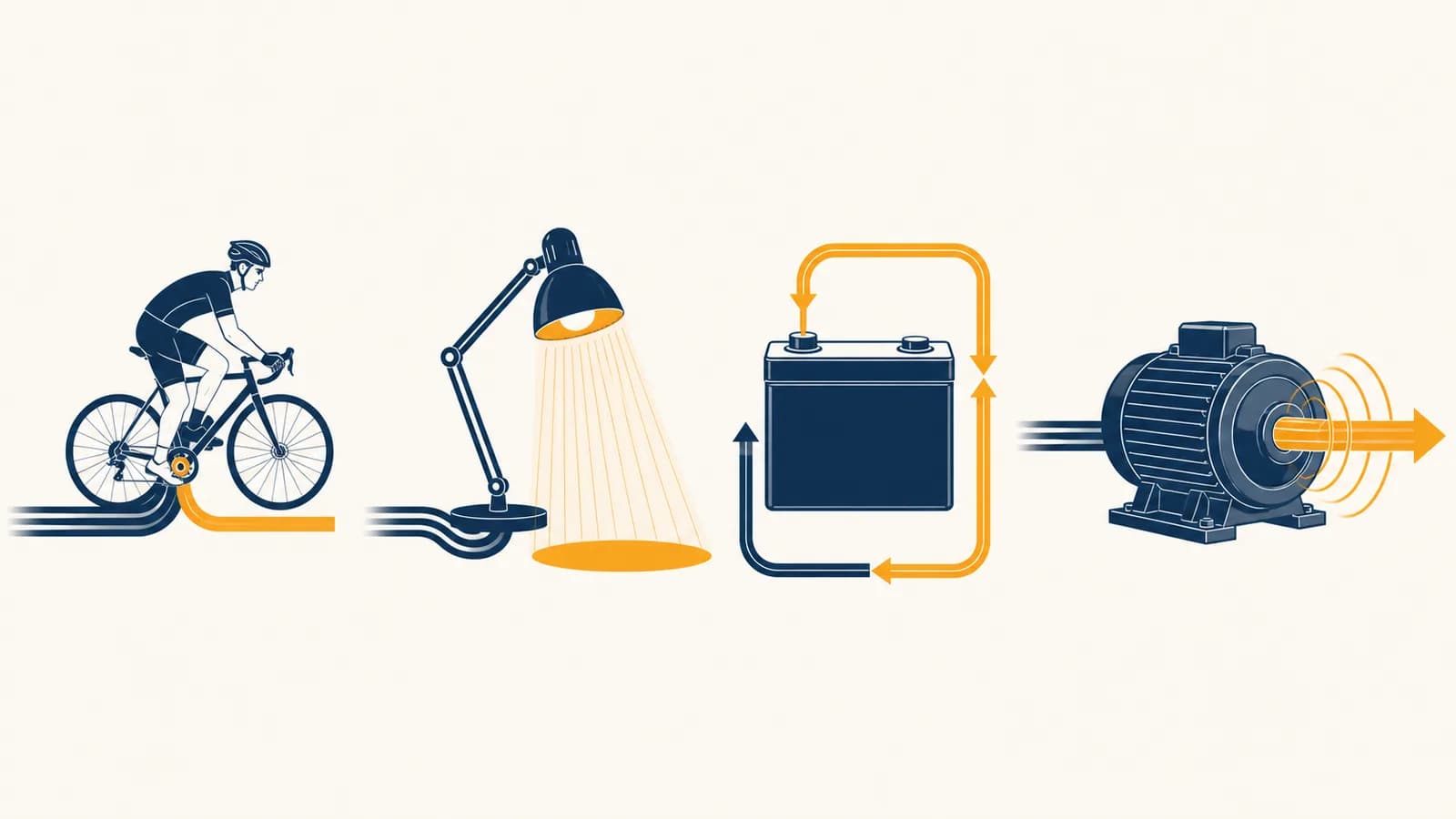
Energy is a conserved physical quantity that measures the capacity of a system to cause change, in the context of physics. Energy and power explain how motion starts, machines run, batteries empty, food fuels muscles, and electricity reaches a home. Energy is measured in joules, while power is the rate of energy transfer and is measured in watts. Work transfers energy when a force moves an object through a distance. These ideas exist because physicists need one consistent way to track change across motion, heat, light, electricity, chemical reactions, and every device that converts one form into another.
What energy actually is
Energy is a numerical property of a physical system that remains accountable as the system changes. It can move between objects or shift among kinetic, potential, thermal, chemical, electrical, and radiant stores, but an isolated system keeps the same total.
Calling energy a property is more accurate than calling it a substance. A moving ball does not contain a fluid called kinetic energy. Its mass and velocity give the ball a measurable capacity to change other things. It can dent clay, compress a spring, or warm the floor slightly when friction stops it.
The SI unit of energy is the joule, symbol J. One joule is the energy transferred when a force of one newton acts through one metre in the force's direction. Since a newton equals a kilogram metre per second squared, a joule can also be written as a kilogram metre squared per second squared.
Different energy names describe different calculations and physical arrangements. Kinetic energy depends on motion. Gravitational potential energy depends on position in a gravitational field. Elastic potential energy depends on deformation. Thermal energy is associated with the microscopic motion and interactions of particles. The categories help people keep an energy account, but energy remains one quantity, measured in the same unit.
Energy is conserved, not necessarily useful. Friction can turn organized motion into dispersed thermal energy. The total still balances even when recovering that energy would be impractical.
How work transfers energy
Work is energy transferred by a force acting through a displacement. For a constant force, only the component parallel to the movement does work, so the transfer depends on force, distance, and the angle between their directions.
A 50 N force pushing a box 4 m in the same direction does of work.
The angle matters because a force can point partly sideways. If someone carries a bag horizontally at constant height, the upward supporting force is perpendicular to the horizontal displacement. That force does zero mechanical work on the bag because . The person's body still uses chemical energy because muscles are not rigid supports. The mechanical calculation for the bag and the biological energy cost answer different questions.
Decide what belongs inside the energy account. A box alone, a box plus floor, and a person plus box have different transfers across their boundaries.
Measure how far the point where the force acts moves, and record its direction.
Use the force component parallel to the displacement, or use the cosine form directly.
Positive work adds energy to the chosen object. Negative work removes energy from it. Zero work changes no energy through that force.
Suppose a sled moves 6 m while a rope pulls with 40 N at 30 degrees above the horizontal. The work done by the rope is , about 208 J. The upward part reduces the normal force, but it does not directly move the sled upward.
The work energy theorem states that the net work on an object equals its change in kinetic energy. This result follows from force and motion, so it connects energy bookkeeping to forces and acceleration in Newtonian mechanics. If the net work is positive, speed rises. If it is negative, speed falls.
How kinetic and potential energy work
Kinetic energy measures energy associated with motion, while potential energy measures energy associated with an arrangement of interacting objects. Their formulas convert speed, height, or deformation into the same joule account, allowing one store to be compared with another.
Kinetic energy grows with the square of speed
An object's translational kinetic energy depends on its mass and the square of its speed. Doubling mass doubles kinetic energy. Doubling speed multiplies it by four, which is why extra speed has such a strong effect on stopping distance and collision energy.
A 1,000 kg car moving at 20 m/s has of kinetic energy.
If that car instead travels at 10 m/s, it has 50,000 J. The speed is halved, but the energy is one quarter. Brakes must transfer the car's kinetic energy into thermal energy in the brake system, tires, road, and surrounding air. Braking force and road conditions determine how much distance that transfer requires.
Gravitational potential energy belongs to a system
Near Earth's surface, raising an object increases the gravitational potential energy of the object and Earth system. The approximate change equals mass times gravitational field strength times vertical height. The chosen zero height is arbitrary; changes in energy are what predict motion.
Lifting a 10 kg box by 2 m adds about to the gravitational store.
The formula assumes the gravitational field is nearly constant over the height involved. Satellites and planets require the more general gravitational potential energy relation. That wider picture appears with orbits and gravitational fields.
Elastic potential energy records deformation
An ideal spring stores elastic potential energy when stretched or compressed away from equilibrium. If the spring follows Hooke's law, its force increases in direct proportion to displacement, so the stored energy grows with displacement squared.
A 200 N/m spring compressed by 0.10 m stores .
Energy versus power
Energy measures how much change can be produced or how much has been transferred; power measures how fast that transfer happens. Two machines can do the same work but have different power if one completes the work in less time.
Measured in joules or kilowatt hours. It answers, “How much was transferred or transformed?” A larger battery capacity means more total available energy under stated conditions.
Measured in watts. It answers, “How quickly is energy being transferred?” A more powerful motor can transfer a given amount of energy in less time.
Average power is energy transferred divided by elapsed time. Instantaneous power describes the rate at a particular moment. If force and velocity point in the same direction, instantaneous mechanical power is their product. More generally, their dot product accounts for the angle between them.
Lifting a load requires 600 J. Doing it in 3 s gives 200 W of average mechanical power; doing it in 6 s gives 100 W.
A high power rating does not tell you how long a device runs. A 2,000 W kettle operating for 180 seconds transfers , or 0.1 kWh. A 10 W lamp could use the same energy by operating for 10 hours. Power is a rate, so energy depends on both power and time.
Two people climb the same staircase and gain the same gravitational potential energy if their masses are equal. The person who reaches the top in half the time produces twice the average mechanical power, even though the work done against gravity is equal.
How conservation of energy works
Conservation of energy means the total energy of an isolated system stays constant. Energy may cross a chosen boundary or change form inside it, so solving a problem requires naming the system and tracking every important transfer rather than assuming energy disappeared.
Consider a ball dropped from rest. As it falls, the gravitational potential energy of the ball and Earth system decreases. The ball's kinetic energy increases. If air resistance is negligible, the decrease in gravitational potential energy equals the increase in kinetic energy.
When the ball hits the floor and stops bouncing, its visible kinetic energy has gone, but total energy has not. Deformation and internal friction warm the ball and floor. Vibrations carry sound through the air and solid materials. The final energy is more spread out, which makes it harder to collect and use.
An energy balance can include energy transferred by mechanical work, heating, electrical currents, and radiation. The exact vocabulary varies among courses, but the account must close. Energy entering a system minus energy leaving it equals the change stored in that system.
If a battery receives 500 J while charging and 80 J is transferred to the surroundings as heat, its stored energy rises by 420 J.
Conservation is powerful because the intermediate motion can be complicated while the energy endpoints remain simple. A roller coaster car descending through a curved track is constantly changing direction. Ignoring losses, its speed at a given height can be found from energy without calculating the force at every point.
How efficiency shows up in machines
Efficiency is the fraction of input energy transferred to the intended useful output. It cannot exceed 100 percent for a complete device, because output energy cannot exceed input energy, and real processes usually send some energy into unwanted heating, sound, or deformation.
A motor receiving 2,000 J and delivering 1,600 J of mechanical work is efficient.
The missing 400 J in that example is not destroyed. Electrical resistance warms the motor windings. Friction warms bearings and moving parts. Some energy leaves as sound and vibration. Engineers reduce these transfers with lower resistance conductors, lubrication, careful alignment, and designs that avoid unnecessary changes in motion.
Efficiency depends on the stated useful output. A space heater's intended output is thermal energy in a room, so heating is useful. For a computer processor, the same heating is unwanted because the intended output is information processing. The system boundary also matters. Judging a motor alone differs from judging the entire chain that generates and delivers its electricity.
Efficiency and power are independent ideas. A machine can be efficient but low powered, transferring nearly all its input energy usefully at a slow rate. Another can be powerful but inefficient, producing a large useful output each second while wasting an even larger amount.
How energy and power show up in electricity
Electrical power is the rate at which a circuit component receives or transfers electrical energy. Voltage measures energy transferred per unit charge, and current measures charge flow per unit time, so multiplying voltage by current gives power.
A device operating at 12 V and drawing 3 A receives of electrical power.
For a resistor, Ohm's law lets the same relation take two other forms: and . The correct interpretation depends on what stays fixed. With fixed resistance, doubling current makes heating power four times as large. With fixed voltage, lowering resistance increases current and total power.
Household electricity bills charge for energy, commonly measured in kilowatt hours, not for power alone. One kilowatt hour is the energy transferred by 1 kW for one hour. Converting units gives . The kilowatt hour is an energy unit despite the word watt inside it.
A 1.5 kW appliance used for 40 minutes operates for two thirds of an hour. Its energy use is . To estimate cost, multiply that energy by the price per kilowatt hour shown on the electricity bill.
A battery has both energy and power limits. Its stored energy helps determine runtime. Its maximum safe power helps determine what loads it can supply at once. Internal resistance causes heating when current flows, so demanding high power can reduce terminal voltage and waste more energy inside the battery.
How heat, temperature, and energy differ
Thermal energy is part of a system's internal energy, temperature describes the statistical state of its particles, and heat is energy transferred because of a temperature difference. The terms are related, but they do not name the same physical quantity.
A bathtub of warm water can have more internal energy than a small cup of hotter water because the tub contains far more matter. Temperature is not the total amount of thermal energy. It relates to the distribution of microscopic particle energies and determines the direction of spontaneous heat transfer.
An object contains a certain amount of heat, and a higher temperature always means more total energy.
Heat names energy in transfer. Internal energy depends on the material, amount, temperature, phase, and microscopic interactions.
The energy needed to change an object's temperature without a phase change is often modeled as . Here is specific heat capacity. During melting or boiling, energy can change the arrangement of particles while temperature remains constant, so a latent heat model is needed instead.
How food, fuel, and batteries store usable energy
Food, fuels, and batteries store chemical potential energy in arrangements of atoms and electrons. Reactions move the system toward lower chemical energy while transferring energy into motion, electrical work, or heating, always with surrounding matter included in the full account.
Chemical bonds are often described loosely as containing energy. Breaking an individual bond requires energy. Energy is released overall when forming the new product bonds releases more energy than breaking the starting bonds requires. Combustion transfers much of that difference as thermal energy. A battery reaction instead separates the oxidation and reduction processes so electrons travel through an external circuit.
Food labels use the kilocalorie, commonly written as Calorie with a capital C. One dietary Calorie equals 1,000 small calories and is defined as 4,184 J. The body does not convert all food energy into external mechanical work. It also maintains temperature, drives chemical synthesis, moves substances across cell membranes, and supports organ function.
A battery does not store charge the way a tank stores water. Ordinary operation moves electrons through an external circuit while chemical reactions inside the battery maintain a voltage and complete charge transport internally.
How units answer everyday energy questions
Energy calculations become reliable when every quantity is converted into compatible units before substitution. Joules measure energy, watts measure joules per second, and kilowatt hours measure energy, so dimensional analysis reveals many mistakes before any arithmetic is finished.
A unit is part of a measurement, not a decoration added afterward. If power is in watts and time is in seconds, multiplying them produces joules. If power is in kilowatts and time is in hours, the result is kilowatt hours. Mixing watts with hours produces watt hours, which is valid but must be converted consistently.
| Quantity | Common unit | Meaning |
|---|---|---|
| Energy or work | joule, J | newton metre, or watt second |
| Power | watt, W | joule per second |
| Electrical energy | kilowatt hour, kWh | 3.6 million joules |
| Food energy | kilocalorie, kcal | 4,184 joules by definition |
Prefixes change scale. A kilowatt is 1,000 W. A megawatt is 1,000,000 W. A millijoule is one thousandth of a joule. Converting a 500 W device to kilowatts gives 0.5 kW, so two hours of use transfers 1 kWh.
Dimensional checks cannot prove that a model is physically correct, but they can disprove an inconsistent equation. An expression for energy must reduce to energy units. For instance, has units of momentum, while has energy units. The missing factor of one half in kinetic energy cannot be found by units alone because pure numbers have no dimensions.
Four mistakes people make with energy and power
Most errors come from confusing a quantity with its rate, losing track of the chosen system, treating transformed energy as destroyed, or using a formula outside its assumptions. Each mistake can be caught by checking units, boundaries, transfers, and conditions.
1. Treating watts as an amount of energy
A watt is a rate of one joule per second. Saying a device “uses 100 watts” describes its power at that time, not a fixed energy amount. Runtime is needed. At constant power for time , the energy transferred is .
2. Saying energy was used up
Useful stored energy can decrease, but total energy does not vanish. A flashlight transfers chemical energy from its battery into light and thermal energy. Once dispersed in the surroundings, that energy is difficult to recover, so the battery is depleted even though the energy account still balances.
3. Forgetting which system owns potential energy
Gravitational potential energy belongs to the interacting object and Earth system, not to the object alone. Elastic potential energy belongs to the deformed spring or elastic system. Naming the system prevents double counting and makes it clear when energy crosses a boundary.
4. Applying ideal formulas without checking conditions
The familiar relation assumes a nearly uniform gravitational field. The spring expression assumes linear elastic behavior. A constant power calculation assumes the stated power remains constant. Real materials, motors, and batteries can change behavior with temperature, speed, load, or deformation.
The takeaway: Start every energy problem by choosing a system, then list its initial stores, final stores, and transfers across the boundary. Use power only when time or transfer rate matters, and check that the units match the quantity being asked for.
Energy bookkeeping connects the whole of physics
Energy provides a common account for mechanics, electricity, heat, waves, matter, and modern physics. Watching where energy is stored, how it crosses a boundary, and how quickly it moves turns many separate formulas into one connected way of predicting change.
Look at an ordinary event such as riding a bicycle uphill. Chemical reactions in muscles transfer energy into mechanical work and thermal energy. The bicycle and rider gain gravitational potential energy. Air drag and rolling resistance transfer energy into the surroundings. The rider's power determines how quickly the climb can happen, while total energy determines the required work.
The same questions apply to a phone charging, a refrigerator cooling food, a loudspeaker making sound, or sunlight warming pavement. What is the system? What energy stores change? What crosses the boundary? Over what time? Those questions also show how energy fits into physics as a whole.
Choose one device nearby and read its power label. Estimate how long it runs, calculate the energy transferred, and identify the intended output and the unwanted transfers. That small audit turns a printed number into a physical story you can test.